

Ichnos Glenmark Innovation Files IPO Prospectus Following $1.925B Deal with AbbVie for Trispecific Antibody ISB 2001

Ichnos Glenmark Innovation
Cancer Treatment Solutions Provider
AbbVie and Ichnos Glenmark Innovation Announce Major Exclusive Licensing AgreementRecently, AbbVie and Ichnos Glenmark Innovation (IGI) announced the execution of a significant exclusive licensing agreement. Under the terms of the agreement, AbbVie will pay an upfront fee of $700 million and has committed to paying up to $1.225 billion in development, regulatory, and commercial milestone payments upon achievement of specified conditions, bringing the total potential transaction value to $1.925 billion. In return, AbbVie will obtain exclusive rights to develop, manufacture, and commercialize IGI’s trispecific antibody ISB 2001 in North America, Europe, Japan, and Greater China.
This marks another significant move by AbbVie in the field of triple-specific antibody therapies for multiple myeloma. In 2024, AbbVie partnered with Simcere Pharmaceutical for $1.055 billion to license SIM0500, a GPRC5D/BCMA/CD3 trispecific antibody.
This transaction is also one of AbbVie’s key recent moves to strengthen its oncology and immunology pipeline. Previously, the company completed its acquisition of the CAR-T company Capstan and entered into collaborations on siRNA technology platforms (a technological platform that uses small interfering RNA to precisely silence the expression of disease-causing genes, thereby treating conditions such as cancer and genetic disorders).
These initiatives continue to underscore AbbVie’s expansion strategy in oncology and autoimmune diseases, enriching its pipeline through the integration of innovative therapies.
In late January 2024, Glenmark Pharmaceuticals, a leading Indian pharmaceutical company, and its subsidiary Ichnos Sciences jointly established the innovation alliance Ichnos Glenmark Innovation (IGI). The formation of this alliance aims to integrate the core strengths of both parties in pharmaceutical R&D—combining Glenmark’s extensive experience in small-molecule drug development with Ichnos Sciences’ expertise in novel biologics—to collectively address therapeutic challenges in hematologic malignancies and solid tumors.
As a critical foundation for IGI, Glenmark is itself a global pharmaceutical company established in 1977, with business spanning dermatology, respiratory diseases, oncology, and other therapeutic areas. Leveraging its global manufacturing network and expertise in small-molecule drug development, Glenmark provides IGI with end-to-end support ranging from target selection to clinical development. Ichnos Sciences, an independent entity spun off from Glenmark in 2019, focuses on the development of novel biologics. Headquartered in New York, USA, it maintains R&D and manufacturing facilities in Switzerland.
Following the establishment of IGI, Glenmark further strengthened resource integration and sustained investment through equity ties. Since its inception, IGI has raised approximately $171 million in cumulative funding, without involvement from other external institutional investors. This close capital linkage has enabled IGI to steadily advance its clinical programs during the early stages without relying on large-scale external financing. The funds have been primarily used to propel forward clinical-stage pipeline candidates such as ISB 2001 and ISB 1442, as well as to support the operations of its global R&D center.
This strategy avoids the equity dilution risks associated with frequent fundraising in the early stages of biotech development, while achieving rapid monetization of asset value through technology licensing, reflecting IGI’s unique approach to capital operations in the field of innovative oncology drugs.
Supporting the implementation of this strategy is IGI’s robust execution team: its management members each possess over 20 years of industry experience, and it has established a Scientific Advisory Board composed of experts in drug development, immuno-oncology, protein engineering, and other fields. Leading approximately 150 employees dedicated to innovation in cancer therapy, the team provides core human resource support for resource integration, financing strategy execution, and R&D advancement.
Following the establishment of the alliance, the global R&D layout was further strengthened with the creation of three major innovation centers in New York (USA), Lausanne (Switzerland), and Mumbai (India). The New York headquarters leads clinical development and comprehensive management; the Lausanne center focuses on the iteration of the BEAT platform and early-stage research and development of biologics; and the Mumbai center leverages Glenmark’s expertise to provide end-to-end support for small-molecule drugs, from target selection to clinical development. The synergy among these three locations has formed a complete innovation chain spanning from early-stage research to clinical translation.
IGI’s R&D roots can be traced back to its predecessor, Ichnos Sciences. During its period of independent operation, the company has built a clinical-stage product portfolio covering multiple oncology indications since its inception, with a focus on the development of “first-in-class” multispecific antibody drugs.
At the core of its technology is the independently developed BEAT (Bispecific Engineered Antibody Therapy) protein engineering platform. This platform supports the design of full-length multispecific antibodies, features a highly modular architecture, and enables flexible development of various target combinations. With mature manufacturing processes capable of producing clinical-grade antibodies, it lays a solid foundation for the continuous generation of innovative therapeutics.
As the cornerstone of IGI’s pipeline development, the breakthrough of the BEAT platform lies in its ability to achieve precise design and efficient production of multi-target antibodies. The core advantages of this platform are reflected in three aspects:
First,Druggability Optimization, systematically enhancing antibody stability, pharmacokinetic properties, and therapeutic window, reducing off-target toxicity and improving in vivo persistence; second,Flexible Design Capability, supports the construction of various molecular formats such as bispecific, trispecific, and tetraspecific antibodies, which can simultaneously target tumor cell antigens, immune modulatory molecules, and effector cells (e.g., T cells) to activate profound anti-tumor immune responses; thirdly, it has undergone extensive clinical validation, with its efficacy and safety demonstrated through clinical-stage pipelines such as ISB 2001, providing reliable support for the advancement of subsequent pipelines.
Leveraging the BEAT technology platform, IGI has built a pipeline centered on oncology (particularly hematologic malignancies), establishing a multi-tiered portfolio spanning from clinical-stage assets to early-stage exploration. Among these,The most representative product is ISB 2001, the “protagonist” of the collaboration with AbbVie valued at over $1.9 billion. Due to its outstanding clinical potential, ISB 2001 has been granted FDA Orphan Drug Designation and Fast Track Designation.
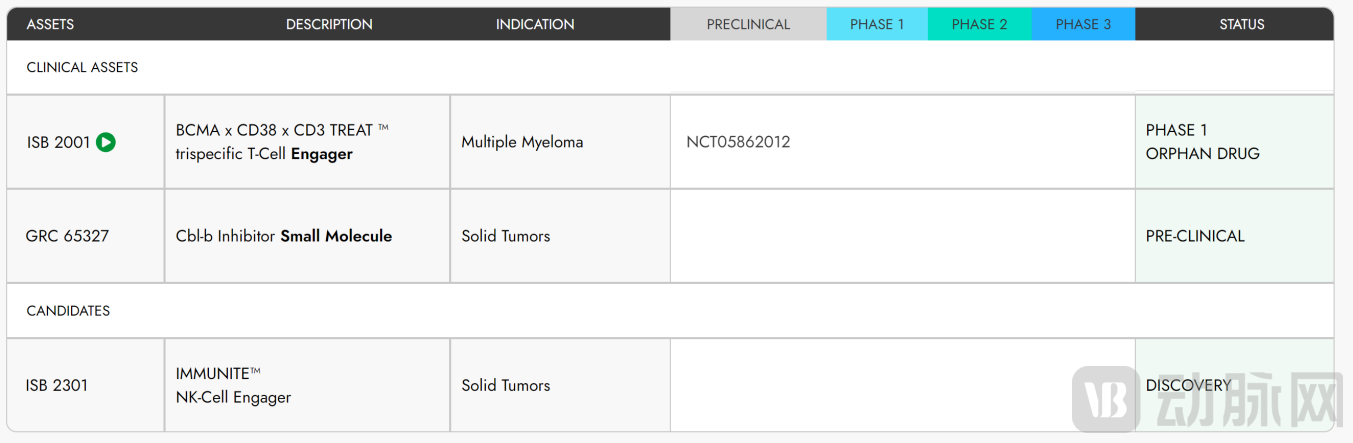
ISB 2001 Pipeline and Indications Schematic Diagram Source: IGI Official Website
As a globally leading trispecific antibodyT Cell Engager (TCE), ISB 2001 innovatively targets BCMA (a tumor-specific antigen) and CD38 (a marker for tumor and immunosuppressive cells) on the surface of myeloma cells, as well as CD3 on the surface of T cells.
CD38 and BCMA are signature proteins of myeloma cells, while CD3 serves as the signaling switch for T cells to execute immune attacks. By simultaneously targeting these three markers, ISB 2001 not only activates T cells and enables them to precisely locate tumor cells, but also blocks the “suppression” of T cells by immunosuppressive cells through binding to CD38, ultimately achieving enhanced anti-tumor efficacy and overcoming resistance to conventional therapies.
In terms of design, ISB 2001 has also undergone targeted optimizations. Its Fc region was mutated to eliminate ADCC effects, thereby avoiding nonspecific immune responses and further enhancing the drug’s safety profile. Meanwhile, a common light chain design was adopted to effectively address the issue of light- and heavy-chain mispairing, ensuring the stability and efficacy of the drug’s molecular structure.
Currently, ISB 2001 is undergoing treatmentRelapsed or Refractory Multiple Myelomain the Phase I clinical trial stage, targeting patients with drug resistance who have undergone multiple lines of therapy (median of 6 lines), including populations resistant to CD38 monoclonal antibodies, BCMA-targeted therapies, and T-cell-directed treatments.
Data presented at the 2025 American Society of Clinical Oncology (ASCO) Annual Meeting showed that among 33 patients treated with ISB 2001 at doses ≥50 µg/kg, the objective response rate (ORR) was 79%, and the complete response/strict complete response (CR/sCR) rate was 30%. Even in patients resistant to CD38 or BCMA therapies, the ORR remained high at 72% and 73%, respectively. The data demonstrate an excellent safety profile for ISB 2001, with no dose-limiting toxicities observed; cytokine release syndrome (CRS) was predominantly Grade 1–2, with no serious risks identified.
Furthermore, IGI’s pipeline includes several promising multispecific antibody candidates:
ISB 1442 is a product undergoing Phase I clinical trials for relapsed/refractory multiple myeloma. It targets CD38 and CD47—CD38 is highly expressed on the surface of various hematologic tumor cells, while CD47 serves as a key signal that tumor cells use to evade macrophage phagocytosis. Dual blockade of these targets holds promise for overcoming immune evasion and activating macrophage-mediated phagocytic clearance.
In the field of small-molecule drugs, the HPK1 inhibitor GRC 54276 is also in Phase I clinical trials. Hematopoietic progenitor kinase 1 (HPK1) plays a pivotal role in immune cell signaling pathways. Inhibition of HPK1 can modulate the activity of immune cells such as T cells and natural killer (NK) cells, thereby enhancing the body’s immune surveillance and cytotoxic capacity against tumor cells, which may make it suitable for the treatment of various types of cancer.
Furthermore, IGI has also made strategic moves in the field of autoimmune diseases: ISB 880 (ALM 27134) is a monospecific monoclonal antibody targeting IL-1RAP, showing therapeutic potential for various autoimmune skin conditions; however, it was licensed to Almirall in December 2021 for further development. Tela Zorlim Ab (ISB 830) is a humanized monoclonal antibody against OX40, whose development has advanced to Phase IIb. It primarily targets T cells associated with recurrent atopic dermatitis and, unlike comparable competitors, lacks depleting activity, thereby minimizing the risk of inducing long-term infections.
These pipelines collectively form IGI’s R&D matrix, with the BEAT platform at its core. This strategy not only focuses on unmet needs in oncology but also maintains exploratory efforts in autoimmune diseases, demonstrating the diversified innovation potential driven by its technology platform.
TCE is one of the core design pathways in the development of tri-specific antibodies. Its central mechanism involves using a multi-specific antibody structure to simultaneously target antigens on the surface of tumor cells and molecules on the surface of immune effector cells (such as T cells and CD8+ T cells), thereby establishing a bridging channel between tumor cells and effector cells to activate the precise cytotoxic function of the immune effector cells.
In recent years, T-cell engagers (TCEs) have emerged as a new growth driver following antibody-drug conjugates (ADCs). Numerous domestic and international companies are accelerating their commercialization efforts, with the entry of multiple multinational corporations (MNCs) fostering both competitive dynamics and innovative vitality within the industry.
As a key player in the TCE field, Johnson & Johnson has delivered particularly impressive results. At the recent ASCO Annual Meeting, Johnson & Johnson presented clinical data on its BCMA/GPRC5D/CD3 trispecific T-cell engager (TCE), demonstrating an overall response rate (ORR) of 100% in treatment-naïve patients with BCMA and GPRC5D expression, and an ORR of up to 86% in patients refractory to three prior lines of therapy.
Johnson & Johnson’s trispecific antibody has further fueled enthusiasm in this therapeutic arena with its outstanding efficacy—AstraZeneca is developing AZD9793, an innovative CD8-engaging T-cell engager (TCE) trispecific antibody, currently advancing for the treatment of GPC3-positive solid tumors, including hepatocellular carcinoma. AbbVie’s two recent acquisitions of trispecific antibody pipelines underscore its commitment to betting on next-generation antibody innovation.
In this arena, Chinese innovative pharmaceutical companies have also established a dense presence, accounting for nearly half of the global CD3/BCMA-based trispecific antibodies. Innovent Biologics’ IBI3003 (a GPRC5D×BCMA×CD3 trispecific antibody) is in Phase I clinical trials and has been licensed to Bristol Myers Squibb for development rights outside China. The GPRC5D/BCMA/CD3 trispecific antibody pipelines of Chinese enterprises such as Qilu Pharmaceutical, TianGuangShi Biologics, and Kangyuan Bochuang have all entered clinical stages.
From the perspective of indication expansion, the exploration of TCE trispecific antibodies hasFrom Hematologic Malignancies to Solid Tumors and Autoimmune Diseases:
In the field of solid tumors, AstraZeneca’s AZD9793 is the world’s first GPC3/TCR/CD8 trispecific antibody, targeting hepatocellular carcinoma by directing CD8+ T cells to tumor antigens for precise cytotoxicity; GB263T from Genor Biopharma (an EGFR/c-Met dual-epitope trispecific antibody) is indicated for non-small cell lung cancer, focusing on multidimensional coverage of epithelial tumor antigens; Merck’s HPN328 (a DLL3/CD3/albumin trispecific antibody) leverages an albumin-binding domain to extend its half-life and is applicable for small cell lung cancer.
In the field of autoimmune diseases, GSK has licensed CMG1A46, a CD19/CD20/CD3 trispecific antibody from the Chinese innovative biopharmaceutical company Enmu Biologics, through a deal with a potential total value of $850 million. This agent is being developed for systemic lupus erythematosus (SLE) and lupus nephritis, featuring a low-affinity CD3-binding design to mitigate the risk of cytokine release syndrome. Meanwhile, Novartis’s PIT565 (a CD3/CD19/CD2 trispecific antibody) is exploring deep depletion of aberrant B cells for the treatment of SLE and rheumatoid arthritis.
Overall, the pipeline strategies of companies such as Johnson & Johnson, AbbVie, Innovent Biologics, and Simcere Pharmaceuticals—spanning target selection, effector cell types, and indication coverage—are collectively driving the maturation of trispecific T-cell engager (TCE) technology and market expansion, fostering an industry ecosystem characterized by both competition and synergy. Looking ahead, with continued advancements in clinical data and technology, these therapies hold promise for delivering new therapeutic breakthroughs across a broader range of disease areas.