

Domestic Membrane Material Leader Secures Core IP Rights Amid Landmark Ruling

Cobetter
Developer of Microporous Filter Membranes, Nanofibers, and Ultrafiltration Membranes
In 2021, Saipu (Hangzhou) Filtration Technology Co., Ltd. (hereinafter referred to as “Saipu”) filed an invention patent application with the China National Intellectual Property Administration for a regenerated cellulose virus-removal membrane, with the technical solution beingVirus-removing filter membraneof the formulation process. At that time, Cobetter had been established for less than a year, yet this nascent enterprise achieved a rapid breakthrough in a manufacturing process that had bottlenecked China’s upstream biopharmaceutical industry for decades.
However, the myth of technology often conceals a core of genuine emptiness. In 2022, Saipu and related personnel were sued by Hangzhou Cobetter Filtration Equipment Co., Ltd. (hereinafter referred to as “Cobetter”) on suspicion of trade secret infringement, a case that sent shockwaves through the entire pharmaceutical industry.
Until recently, the truth behind this two-and-a-half-year commercial dispute has gradually come to light. The Xiaoshan District People’s Court of Hangzhou ruled that Saipu committed the corporate crime of infringing on trade secrets. Its legal representative, Zheng Moumou, along with former Cobetter employees Zhu Moumou and Wang Moumou, were found guilty of infringing on trade secrets and sentenced to fixed-term imprisonment ranging from one year and eleven months to two years and nine months, with a total fine of RMB 2.5 million. Meanwhile, Saipu and other liable parties were ordered to pay RMB 12 million in civil damages.
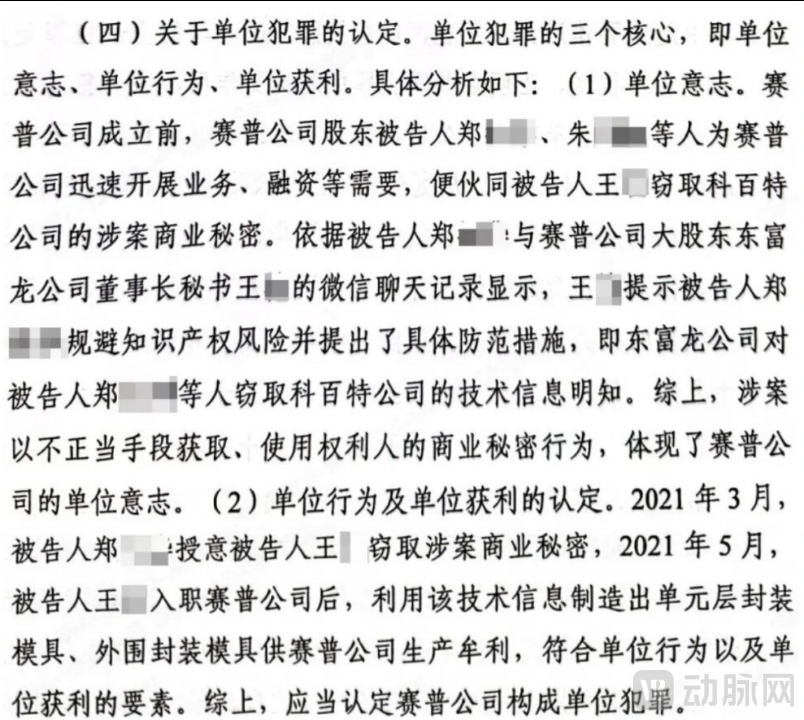 Screenshot of the Scanned Judgment
Furthermore, the two parties have pending cases in areas such as membrane materials, which also involve illegal acts including infringement of Saipu’s trade secrets and patent infringement. Genuine intellectual property innovation is protected by law, whereas unlawful “rapid copying” practices are inadvisable.
It is worth noting that the dispute between Cobetter and Saipu is not an isolated case in the membrane materials industry; multinational leader Cytiva has also recently filed similar lawsuits. Why have membrane materials for upstream biomanufacturing become a hotspot for intellectual property infringement?
As an irreplaceable core consumable in the life sciences, pharmaceuticals, and medical device industries, membrane materials hold significant strategic importance. In the production of antibodies and vaccines, as well as in medical devices such as hemodialyzers and ECMO systems, the quality and batch-to-batch consistency of membrane materials directly determine product performance.
However, due to the late start of domestic enterprises, the market penetration rate of Chinese-made virus-removal membranes and ultrafiltration membranes for biopharmaceutical applications remains extremely low. Multinational corporations such as Cytiva, Merck-Millipore, and Asahi Kasei once monopolized the domestic membrane material market, driving the unit price of high-end membrane filter cartridges up to $300.
Breakthroughs in the field of high-end membrane materials require overcoming challenges in both R&D and mass production.
The revolution in membrane materials is, at its core, a revolution in materials science. An ideal high-end membrane material must simultaneously meet three criteria: precise separation, stable durability, and safe biocompatibility, requiring companies to conduct tens of thousands of experiments to screen for suitable materials.
Furthermore, key parameters of high-end membranes, such as pore size and thickness, must be controlled at the nanometer scale. For instance, the pore size of virus-removal membranes needs to be precisely maintained within 15–20 nm; a deviation exceeding 2 nm would result in separation failure. To achieve mass production of high-end membranes, companies must establish Class 100 cleanroom environments and implement real-time online monitoring systems. The costs associated with equipment investment and process commissioning constitute another significant consideration.
To change the current situation of the domestic membrane material industry, the National Development and Reform Commission has explicitly encouraged breakthroughs in core technologies for pharmaceutical products containing membrane separation materials in the updated version of the "Guidance Catalog for Industrial Structure Adjustment," setting the tone for the development of the industry. Additionally, global supply chain disruptions and price increases of imported products during the pandemic have provided a historical opportunity for domestically produced membrane materials to break through monopolies.
Public information shows that in September 2021, Cobetter took the lead in breaking through, with its independently developed and manufactured virus removal filtration product, Viruclear VF, being launched on the market, providing a direct domestic alternative solution for numerous Chinese biopharmaceutical companies.
Subsequently, Cobetter launched a range of high-end virus filtration products made from polyethersulfone (PES) and regenerated cellulose (RC), further enhancing its product line. These products allow end users to select the appropriate models through testing based on factors such as drug solution characteristics and application scenarios.
Breakthroughs by domestic players have spurred companies to “showcase their unique strengths,” aiming to rapidly launch products under the banner of Chinese brands and seize first-mover advantage in this blue-ocean market.
However, achieving true “domestic substitution” of membrane materials requires not only delivering high-quality products but also building an ecosystem that encompasses both upstream and downstream sectors, while ensuring the stability of intellectual property rights across the entire ecosystem.
Many emerging biopharmaceutical companies, when selecting suppliers in their early stages, often prioritize the “lead time and price” of specific products, while overlooking the completeness of the corresponding supply chain, related technical intellectual property rights, and the stability of the supplier’s corporate background.
However, under the current policy framework, filter membranes are classified as part of the "technical parameters" in drug registration dossiers. Any changes to them would require re-validation of the associated manufacturing processes, resulting in high costs and significant challenges for implementing such changes.
In other words, supplier instability may not only delay a company’s product launch but also cause it to miss market windows, thereby eroding project value. Therefore, the stability of intellectual property rights held by membrane material suppliers is critical.
To ensure the stability of intellectual property rights across the entire ecosystem, Cobetter has been progressively building a complete filtration and separation industry chain since its establishment in 2003. This chain spans from membrane materials to filtration product components, and from filtration system design to filtration validation testing and analysis. Today, Cobetter is able to help customers explore opportunities and facilitate upstream-downstream integration, while ensuring the quality of membrane materials and the stability of its products.
Backed by robust intellectual property rights and ecosystem advantages, Cobetter has not only achieved large-scale domestic substitution by covering over 90% of microelectronics enterprises and major pharmaceutical companies in China, but also established connections with numerous pharmaceutical firms in the United States, Japan, Australia, Central and Eastern Europe, India, and other regions, with its products exported to more than 100 countries and territories worldwide.
Domestic High-End Membranes: Companies Break Through
In critical fields such as biomaterials for biopharmaceuticals, where China faces technological bottlenecks, the challenge of domestic substitution has never been about “rapid replication,” but rather about “independent breakthroughs” to capture market share through proven capability.
The model of taking shortcuts to accelerate speed is, in essence, a violation of market rules, harming those true industry pioneers who invest significant time and assume substantial risks in their genuine pursuit of innovation.
Today, breakthroughs by companies such as Cobetter in product performance and market implementation signify that domestic innovation is beginning to yield results, having moved from “substitution” to “surpassing.”
Breakthroughs by companies such as Cobetter in product performance and market implementation signify that domestic innovations are beginning to yield results, having progressed from “substitution” to “surpassing.”
In this new era, sustaining the healthy development of the entire biopharmaceutical industry chain requires not only that relevant companies uphold baseline standards and jointly foster a virtuous ecosystem that “respects innovation and resists infringement,” but also that the government introduce robust and precisely targeted intellectual property protection policies to strengthen IP safeguards and crack down on IP violations.
After all, to achieve sustainable innovation, it is essential to have more robust safeguarding mechanisms that give innovators the courage to “pioneer.”
In critical fields such as biomedical membrane materials, where technological bottlenecks persist, the challenge of domestic substitution has never been about “rapid replication,” but rather about “independent breakthroughs” to capture market share through genuine competitive strength.
The model adopted by some enterprises, which takes shortcuts to accelerate growth, fundamentally undermines market rules and harms true industry pioneers who invest significant time and bear substantial risks in their pursuit of innovation.
Companies such as Cobetter have achieved breakthroughs in product performance and market implementation, and have gradually strengthened their awareness of intellectual property protection. This signifies that domestic innovation has begun to scale up, transitioning from “substitution” to “surpassing.”
In this new era, sustaining the healthy development of the entire biopharmaceutical industry chain requires not only that relevant enterprises uphold baseline standards and jointly foster a virtuous ecosystem that “respects innovation and rejects infringement,” but also that the government introduce robust and precisely targeted intellectual property protection policies to strengthen IP protection and crack down on IP infringements.
After all, to achieve sustainable innovation, more robust safeguard mechanisms are essential to empower innovators with the courage to be pioneers.