

DeepSynChem: Nobel-Prize-Enabled Modular Click Chemistry Compound Libraries Revolutionizing Drug Discovery
In traditional drug development, chemical synthesis has always remained a formidable technical challenge. The highly complex molecular design and the lengthy, intricate synthesis processes not only prolong the new drug discovery cycle but also create substantial technical barriers, preventing many innovative ideas from being put into practice. This “centralized” R&D paradigm has become a core bottleneck constraining pharmaceutical innovation, particularly in improving accessibility. However, a chemical paradigm “revolution” rooted in Nobel Prize-winning research is now offering a novel pathway to overcome this dilemma.
"Click Chemistry," which won the Nobel Prize in Chemistry in 2022, centers on the rapid construction of functional molecules using efficient and reliable modular reactions. In China, the leader and deep practitioner of this "revolution" is a student of Professor Karl Barry Sharpless, the "father of click chemistry."Professor Dong Jiajia, Director of the Click Chemistry Laboratory at Shanghai Jiao Tong University and Founder of DeepSynthTo transform the “decentralized” methodology of click chemistry into a “disruptive” industrial tool, he founded DeepSynth Pharmaceutical R&D (Shanghai) Co., Ltd. (hereinafter referred to as “DeepSynth”), with the aim of drastically lowering the prohibitively high barriers to early-stage drug discovery and empowering China’s innovative forces.

Professor Dong Jiajia, Director of the Click Chemistry Laboratory at Shanghai Jiao Tong University and Founder of D&P Synthesis
Discoverer of the Second-Generation Click Chemistry SuFEx
Recently, VCBeat conducted an exclusive interview with Professor Dong Jiajia, who outlined a grander vision: DeepHealth is poised to participate in, and even lead, a “revolution” in the paradigm of China’s pharmaceutical industry. This is not merely a technological upgrade, but a fundamental reshaping of industrial logic and innovation stakeholders.
Nobel Prize-Winning Click Chemistry: A “Paradigm Revolution” Rather Than a “Technological Improvement”
To understand the mission of DeepChem, one must first grasp the “disruptive” nature of click chemistry. Professor Dong Jiajia’s exposition elevates it from what appears to be a deceptively simple chemical technique to a macro-level perspective encompassing the history of science and industrial transformation. Professor Dong began his career at an early-stage new drug R&D company based in Shanghai, China. Unlike the prevailing single-discipline outsourcing model of the time, this company rarely attempted to tightly integrate chemical and biological research. This small, agile, and seamlessly collaborative interdisciplinary “dynamic” model appealed to Professor Dong, who was then deeply committed to pursuing drug development. After witnessing the success of the company’s project—an early-developed sodium-glucose cotransporter 2 (SGLT-2) inhibitor—Professor Dong received a strong recommendation from the company’s founder, Professor Brian Seed, a leading scientist in the U.S. biomedical community. He subsequently decided to return to academia, applying for a postdoctoral position under the supervision of Professor K. Barry Sharpless, whom he had admired since his student days.
Professor Dong Jiajia pointed out that the synthetic chemistry and pharmaceutical industry since the first half of the 20th century, known as the “Woodward Paradigm,” was shaped by American chemist R. B. Woodward. This paradigm pursues artistic elegance and complexity in synthesis, maintaining value through high barriers established by highly specialized synthetic methods. It has defined the highly centralized R&D model of multinational pharmaceutical companies over the past half-century, relying on sophisticated designs by authoritative experts. However, under the wave of globalization, the unsustainability of this model has become increasingly evident.
Click chemistry represents a “strategic” reversal of the “Woodward paradigm.” Proposed by Professor K. Barry Sharpless in 2001 as a novel concept in chemical synthesis, click chemistry earned him another Nobel Prize in 2022. It employs simple and highly efficient chemical reactions to effectively link chemical building blocks, thereby enabling molecular functionality. This approach aims to significantly decentralize synthetic chemistry techniques, facilitating their more effective translation into relevant interdisciplinary practices.
Reactions that meet the requirements of click chemistry possessHigh yield, simple structure of small-molecule starting materials, negligible adverse reactions, facile experimental operation, and aqueous-phase reactivityadvantages. The core concept of click chemistry is “Simple, Reliable, EfficientIt provides a standardized toolkit akin to “molecular Lego,” enabling researchers without a background in synthetic chemistry (such as biologists) to rapidly and modularly construct a vast array of structurally diverse compounds. In essence, this transforms drug discovery from a “craft” reliant on a select few elites into a “process” that allows for large-scale, standardized exploration. Professor Dong Jiajia vividly likened this development to the advent of the internet, which empowered everyone to become an information publisher and participant in dissemination, rather than relying solely on traditional media as the single channel.
On the other hand,The Rise of Click Chemistry Aligns Deeply with Major Trends Such as Artificial Intelligence (AI)AI requires massive amounts of standardized data (molecules) for learning and prediction, and click chemistry is precisely the ideal tool for generating such data. Professor Dong Jiajia also pointed out that while China has enormous unmet medical needs and abundant human resources (engineers), it lacks an efficient and accessible R&D system for innovative supply. Click chemistry timely provides methodological possibilities to address this gap.
Ultra-High-Throughput Construction Technology as a Moat: Decentralized Platform Facilitates Breakthrough Discoveries in Molecular Glues
DeepSynth has thus become the vehicle for implementing click chemistry methodologies. Leveraging its insights into click chemistry, DeepSynth has built a unique strategic framework and core competitiveness. Professor Dong Jiajia clearly distinguishes DeepSynth from traditional click chemistry companies by first addressing what DeepSynth “is not.”
First,Core Positioning, i.e.,DeepSynth aims to be an enabler, not a pharmaceutical manufacturer, etc.. Moreover, DeepSynth is not a traditional custom synthesis contract research organization (CRO),Its goal is to maximize the efficiency of early-stage drug discovery, particularly in the construction and screening of compound libraries.In other words,The ultimate vision of DeepSynth is to become a “decentralized” drug discovery platform.DeepSynapse aims to enable innovation drivers such as university professors and startups to validate their drug hypotheses at an exceptionally rapid pace, thereby significantly increasing the frequency and success rate of innovative trial-and-error efforts.
To this end, DeepSynth is committed to building a technological “moat” in the application of click chemistry.This is reflected not only in its extensive proprietary library of building blocks, but also in its unique, patented methodology for efficiently assembling these “molecular Legos.”。
Professor Dong Jiajia and Professor K. Barry Sharpless’s team discovered a safe and efficient method for the direct synthesis of azide compound libraries from readily available primary amine compounds, which they named the “Modular Click Compound Library Approach.”It is worth noting that triazole compounds, synthesized from azides and alkynes, already correspond to a “virtually infinite” potential drug-like chemical space. Furthermore, the precision and speed of click chemistry in compound discovery may enable the construction of a unique, global library containing tens of millions of physical molecules. As compound libraries form the foundation of drug screening, major international pharmaceutical companies all maintain large, high-quality libraries.
DeepSynth’s core technologies enable the synthesis and screening of tens of thousands to hundreds of thousands of compounds within weeks. Professor Dong Jiajia revealed that, in a molecular glue project conducted in collaboration with Professor Lu Min from Ruijin Hospital, Shanghai Jiao Tong University School of Medicine, DeepSynth synthesized tens of thousands of compounds within an extremely short timeframe, significantly enhancing R&D efficiency and accelerating the translation of research outcomes into practical applications.This “quantitative change” directly triggered a “qualitative change.”
Furthermore, it is worth mentioning Dipu Shenhe’s collaboration with renowned institutions such as The Scripps Research Institute (TSRI) in the United States.First New Molecule in 50 Years Shows Promise for Treating Drug-Resistant Tuberculosis, with Findings Published in a Prestigious JournalNature[1]。
According to a 2019 report in Chemical & Engineering News (C&EN), Mike Petrassi, Vice President of Medicinal Chemistry at the Calibr division of the Scripps Research Institute, stated that, thanks to the new method for constructing triazole compound libraries discovered by Jiajia Dong and K. Barry Sharpless, his team identified a novel candidate compound with significant development potential for the treatment of tuberculosis from their constructed triazole library.[2]Moreover, DeepSynth has collaborated with Professor Wenqing Shui’s research group at ShanghaiTech University to design and synthesize a large-scale, modular click chemistry compound library by integrating modular click compound libraries with affinity mass spectrometry technology, thereby enabling screening against the challenging target of the glucagon-like peptide-1 receptor (GLP-1R).A novel class of small-molecule allosteric modulators of GLP-1R was discovered, and the findings were published in Proceedings of the National Academy of Sciences (PNAS)[3]。These cases fully demonstrate the significant advantages of its technology platform in exploring chemical space and discovering lead compounds.
China’s New Model for Innovative Drugs Sets Sail, Completing the “Critical Leap” in Ecosystem Building
Professor Dong Jiajia candidly stated that Dipu Shenhe is currently actively expanding pathways for value realization and exploring ecosystem collaborations with various stakeholders. In the short term, strategic partnerships with large pharmaceutical companies and research institutions serve as an effective means to validate the platform’s capabilities. However, from a long-term development perspective,DeepSynth aims to build an open value network: by adopting a low-threshold strategy to unlock broad collaborative potential, it co-creates and shares value with partners, ultimately achieving win-win outcomes when high-value results are successfully incubated.. This relies on its core capabilities in accurately identifying potential and designing win-win mechanisms.
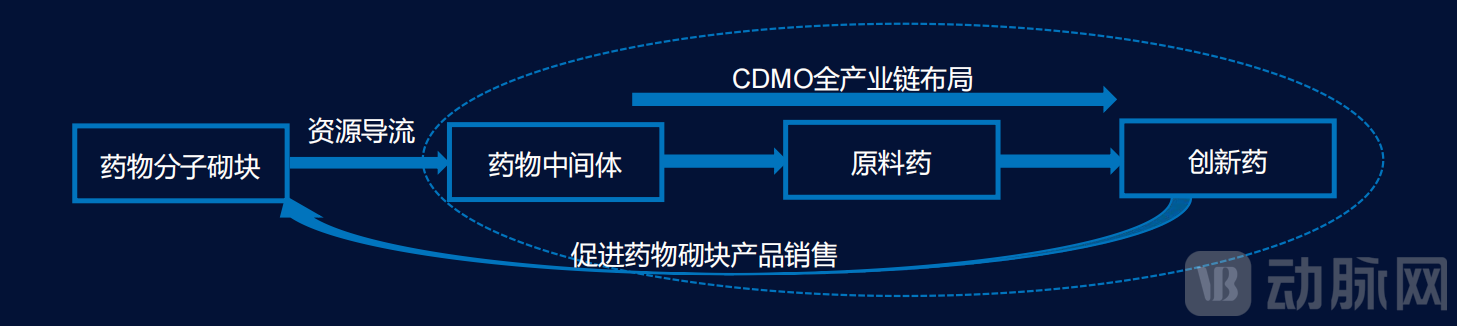
DeepSynth holds core technologies for innovative drug screening and key molecular building blocks, positioning it to enter the downstream drug development market within the industry chain in the future.
Figure source: DeepSynco
Currently, DeepSynth plans to first leverage its existing resources to serve universities, hospitals, and research institutes, and establish strategic partnerships; secondly, building on this initial strategy, it aims to secure strategic partners and access potential intellectual property (such as novel target candidate drug molecules),Expanding from the drug discovery phase into preclinical and clinical development stages; subsequently, entering the field with AI-driven drug discovery to provide end-to-end drug discovery solutions, further expanding the space of potentially druggable compounds.。
Meanwhile, Professor Dong Jiajia’s reflections did not stop at the corporate level but extended to the fate of China’s entire biopharmaceutical industry. He placed DeepSynth’s explorations within a grand historical context. He stated that pharmaceutical innovation in China must shift toward internal circulation, genuinely serving the health needs of the entire Chinese population; however, this presupposes the establishment of an efficient R&D system that is both deeply aligned with China’s unique characteristics and globally competitive.
Professor Dong Jiajia pointed out that DeepSure does not aim to single-handedly construct a new edifice, but rather to serve as the force that “pries loose the bottommost brick of the old tower’s foundation.” By lowering the initial threshold for drug discovery to an extremely low level, it hopes to stimulate China’s innovation vitality. Furthermore, true innovation follows a “decentralized” model. Only when thousands of researchers can engage in drug discovery with minimal barriers can a “decentralized,” vibrant ecosystem for pharmaceutical innovation in China take shape. What DeepSure aims to do is stand at the forefront of technological change and advance with the times.
Final Thoughts
During the interview, Professor Dong Jiajia repeatedly mentioned “serendipity.” From the experience gained in his first job to earning the recognition of Professor K. Barry Sharpless, it seemed that fortune always favored him at critical junctures in life. Yet, on a deeper level, this appears more like an inevitability—the proactive choices made by a scientist, who deeply felt the pain points of the industry and benefited from his mentor’s guidance, at pivotal turning points.
The story of DeepSynth is more than just a blueprint for the growth of a startup; it represents a hopeful inquiry by a Chinese scientist, leveraging his global perspective and insights, into the future of China’s pharmaceutical industry. It concerns technology and vision, corporate survival, and the destiny of the industry as a whole.
With the aid of click chemistry, this “Nobel Prize-winning key,” Dipu Shenhe is striving to open a door to the future—a gateway that may lead to a “new era” in China’s pharmaceutical industry, where “innovation is accessible to all.” The path ahead is undoubtedly arduous, but as Professor Dong Jiajia believes: “Once you try click chemistry, there is no going back.”
The Future and Change May Have Already Occurred.
[1] Krieger, I.V., Sukheja, P., Yang, B. et al. SuFEx-based antitubercular compound irreversibly inhibits Pks13. Nature (2025). doi:10.1038/s41586-025-09286-3
[2] Chemists make arrays of click chemistry–ready azides efficiently and safely. Retrieved October 2, 2019 from https://cen.acs.org/synthesis/Chemists-make-arrays-click-chemistryready/97/i39
[3] Y. Xin, S. Liu, Y. Liu, Z. Qian, H. Liu, B. Zhang, T. Guo, G.J. Thompson, R.C. Stevens, K.B. Sharpless, J. Dong, & W. Shui, Affinity selection of double-click triazole libraries for rapid discovery of allosteric modulators for GLP-1 receptor, Proc. Natl. Acad. Sci. U.S.A. 120 (11) e2220767120, https://doi.org/10.1073/pnas.2220767120 (2023).