

Bose Quantum Secures Hundreds of Millions in Series A++ Funding to Advance 'Quantum + AI for Science' and Launches Era of Practical Quantum Computing

QBOSON
--
Recently, QBOSON (Beijing Bose Quantum Technology Co., Ltd.), a leading domestic quantum computing enterprise (“QBOSON”), completed an A++ round of financing amounting to hundreds of millions of yuan. This round was jointly led by Huade Kechuang and Nanshan Zhanxin Tou, with follow-on investments from well-known institutions and listed companies such as GF Xinde, Hunan Caixin Industry Fund, and Weide Information (688171). Existing shareholder Qifu Capital continued to increase its investment.
The funds will continue to be used for: ① the research and development of “special-purpose” coherent optical quantum computers and “general-purpose” optical quantum computers; ② building capabilities in quantum computing chip fabrication processes; ③ constructing and commencing operations at China’s first large-scale manufacturing plant for special-purpose optical quantum computers in Nanshan District, Shenzhen; and ④ expanding the commercial ecosystem for integrated “quantum computing + AI” applications.
This financing round serves as another strong endorsement of QBOSON as a representative enterprise in the field of practical quantum computing in China. This achievement is not an isolated event but rather part of the broader global surge in quantum computing investment. Previously, industry moves by tech giant NVIDIA—such as its systematic investments in PsiQuantum (photonic quantum route), QuEra (neutral atom route), and Quantinuum (ion trap route)—have clearly demonstrated the firm confidence of top-tier global capital in the commercialization and industrialization prospects of quantum computing.
As a representative enterprise in China’s photonic quantum computing sector, QBOSON’s latest financing round vividly demonstrates the country’s steady progress and growing prominence in this global innovation race. It marks the establishment of robust two-way engagement between Chinese quantum startups and the capital market, underscoring QBOSON’s significance as a core value platform within the quantum computing industry. Leveraging its advantages in stable real-device operation and a fortified application ecosystem, QBOSON will further amplify its role as an industry benchmark, continuously driving the commercialization and industrialization of quantum computing.
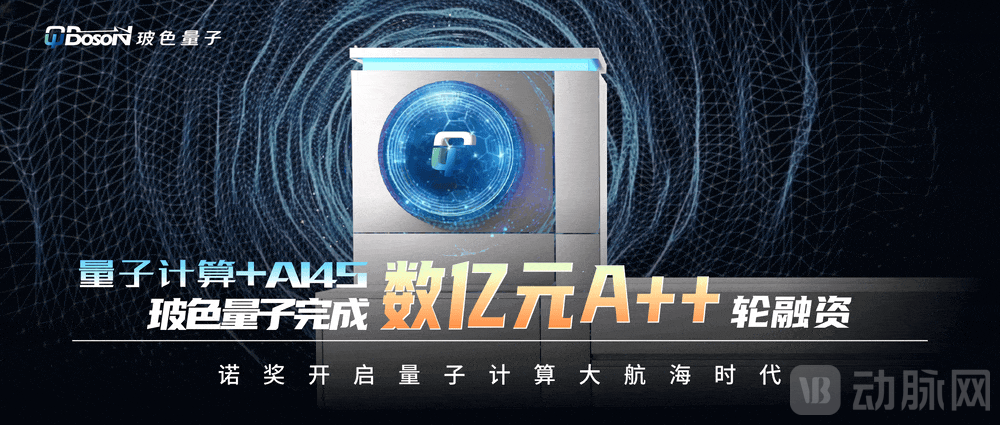
Nobel Prize Crowns Quantum Computing for the First Time: Ushering in a New Age of Discovery and Diverse Innovation
On October 7, 2025, the announcement of the Nobel Prize in Physics wrote a historic footnote for quantum computing: John Clarke, Michel H. Devoret, and John M. Martinis were awarded the prize “for the discovery of macroscopic quantum mechanical tunnelling and energy quantisation in an electric circuit.”
This groundbreaking discovery, made four decades ago, gave rise to the research field of superconducting quantum computing and brought to the forefront the scientific challenge of “reducing various interference factors—such as noise and temperature—in macroscopic quantum systems to the level of individual qubits,” a problem that remains a key focus for researchers today. Forty years on, coinciding with the centennial of the birth of quantum mechanics, this milestone is sure to further inspire scientists and engineers in their broad exploration of pathways toward realizing quantum computers. Whether manipulating macroscopic systems such as superconductors or microscopic systems including photons, trapped ions, and neutral atoms; whether building gate-based, Turing-complete quantum computers or non-gate-based quantum devices practically applicable to specific domains in the near term, their work serves as a guiding lighthouse at the dawn of the great age of quantum computing exploration, now illuminating a magnificent journey characterized by parallel development of general-purpose and specialized approaches and vibrant competition among diverse technological routes.

From an application perspective, quantum computing has clearly diverged into two major technological camps: general-purpose and special-purpose. General-purpose quantum computers aim to implement arbitrary quantum algorithms, relying on core properties such as quantum entanglement and superposition to pursue universal computational capabilities. Their development requires overcoming hardware bottlenecks, including high-precision qubit control and error correction, as well as developing gate-based algorithms with practical value, thereby demonstrating “quantum advantage” in more practical domains. In contrast, special-purpose quantum computers focus on optimizing specific, high-value, and reusable problem sets. By customizing quantum physical systems to enhance solving efficiency, they lay a practical foundation and create market space for a broad category of application scenarios, despite having somewhat limited scope. As a result, they are the first to achieve commercial deployment in the NISQ (Noisy Intermediate-Scale Quantum) era, becoming the main force in current industrial applications.
In this dual-track industrial landscape, QBOSON, leveraging photonic quantum systems, has strategically established full-stack R&D capabilities spanning both specialized and universal quantum computing. By prioritizing specialized quantum computers, the company has accumulated practical algorithms and secured commercial orders across multiple sectors, including artificial intelligence, biopharmaceuticals, and finance, while cultivating a mature community of quantum application developers. Simultaneously, QBOSON maintains long-term investment in universal photonic quantum computers and quantum-classical hybrid computing capabilities tailored to real-world needs. Guided by the pathway of photonics and a priority on practical application, QBOSON continuously transforms theoretical potential into tangible productive forces that drive progress, striving to become a core force in propelling quantum computing into genuine industrial adoption.
“Quantum” hardware is merely the starting line; the comprehensive practicality of “computing” systems is the decisive factor.
From the foundational discoveries recognized by the Nobel Prize to the current competitive development of diverse technological approaches, quantum computers face increasingly comprehensive requirements on their path from laboratory research to industrial application. Improvements in a single physical metric do not equate to the practical usability of quantum computers. In an era where computing power has become a core productive force across industries, breakthroughs in quantum hardware merely represent the “starting line” for building new-quality productive forces. What the market truly expects from quantum computers is the ability to deliver stable, reliable, and scalable computational capabilities; to provide algorithm development tools that are both usable and user-friendly; to efficiently adapt to rapidly evolving AI frameworks; and to demonstrate practical value surpassing that of classical computers in real-world use cases.
In the current era of noisy intermediate-scale quantum (NISQ) devices, “general-purpose” quantum computers based on different physical platforms have made significant progress in key physical metrics such as scalability, connectivity, coherence time, fidelity, and error correction. However, no single platform has yet overcome all technical challenges to construct even one complete fault-tolerant logical qubit, thus failing to secure the “ticket” to practical quantum computing. In contrast, “special-purpose” quantum computers circumvent the complex construction of logical gates, offering relatively easier control over error rates and decoherence issues while reducing operational complexity. With highly scalable qubit architectures, they already possess the capability to provide stable computational power over extended periods.
QBOSON is currently focused on achieving practical and industrial breakthroughs in “special-purpose” photonic quantum computing. It continuously iterates and releases its independently developed and controllable 1,000-qubit coherent photonic quantum computer, providing a full-chain suite of development tools and service validation platforms that cover problem mapping, resource scheduling, quantum state evolution, and result optimization. Furthermore, by open-sourcing multiple quantum-native AI training suites within the PyTorch ecosystem, QBOSON has lowered the barrier to entry for quantum computing applications and expanded the developer ecosystem for quantum technologies. This enables more industries and research institutions to experience and leverage the advantages of quantum computing, thereby accelerating the efficient translation of scientific achievements into industrial applications.
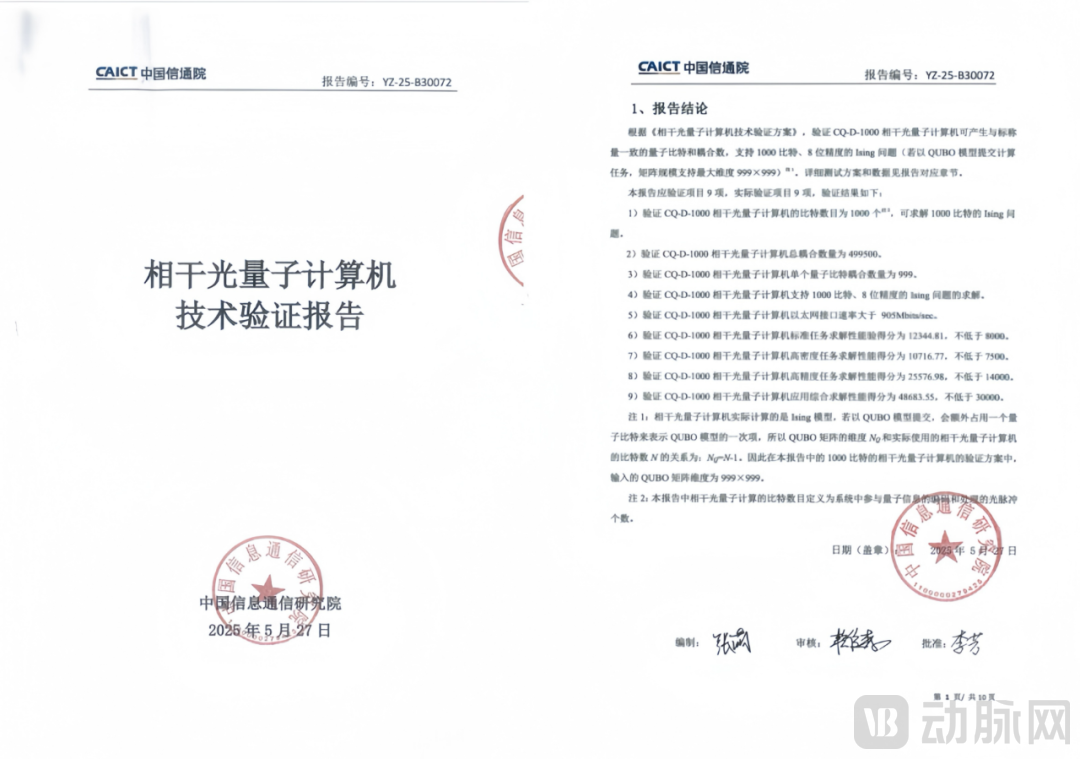
Meanwhile, the whole-machine system capable of stable long-term operation at room temperature also provides feasibility for large-scale deployment in production environments. In scenarios involving large-scale iterative computations such as AI training, hundreds of thousands of accurate sampling calculations are often required, posing new demands on the stability of quantum computers. Building upon its available 1,000-qubit physical machine, QBOSON has strengthened the development of error-correction algorithms and multi-machine parallel technologies, continuously enhancing system robustness and achieving stable operation for more than 12 hours per day at room temperature. Furthermore, the China Academy of Information and Communications Technology (CAICT) has issued the "Technical Verification Report for Coherent Optical Quantum Computers," certifying the practical technical validation of nine key indicators, including the number of qubits, total coupling count, coupling precision, performance in solving standard tasks, performance in solving high-density tasks, and comprehensive application-solving performance.
Since the launch of the company’s 100-qubit quantum computing cloud service, the platform has accumulated over 68 million solution requests, covering more than 900 universities and institutions, with over 10,000 developers participating in R&D. This growth has been driven by an increasing number of users from government agencies, enterprises, research institutions, and quantum algorithm developers. Guided by first-hand feedback from users and developers, QBOSON continuously adjusts its R&D direction for the integrated hardware and software system. Adhering to a strategy driven by real-world needs rather than mere research metrics, QBOSON has created a flywheel effect for product iteration, better aligning with practical application requirements and delivering quantum computing solutions that the market truly needs.
“Quantum Computing + AI” Is a Vast Frontier: Building an Ecosystem of Practical Application Scenarios
Just as GPU-accelerated vector operations have propelled the development of deep neural networks, the novel computing paradigm of quantum computers presents new opportunities for transforming AI models. Building on the Boltzmann machine proposed by Geoffrey Hinton, a pioneer in neural networks and 2024 Nobel Laureate in Physics, QBOSON has proactively pioneered a new paradigm for quantum neural networks. By leveraging the mathematical equivalence between the Ising model and Boltzmann machines, QBOSON replaces traditional methods such as Gibbs Sampling with quantum sampling, thereby overcoming the inefficiency in training Boltzmann machines due to their high computational complexity. This breakthrough paves the way for “killer applications” at the intersection of quantum AI and biopharmaceuticals.
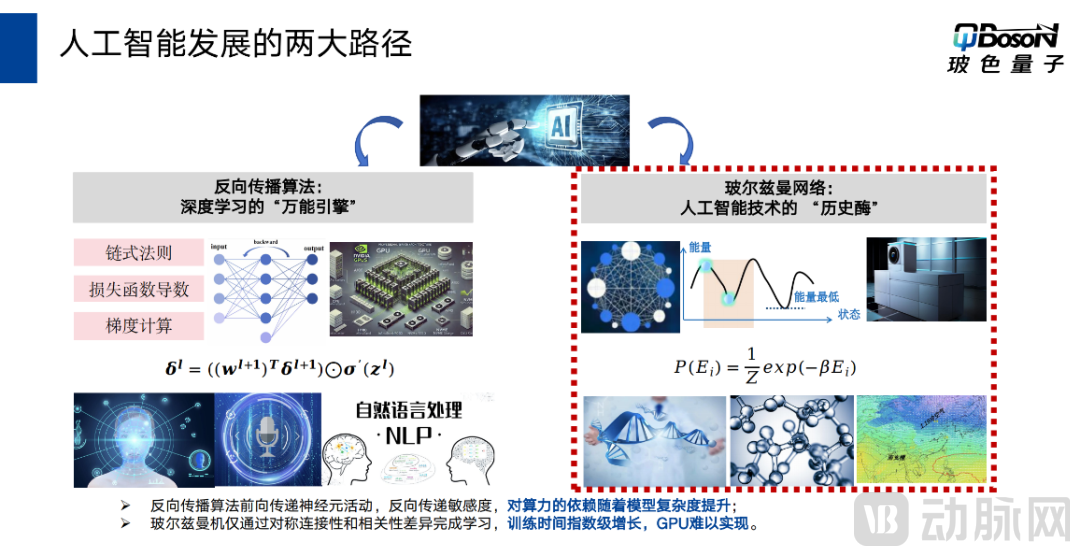
To date, the Boltzmann Machine–Variational Autoencoder (QBM-VAE) trained on QBOSON’s coherent optical quantum computer has been applied in multiple scenarios, including peptide generation, small molecule generation, single-cell clustering, mRNA vaccine design optimization, and protein multi-omics analysis. It has been proven to effectively shorten drug development cycles, improve the accuracy of genomic research, and reduce drug development costs.
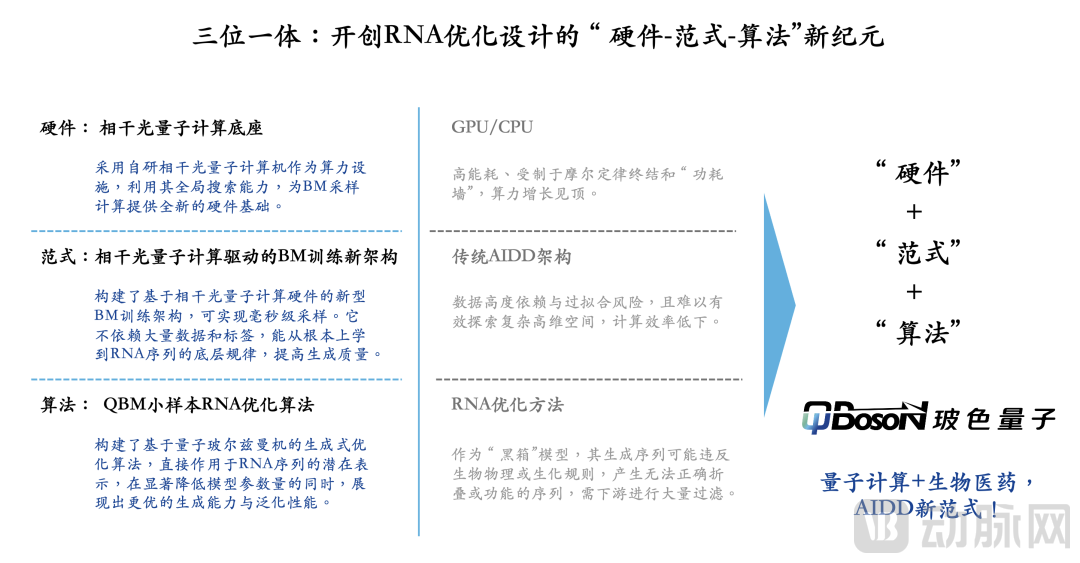
The Trinity: Pioneering RNA Optimization Design, Ushering in a New Era of “Hardware-Paradigm-Algorithm”
In terms of ecological collaboration, QBOSON is also exploring practical quantum computing applications with Guangzhou National Laboratory, Shanghai Jiao Tong University, the School of Pharmaceutical Sciences at Sun Yat-sen University, Beijing Cancer Hospital, and Tsinghua Changgung Hospital in scenarios such as protein structure prediction, molecular similarity screening, peptide docking, and allosteric site prediction. Furthermore, QBOSON has established a “pharmaceutical company–university–hospital–national laboratory” four-in-one collaborative framework. In the future, it will join hands with top-tier universities, hospitals, and pharmaceutical companies to deepen cooperation, promote ecosystem co-construction, share quantum computing power and data resources, and accelerate the process of drug development and clinical validation.
Jiang Peixing, Chairman of Huade Sci-Tech Innovation, stated that QBOSON, as a leading domestic quantum computing enterprise, is continuously advancing the R&D and practical deployment of coherent optical quantum computers, with its quantum computing power services ranking among the world’s best. QBOSON not only independently tackles key algorithms and application software in the field of quantum computing AI but also actively collaborates with industry partners to build an ecosystem, achieving real-world applications in sectors such as AI, biopharmaceuticals, finance, and energy, thereby vigorously promoting the transition of China’s quantum computing from “laboratory R&D” to “industrial application.”
Wen Kai and Ma Yin, co-founders of QBOSON, jointly stated that following this round of financing, QBOSON will continue to deepen its technological layout and ecosystem development in the field of “quantum computing + AI.” Leveraging the Quantum Boltzmann Machine, QBOSON is not only leading the life sciences basic research and drug discovery industries toward a more precise and efficient R&D paradigm, thereby ushering in a new era of AI-driven drug development, but also comprehensively advancing the practical application of quantum computing across various industry scenarios.
With the infusion of capital, QBOSON will continue to increase its investment across the entire field of quantum computing, fully leverage the advantages of domestically produced specialized quantum computing, and join hands with a growing number of strategic partners to solidify the “Chinese foundation” of quantum computing power for industries across the board.