

Eikon Therapeutics Files for IPO: $1.1B-Backed Biotech Led by Ex-Keytruda Chief Aims to Revolutionize Drug Discovery with Nobel Prize-Winning Microscopy
Eikon
Biopharmaceutical R&D Developer
In February 2025, U.S. biopharmaceutical company Eikon Therapeutics (“Eikon”) announced the completion of a $350 million Series D financing round, bringing its cumulative fundraising to over $1.1 billion.Amid the global cooldown in biopharmaceutical investment and financing (as exemplified by the Nasdaq Small Cap Biotechnology Index (XBI), which has retraced nearly 60% from its 2021 peak), Eikon has secured substantial funding against the trend, becoming one of the few innovative drug companies that continue to attract strong investor interest.
Why Does Capital Still Bet on Eikon During an Investment Contraction? The Answer May Lie in Its Unique R&D Methodology: Transforming Drug Discovery by Observing the Dynamic Motion of Intracellular Molecules.
In traditional drug development, scientists often rely on static data to understand molecular mechanisms of action, whereas Eikon’s technology enables real-time tracking of interactions between intracellular proteins and small molecules. For drug discovery, this “dynamic imaging” capability allows for precise screening of potential drug candidates and rapid elimination of ineffective compounds, making it a scarce and highly sought-after asset in the eyes of investors.
From Nobel Prize-Winning Laboratories to Industrialization
The story of Eikon began with the 2014 Nobel Prize in Chemistry.At the time, Eric Betzig was awarded the prize for developing super-resolution fluorescence microscopy, a technology that breaks through the traditional optical microscope’s resolution limit of approximately 200 nanometers. This advancement enables the observation of intricate intracellular structures with ultra-high clarity and the tracking of protein movements, thereby upgrading scientific research tools from blurry telescopes to molecular cameras.
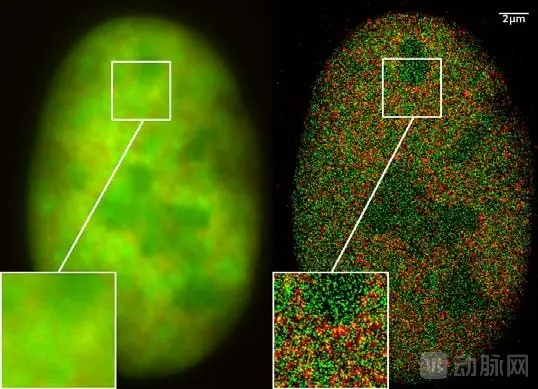
Figure 1: Comparison of imaging between conventional optical fluorescence microscopy (left) and super-resolution fluorescence microscopy (right)
In 2019, Betzig co-founded Eikon with scientists from the Lawrence Berkeley National Laboratory., extending the microscopy revolution from the laboratory to drug development. 2022 marked a pivotal turning point. Roger Perlmutter, former Global Head of Research and Development at Merck & Co., joined as CEO. He previously spearheaded the launch of the oncology immunotherapy Keytruda (pembrolizumab), which achieved $25 billion in sales in 2023, becoming the world’s top-selling drug.
Perlmutter’s addition has propelled Eikon’s strategic transformation from a science-driven to a clinical-driven model.
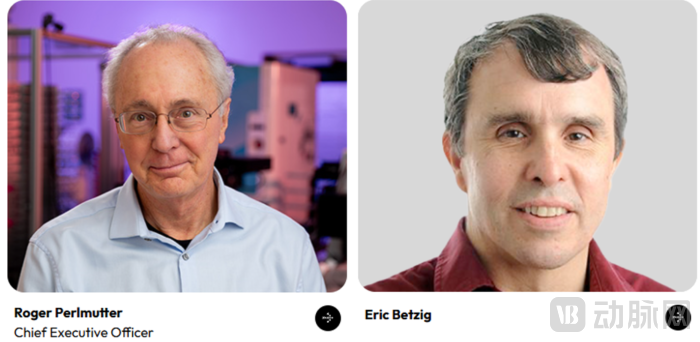
Figure 2: Profiles of the Founding Team at Eikon Therapeutics
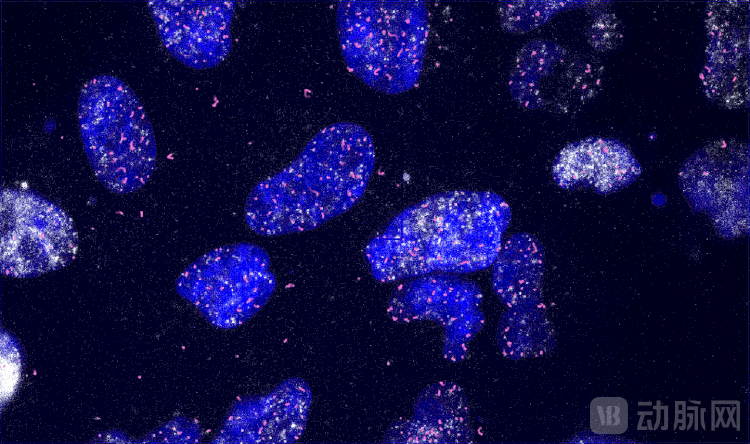
Figure 3: Schematic illustration of Eikon Therapeutics tracking individual proteins in live cells using super-resolution fluorescence microscopy
Since its inception in 2019, Eikon has continued to garner favor from the capital markets, having raised over $1.1 billion in cumulative funding through its Series C round., providing robust financial support for the iteration of its technology platform and the advancement of its clinical pipeline. Unlike tech-platform companies such as Recursion (which relies on automated imaging and AI algorithms to discover drugs) and Schrödinger (which centers on molecular simulation and physics-based modeling), Eikon’s SMT technology enables real-time observation of single-molecule dynamic behaviors, thereby delivering precise spatiotemporal insights for drug discovery.
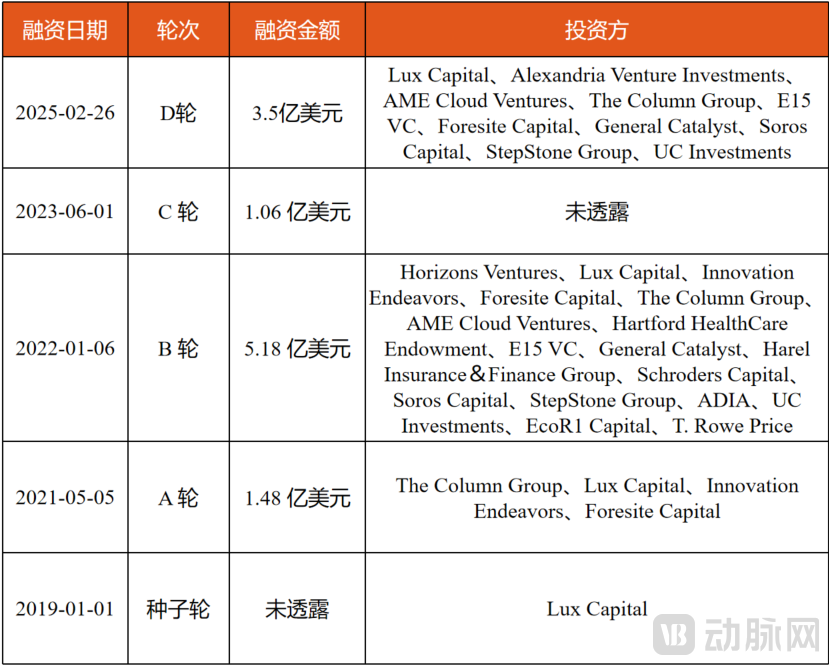
Table 1: Overview of Eikon Therapeutics’ Financing History
Hardware + Algorithms + Automation: Building an Industrializable Imaging System
Eikon’s technology platform emphasizes interdisciplinary integration and engineering implementation. The company has developed its own proprietary microscopy systems in-house, co-designed by hardware, optical, and electrical engineers, and continuously iterated based on feedback from drug development scientists, chemists, and biologists. This approach ensures that equipment design is closely aligned with final experimental requirements, enabling the stable capture of high-quality Single Molecule Tracking (SMT) data and directly supporting R&D teams in the drug discovery process.
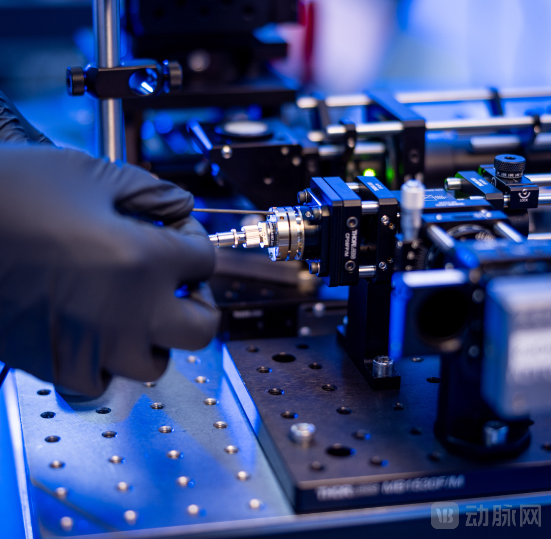
Figure 4: Schematic of the operation of Eikon Therapeutics’ proprietary in-house developed microscope system
At the data processing level, Eikon relies on artificial intelligence and machine learning to handle the massive volume of data generated by imaging. ItsFully automated instruments can generate data on a scale approaching petabytes (PB) per day, making them one of the largest data producers globally.To this end, the company has assembled a team of more than 30 software engineers and data scientists from technology companies such as Alphabet and Meta to develop next-generation machine learning-based analytical algorithms for extracting multidimensional behavioral information of proteins in live-cell environments.
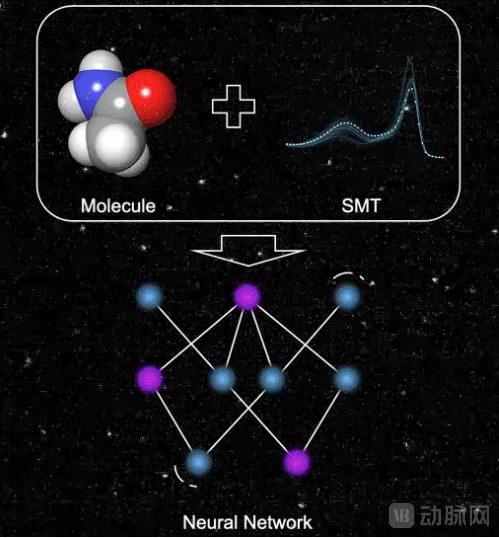
Figure 5: Schematic of Eikon Therapeutics Technology Integration
In addition to hardware and algorithms,Eikon also places significant emphasis on the development of reagents and automated systems.The company has independently developed novel dyes, cell line engineering tools, and consumables, and established an automated imaging and detection platform, enabling scalable and stable single-molecule imaging. This not only enhances experimental efficiency but also ensures end-to-end controllability from materials to equipment.
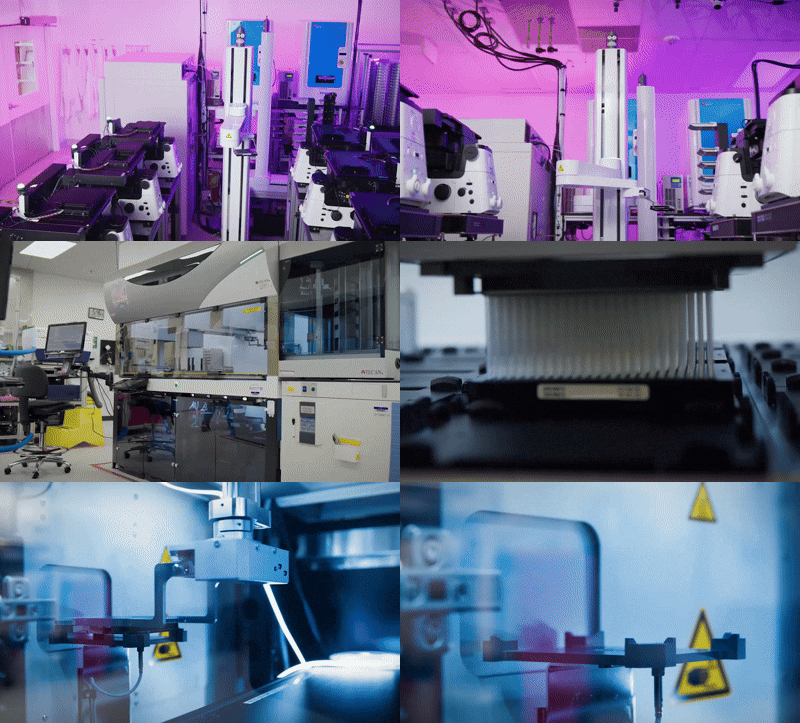
Figure 6: Demonstration of the Eikon Therapeutics Automated Laboratory Platform in Operation
The core of the technology lies in its SMT platform.Eikon employs innovative Oblique Line Scanning (OLS) technology to achieve high-speed dynamic tracking of proteins within living cells.Unlike conventional microscopes, which can only record molecular positions, SMT enables real-time tracking of molecular trajectories with millisecond temporal resolution and nanometer spatial resolution. In a single experiment, each instrument can simultaneously monitor the dynamics of hundreds of thousands of molecules across hundreds of cells in under one second. Such multidimensional data not only elucidates protein functions under different cellular states but also helps infer drug binding, dissociation, and mechanisms of action.
Compared with traditional methods, this platform captures dynamic process data in authentic cellular environments and enables high-throughput R&D through automation, thereby significantly enhancing the efficiency of drug screening.
Covering Immunomodulation and DNA Repair, with a Focus on Oncology
As the platform matures, Eikon accelerates its pipeline layout.June–July 2023: Three consecutive external licensing collaborations completed: Licensed TLR7/8 agonists BDB001 and BDB018 (later renamed EIK1001) from Boditech; licensed selective PARP1 inhibitors EIK1003 and EIK1004 from Imprint Pharmaceuticals; and acquired a series of preclinical projects from Cleave Therapeutics.
Unlike simple in-licensing, Eikon seeks to integrate external assets and its proprietary R&D into a unified system. Building on single-molecule live-cell imaging, the company further incorporates AI algorithms and an automated experimental platform to link target validation, molecular screening, and data modeling. This approach not only accelerates the mechanistic validation of in-licensed projects but also supports the continuous incubation of its internally developed pipeline.
Supported by its single-molecule live-cell imaging platform, Eikon has established a pipeline covering immunomodulation and DNA repair pathways, with four core projects being prioritized as of 2025.
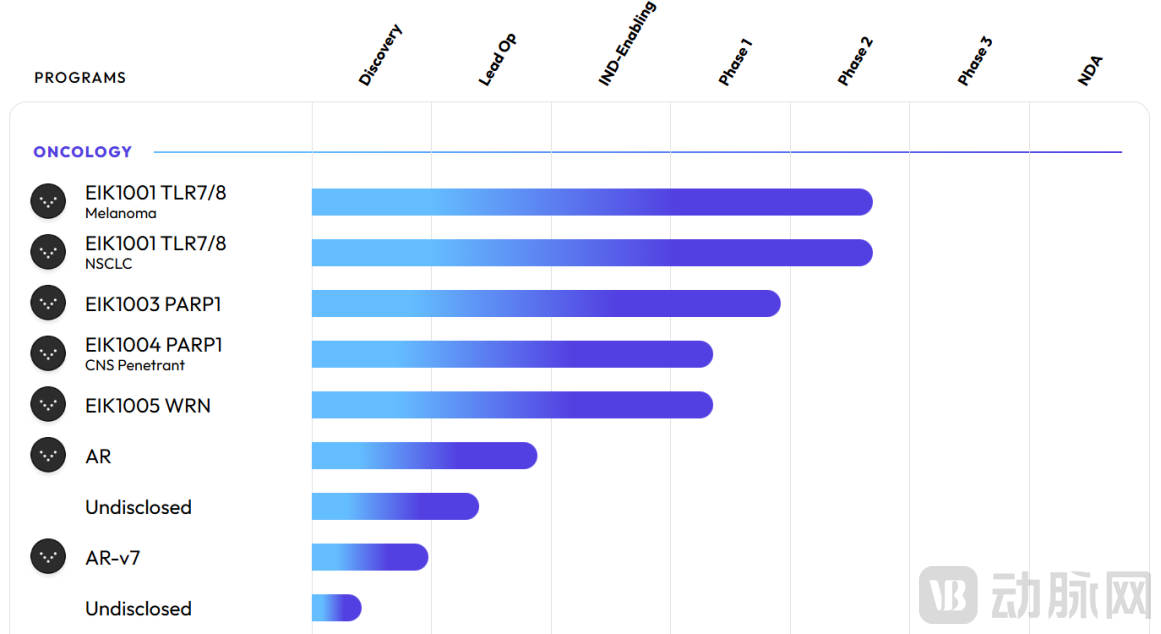
Figure 7: Overview of Eikon Therapeutics’ Pipeline Progress
EIK1001 is a Toll-like receptor 7/8 (TLR7/8) co-agonist designed to activate innate immunity and enhance T-cell activation, thereby improving tumor immune clearance. Currently in a Phase III clinical trial (NCT06697301) for the treatment of advanced melanoma, early results from its combination with PD-1 inhibitors have demonstrated favorable safety profiles and potential efficacy improvements.
In the field of DNA repair, Eikon has two PARP1 inhibitors and one WRN inhibitor in its pipeline. EIK1003 focuses on ovarian and breast cancers associated with BRCA mutations or homologous recombination deficiency (HRD). It has entered Phase I/II clinical trials, with interim data showing superior response rates and tolerability compared to traditional PARP inhibitors.
EIK1004 demonstrates central nervous system (CNS) penetration and is currently in Phase I clinical trials, exploring its potential for DNA repair inhibition in CNS tumors such as brain cancer, with promising preliminary pharmacokinetic results. EIK1005 is an internally developed WRN inhibitor targeting microsatellite instability-high (MSI-H) and other DNA repair-deficient tumors, and is currently in the preclinical stage.
In addition to its core pipeline, Eikon is also exploring early-stage immunomodulation and androgen receptor antagonist projects, all leveraging its imaging platform to accelerate screening and mechanism validation.
Compared with existing therapies, Eikon’s strategy is more selective and differentiated. Taking PARP inhibitors as an example, drugs such as olaparib, rucaparib, and talazoparib are already available on the market; however, they often cause toxic side effects or drug resistance due to insufficient selectivity. EIK1003 and EIK1004 focus on high selectivity for PARP1, with the aim of reducing side effects and delaying the onset of resistance.
Overall,Eikon’s pipeline targets the bottlenecks of existing therapies—namely, drug resistance and insufficient durability—while leveraging the advantages of its imaging platform to explore breakthroughs in tumor immunology and DNA repair.
Nobel-Level Dynamic Imaging Technology and Differentiated Clinical Pipeline
Amid a tightening biopharma investment and financing environment, Eikon Therapeutics still secured over $1.1 billion in funding.Its core competitiveness can be summarized in two aspects: Nobel Prize-level dynamic imaging technology and a differentiated clinical pipeline.
First is the scarcity of the technology. Dynamic imaging remains a rare approach in drug development; Eikon leverages this method to track protein dynamics in live cells in real time, providing new tools for mechanistic studies and drug design. If this model proves feasible in clinical settings, its impact may extend beyond one or two drugs, resembling Illumina’s role in the sequencing field—offering the industry a more exemplary R&D paradigm.
The team composition ensures strong translational capacity from science to clinical application. Betzig provides technical endorsement, while the addition of Roger Perlmutter, former head of R&D at Merck & Co., has given investors confidence in the certainty of clinical implementation and commercialization. This “science + industry” combination mirrors the path taken by Relay Therapeutics and Insitro during their early financing rounds, both of which were highly sought after due to collaborations between top-tier scientists and former executives from major pharmaceutical companies.
In terms of its pipeline, Eikon has translated its platform capabilities into clinically validated assets, with EIK1001 having entered Phase III clinical trials, thereby directly reducing investment uncertainty. This enables the company to move beyond relying solely on its platform narrative and instead demonstrate commercial potential through clinical progress.
From the perspective of industry and policy trends, Eikon’s model aligns with an investment logic centered on actionable innovation. According to data reported by PhRMA, the average development timeline for a new drug spans 10–15 years, requires an investment of $2.6 billion, and yields a success rate of less than 10%. Against this backdrop of high costs and low success rates, platforms that can accelerate target discovery and provide dynamic data for the design of combination therapies are particularly scarce. Meanwhile, U.S. policy support in the form of orphan drug exclusivity, patent protection, and tax incentives further enhances the certainty of returns for innovative models. Although Eikon requires substantial upfront investment, once it clears clinical and regulatory hurdles, it benefits from higher barriers to entry and more robust returns.
Opportunities for Chinese Biotech from Eikon's Perspective
Eikon’s development has not been smooth. Its primary challenge lies in technical complexity and translation risk: the journey from molecular imaging to confirming therapeutic efficacy is lengthy and extremely difficult. The company’s pipeline has also entered highly competitive arenas; for instance, major players such as AstraZeneca have already gained a first-mover advantage with PARP inhibitors, forcing Eikon to demonstrate its value through differentiated design and robust clinical data. Furthermore, with its tools business scaled back, the company is now almost entirely dependent on the success of its pipeline, resulting in a high concentration of risk.
Yet this very fact offers valuable insights for Chinese biotech companies:
First, interdisciplinary integration is the key to building barriers.Eikon’s ability to establish a competitive edge in target discovery relies on the deep integration of optical imaging, computational modeling, and pharmacology. Chinese biotech companies are also attempting to break through the limitations of single technologies via multidisciplinary collaboration, exploring paths for differentiated competition. For instance, Insilico Medicine is advancing its proprietary pipeline through an integrated “AI + experimentation + clinical” R&D model, while XtalPi combines quantum physics calculations, AI, robotics, and large-scale cloud computing to achieve cost reduction and efficiency gains across multiple critical stages of innovative drug development.
Second, the platform must expand into pharmaceuticals.At its inception, Eikon simultaneously advanced its imaging platform and in-house pipeline, avoiding the narrative of a mere tool-provider company. A similar trend is becoming increasingly evident in China. Companies such as BioMap and DeePhi Tech are emphasizing proprietary pipelines, seeking to translate their platform narratives into verifiable drug development pathways and demonstrate platform value through clinical data.
Third, capital places greater emphasis on how scientific breakthroughs are translated and commercialized into products.Eikon secured over $1 billion in financing despite the capital winter, precisely because its breakthrough was not merely conceptual but directly targeted drug innovation. In the Chinese market, investment logic is also shifting: compared to standalone technological concepts, capital favors a complete chain encompassing “technology–platform–drug–clinical development,” a trend evidenced by the financing cases of multiple biotech companies in the past two years.
The story of Eikon serves as a mirror: it reflects how science integrates with engineering, how platforms are translated into drugs, and how companies stand out during a capital winter. These are the most valuable references for China’s biotech industry.