

Boehringer Ingelheim Inks $991M ADC Deal with Korea's AimedBio for Next-Gen Cancer Therapy

Boehringer Ingelheim
Developer of Innovative Drugs and Therapies

AimedBio
Developer of Brain Disease Treatment Drugs
On October 15, 2025, German pharmaceutical company Boehringer Ingelheim announced that it had signed an ADC licensing agreement with South Korean biotechnology company AimedBio., covering a preclinical-stage candidate drug, with total agreement value of up to $991 million (including upfront payment and subsequent development, regulatory, and commercial milestone payments). According to announcements by both parties, the candidate ADC will initiate its First-in-Human (FIH) trial in 2026, targeting various solid tumors.
AimedBio: Three Major Platforms Collaborate to Create a Closed-Loop ADC R&D System
AimedBio, spun out from Samsung Medical Center in 2018 and headquartered in Seoul, South Korea, is driven by its core mission to “develop next-generation antibody-drug conjugates (ADCs) to address unmet clinical needs,” focusing on the R&D of precision targeted therapies to break through bottlenecks in cancer treatment.
Its core competitiveness lies in three integrated pillars of ADC development technology, with synergistic coordination across platforms to form a complete technical closed loop from target discovery to efficacy validation:
Multi-omics Platform: Breaking the Limitations of Traditional Target Screening Detached from Clinical Practice—By collaborating closely with clinicians, we directly address the most urgent needs in current cancer treatment; meanwhile, by integrating patient clinical data with public database analysis, we precisely identify gene targets with “high efficacy and low risk,” avoiding blind R&D and enhancing the clinical applicability of ADC drugs from the source.
ADC Platform: Breaking Through the Bottleneck of Insufficient Specificity in Conventional Antibody Screening—Leveraging a Proprietary PDC (Patient-Derived Cell)-Based Antibody Screening Method, the Selected Antibodies Can Precisely Recognize and Bind to Target Conformations, Significantly Reducing Off-Target Probability, Enhancing the Targeting Capability and Therapeutic Efficacy of ADC Drugs at the Core Component Level, and Establishing Technical Barriers.
Patient-Derived Cell/Xenograft (PDC/PDX) Model Platform: Addressing the Industry Challenges of High Failure Rates and Prolonged Timelines in Clinical Trials—By simulating real-world clinical environments with PDCs, this platform provides more reliable predictions of drug efficacy and safety, effectively reducing the risk of late-stage development failures. It also enables rapid screening of the most promising candidate drugs, significantly saving R&D time and resources, and accelerating the translation of drugs to market.
In terms of product pipeline layout, AimedBio has built a diversified R&D matrix around the aforementioned technology platforms,Focusing on the field of antibody-drug conjugate (ADC) drugs, while also giving consideration to monoclonal antibody (mAb) research and development.In addition, the company has established a Payload technology platform, with its two core payload products, AMB401 and AMB402, developed in collaboration with Samsung Biologics to provide key technical support for ADC drug development.
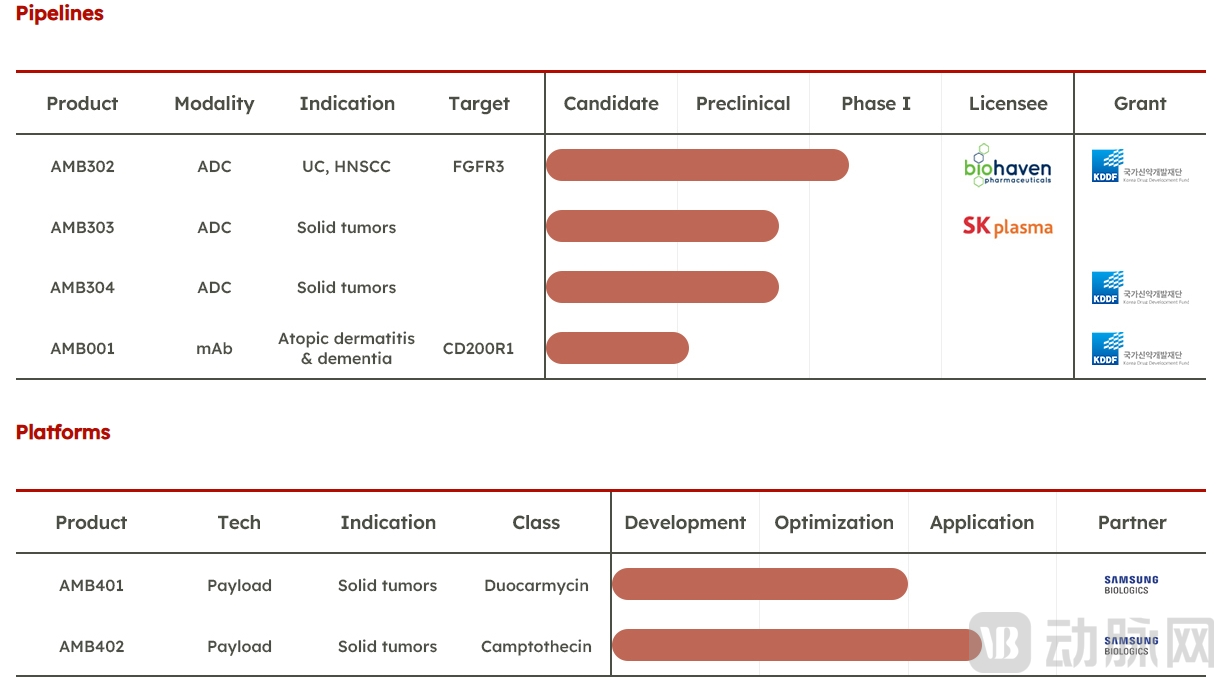
AimedBio Pipeline Overview
The Window for ADC Collaborations Has Arrived
Against the backdrop of accelerating global consolidation in the antibody-drug conjugate (ADC) industry and the sustained growth in demand for cancer therapies, the ADC sector is poised for a new wave of explosive growth. According to data from the World Health Organization (WHO), there were 20 million new cancer cases and 9.7 million cancer-related deaths worldwide in 2022.The limitations of conventional therapies have created an urgent patient demand for novel drugs, while antibody-drug conjugates (ADCs), leveraging their advantage in precise delivery, have emerged as a key breakthrough direction in cancer treatment.。
Against this backdrop,Boehringer IngelheimIn recent years, it has continuously expanded its technological landscape through internal R&D and external collaboration.: In 2020, it acquired NBE Therapeutics for €1.18 billion, gaining an ADC platform and clinical-stage compounds; in 2022, it collaborated with A*STAR to obtain tumor-specific antibodies, solidifying its R&D foundation; in 2025, activities intensified further, with a partnership worth over $1.3 billion reached with Synaffix in January to license its glycoconnect enzyme-mediated ADC technology, followed by a $31 million investment in April to establish a dedicated ADC research and development center in Basel, Switzerland.
This partnership with South Korea’s AimedBio continues the strategy of combining early-stage innovation with strategic synergy. In terms of deal structure, the total agreement value reaches $991 million, covering upfront payments, R&D milestones, and sales-based milestone payments. While the ADC technology platform has matured, competition for novel targets remains in its early stages. Startups possessing unique antigen-recognition capabilities or novel payloads often gain a licensing negotiation advantage even before entering clinical trials, which is precisely why AimedBio has attracted Boehringer Ingelheim.
From a global perspective, the ADC industry has exhibited three major trends.
First, the target ecosystem is diversified.Beyond traditional targets such as HER2 and TROP2, emerging antigens including CLDN18.2 and B7-H3 are gaining prominence, thereby broadening the scope of indications. Companies possessing differentiated antigen recognition mechanisms are thus better positioned to stand out.
Second, innovation in payload mechanisms.The shift from microtubule inhibitor MMAE to topoisomerase I (Topo I) derivatives has become the mainstream direction. These payloads maintain potent cytotoxic activity while offering a wider safety window. Representative agents include DS-8201 (brand name Enhertu), jointly developed by Daiichi Sankyo and AstraZeneca, which has been approved for multiple indications including breast cancer and gastric cancer.
Third, the rise of regional innovation forces.Multiple market research reports indicate that the Asia-Pacific region is experiencing rapid growth in the antibody-drug conjugate (ADC) sector, with compound annual growth rate (CAGR) estimates for the coming years clustering in the range of approximately 13%–17% (DataBridge projects around 16.7%, while Cognitive estimates roughly 13.5%).
The enthusiasm in the capital market further confirms the overall upward trend of the ADC industry.Since the beginning of 2025, major deals in the antibody-drug conjugate (ADC) field have continued to emerge, with several licensing transactions exceeding $500 million.Notably, on January 2, Innovent Biologics partnered with Roche, granting the global rights to its next-generation DLL3-targeted antibody-drug conjugate (ADC), IBI3009. The deal includes an $80 million upfront payment and up to $1 billion in milestone payments. Just five days later, Duality Biologics entered into an exclusive licensing agreement with Avenzo Therapeutics for DB-1418, an EGFR/HER3 bispecific ADC, featuring a $50 million upfront payment and up to $1.15 billion in milestone payments.
Looking ahead, with continuous advancements in target screening, antibody engineering, linkers, and cytotoxic drug technologies, the efficacy and safety of antibody-drug conjugates (ADCs) will be further enhanced, and their indications across cancer types will continue to expand. ADCs are poised to become a core therapeutic modality in oncology, following chemotherapy, targeted therapy, and immunotherapy, thereby offering more treatment options for cancer patients worldwide.