

Surviving the Storm: Strategies for Innovative MedTech Startups Amidst Volume-Based Procurement, DRG Reforms, and Capital Downturn
“A grain of sand from the times falls on each person’s shoulder like a mountain.” This phrase is particularly apt for describing today’s healthcare entrepreneurs.
In recent years, the healthcare industry has undergone dramatic changes: centralized procurement has become normalized on the market side; DRG/DIP payment reforms have been fully implemented on the payer side; anti-corruption campaigns in the pharmaceutical sector have continued to intensify on the regulatory side; and the investment and financing boom has cooled on the capital side. It is important to recognize that in the healthcare sector, which is highly sensitive to policy shifts, any one of these factors alone would be sufficient to disrupt the market landscape, let alone the fact that the industry is currently experiencing a comprehensive, end-to-end transformation spanning markets, payment mechanisms, regulation, and capital.
For today’s healthcare entrepreneurs, the bad news is that macroeconomic volatility has sent startup difficulties soaring; the good news is that these challenges are not isolated incidents, as all peers face the same test from the same starting line.
So, what specific challenges has industry transformation brought to healthcare enterprises? How can entrepreneurs overcome these hurdles? Through in-depth interviews, VCBeat has systematically analyzed the crises faced by healthcare companies amid industry shifts and the strategic decisions made by entrepreneurs, offering valuable insights for the sector.
Volume-based procurement (VBP) is undoubtedly one of the most significant changes in the healthcare industry in recent years. It has disrupted the traditional sales and distribution models relied upon by medical companies, which depended on distributors and agents, thereby reducing their sales costs. However, this also requires medical companies to actively participate in VBP; otherwise, they risk losing access to the entire market. For instance, a company’s coronary stent product failed to win a bid in the first national volume-based procurement of high-value consumables due to an excessively high quote, resulting in virtually no revenue from this product in the domestic market for two years. It only regained market access and generated certain revenue after successfully winning a bid in the subsequent follow-up procurement.
To date, centralized volume-based procurement (VBP) has covered most sectors. The majority of medical device sub-sectors and categories, such as cardiovascular devices, orthopedic consumables, sutures, and syringes, have been included in VBP. In the pharmaceutical sector, 11 rounds of national-level centralized drug procurement with guaranteed volumes have been conducted, covering 490 drugs, while local-level VBP involves an even broader range of product categories.
Today, centralized procurement has profoundly reshaped the market landscape of the healthcare industry. Some companies claim that centralized procurement has had minimal impact on their ex-factory prices, revenue, and corporate development, or that it has helped them increase their market share. However,Language Can Be Embellished, But Data Never Lies. The extent of product price reductions, along with revenue and profit data, will accurately reflect the impact of volume-based procurement (VBP) on these enterprises. Taking orthopedics as an example, from 2021 to 2023, the Chinese government organized VBP for artificial joints, spinal implants, and sports medicine consumables, resulting in average price reductions of 82%, 84%, and 74%, respectively.
The significant decline in end-user product prices has capped market potential and directly impacted the revenue and profits of orthopedic companies. Taking leading (listed) enterprises that were expected to benefit from the so-called "volume-based procurement dividends" as examples, AK Medical’s revenue decreased from RMB 1.04 billion in 2020 to RMB 760 million in 2021; Chunli Medical’s revenue dropped from RMB 1.21 billion in 2023 to RMB 810 million in 2024; and Weigao Orthopaedics’ revenue fell from RMB 2.15 billion in 2021 to RMB 1.85 billion in 2022, further declining to RMB 1.28 billion in 2023.
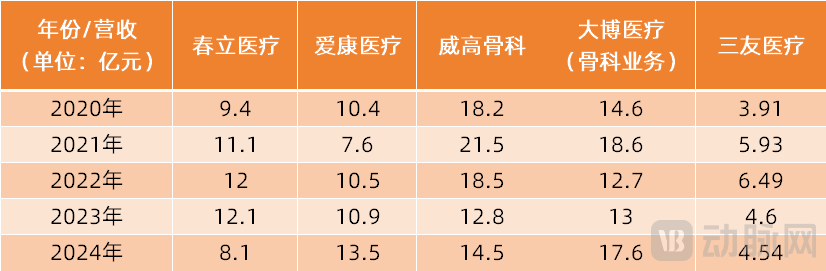
In terms of net profit, Weigao Orthopaedics dropped from RMB 600 million in 2022 to RMB 112 million in 2023; Chunli Medical declined from RMB 322 million in 2021 to RMB 125 million in 2024; and Sanyou Medical fell from RMB 198 million in 2022 to RMB 11.47 million in 2024. Perhaps the only gains for China’s leading orthopedic companies are their market shares.
Leading enterprises have been significantly affected, while small and medium-sized enterprises face even more difficult circumstances.Since the implementation of centralized procurement, multiple orthopedic companies have filed for bankruptcy and liquidation, including some that had won bids in the procurement process. According to a previous announcement by the Tianjin Medical Procurement Center: the selected enterprises for the inter-provincial alliance centralized procurement project for orthopedic traumaChangzhou Dazhang Medical Device Co., Ltd. and Changzhou Kangyu Medical Device Co., Ltd. have both gone bankrupt, unable to continue supplying the selected products.
An industry analyst stated, “This may be because such companies won bids at lower prices but were awarded smaller volumes. When the awarded volume falls short of expectations, the resulting revenue may fail to cover the production costs of the products, prompting companies to abandon supply obligations. Moreover, low shipment volumes and insufficient cash reserves can lead to a cash flow crisis, ultimately driving these enterprises into bankruptcy liquidation.”
Not limited to orthopedics, since the normalization of centralized volume-based procurement (VBP), this trend has been observed across medical device sectors—including in vitro diagnostics (IVD), coronary stents, and neurointerventional devices—as well as the pharmaceutical industry. Although sales volumes for various products have increased, the overall revenue growth rate of Chinese healthcare enterprises has shifted from double-digit figures to single-digit or even negative growth. According to the "Report on the Development of China's Medical Device Industry," by the end of 2023, the main business revenue of China's medical device manufacturers (excluding pharmaceuticals) was approximately RMB 1.16 trillion, representing a year-on-year decline of about 6.4%. In 2024, the combined revenue of listed companies in the pharmaceutical industry decreased by 1.0% year-on-year, while net profit attributable to parent company shareholders dropped by nearly 12%. The reduction in revenue, profits, and cash flow will inevitably disrupt corporate expansion efforts, affecting their strategic planning and development pace.
From 2018 to 2025, the centralized volume-based procurement (VBP) program has been in place for eight years, with its rules continuously evolving.At this stage, although centralized procurement rules have moved beyond a "lowest-price-only" approach, the allocation of procurement volumes remains strongly tied to price.In most volume-based procurement (VBP) programs, the rule design generally favors allocating a larger share of the contracted purchase volume to products with the lowest winning bid prices or the highest price reductions; the remaining selected products then share the leftover market quota. For instance, in the "Follow-up Procurement after the Expiration of the National Centralized Volume-Based Procurement Agreement for Coronary Stents," proposed winning products were categorized into Groups A, B, and C based on their quoted prices, with lower-priced products receiving a higher allocation percentage and thus securing a larger share of the distributable volume.
Based on past experience, participation in centralized volume-based procurement (VBP) has become an almost inevitable choice for medical enterprises. However, different strategic decisions regarding VBP have led to significant divergence among companies: some saw substantial increases in sales and profits after being selected; others, despite being selected, were unable to meet supply demands, leading to crises such as cash flow breaks and compliance risks; some missed out on market opportunities by not being selected, while others, though not selected, successfully carved out a strong presence in overseas markets. All these outcomes stem from differing strategic decisions.
Chen Dongwen, Managing Director at Chende Capital, cited an example: “In the past, some entrepreneurs lacked sufficient understanding or attention to the rules of centralized volume-based procurement (VBP), failing to adequately prepare for price assessments and product volume declarations. This resulted in low declared volumes or excessively high bid prices, leading to limited awarded volumes or even failure to win bids. Over the past few years of VBP implementation, many companies with annual revenues in the tens of millions of yuan have seen their revenues plummet to mere millions due to non-selection or low awarded volumes, significantly hindering their business development.”
Some enterprises have won bids at ultra-low prices, only to incur losses on every unit sold. In pursuit of profit, some companies resort to non-compliant practices, such as lowering production standards, to supply their products. For instance, after the implementation of centralized procurement for traditional Chinese medicine (TCM) decoction pieces, three enterprises were disqualified by the Shandong Provincial Healthcare Security Administration for breaching their commitments and violating the terms of the procurement documents, and were subsequently placed on a list of non-compliant entities. Additionally, there has been a recent surge in reports from various regions regarding compliance violations by companies participating in centralized procurement, with issues primarily centered on product quality, supply assurance, and corporate compliance. This underscores that winning bids at ultra-low prices is not a rational decision, as it not only disrupts normal business operations but also undermines healthy competition and development within the industry.
If the quoted price is too high, the bidder may fail to win the contract or receive a smaller allocation; if it is too low, revenues will fail to cover costs. Entrepreneurs should learn from these lessons. In the face of centralized volume-based procurement (VBP), small and medium-sized enterprises (SMEs) should proactively assess competitors’ and their own production costs, and adjust strategies accordingly: If they hold a cost advantage, they can plan capacity expansion in advance to leverage lower costs for increasing product volume commitments and market share; if their competitiveness is weak, they should focus investment on other product lines where they have strengths. Meanwhile, SMEs should not aim to win bids across their entire product portfolio, but rather concentrate resources on a select few products, boost volume commitments, reduce production costs, and thereby capture greater market share and revenue.
It is worth noting that since the implementation of centralized volume-based procurement (VBP), medical companies have firmly believed in breaking through with innovation, actively launching new products and vying for shares in other niche markets. “However, as an increasing number of categories are included in VBP, each company’s core business has become a source of incremental growth for competitors. With more players entering the market, competition has already become intense even before innovative products receive regulatory approval,” said Zhang Taihao, Vice President of Zenith Capital.
For example, over 10 Pulsed Field Ablation (PFA) systems, regarded as the future mainstream products in electrophysiology, have already received regulatory approval in China. The domestic PFA market has begun to experience intense competition even before reaching maturity, and differentiated innovations such as nanosecond pulsed technology and procedural local anesthesia are expected to be key to gaining a competitive edge.
“The medical device sector should not be judged solely by the number of regulatory approvals; it is also essential to assess a company’s competitiveness within its field.” This call has been echoed by numerous industry insiders:The review and approval process for innovative medical devices should raise the bar by rejecting products with poor clinical trial data, thereby elevating industry standards, reducing low-quality competitors, and preventing substandard products from capturing market share through low pricing.。
Healthcare payment policies are also a critical factor influencing the healthcare industry. In 2019, China officially launched reforms to adopt Diagnosis-Related Groups (DRG) and Big Data Diagnosis-Intervention Packet (DIP) payment methods. Currently, coverage of these case-based payment models has been basically extended to all medical insurance pooling regions.
DRG and DIP payment models essentially establish “bundled prices” for hospitals based on different diseases. Hospitals retain any surplus if treatment costs fall below the bundled price, but must bear the loss if costs exceed it. Under DRG/DIP payment systems, cost control has become a critical priority for hospitals. Cost components in the diagnostic and treatment process, such as medical equipment, high-value consumables, and in vitro diagnostics (IVD), are facing stringent price pressures, leading hospitals to favor products with higher cost-effectiveness.
Pharmaceuticals and medical devices have shifted from being profit centers to cost centers, fundamentally altering their role within hospitals. Against this backdrop, hospitals have reduced services such as examinations and tests, leading to an overall decline in demand for the in vitro diagnostics (IVD) market and significantly impacting the revenues of related companies. For instance, in the first quarter of 2025, among the 60 listed IVD companies in China, 51 experienced a decline in revenue or profits, with only nine achieving simultaneous growth in both revenue and net profit.
Meanwhile, following the implementation of DRG/DIP payment systems, the adoption of new technologies and medical devices in hospitals has been constrained in the short term. At their inception, new technologies generally entail higher usage costs. Driven by self-interest, hospitals may prefer more mature, lower-cost treatment options and remain cautious toward innovative technologies. For instance, Pulsed Field Ablation (PFA) systems, an innovation in the electrophysiology field, offer advantages over traditional radiofrequency ablation and cryoablation, including broader indications, shorter ablation times, superior therapeutic efficacy, and fewer complications, positioning them as future mainstream products. Overseas, Boston Scientific’s PFA system achieved first-year sales exceeding $1 billion, partially replacing radiofrequency and cryoablation procedures. In China, however, only slightly over 1,000 PFA procedures were performed during its first year on the market, accounting for an extremely small proportion of total electrophysiology interventions.
This is primarily driven by two factors. On one hand, the hospital admission process in overseas markets is fast and convenient, and the overall average cost of pulsed field ablation (PFA) carries a premium of approximately 10%–20% compared to radiofrequency ablation and cryoablation, aligning with the expectations of both hospitals and patients, thus leading to rapid adoption. On the other hand, in China, the cost of PFA carries a 100% premium over the average prices of radiofrequency ablation and cryoablation. Given the strong incentive for domestic medical institutions to control costs, this may hinder the widespread promotion and adoption of PFA.
For innovative medical devices and novel drugs, how to gain hospital formulary access and increase utilization under the DRG/DIP payment systems remains an urgent issue to be addressed. Although some provinces and municipalities have issued guiding policies to support the rapid clinical adoption of innovative products, implementation-level policies are still needed.
Among these, Zhejiang Province’s measures to promote the rapid adoption of innovative drugs serve as a reference for all other provinces in China. The province issued the Interim Administrative Measures on Medical Insurance Payment Incentives for Innovative Pharmaceutical Technologies, which provides incentives for innovative drugs within the Diagnosis-Related Group (DRG) payment system, thereby supporting their timely introduction into clinical practice. For national reimbursement negotiation drugs that are not included in the incentive catalog for innovative pharmaceutical technologies or subject to special case negotiations, separate incentives are provided. Specifically, additional points are awarded during year-end settlement based on the inpatient expenditure on national reimbursement negotiation drugs, with the conversion rate capped at 10%. In the 2024 DRG settlement, Zhejiang Province disbursed a total of RMB 600 million in separate incentives for national reimbursement negotiation drugs, using financial incentives to alleviate healthcare institutions’ concerns about adopting innovative drugs.
“An industry insider stated, ‘Currently, numerous policies support the application and development of innovative drugs, but there are fewer supportive policies for the application of innovative medical devices, necessitating greater support.’”
Amidst the shifting landscape of payment reforms, some entrepreneurs continue to promote hospital adoption of their products through traditional marketing models, while others leverage local supportive policies and novel marketing strategies to accelerate commercialization. For instance, certain innovative companies conduct real-world data studies or evidence-based medicine research aligned with the priorities of healthcare institutions, demonstrating that their products improve clinical outcomes, shorten length of stay, reduce readmission rates, and lower overall quality-related costs. By leveraging such research data, these companies facilitate rapid hospital formulary inclusion and scaled application of their products, achieving rapid growth.
Beyond policy, the healthcare industry has also undergone significant changes in the capital market in recent years.
From 2019 to 2021, capital market activity in China’s healthcare sector surged, with the number of financing and investment deals rising from 818 to 1,362, and total funding amount increasing from USD 15.8 billion to USD 34 billion. During this period, a substantial influx of capital enabled many innovative healthcare companies to secure financing at high valuations.
Over the following three years, investment and financing activity in the healthcare sector cooled, with the number of deals declining from 1,218 in 2022 to 811 in 2024, while total funding dropped from $15.6 billion to $7.3 billion, a decrease of 53%.
As the number of financing events and the amount of capital raised plummeted, many companies filed for bankruptcy and liquidation due to failed fundraising rounds and broken cash flows.For instance, a POCT (point-of-care testing) company advanced its innovative POCT system after securing tens of millions of yuan in financing in 2019 and 2020. Unfortunately, the company collapsed just before its product received regulatory approval: in 2024, it entered bankruptcy liquidation proceedings. Prior to this, the founder had engaged in negotiations with numerous investment institutions, but failed to reach an agreement due to valuation discrepancies. The company also held discussions with several local governments regarding project implementation in hopes of securing financial support, but these efforts ultimately ended in failure.
In fact, many entrepreneurs in China are misled by the high valuations during peak fundraising periods, preferring to let their capital chains break rather than lower their valuations when the market cools down. In contrast, some seasoned entrepreneurs have the courage to make painful sacrifices and compress their valuations to secure funding, using the raised capital to drive product launches or commercialization and achieve business growth.
From an investment and financing perspective, entrepreneurs must recognize the cyclical nature of industry development, maintain a sense of crisis, make decisive moves when crises arise, mitigate risks, and seize opportunities.
Overall, although the healthcare industry is undergoing comprehensive changes across the entire value chain—from markets and payment systems to capital—some companies are thriving against the tide amidst these dramatic shifts. We advocate for the healthy development of the healthcare sector under policy guidance and look forward to witnessing the rebirth and transformation of healthcare enterprises.