

Cerca Magnetics Limited Files for IPO: Pioneering Wearable OPM-MEG Technology in Zero-Field Medicine

Cerca Magnetics
--
When a child with autism requires brain function assessment, the bulky frame of traditional magnetoencephalography (MEG) equipment, its cryogenic liquid helium cooling system, and the requirement for head immobilization during testing often make the diagnostic process challenging.
Behind this dilemma lies a long-standing bottleneck in the precise diagnosis of neurological disorders worldwide. In recent years, zero-field medicine (fully named “Ultra-Weak Magnetic Functional Information Medicine”) has emerged, offering a novel approach to overcoming this challenge.
By leveraging high-precision magnetic field measurement techniques, such as quantum spin sensing, in near-zero magnetic environments to capture the extremely weak magnetic signals generated by human organs like the heart and brain, this discipline enables non-invasive, ultra-early diagnosis at the functional level, and is regarded as one of the key directions for the future of medicine.
At the University of Nottingham in the UK, a startup named Cerca Magnetics Limited (hereinafter referred to as “Cerca”) is bringing its wearable magnetoencephalography (MEG) system based on optically pumped magnetometers (OPMs) into clinical use.
From its inception in an academic laboratory in 2020, to winning the Institute of Physics Quantum Innovation Award in the UK in 2023, and further to receiving government funding in 2024 to explore early screening for Alzheimer’s disease, this quantum healthcare startup has anchored its strategy in clinical translation, thereby opening up new possibilities for the application of zero-field medical technology in the non-invasive diagnosis of cardiovascular and cerebrovascular diseases.
1Taking Magnetoencephalography Out of the Shielded Room: Cerca’s Wearable Zero-Field Medical Practice
Cerca’s technology originated from the Quantum Sensing Laboratory at the School of Physics and Astronomy, University of Nottingham. The team has long been dedicated to the research and development of optically pumped magnetometers (OPMs) for biomagnetic field detection, aiming directly at addressing the core limitations of traditional superconducting quantum interference device (SQUID) systems in clinical applications. This research direction aligns closely with the core mission of Zero-Field Medicine: “to achieve early disease diagnosis through high-precision, non-invasive detection of the human body’s extremely weak magnetic fields.”
Magnetoencephalography (MEG), as a non-invasive, radiation-free functional imaging technique, is capable of capturing extremely weak neuromagnetic signals with intensities as low as one-billionth of the Earth’s magnetic field (50–500 fT). It holds unique value in epileptic focus localization, mapping of brain functional areas, and even the early detection and diagnosis of psychiatric disorders.
However, traditional MEG systems are not only prohibitively expensive—often costing tens of millions of dollars—but also require costly magnetically shielded rooms. Furthermore, their bulky design, reliance on liquid helium cooling, and stringent head immobilization requirements make them highly unsuitable for children and patients with special needs, significantly compromising diagnostic efficacy.
The emergence of OPM technology offers new possibilities in principle: it operates at room temperature without requiring liquid helium cooling, and holds the potential for miniaturization and wearability.
In 2018, the research team at the Sir Peter Mansfield Imaging Centre, University of Nottingham, integrated atomic magnetometers with 3D printing technology to develop the first prototype of a “wearable” magnetoencephalography (MEG) system. Weighing only 905 grams and allowing for personalized fitting, this device ensures close contact between the sensors and the subject’s scalp, fundamentally transforming the traditional detection paradigm that relied on bulky equipment weighing up to 450 kilograms and required complete head immobility.
Building on this technology, the center partnered with Magnetic Shields in 2020 to establish Cerca Magnetics, launching a novel atomic magnetometer-based magnetoencephalography (MEG) system. The following year, Cerca successfully unveiled its first-generation OPM-MEG prototype. Although the device still required simple fixation, it achieved room-temperature operation and eliminated dependence on liquid helium, laying the foundation for subsequent clinical validation and technological iterations.
In 2023, Cerca Magnetics launched the first true wearable magnetoencephalography (MEG) scanner, embedding sensors into a lightweight helmet. This design eliminates the need for head immobilization, allowing scans to be performed while the patient is seated or engaging in slight movements, thereby significantly enhancing the flexibility and comfort of the examination.
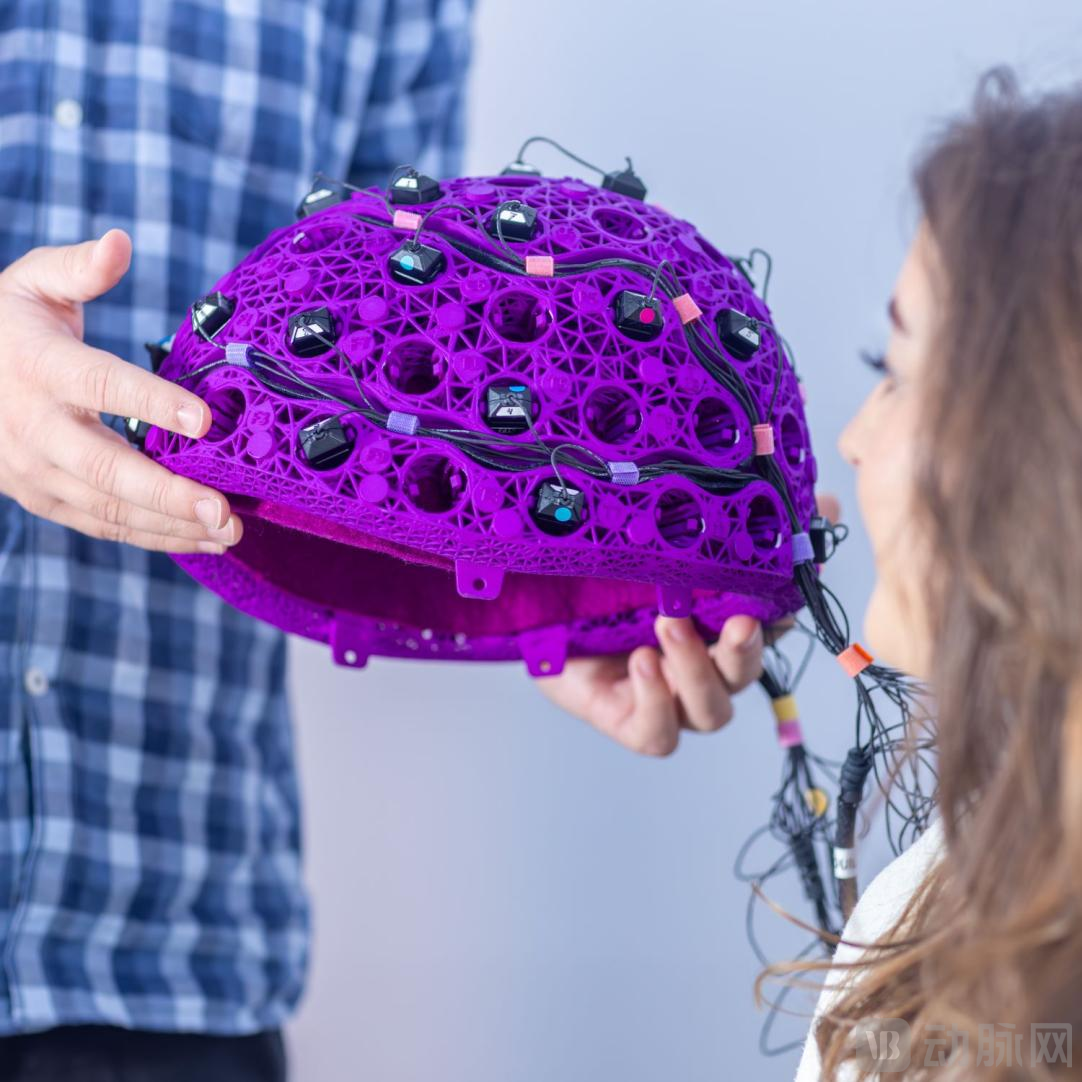
Cerca Wearable MEG Scanner Source: Cerca Official Website
The product subsequently received the inaugural qBIG Quantum Innovation Award from the Institute of Physics (UK) and was deployed in a clinical pilot at The Hospital for Sick Children in Toronto to support neurodevelopmental research in children with autism. Feedback indicated that patient compliance during testing increased from less than 50% to over 90%, preliminarily validating the clinical value of its wearable design.
In 2024, Cerca Magnetics received a £2 million special grant from the UK government to deploy an OPM-MEG system at the University of Oxford’s Centre for Human Brain Activity, enabling research into the early diagnosis of Alzheimer’s disease. The project aims to detect abnormalities 5–10 years before patients exhibit memory decline symptoms by analyzing subtle changes in magnetoencephalographic signals. Preliminary data indicate that the system has already captured differences in magnetic field fluctuations within the default mode network of patients’ brains.
Meanwhile, Cerca Magnetics has not limited itself to the field of magnetoencephalography (MEG). In 2025, it explicitly announced its expansion into magnetocardiography (MCG), with plans to develop a comprehensive imaging solution covering both “brain” and “heart” systems, thereby further broadening the application boundaries of ultra-weak magnetic field measurement technology in precision medicine.
2OPM Technology Integrates Wearable Helmets: Lighter, More Accurate, and More Accessible
Cerca’s disruptiveness stems from its medical adaptation of optically pumped magnetometer (OPM) technology, providing key technical support for the clinical implementation of zero-field medicine.
This technology is based on the Zeeman effect in quantum mechanics, wherein atomic energy levels split in response to an external magnetic field, with the degree of splitting dependent on the magnetic field strength. Through engineering innovations leveraging this physical phenomenon, Cerca has successfully addressed the long-standing pain points associated with the clinical application of traditional SQUID devices.
The working principle of OPM technology can be divided into three key steps:
First, inAtomic PolarizationIn this step, Cerca seals rubidium or cesium atoms within a specialized atomic vapor cell and emits laser light at a specific wavelength using a frequency-stabilized laser. The laser energy “pumps” the atoms, aligning their spin directions to form an ordered spin array.
Secondly, inMagnetic Field ResponseDuring this stage, when the human body generates extremely weak magnetic fields (such as the ~1 fT-level magnetic fields produced by brain neurons or the 1,000–10,000 fT-level magnetic fields associated with cardiac activity), these fields act on pre-polarized atoms, causing a deflection in their spin orientation. The stronger the magnetic field, the greater the deflection angle, which consequently alters the atoms’ absorption efficiency of laser light.
Finally, inSignal ReadingIn this stage, high-precision photodetectors capture changes in the efficiency of atomic absorption of laser light, convert them into electrical signals, process them using specialized algorithms, and ultimately reconstruct them into magnetoencephalographic or magnetocardiographic images interpretable by physicians.
The key breakthrough in this process lies in eliminating the reliance on cryogenic cooling. Traditional SQUID devices require liquid helium at -269°C to maintain a superconducting state, whereas OPM technology, through its design incorporating atomic vapor cells and laser pumping, can operate stably at room temperature (20–25°C).
Furthermore, the clinical deployment of Cerca’s OPM system hinges on the engineering optimization of three core components, as these details determine the device’s performance and practicality.
● OPM Sensors: Compact Size, High Sensitivity, Compatible with Helmet Integration.Unlike SQUID sensors, which require cryogenic storage, OPMs leverage the quantum properties of alkali atoms to measure minute magnetic fields, achieving sensitivity comparable to superconducting devices while eliminating the need for liquid helium cooling.
● Background Magnetic Field Control: Say Goodbye to Traditional Shielded Rooms; the Helmet Can Be Used in Clinical Settings.To address the specific requirements for ultra-weak magnetic field measurements, Cerca Magnetics has adopted a novel magnetic shielding room design and electromagnetic coil technology to create an exceptional magnetic environment with a static magnetic field below 1 nT and a shielding factor (the ratio of external magnetic field strength to residual magnetic field strength after shielding) exceeding 50,000.
● System Integration: 3D-Printed Helmet for Universal Fit and Unrestricted Mobility.Cerca employs a unique helmet design that integrates 64 sensors closely positioned against the scalp. Coupled with advanced array algorithms, this system effectively eliminates irrelevant magnetic fields generated by interference sources. Published data demonstrate that its performance in measuring neural oscillations and functional connectivity even surpasses that of the best cryogenic systems. Its ergonomic design allows subjects to move freely during scanning, and the same system can accommodate various head shapes, ranging from adults to infants.
The value of medical imaging equipment ultimately boils down to “usability and user-friendliness.” Cerca’s OPM-MEG system achieves a dual balance of “precision” and “flexibility” in performance.
Sufficiently “Accurate” Precision, meeting the needs of clinical diagnosis. The system features millimeter-level spatial resolution and millisecond-level temporal resolution, enabling precise localization of brain functional areas or epileptic foci while capturing rapidly changing neural signals, thereby fully satisfying the requirements of neurological clinical diagnosis and scientific research.
"Live" Enough to Use, breaking through limitations related to patient populations and clinical scenarios. The device is compact and lightweight, supporting flexible deployment across institutions. Sensors are integrated into a 3D-printed, adjustable helmet, allowing patients to undergo scanning while comfortably seated or even in motion. This significantly enhances examination comfort and applicability, achieving full-age coverage from neonates to adults.
Costs are "low" enough, lowering the barrier to medical accessibility. The system costs only 50% of traditional SQUID devices and eliminates the need for ongoing liquid helium refills. It can operate stably in standard clinical settings, significantly reducing the capital investment and operational maintenance thresholds for healthcare institutions, thereby creating conditions for the widespread adoption of advanced magnetoencephalography (MEG) technology.
3Zero-Field Medical: From the Laboratory to the Bedside
As zero-field medicine transitions from theory to practice, Cerca Magnetics is systematically bridging the gap between laboratory research and clinical application for OPM technology by building an industrial collaboration network, advancing clinical validation, and optimizing its supply chain.
In terms of technology integration, Cerca has established a deep strategic partnership with QuSpin, a U.S. quantum sensing company, to jointly develop high-performance atomic physics modules, thereby enhancing the performance and reliability of OPM devices. This collaboration enables Cerca to acquire advanced atomic manipulation technologies and strengthen its product competitiveness.
Clinical validation has demonstrated that Cerca’s devices have been deployed at institutions such as the Hospital for Sick Children in Toronto and University College London Hospitals. In studies on epileptogenic focus localization, the OPM system increased localization accuracy to 92% and reduced detection time from 4 hours to 2 hours. In neonatal brain function monitoring, the system successfully captured abnormal signals in the brain activity of preterm infants, providing a basis for early intervention.
Globally, zero-magnetic medicine is embracing dual opportunities in policy and market support. The UK has designated quantum technology as a national strategy and plans to invest £250 million to support research and development. Meanwhile, in China, research and applications in zero-magnetic medicine are advancing steadily. Innovative enterprises such as Beijing Weici Technology are actively developing magnetocardiography (MCG) and magnetoencephalography (MEG) systems based on atomic magnetometers, striving to overcome challenges in core sensor technologies and clinical solutions.
Meanwhile, research institutions such as the Chinese Academy of Sciences and Beihang University are continuously advancing fundamental research in ultra-weak magnetic field measurement, magnetic shielding technology, and novel quantum sensors, thereby providing academic support for the long-term development of zero-field medicine. Like Cerca Magnetics, these institutions are jointly committed to translating ultra-weak magnetic field measurement technologies into accessible clinical tools.
Despite challenges related to clinical recognition, signal stability, and commercialization pathways, the urgent global demand for early diagnosis of diseases such as Alzheimer’s disease, epilepsy, and myocardial ischemia provides strong momentum for the development of zero-field medical technology.
Cerca’s five-year journey has outlined a viable path for translating zero-field medical science from laboratory theory into clinical tools. From atomic spin research in Nottingham laboratories to clinically viable wearable helmets, its true value lies in demonstrating that the clinical translation of zero-field medicine is, at its core, an engineering practice aimed at addressing real-world medical pain points through technology.
With the continuous exploration by companies such as Cerca Magnetics, and the joint promotion of industry, academia, and research forces worldwide, zero-field medical imaging is gradually evolving from a cutting-edge scientific concept into a diagnostic tool that delivers tangible value to physicians and patients, ushering in a new era of greater precision and accessibility for the early diagnosis of cardiovascular and cerebrovascular diseases.