

Genetesis Files IPO Prospectus Following FDA-Approved MCG Technology and Over $40M in Funding

Genetesis
Medical Information Processing Technology R&D Provider
Acute chest pain is one of the most common presentations in the emergency department, and its underlying etiologies can sometimes be life-threatening. Taking ischemia with no obstructive coronary arteries (INOCA) as an example, patients with this condition exhibit symptoms of myocardial ischemia, yet coronary angiography reveals no significant obstruction, leaving them trapped in a long-term dilemma of “undiagnosable and mistreated.”
Traditional diagnostic methods have significant limitations: electrocardiography has low sensitivity, CT angiography involves radiation exposure, and coronary angiography is expensive and invasive. The pain points in clinical diagnosis represent substantial market opportunities. According to data from Bizwit Research & Consulting, the global cardiovascular diagnostics market is projected to reach RMB 55.576 billion by 2030, with non-invasive diagnostic technologies experiencing rapid growth.
In 2013, Genetesis founder Peeush Shrivastava targeted this pain point by establishing the company to specialize in non-invasive detection of myocardial ischemia. Today, leveraging magnetocardiography (MCG) technology, the company has not only revolutionized cardiac diagnosis but also emerged as a key pioneer in the commercialization of zero-field medical science, driving the implementation of ultra-early non-invasive diagnostics.
Before delving into the corporate story, it is essential to first clarify the underlying technology that supports its development: Ultra-Weak Magnetic Functional Information Medicine, also known as Zero-Field Magnetism Medicine. It is not a single device or technology, but an emerging interdisciplinary field.
At its core, it leverages an ultra-weak magnetic field environment and quantum-level ultra-high-sensitivity sensors to create a measurement space nearly free from external magnetic interference. Within this environment, it precisely detects weak biomagnetic signals generated by the electrophysiological activities of human organs such as the heart and brain, with intensities reaching only the picotesla (pT) level.
A Core Challenge in Modern Medical Diagnosis: Traditional imaging techniques, such as CT and MRI, primarily reveal anatomical structures. However, for many diseases, particularly in the early stages of cardiovascular and cerebrovascular disorders, functional changes often precede structural alterations by a significant margin.
Zero-magnetic medicine specifically targets this “diagnostic window period,” aiming to achieve ultra-early, non-invasive diagnosis and functional assessment of diseases by capturing and analyzing extremely weak physiological magnetic signals before significant organic lesions have developed. Its unique value is reflected across multiple dimensions:
● Frontier of Functional Information: It can obtain physiological functional information that traditional imaging cannot provide, opening a new window for understanding disease mechanisms.
● Potential for Ultra-Early Diagnosis: It demonstrates extremely high sensitivity in scenarios such as myocardial ischemia and localization of functional brain areas, holding promise for earlier warning.
● Absolutely safe and non-invasive: The detection process is radiation-free and non-invasive, making it suitable for special populations such as pregnant women and children, as well as for long-term follow-up.
● Ambient Temperature Operation and Cost Optimization: By leveraging emerging technologies such as atomic magnetometers, it is gradually reducing reliance on liquid helium cooling and large shielded rooms, thereby laying the foundation for future widespread adoption.
In short, zero-field medical imaging represents a profound evolution in medical imaging—from visualizing anatomy to interpreting function—and stands at the forefront of future medicine. Genetesis’s CardioFlux system is a successful implementation of the zero-field medical imaging paradigm in the cardiovascular field.
In 2013, while most medical innovators were focusing on traditional imaging technologies, Genetesis, a startup based in Cincinnati, Ohio, chose a differentiated path: non-invasive biomagnetic imaging. Founder Peeush Shrivastava, along with two other co-founders, clearly established “non-invasive detection of myocardial ischemia and coronary artery disease” as their core direction.
At its inception, the company secured approximately $1.9 million in angel funding, with investors including Mark Cuban, owner of the Dallas Mavericks, as well as CinyTech and Danmar Capital, thereby injecting the first critical tranche of capital into its technology research and development.
In 2017, Genetesis was selected for the NVIDIA Inception program and won the “Most Socially Impactful” Startup Award, receiving a $1.5 million prize and GPU technical support. In the same year, it completed the installation of its first clinical prototype system at Ascension Hospital in Michigan, beginning systematic collection of clinical data.
After two years of data accumulation and technical optimization, the CardioFlux system it developed received U.S. FDA 510(k) clearance in 2019, serving as the “ticket” for the commercialization of magnetocardiography technology.

Schematic Diagram of the CardioFlux System Model Source: Genetesis Official Website
Regulatory endorsement is a hallmark of technological maturity and a guarantee of investor confidence. In 2020, the system received FDA Breakthrough Device designation for imaging equipment. That same year, TDK Ventures, the venture capital arm of global electronic components giant TDK, made a strategic investment in the company. This marked TDK’s first investment in the healthcare sector, leveraging its 85 years of expertise in magnetic materials and MEMS technology to support Genetesis and provide a solid foundation for enhancing its sensor performance.
With growing technological acceptance and clearer market demand, Genetesis closed a $17.5 million Series C financing round in October 2022, led by the deep-tech investment firm Mithril Capital, bringing its total funding to over $40 million. The proceeds are primarily designated for clinical trials and global commercialization efforts.
Meanwhile, the company launched the ACCMED trial in collaboration with top-tier medical institutions such as the Cleveland Clinic and Ascend Medical, completing clinical validation in just 18 months and further confirming the system’s effectiveness in real-world healthcare settings.
The core challenge in diagnosing heart disease lies in how to non-invasively, rapidly, and accurately capture early signals of cardiac functional abnormalities. Traditional technologies each have limitations: electrocardiograms (ECG) can only detect electrical activity and lack sensitivity; troponin tests require a six-hour waiting period; and coronary CT angiography (CCTA) carries radiation risks.
Genetesis’s solution is based on a fundamental principle: the heart generates weak magnetic fields during its electrical activity. However, the intensity of these fields is only in the range of tens of picoteslas (pT), equivalent to one hundred-millionth of the Earth’s magnetic field and a million times weaker than the magnetic field emitted by a mobile phone.
To detect such faint signals, two major challenges must be overcome:Ultra-High Sensitivity Sensorand a magnetically shielded environment.
At the signal acquisition level, the CardioFlux system employs an array of 36 atomic magnetometers, coupled with a dedicated magnetic shielding apparatus, to create a “quiet space” capable of detecting extremely weak magnetic fields. These sensors, jointly developed by Genetesis and TDK, are based on advanced MR technology and achieve picotesla (pT)-level sensitivity without requiring the liquid helium cooling needed for traditional superconducting quantum interference devices (SQUIDs).
During the data processing stage, the raw data acquired from scanning is uploaded to Genetesis’s self-developed “Faraday Analysis Cloud Platform.” Here, AI algorithms play a pivotal role by intelligently identifying and removing environmental magnetic interference, extracting valid cardiac magnetic field signals from noisy background noise, and generating clear cardiac magnetic field distribution maps.
Final clinical judgments become intuitive and precise. By observing abnormal regions in magnetic field maps, physicians can directly identify the location and severity of myocardial ischemia without relying on invasive procedures or radiation-based examinations. The entire process, from scanning to result output, takes only 90 seconds, providing a valuable time window for emergency decision-making.
Compared with traditional technologies, the advantages of CardioFlux are reflected in multiple dimensions, including precision, speed, safety, and low cost, which collectively constitute its market competitiveness.
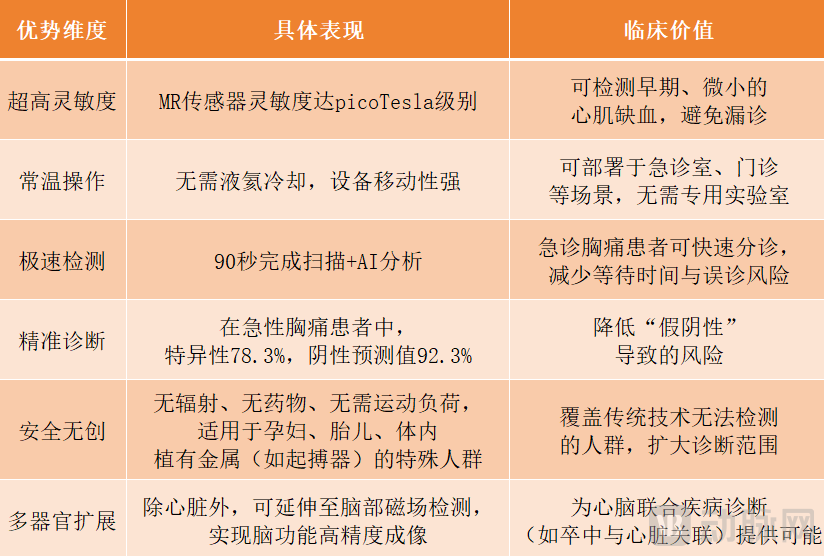
Overview of the Six Core Highlights of the CardioFlux System
In terms of precision, a clinical study involving 101 patients with low-to-moderate risk chest pain demonstrated that the CardioFlux system achieved a specificity of 78.3% and a negative predictive value as high as 92.3% in detecting cardiac chest pain. This indicates its high efficacy in ruling out non-cardiac chest pain, thereby helping to reduce unnecessary waste of medical resources.
In terms of detection speed, the system completes scanning and AI analysis within 90 seconds. Compared with the 6-hour waiting time for troponin testing and the 30-minute examination time for coronary CTA, this system significantly improves the efficiency of triage decision-making for emergency patients with chest pain. In emergency scenarios where every second counts, this time advantage translates into tangible clinical value.
The reduction in operating costs is equally significant. Traditional superconducting quantum interference devices (SQUIDs) require cooling with liquid helium to -269°C, resulting in complex maintenance and high costs. The CardioFlux system operates at room temperature, offering enhanced portability and significantly lower maintenance expenses. Furthermore, as it does not require specialized magnetic shielding modifications to the installation room, this cutting-edge technology can transition from dedicated research laboratories to broader clinical settings, such as standard emergency departments and outpatient clinics.
In terms of safety, the system’s characteristics of being radiation-free, drug-free, and requiring no exercise stress make it suitable for special populations, including pregnant women, fetuses, and individuals with metallic implants such as pacemakers, effectively filling the application gaps of traditional technologies.
The scalability of the technology opens up significant potential for future growth. Beyond cardiac detection, the underlying principles of this system can be extended to cerebral magnetic field detection, enabling high-precision imaging of brain function and providing new possibilities for the diagnosis of combined cardiovascular and cerebrovascular diseases.
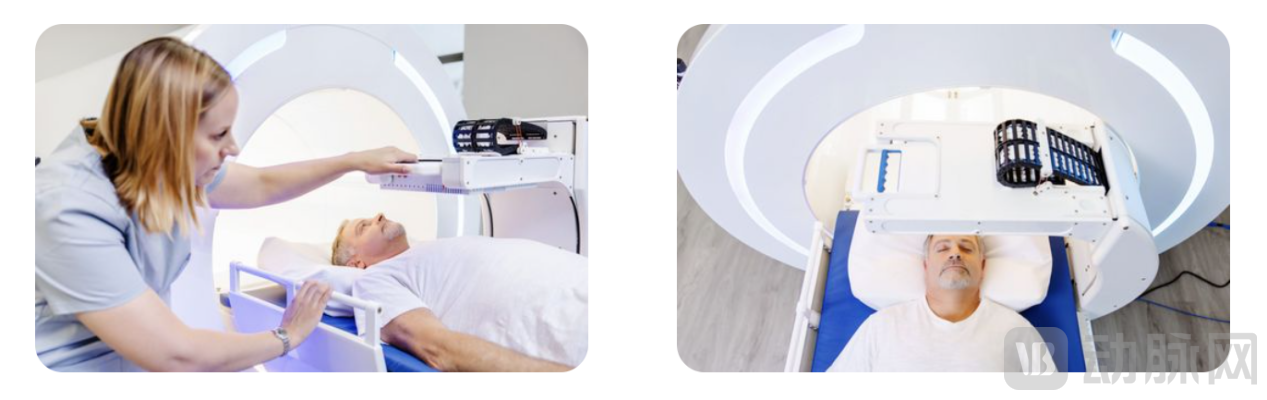
Schematic Diagram of the CardioFlux System Operation Source: Genetesis Official Website
However, Genetesis still falls short of the ultimate goal of zero-magnetic-field technology. By creating a “relatively quiet” measurement environment through built-in magnetic shielding in its devices, it achieves picotesla (pT)-level sensitivity, which is sufficient for cardiac magnetic field detection. Nevertheless, compared with cutting-edge zero-magnetic-field technologies that aim for large-scale zero-magnetic-field spaces and femtotesla (fT)-level sensitivity, there remains an order-of-magnitude difference in terms of environmental noise shielding and signal detection capability.
Genetesis’s commercial achievements are merely a microcosm of the global development of zero-magnetic medicine. This emerging discipline is rapidly advancing along diverse pathways, demonstrating substantial clinical potential.
In the United States, Genetesis exemplifies a corporate-led pathway for technology commercialization. Its CardioFlux system has been deployed in multiple hospitals across the U.S., with clinical trials involving nearly 2,000 participants, thereby accumulating extensive real-world data. In 2023, the system received another FDA Breakthrough Device Designation, with its indications expanded to “identifying myocardial ischemia in patients with coronary microvascular disease.”
Meanwhile, China has demonstrated systematic national innovation strength in the field of zero-magnetic medicine. Since 2008, the team led by Academician Fang Jiancheng of the Chinese Academy of Sciences has pioneered related research in China, successfully developing the country’s first zero-magnetic medical imaging device, whose ultra-weak magnetic sensitivity set a world record.
In August 2025, the world’s first “Joint Laboratory for Zero-Magnetic Interventional Medicine” was officially unveiled at Pudong Hospital affiliated with Fudan University, marking a new phase in which zero-magnetic medicine transitions from laboratory research to industrial application. The laboratory integrates top-tier clinical resources from Zhongshan Hospital, Huashan Hospital, and Ruijin Hospital, all affiliated with Fudan University, as well as core technical teams from Beihang University and the Hangzhou Institute of National Major Science and Technology Infrastructure for Ultra-Weak Magnetic Fields, thereby establishing a complete innovation chain encompassing “medicine, engineering, research, production, and application.”
Furthermore, Tongji Hospital affiliated with Tongji Medical College of Huazhong University of Science and Technology signed a strategic cooperation agreement with Academician Fang Jiancheng’s team in July 2025 to jointly promote the research, development, and application of zero-field medical equipment. These developments indicate that China is rapidly advancing in the clinical translation and industrial ecosystem integration of zero-field medicine.
It is evident that Genetesis and the global development of zero-field magnetic medicine are mutually reinforcing. In terms of market expansion, the rapid growth of zero-field magnetic medicine in Asia, particularly in China, is providing potential opportunities for globalization. Nevertheless, the path ahead for Genetesis remains filled with both challenges and opportunities.
Bridging the technological gap requires sustained investment. Although Genetesis’s current picotesla (pT)-level sensitivity is sufficient for cardiac detection, advancing to the femtotesla (fT) level remains necessary to detect weaker magnetoencephalographic signals. This necessitates generational breakthroughs in sensor technology and magnetic shielding design.
In terms of market acceptance, although the FDA Breakthrough Device Designation has been obtained, it will still take time and sustained educational efforts to achieve widespread acceptance and routine clinical adoption of this new technology among physicians.
Expanding the scope of application is another important direction. Although MCG demonstrates excellent performance in detecting myocardial ischemia, its diagnostic value for other cardiac diseases requires further validation. Transitioning from a “specialized” to a “general-purpose” approach is a challenge that Genetesis must address in the future.
The pace of technological innovation continues to accelerate, as quantum physics and clinical medicine achieve seamless integration. Humanity is now interpreting the faint magnetic signals emitted by the heart and brain with unprecedented precision. Spanning from magnetocardiography to magnetoencephalography, and from single organs to whole-body systems, zero-field medical imaging is ushering in its own era.