

FieldLine's Wearable OPM-MEG System HEDscan Accelerates Global Adoption of Zero-Field Medicine

FieldLine
--
For a long time, magnetoencephalography (MEG) technology has been confined to a few top-tier laboratories due to the high cost and stringent deployment requirements of superconducting quantum interference devices (SQUIDs). This predicament is undergoing a fundamental transformation with the emergence of optically pumped magnetometers (OPMs), a novel quantum sensing technology.
In the international academic context, this type of research is referred to asOPM-MEG (Magnetoencephalography Based on Optically Pumped Atomic Magnetometers)orQuantum Magnetic Sensing Neuroimaging. In Chinese academia, this technological system has been systematically defined as"Zero-Magnetism Medicine" (full name: "Ultra-Weak Magnetic Functional Information Medicine"), emphasizing the precise measurement and functional identification of ultra-weak magnetic signals in the human body through quantum sensing in a near-zero magnetic environment.
FieldLine, a company based in Colorado, USA, exemplifies this concept with its wearable magnetoencephalography (MEG) system, HEDscan. By utilizing an array of optically pumped magnetometer (OPM) sensors that operate at room temperature, the system eliminates the need for liquid helium cooling and large magnetically shielded rooms, while still capturing cerebral magnetic signals with high sensitivity. This innovation offers a more flexible technological pathway for brain science research, neurological disease diagnosis, and brain-computer interface development.
1From research funding to wearable MEG systems used by multiple research institutions
The advent of FieldLine targets the core pain points of traditional MEG technology: reliance on liquid helium-cooled superconducting equipment, which not only incurs a unit cost of $3–5 million but also requires magnetically shielded rooms costing millions, thereby severely limiting technological adoption and hindering the clinical implementation of zero-field medicine.
Government research funding has become a key driving force behind technological breakthroughs. In 2018, funding from the U.S. National Institute of Mental Health (NIMH) provided the initial impetus for FieldLine, supporting the development of its MEG prototype. A year later, additional funding from the U.S. National Institute of Neurological Disorders and Stroke (NINDS) propelled the system’s transition from a laboratory prototype to a whole-head wearable device, resolving core engineering challenges such as sensor arrangement and signal synchronization.
2021, FieldLine Medical was launchedHEDscan: The World's First Commercial, Non-Cryogenic, Full-Head Wearable MEG System, marking the official entry of core zero-field medical applications into the commercialization phase. Since then, the system has undergone rapid iteration: upgrading from the initial version to a configuration with 144 sensors (288 channel cores), with the manufacturer claiming that it can support up to 512 sensors for full-brain coverage, continuously pushing the performance limits of OPM-MEG systems.
Today, HEDscan has been officially procured by the University of Birmingham in the UK and listed as one of the core laboratory instruments. It is also in use at multiple international institutions, including NatMEG in Sweden. This marks a critical step for OPM-MEG systems in transitioning from research validation to the international scientific research market.
2Three Major Innovations Reshape the Architecture of Magnetoencephalography Systems
The HEDscan system employs a highly integrated architecture: users wear a wearable helmet with embedded optically pumped magnetometer (OPM) sensors positioned close to the scalp to acquire magnetoencephalographic signals in real time; global field compensation coils work in concert with a compact shielding structure to suppress environmental magnetic interference; acquired data are transmitted in real time to an integrated processing unit for noise reduction, modeling, and visualization analysis, forming a complete closed-loop system.
This solution not only supports modular expansion (up to 144 sensors) but also implements an automated workflow of “acquisition–denoising–analysis–visualization,” serving as a “turnkey solution” in the field of zero-field medical magnetoencephalography imaging.
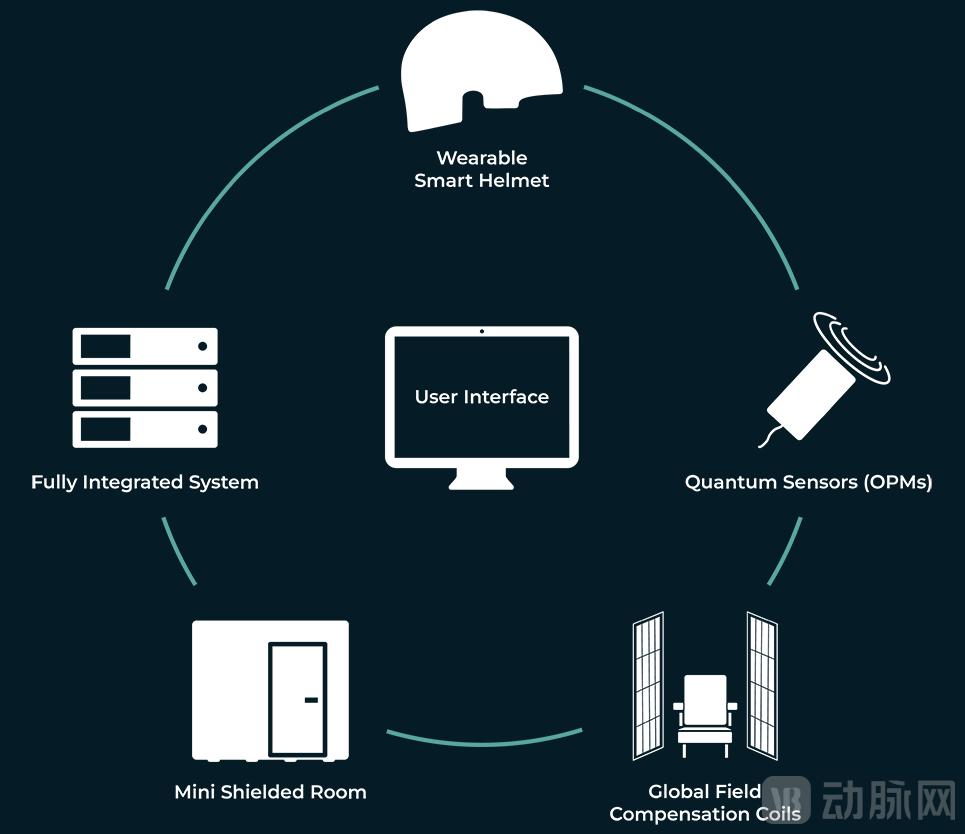
HEDscan System Workflow Diagram Source: FieldLine Official Website
OPM Quantum Sensing: Say Goodbye to Liquid Helium Dependence and Reduce Operational Costs
Traditional SQUID-MEG systems rely on cryogenic temperatures, resulting in annual maintenance costs reaching hundreds of thousands of dollars and further limiting the deployment flexibility of zero-field medical applications. HEDscan’s OPM sensors fundamentally resolve this issue by achieving ultra-high sensitivity magnetic field detection through laser-pumped atoms. These sensors operate stably at room temperature, completely eliminating the need for liquid helium cooling systems and enabling lightweight device design.
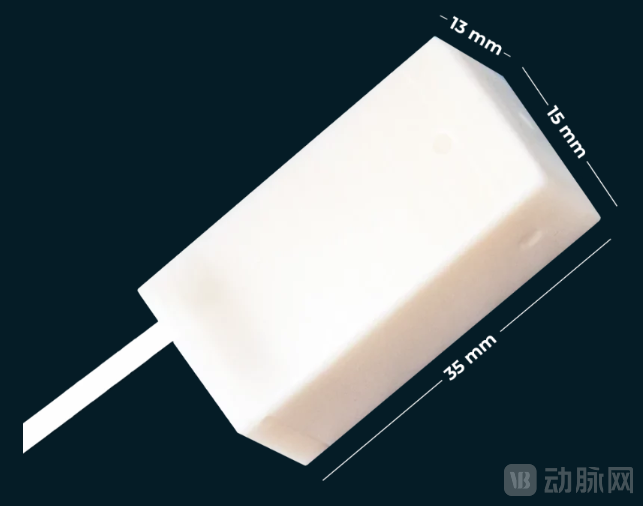
Schematic Diagram of OPM Sensor Source: FieldLine Official Website
The smaller form factor also delivers a significant leap in signal quality. FieldLine’s proprietary OPM sensors, with a volume of less than 7 cm³, can be deployed directly against the scalp, boosting the signal-to-noise ratio (SNR) by 5–10 times compared to traditional SQUID systems.
Its published specifications indicate that the sensor sensitivity reaches < 15 fT/√Hz in the 10–130 Hz frequency band (the core frequency range for EEG signals), with a dynamic range of ±150 nT and inter-sensor crosstalk below 3%. These metrics match the highest international standards for OPM technology, providing technical support for the core requirement of “precisely capturing extremely weak magnetic signals.”
Wearable Helmet: Breaking the Scene Limitations of Static Imaging and Expanding Application Boundaries
The wearable design of the “Smart Helmet” is key to expanding the application boundaries of HEDscan. Traditional MEG helmets, designed to accommodate superconducting sensors, are not only heavy but also have fixed dimensions, making it difficult to cover special populations such as infants and children, and unable to support detection while subjects are in motion.
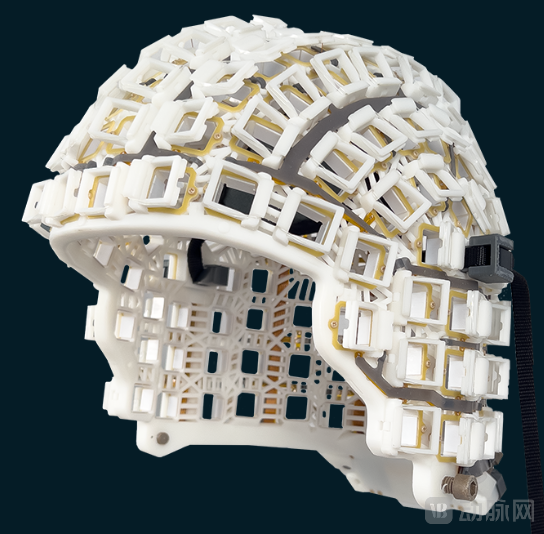
Schematic Diagram of Wearable Helmet Source: FieldLine Official Website
FieldLine's helmet adoptsLightweight and ModularThe design allows for flexible adjustment to accommodate diverse head shapes from infancy through adulthood, enhancing sensor-to-scalp contact and further ensuring the stability of signal acquisition. This flexibility unlocks entirely new research scenarios. In studies of pediatric neurodevelopment, assessments can be conducted without sedation; in the field of brain-computer interfaces (BCI), it supports data collection during dynamic activities such as natural gesture manipulation and walking; and in psychiatric research, it enables the capture of brain activity patterns that more closely reflect real-life conditions.
As stated in the report by the Quantum Economic Development Consortium (QED-C),The wearable nature of OPM technology makes it an ideal tool for pediatric brain research and dynamic neural function analysis., which is precisely the core value reflected in the “diversification of scenarios” for Zero-Magnetic Medicine.
Low Infrastructure Threshold: Eliminating the Need for Dedicated Magnetically Shielded Rooms to Reduce Deployment Costs
Traditional MEG’s reliance on large magnetic shielding rooms (MSRs) drives deployment costs into the millions of dollars, making it affordable only for a select few top-tier hospitals and research institutions. FieldLine has innovatively introduced a “Compact MSR/Tube Shield” solution, designed to suppress environmental magnetic interference through a compact shielding structure. Official technical documentation indicates that this system can be installed in standard rooms within conventional medical facilities, without requiring extensive infrastructure modifications.
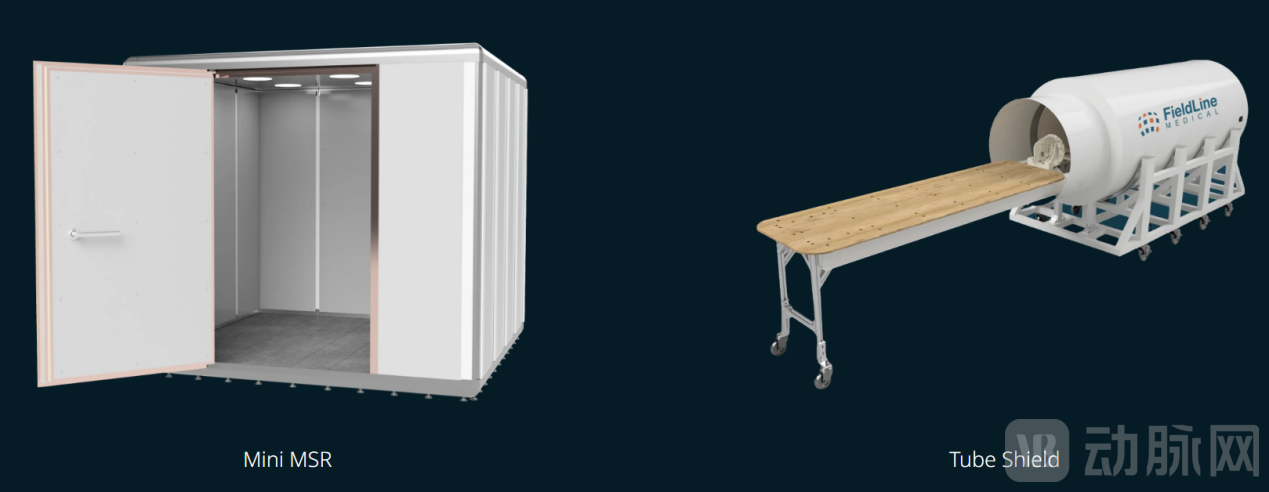
Two Shielding Solutions from FieldLine – Source: FieldLine Official Website
This breakthrough has significantly lowered the barrier to the widespread adoption of MEG technology. According to official data, the HEDscan system costs between $200,000 and $1.5 million, catering to diverse clinical needs. For regional hospitals and university laboratories with limited budgets, this allows for the introduction of high-end magnetoencephalography imaging equipment without requiring extensive infrastructure renovations. From a commercial perspective, this design precisely targets the mid-to-low-end market segment not yet covered by traditional industry giants, thereby establishing a differentiated competitive moat for FieldLine.
3Entering the Clinical and Commercialization Phase: The Next Stage for Zero-Field Medical Technology
FieldLine’s commercialization journey coincides with a critical transition in the magnetoencephalography (MEG) industry, shifting from the “superconducting era,” which relies on liquid helium cooling, to the “OPM era,” based on room-temperature quantum sensors. Currently, companies represented by FieldLine, together with research institutions, are jointly driving the maturation of the zero-field medicine sector. As the core application within this sector, wearable MEG is seeing an increasingly clear path to commercialization, while simultaneously facing practical challenges in clinical validation and large-scale adoption.
From a technical perspective, the continuous maturation of OPM technology has laid a solid foundation for the development of zero-field medicine. In addition to international products such as FieldLine’s HEDscan and the UK-based Cerca’s OPM-MEG, Chinese enterprises have made significant progress in technology translation. For instance, Hangzhou Zero-Field Medical has successfully developed a zero-field cardiac and cerebral imaging system with 128 acquisition channels, which has undergone clinical validation studies at multiple Grade A tertiary hospitals. Furthermore, Unimag Technology’s products have obtained China’s “Innovative Medical Device” certification and entered clinical application.
From the perspective of commercialization progress, both domestic and international enterprises are accelerating the translation of zero-magnetic technology from the laboratory to the bedside; however, the field as a whole remains in a critical transitional phase from scientific validation to large-scale clinical adoption. The development of zero-magnetism medicine in China presents“Platformization” and “Clusterization”Feature—The world’s first zero-magnetic interventional medicine joint laboratory has been unveiled in Shanghai, while regions such as Deqing, Zhejiang are concentrating efforts to build a geomagnetic industry cluster valued at hundreds of billions of yuan, driving the mass production and application of devices like magnetocardiography imaging systems.
From the perspectives of policy and demand, global investment in brain science research continues to increase. The U.S. BRAIN Initiative and China’s 14th Five-Year Plan for Bioeconomy Development explicitly list novel medical imaging technologies as key areas of support, providing sustained backing for fundamental research on zero-field magnetic technology. Meanwhile, the vast market potential for early diagnosis of cardiovascular, cerebrovascular, and neurodegenerative diseases—particularly unmet clinical needs such as non-invasive screening for coronary heart disease and precise localization of pediatric epilepsy—is accelerating the translation of zero-field medical technology from the laboratory to clinical practice.
As OPM technology matures and multinational research initiatives deepen, zero-field medicine is transitioning from conceptual exploration to systematic implementation. From wearable magnetoencephalography to magnetocardiography imaging, and from research platforms to clinical applications, quantum magnetic sensing is becoming a key bridge connecting neuroscience and medical imaging.
In the future, competition in this sector will extend beyond technical performance, hinging instead on who can achieve breakthroughs first in clinical validation, standard-setting, and industrial collaboration.The Next Phase of Zero-Field Medical Technology: From Silent Signals in the Laboratory to Real-World Echoes in Clinical Practice