

120 Million Pets in Urgent Need: What's Hindering the Establishment of Pet Blood Banks?
The recent incident in Guangzhou involving stray cats being bled has drawn widespread public attention. In reality, a gray-market supply chain for pet blood transfusions has long existed. Unscrupulous individuals extract blood from animals known as “blood cats” and “blood dogs” and provide it to other pets for compensation.
As of 2024, the number of pet dogs in urban areas of China exceeded 52 million, while the number of pet cats surpassed 71 million, with these figures continuing to rise. This population of 120 million cats and dogs has generated substantial demand for blood products, including transfusions required for traffic accident injuries, intraoperative use during surgeries, and treatment for conditions such as anemia. However, in reality, most veterinary hospitals lack a stable supply of blood products.
In such circumstances, pet owners either seek volunteers through their social circles or online platforms to donate blood for their pets, or they procure blood of unknown origin through illicit channels. These approaches carry significant safety risks and ethical controversies, and may result in missed optimal treatment windows during emergency transfusion scenarios.
Consequently, professionals in the pet industry have long recognized the necessity of establishing standardized pet blood banks. Why does this sector, which holds significant commercial potential and meets substantial social demand, remain largely undeveloped? What is currently lacking in our efforts to build comprehensive pet blood bank systems? VCBeat has conducted an in-depth investigation into these questions.
Blood sources for pet blood banks are primarily categorized into two types: one is an in-house donor blood bank, which operates on a self-breeding and self-use model; the other is a community-based blood bank, which relies on shared information from veterinary hospitals, pet owners, and related online platforms, forming a regional, localized, and voluntary blood donation system.
Self-built donor programs offer stable blood sources, controllable collection volumes, and high blood safety; however, they entail high fixed costs and exhibit significant economies of scale.The initial investment in pet facility infrastructure, along with subsequent operational and maintenance costs, constitutes a significant fixed expense, requiring a substantial volume of veterinary blood product utilization to achieve a break-even point.
Even in the U.S., a market with a relatively larger scale of pet blood banks, the practice of keeping animals in captivity for blood donation remains highly controversial. Animal welfare advocates consider such captivity “quite inhumane,” with some donor kennels described as “closed colonies.” For instance, Animal Blood Resources International (ABRI), a company specializing in pet blood products and a major supplier in the U.S. Midwest, operates similar donor kennels in California.
According to reports, in the first three quarters of 2024, donor kennels in California produced more than 97% (by sales volume) of the state’s canine blood products, including whole blood, red blood cells, and fresh frozen plasma. However, without blood provided by captive donors, many other pets in urgent need would die from injuries and diseases.
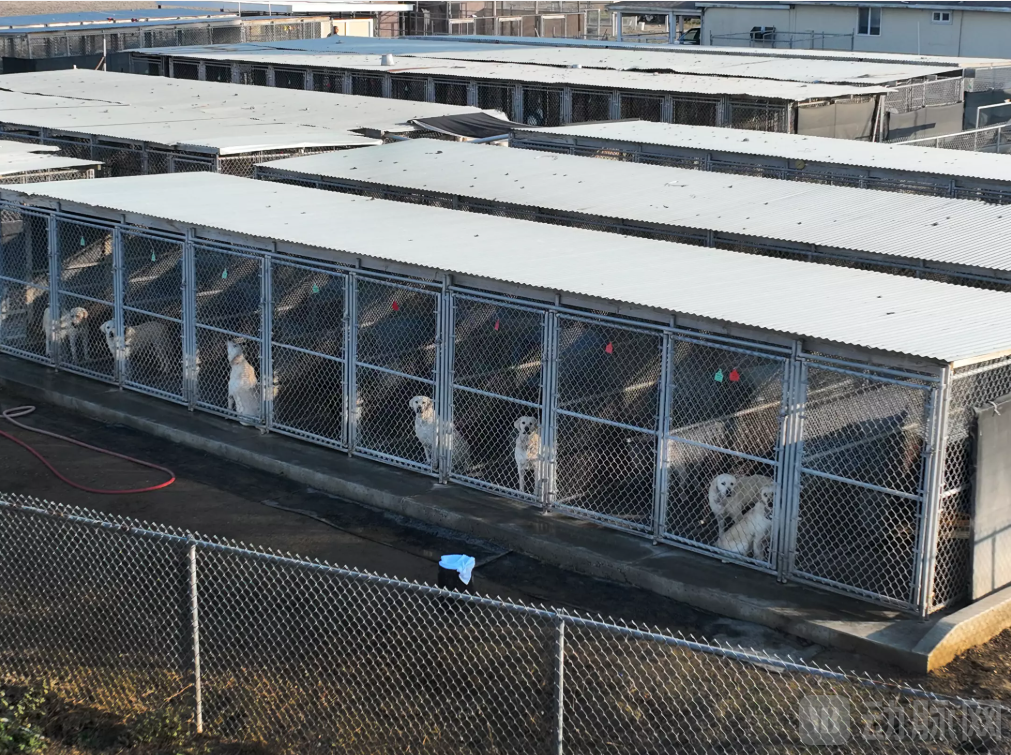
Animal Blood Resources International’s Supplier at a Canine Donation Kennel in California
(Source: Los Angeles Times)
To improve the living conditions of dogs by transitioning them from captivity to free-range environments and upgrading their housing facilities, greater financial investment is required, which further raises the commercial barrier to entry.
In addition to the capital-intensive self-built model, there is also an asset-light, community-based “blood donation” system. Under the community-based model, veterinary clinics or pet owners post information on a platform; after supply-demand matching and screening for blood type and infectious diseases, a match can be completed.
Community-based models rely less on capital investment but suffer from unstable blood supply. More importantly, unlike the voluntary unpaid blood donation model in humans, pets cannot autonomously decide to “donate blood”; decisions must be made by their owners on their behalf, thusPet owners must bear a certain degree of moral hazard.: namely, selling pet blood for profit.
Certainly, a hybrid approach combining self-established facilities and platform-based models can also be adopted to address the issue of donor sourcing. However, regardless of the model chosen, a balance must ultimately be struck between commercial interests and social ethics. The challenge of securing donor sources has become a major hurdle on the path toward the commercialization of pet blood banks.
The second major challenge facing the commercialization of pet blood banks is the complexity of the blood utilization process, which requires meticulous operational management across the entire chain from donor to recipient.
Feline blood types are primarily categorized into three groups: Type A, Type B, and Type AB. Canine blood types are relatively complex; the DEA (Dog Erythrocyte Antigen) system, established based on antigen types on red blood cells, identifies 13 distinct blood types. Among cats, Type A is the most prevalent, while Type AB is extremely rare. Notably, no universal donor equivalent to human Type O blood has been identified in cats. Although dogs have numerous blood types, DEA 1.1-negative blood serves as a "universal donor" type. Approximately 20% of dogs possess naturally occurring alloantibodies, meaning hemolytic transfusion reactions can occur even with the first transfusion. In contrast, most dogs do not naturally carry antibodies against other blood types; these antibodies typically develop after transfusion. Consequently, the risk associated with the first transfusion is relatively low, but strict cross-matching remains essential for subsequent transfusions.
If the approach of establishing an in-house donor supply is adopted,Which breeds of cats and dogs should be selected as blood donors, and what ratio of different blood types is required to minimize wastage while meeting therapeutic needs? Achieving this requires precise management.。
From the perspective of the blood collection phase,Pets exhibit lower compliance than humans.This necessitates a higher level of technical proficiency from phlebotomists. The blood collection needles, blood bags, and anticoagulants used for pets differ from those used in humans. Pets have small blood vessels and limited volumes of extractable blood; however, there is a lack of specially designed needles and small-volume blood bags on the market. Furthermore, factors such as blood coagulation rate and platelet count in pets differ from those in humans. Consequently, human-grade anticoagulants and preservation solutions cannot be adopted outright, and their formulation ratios must be adjusted accordingly.Currently, the vast majority of such products on the market are designed for human blood collection, while supplies for pet blood collection are scarce.
Collected pet blood must undergo testing and quarantine procedures. The most critical aspect of testing is blood typing to prevent hemolytic reactions, while quarantine aims to eliminate the risk of infectious diseases. Following these processes, the pet blood is further processed into whole blood or component blood products.
Whole blood contains all blood components, namely red blood cells, white blood cells, platelets, and plasma. It is currently mostly used in cases of severe anemia in pets or when there is a simultaneous reduction in multiple blood components. Component blood therapy involves separating blood into different parts, such as plasma, red blood cells, and platelets, allowing for precise supplementation based on the specific component deficient in the pet.Converting whole blood into component blood requires corresponding separation and filtration equipment.
Whether it is whole blood or component blood, cold-chain distribution is required for transportation from the manufacturing facility to medical institutions. Regarding blood storage, human blood can be stored for up to 35 days in anticoagulant preservative solutions such as CPDA-1 at 2°C–6°C; canine blood under the same conditions can typically be stored for 20–35 days. In contrast, feline blood exhibits relatively poorer storage stability due to the shorter lifespan and greater fragility of red blood cells. Additionally, cats’ smaller body size and lower blood volume make component separation more challenging.
Currently in China, every city has a dedicated human blood center. These are public-interest institutions funded by local government budgets, responsible for local donor recruitment, blood collection and processing, and the supply of blood for clinical use. Consequently, the cold-chain transportation radius for human blood and related products is relatively short. In contrast, the domestic pet blood sector lacks organizations analogous to human blood centers, necessitating commercial pet blood banks to assume these functions. However, commercial entities have limited capabilities in their early stages. To achieve economies of scale, they often adopt a centralized production model, distributing products to veterinary medical institutions across various regions via cold-chain logistics, which significantly extends the transportation radius. To meet the storage requirements for pet blood, it is essential to develop cold-chain equipment capable of ensuring stable, continuous temperature control 24 hours a day.Pet blood banks have higher requirements for cold chain equipment.
The delivery of pet blood to the veterinary hospital does not mean that the job is done; the pet blood bank also needs toAssist veterinary hospitals in the proper storage and use of blood products. Within the human healthcare system, hospitals typically establish a Department of Transfusion Medicine responsible for the storage, testing, compatibility matching, and distribution of blood and blood products. This ensures rational resource allocation, prioritized release of blood based on urgency, and the safety of patients' blood transfusions.
However, such infrastructure is lacking in veterinary hospitals. Therefore, it is essential to strengthen veterinarian training to foster appropriate awareness of blood product utilization. Simultaneously, real-time monitoring of blood product usage should be implemented to align supply with demand, thereby meeting the needs of veterinary hospitals while preventing the idling or wastage of this precious resource.
It is evident that the entire chain, from donor to recipient, requires meticulous management and operations to be realized. Currently, basic supplies of pet food, pharmaceuticals, vaccines, and other products are largely secured; however, there remains no adequate solution for the critical shortage of blood. Fundamentally, veterinary blood transfusion systems and human blood transfusion systems are entirely distinct entities.Pet food, pharmaceuticals, and vaccines can largely be developed using resources similar to those used for human products., thereby completing the entire commercial chain from production and transportation to sales. However,Pet blood supply has followed a completely different path from the human blood supply system right from the outset., while experience can be drawn upon, resources are difficult to share.This makes the establishment of pet blood banks particularly challenging.
“Technical issues account for only 30% of all the challenges hindering the establishment of standardized blood banks in the pet industry,” Dr. Yu Qiwen, Founder and CEO of Guochong | Advanced Science and Guochong | Blood Technology, told VCBeat.
Currently, relevant national authorities have not enacted specific administrative regulations or mandatory national standards for “companion animal blood transfusion.” However, there is a pressing clinical demand, which has created space for the emergence of a gray market in pet blood products. This situation has drawn widespread criticism from animal welfare organizations and pet owners alike.
On July 29, the proposed recommended national standard “Technical Specifications for Clinical Blood Transfusion in Dogs and Cats,” organized by the National Technical Committee on Standardization of Companion Animals (Pets) and led by the Gannan Institute of Innovation and Translational Medicine, passed the project establishment review. Guochong | Blood Technology is one of the main drafting units for this standard. This specification is expected to become China’s first national standard for clinical blood transfusion in pets, filling a gap in the field of safe blood use.
The establishment of standards for pet blood transfusion is merely one component. Dr. Yu Qiwen believes that a comprehensive veterinary transfusion medicine system should encompass at least four major systems: 1) Group standards, and even national standards, covering multiple dimensions such as donor sourcing, blood collection, preservation, transportation, component separation, and clinical application; 2) Drawing on the definitions used for laboratory animals in human medicine, creating a distinct category specifically for donor/bleeding animals and formulating corresponding ethical and welfare guidelines; 3) Establishing standardized blood banks for donor/bleeding animals in accordance with their specific ethical and welfare requirements; 4) Developing detailed rules and regulations for veterinary medical institutions, covering blood testing and quarantine, storage, usage, and traceability. This will be a systematic engineering project requiring multi-party collaboration, including guidance from regulatory authorities, support from research institutions, participation from commercial companies, and oversight by public opinion.
Some commentators argue that current veterinary transfusion medicine is only at a stage comparable to human blood application 50 years ago, leaving substantial room for improvement. Establishing compliant and professional pet blood banks to centrally manage blood collection, testing, storage, cross-matching, distribution, and administration would ensure the quality and safety of pet blood products. This approach not only realizes commercial value but also meets societal ethical requirements.
However, establishing a comprehensive pet blood transfusion system requires considerable time and joint efforts from industry participants and regulatory authorities. Precisely because of the high difficulty and lengthy timeline involved, early movers can gradually accumulate advantages and build unique commercial barriers.