

China Issues Strict Guidelines on Doctors' Online Health Promotion: Ten Prohibited Behaviors Defined
Can Doctors No Longer Provide Health Education Online? Has Doctor-Led Product Promotion Completely “Gone Cold”?
With the National Health Commission releasing the “List of Negative Behaviors for Internet-Based Health Science Popularization by Medical Personnel (Trial)” (hereinafter referred to as the “Negative List”) on November 7, a wave of discussion has swept through the industry.
Social networks have become the primary channel for the public to access information, with health science popularization emerging as a significant component of this vast information landscape. Empowered by technologies such as big data and AI algorithms, user tags and profiles are becoming increasingly distinct, enabling health-related educational content to reach targeted interested users more precisely and consistently. However, irregularities such as promoting products or advertising under the guise of health education, as well as the illicit disclosure of medical information, occur frequently and have been repeatedly exposed by mainstream media. In certain contexts, the term “internet-famous doctors” has even acquired a pejorative connotation.
Previously, regulatory documents have been issued by various levels of authorities to standardize health and medical science popularization conducted by self-media platforms.The “Negative List” has, for the first time nationwide, clearly defined ten “no-go zones” for online health science popularization, further delineating the boundaries for the production of such content.
Currently,Health science popularization is no longer merely a one-way dissemination of information to patients; rather, it has become an integral component of the healthcare industry ecosystem, warranting heightened attention to compliance from all relevant stakeholders.
Since 2025, policies regulating online health science popularization have been issued intensively.
Following the July 2025 press conference in which “internet-famous doctors” were explicitly named, the National Health Commission has recently issued the *Negative Behavior List for Medical Personnel’s Online Health Science Popularization (Trial)*. The document stipulates ten prohibited activities, mandates that medical institutions establish and improve a registration system for online health science popularization accounts, and requires local health administrative departments to strengthen regulatory oversight.
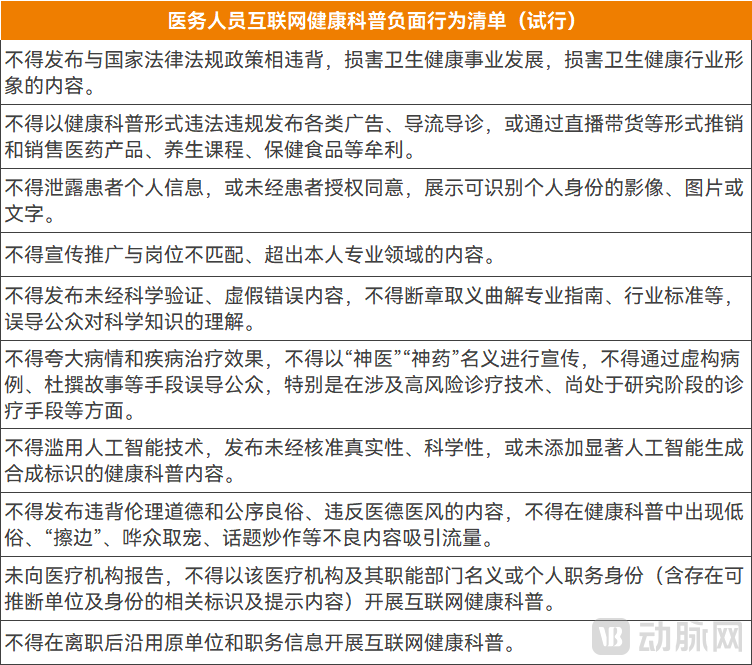
Negative Behavior List for Healthcare Professionals in Online Health Science Popularization (Trial), Source: Official Website of the National Health Commission
From March to May 2025, several provinces and municipalities also issued corresponding documents, such as Shanghai’s “Negative Behavior List for Internet Health Science Popularization (Trial),” Heilongjiang Province’s “Ten Prohibitions on the Publication and Dissemination of Health Science Knowledge (Trial),” and Sichuan Province’s “Negative Behavior List for Internet Health Science Popularization (Trial).”
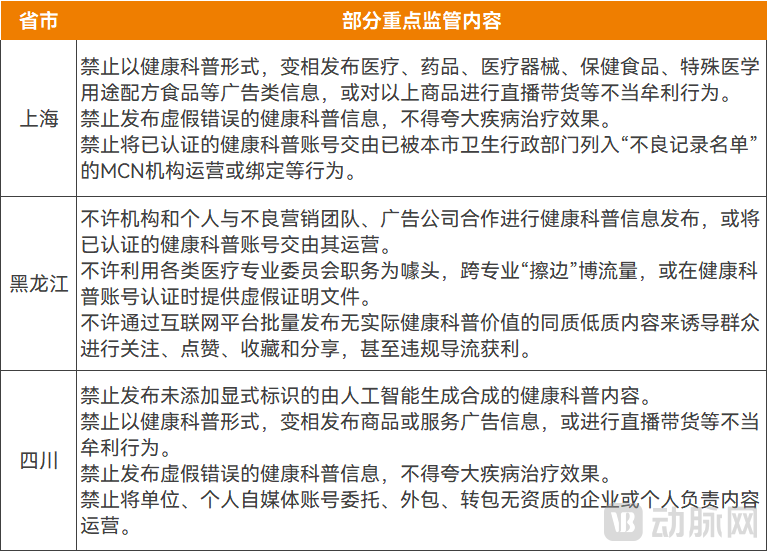
“Negative Lists” Formulated by Certain Provinces and Municipalities, Source: Official Websites of Provincial and Municipal Health Commissions
Furthermore, in August 2025, the Secretariat of the Office of the Central Cyberspace Affairs Commission, the General Office of the National Health Commission, and two other departments jointly formulated the “Notice on Regulating Medical Science Popularization Activities by ‘Self-Media’.” This notice imposes numerous requirements on online platforms, including conducting classified verification and certification of account qualifications, clearly displaying account qualification information, strictly citing sources for medical science popularization content, diligently performing qualification verification, prohibiting unqualified accounts from producing and publishing professional medical science popularization content, and forbidding the disguised publication of advertisements in violation of regulations.
Overall, the regulation of internet-based health science popularization primarily focuses on several key areas:
First, strictly regulate illicit profit-seeking activities and clearly delineate the boundary between science popularization and commercial operations.At the national level, it is explicitly prohibited to publish advertisements, divert traffic for patient referral, or promote pharmaceutical products through live-streaming e-commerce under the guise of science popularization. Local policies have further refined these regulations: Shanghai and Sichuan strictly prohibit disguised advertising and profit-making through live-streaming e-commerce, while Heilongjiang has implemented specific restrictions on the mass publication of low-quality content for traffic diversion and profit.
Secondly, it is required to uphold the authenticity of content and adhere to professional standards, which are based on principles such as no fabrication, no exaggeration, and no engagement in borderline or suggestive practices.These requirements ensure that health science popularization is grounded in professional knowledge and scientific evidence, thereby maintaining public trust in medical information.
At the same time, these documents collectively define the scope of responsibilities for multiple stakeholders and establish a closed-loop system of mutual checks and balances.
The production and dissemination of health science popularization content are not necessarily carried out independently by medical professionals; they may involve multiple stakeholders, including physicians, healthcare institutions, multi-channel network (MCN) agencies, and online platforms. Following the release of this “Negative List,” regulatory policies have more comprehensively clarified the responsibilities and red lines for all aforementioned parties:Physicians must adhere to professional boundaries and ethical baselines; MCN agencies are prohibited from engaging in non-compliant operational activities; medical institutions must fulfill their managerial responsibilities toward healthcare personnel; and platforms must conduct rigorous qualification reviews and content moderation. The responsibilities of all parties are interconnected and involve layered oversight, thereby achieving full-chain coverage in the regulation of online health science popularization.
It is important to emphasize that as generative AI and large language models permeate various industries, the application boundaries of AI technology in health science popularization have also become a key focus of regulatory oversight.
National-level policies, along with those in Sichuan and other regions, explicitly mandate that AI-generated health science popularization content must bear explicit labels and undergo verification for authenticity and scientific accuracy before publication. This requirement directly addresses the risks of AI technology misuse, preventing issues such as false or misleading information and professional deviations arising from the lack of human review. While not prohibiting the reasonable application of AI technology, regulatory measures safeguard the public’s right to know through labeling obligations and uphold professional standards through scientific verification. This approach both adapts to technological development trends and prevents chaos in science popularization caused by new technologies, thereby establishing clear boundaries for the standardized use of AI in the field of health science communication.
Currently, online health science communication is indeed experiencing unprecedented prosperity; precisely for this reason, non-standardized popular science content is more likely to cause significant negative impacts.
However,Health popularization is no longer merely about information dissemination, nor does it only influence the general public; its value has long permeated the entire healthcare industry. Across the healthcare industry chain, multiple stakeholders are closely intertwined with the health popularization ecosystem.
First, online science popularization has become an important component of digital marketing.
In the past, digital marketing primarily targeted physicians with a focus on prescription drugs. However, as social networks have become indispensable channels for public information and communication methods have diversified to include graphics, short videos, and podcasts, the scope of digital marketing has gradually expanded. Currently, consumer-facing (C-end) digital marketing, centered on over-the-counter (OTC) medications and home-use medical devices, has become a vital component of the pharmaceutical and medical device commercial ecosystem. Many pharmaceutical and medical device companies, online pharmacies, and internet healthcare platforms are engaging in digital marketing initiatives anchored by health science popularization.
Across all domains, professional medical knowledge and health science communication serve as the core link. Given the high professional barriers associated with pharmaceutical products, health science communication translates obscure medical knowledge into accessible content, effectively mitigating information asymmetry. Meanwhile, for diseases with low public awareness or newly launched products, complex disease-related information can be precisely conveyed to target populations through engaging formats such as short videos, comics, and interactive case studies, thereby educating the intended audience.
Second, AI, as an auxiliary tool, is playing an increasingly important role in physicians’ work, including serving as a tool for producing science popularization content.
The more diverse the formats of health science communication become, the greater the human and material resources required, while content creativity remains uncertain. AI tools can assist in copywriting, video editing, and other tasks, thereby shortening the production cycle for science communication content. As previously mentioned, medical knowledge is highly specialized; AI can transform it into various stylistic expressions, even aligning with physicians’ personas and habits to create more distinctly positioned intellectual property (IP). To enhance the efficiency and quality of science communication content production, some multi-channel networks (MCNs), internet healthcare platforms, and physician platforms have provided doctors with AI tools.
Meanwhile, AI doctor avatars and virtual AI physician technologies have advanced rapidly over the past two years, transitioning from proof-of-concept to real-world implementation. They have become key entry points on internet health platforms for promptly addressing user needs. The health advice provided by AI doctors during interactions with users can also be regarded as popular science information.
Third, with the rapid development of internet-based medical services, the integration of online and offline services provided by both physicians and healthcare institutions has become increasingly deep, making it inevitable that popular science content will generate indirect “patient guidance and referral” effects.
A core objective for physicians and medical institutions in conducting online health education is to enhance their influence, with the long-term outcome being the attraction of precisely matched patient populations. From the perspective of industry development logic, this “patient guidance and traffic diversion” driven by health education is inevitable. For medical institutions or specialties that have experienced suboptimal consultation volumes in recent years, online health education has become a crucial channel for patient acquisition.
Taking the maternal and child health sector as an example, against the backdrop of a continuously declining birth rate, even public maternal and child health hospitals are more actively adapting to communication trends by strategically deploying popular science content and conducting live-streamed interactions on platforms such as Xiaohongshu (Little Red Book). Such communication, which targets a highly specific audience, inevitably produces a "patient guidance and traffic diversion" effect, even if its original intention is to disseminate medical knowledge.
Therefore,Compliance in online health science popularization concerns not only direct participants such as physicians, medical institutions, MCN agencies, and online platforms, but is also closely related to industry entities including internet healthcare platforms, e-commerce platforms, and pharmaceutical and medical device companies. All relevant parties must avoid pitfalls in practice, standardize their involvement in the production of science popularization content, and strictly refrain from crossing policy red lines.
It is worth emphasizing that,The release of the “Negative List” does not mean that online health science popularization is prohibited, nor does it imply that such activities are subject to significant restrictions. On the contrary, various competent authorities continue to encourage medical professionals to leverage the convenience of internet platforms to make authoritative and professional medical knowledge accessible to a broader audience. This fundamental principle remains unchanged.
“Notice on Issuing the List of Negative Behaviors for Internet-based Health Science Popularization by Medical Personnel (Trial)” not only establishes clear red lines but also emphasizes the need to encourage and support medical personnel in conducting standardized online and offline health science popularization. This should be done through various accessible and engaging formats to provide the public with scientific and accurate health information and knowledge.
However, from a practical standpoint, the current demand for health science popularization can no longer be met by a single poster that is mass-produced and widely posted.In the current communication landscape, producing high-quality online health science content demands greater effort and higher costs, while also reflecting the years of knowledge accumulation and continuous updating by medical professionals.Investment implies an expectation of returns. Who pays for popular science content, and how do they pay?These issues constitute the root cause of the chaos in science popularization and are also the key to resolving it.
Therefore, in addition to policy-level regulations, industry stakeholders directly or indirectly involved in internet-based health science popularization must clarify the key issues and explore more sustainable business models within a compliant framework. The consensus that all parties should establish is:The foundational value of health science popularization lies in professionalism and trust. Only by abandoning short-term metrics driven by traffic and sales conversion, and by establishing a virtuous cycle between professional content and user trust, can we solidify the foundations for the industry’s long-term development.