

Despite Investor Skepticism, Shanghai-Based Professor-Led Startups Raise Over ¥6.8 Billion
Recently, multiple investors have stated that they will no longer invest in startups founded by professors.
In contrast, data released in the “2024 White Paper on the Transformation of Scientific and Technological Achievements in Shanghai” shows that in 2024, researchers in Shanghai founded 153 startups, with these related companies securing a total of over RMB 6.8 billion in financing. Beyond researchers in Shanghai, a large number of companies founded by researchers across China are also accelerating their fundraising efforts and achieving steady growth.
Investment enthusiasm has cooled, yet the commercialization of scientific achievements remains hot. Amid this contradiction, what trends will emerge in professor-led startups? Why are investors pulling back from backing professors’ entrepreneurial ventures? What types of research commercialization projects can gain investor recognition and successfully navigate the “valley of death” in entrepreneurship?
“The value of the saying ‘Investing is investing in people’ continues to rise.”
Some investors have stated that they will not invest in startups founded by professors, primarily because previous investments in professor-led ventures failed due to personal factors: some professors wavered mid-way and chose to return to academia to focus on research; others pursued entrepreneurship on a part-time basis, prioritizing teaching and becoming absent during critical stages of corporate development such as fundraising and negotiations, thereby slowing project progress; still others focused solely on technological innovation while neglecting market logic and the realities of industrial competition, making it difficult to meet the requirements for commercial implementation.
However, this is not an inherent problem among professors or researchers. In 2021, investors collectively flocked to universities to “poach” professors and encourage them to start businesses, leading to the establishment of many ventures under passive pressure. In such circumstances, the failure of these startups is closely linked to their original motive of “forced entrepreneurship.” Moreover, entrepreneurship is inherently a high-risk endeavor with slim odds of survival, and very few companies successfully navigate the “valley of death” in the startup journey.
Despite the high failure rate among researcher-founded startups, a significant number of healthcare enterprises established by scientists continue to secure funding and deliver strong market performance.According to incomplete statistics from VCBeat, more than ten healthcare companies founded by researchers (professors) in Shanghai alone secured financing in 2025. Companies such as Atac, Baiquan Biology, Xueji Biology, Boda Medical, Niantong Intelligence, and Tianjia Biology all completed new rounds of financing in 2025.
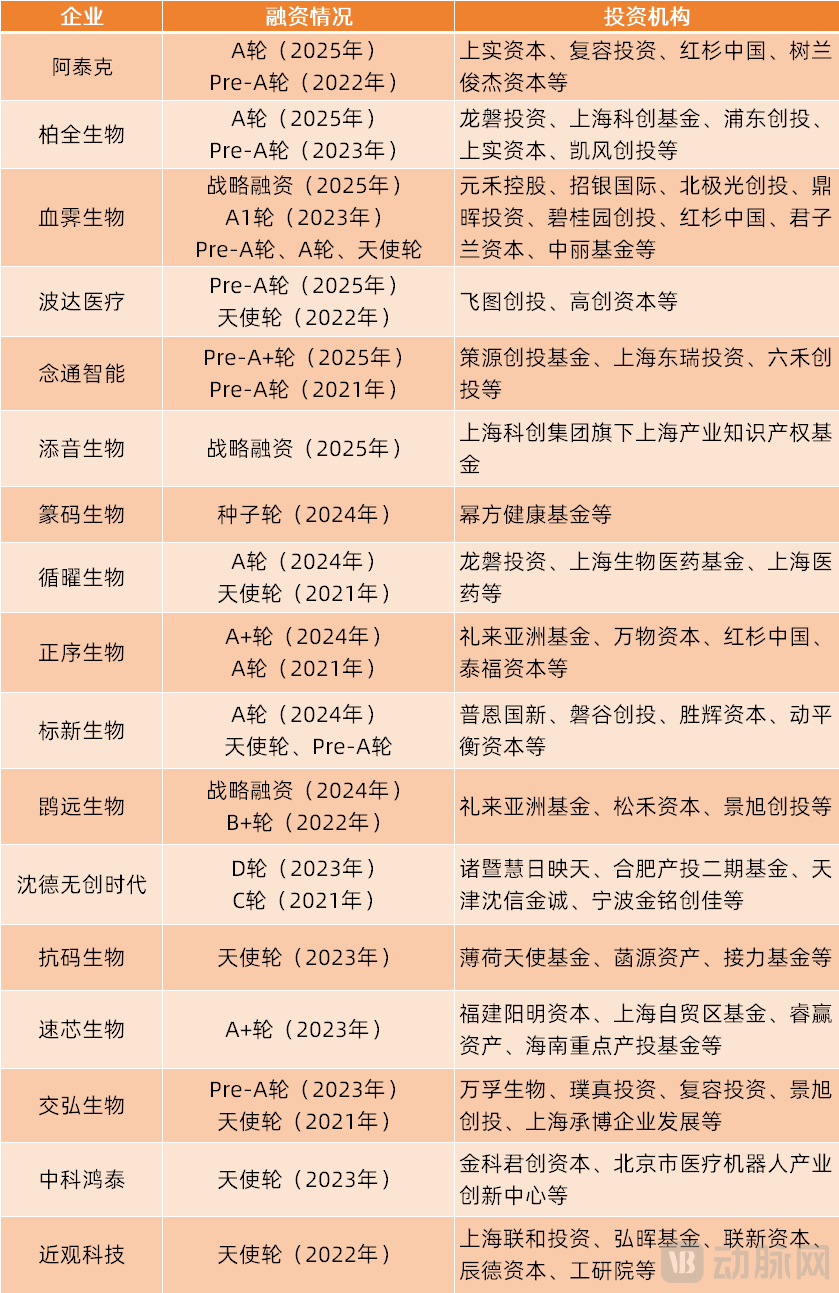
(Researcher-led startups that have completed financing rounds; incomplete statistics by VCBeat)
Similar to the common issues observed among professors whose startups failed, the companies founded by professors who have successfully secured financing also exhibit distinct common characteristics in their founders and core teams.
First, founders with entrepreneurial experience or experience in technology transfer are more likely to gain investor recognition.Dr. Zhu Fangfang, founder of Xueji Biologics, previously worked at the renowned venture capital firm WI Harper Group, where she was responsible for investments in the healthcare sector. She not only invested in numerous early-stage startups but also oversaw their post-investment management. Dr. Zhu stated, “Through this vantage point, I closely observed the successes and failures of many startups and gained valuable insights into industrialization.”
In 2020, Dr. Zhu Fangfang was appointed as an Associate Professor at the School of Biomedical Engineering, Shanghai Jiao Tong University, and founded Xueji Bio in 2021. As the third company globally and the first in China to focus on platelet regeneration through cell therapy, Xueji Bio is dedicated to inducing stem cells to differentiate into platelets in vitro, a breakthrough that may spark the second transfusion revolution.
Guided by Dr. Zhu Fangfang’s expertise in commercialization, Xueji Biotechnology has strategically positioned itself across multiple disease areas and sectors, including transfusion medicine, oncology, platelet disorders, sports medicine, medical aesthetics, and anti-aging. With promising market opportunities, technological maturity, and strong growth prospects, the company’s fundraising efforts have proceeded naturally: between 2021 and 2025, Xueji Biotechnology completed five rounds of financing, backed by prominent investment firms such as Oriza Holdings, CMB International, Northern Light Venture Capital, CDH Investments, and Sequoia China.
To date, Xueji Biotech’s Investigational New Drug (IND) application for its “Megakaryocyte Injection” has been approved by both China’s Center for Drug Evaluation (CDE) and the U.S. Food and Drug Administration (FDA). Furthermore, XJ-MK-002, the world’s first platelet-related cellular therapy, and XJ-PLT-001, the world’s first platelet injection cellular therapy, have each been granted Orphan Drug Designation by the FDA. Notably, XJ-MK-002 has completed its first patient dosing.
It is not only Dr. Zhu Fangfang who possesses such background; Dr. Yang Xiaobao, founder of Biaoxin Biology, and Dr. Xu Fei, founder of Jikang Biology, also had industrialization experience prior to launching their ventures. For instance, Dr. Yang Xiaobao accumulated five years of commercialization experience at pharmaceutical companies such as the Shanghai R&D Center of GlaxoSmithKline (GSK) and Shanghai Dongyue Pharmaceutical. Dr. Xu Fei participated in founding RayBiotech, a GPCR-focused large-molecule biopharmaceutical company, in 2011.
Leveraging the industrial experience and resource accumulation built up by its founders over many years, Biaoxin Biology has successfully completed three rounds of financing. Although Jikang Biology has not secured any financing, it has entered into a strategic preclinical pipeline collaboration agreement with the U.S.-listed company BioAge. Under this agreement, BioAge obtains an exclusive option to license Jikang Biology’s novel APJ agonist antibody. In return, Jikang Biology receives upfront payments and R&D funding, and is eligible for option exercise fees, as well as further development, regulatory, and sales milestone payments and royalties.
Industry analyst Zhang Yang stated, “Compared to research-oriented entrepreneurs without industry experience, this group of entrepreneurs possesses a deeper understanding of the market and commercialization, as well as more flexible responses when facing difficulties. This is also one of the important reasons why these founders are more recognized by investors.”
Second, founding teams jointly established by top scientists and seasoned industry professionals are more likely to attract investor attention.For instance, companies that have completed multiple rounds of financing, such as Boquan Biotechnology, Dage Biotechnology, Shaonao Technology, Kunyuan Biotechnology, Zhengxu Biotechnology, and Zhuanma Biotechnology, all have their core teams configured in this manner.
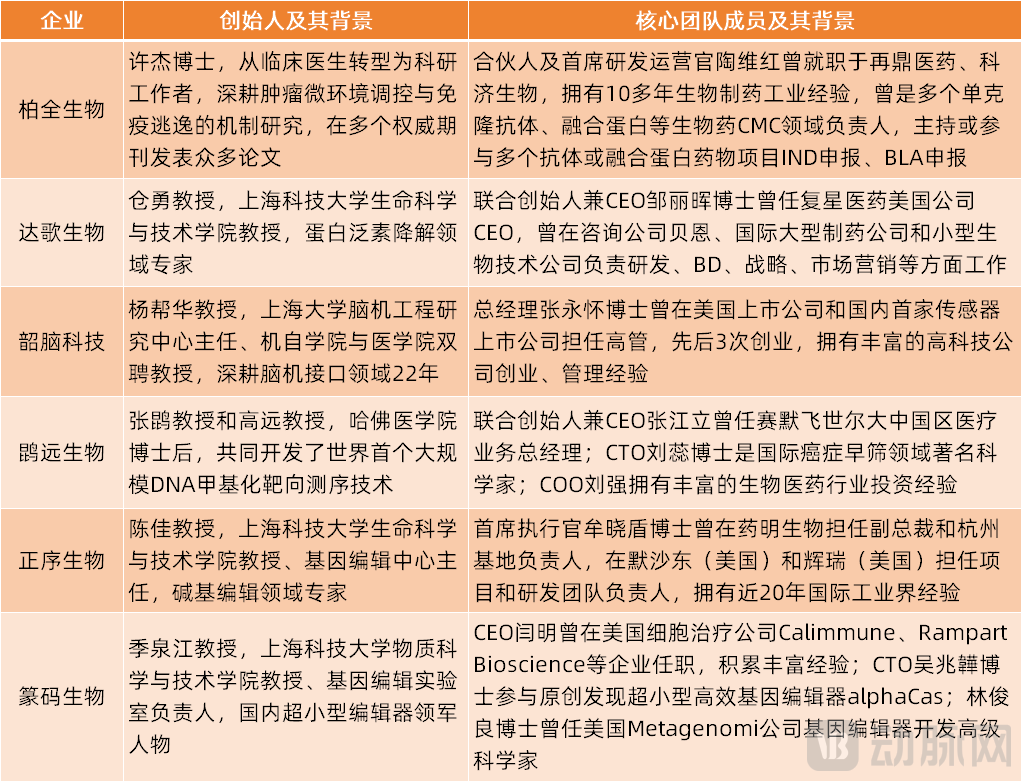
(Founding Teams of Enterprises Established by Some Professors)
Among them, Professor Chen Jia, founder of Zhengxu Bio, is a professor at ShanghaiTech University and Director of the Center for Gene Editing. He specializes in base editing, DNA repair mechanisms, and cancer biology, with multiple research findings published in internationally renowned academic journals such as Nature Biotechnology and Nature Cell Biology. Although he is the founder, Professor Chen primarily focuses on laboratory research, while company management is entrusted to a professional team.
Zhengxu Bio’s management team includes industry veterans such as Dr. Mou Xiaodun and Dr. Li Bin. As Chief Executive Officer of Zhengxu Bio, Dr. Mou Xiaodun previously held senior executive positions at renowned pharmaceutical companies including WuXi Biologics, Merck & Co. (USA), and Pfizer (USA), bringing nearly 20 years of industry experience. Dr. Li Bin has served at multinational pharmaceutical corporations such as Roche, Pfizer, Abbott, AbbVie, and Eli Lilly, accumulating over 30 years of experience in the biopharmaceutical sector, with expertise spanning drug research and development, business development, and venture capital.
Driven by the founder’s technological breakthroughs and a specialized team, Zhengxu Bio has completed three rounds of financing and maintains ample capital. Business development has also progressed smoothly: its lead pipeline candidate, CS-101, has freed multiple patients with β-thalassemia from transfusion dependence and is currently in the Investigational New Drug (IND) clinical trial phase; the first patient treated with its base-editing drug, CS-121 injection, has completed dosing and was successfully discharged, marking the world’s first case of treating hyperlipidemia through targeted base editing of the APOC3 gene.
In the investment arena, the combination of “scientists + seasoned industry professionals + capital” is regarded as a premier configuration and is highly favored by investment institutions. This insight stems from years of investor experience: not every scientist is suited for entrepreneurship. Scientists primarily engage in creative work, whereas industry professionals place greater emphasis on the practical application of innovative technologies. They can assist scientists in market analysis, navigating clinical challenges, resource integration, and corporate operations.
Previously, a management team without a background in the pharmaceutical industry incubated and established a company based on a professor’s scientific achievements, committing itself to “source innovation” in new drugs for Alzheimer’s disease. However, possibly due to an insufficient understanding of the unique characteristics of the pharmaceutical sector, its pipeline progressed rather slowly, and the multi-pipeline strategy required substantial capital investment. The company failed to secure funding from institutional investors. As cash flow dried up, the company gradually ground to a halt. This negative case further underscores the value of seasoned industry professionals.
It is worth noting that in China, forming a team combining “scientists and senior industry professionals” is no easy task. The primary reason is that entrepreneurial co-founders are a scarce resource; such individuals are few in number, and the vast majority already hold high-ranking positions and command substantial salaries in the industry. Persuading them to endure the hardships of entrepreneurship once again is extremely difficult. Furthermore, this endeavor involves a series of challenges, including project attractiveness, equity allocation, and team structure.
Third, top-tier scientists with exceptional innovation capabilities and globally pioneering research achievements are also more likely to attract the favor of investment institutions.Companies such as Artac, Baiquan Biotech, and Xunyao Biotech have secured multiple rounds of financing by leveraging their globally first-in-class innovations.
Taking Atek as an example, the company is a globally pioneering innovative platform for the development of next-generation novel protein-degrading drugs. Its core technology is derived from the protein autophagy degradation technique published by Fudan University in the main edition of Nature in 2019 (ATTEC),The technique was ranked among the journal’s top ten global papers of the year.。
Benefiting from its globally pioneering technology, ATTEC established partnerships with global pharmaceutical giants from its inception. Its pipeline of therapeutics for neurodegenerative diseases, developed on the ATTEC-based protein degradation drug discovery platform, has gained recognition from this pharmaceutical company, demonstrating global competitiveness in original innovation.
Meanwhile, Aiteke has also built a pipeline of in-house developed investigational products in the fields of neurodegenerative diseases and oncology. Currently, Aiteke has advanced its globally competitive projects to the preclinical candidate (PCC) selection stage. Its lead candidate, ATCN1001, has demonstrated robust target degradation efficiency in in vivo validation studies, holding promise as a breakthrough innovative therapy for Parkinson’s disease.
Possibly driven by technological breakthroughs and clinical progress, Ataike completed tens of millions of yuan in Series A financing in August 2025, with joint investment from Shanghai Industrial Capital and Sanfu Fund. The funds will be used to advance drug development and preclinical studies of molecular glue degraders targeting pathogenic proteins in neurodegenerative diseases, identified through the ATTEC technology platform.
Fourth, professor-entrepreneurs who demonstrate the courage to burn their bridges are more likely to impress investors.In the past, many investors suffered losses by backing professors who lacked genuine entrepreneurial commitment: some professors embarked on startups with a “safety-net” mindset—“If it doesn’t work out, I’ll just return to academia and continue as a professor.” However, entrepreneurs who keep such fallback options often find it harder to persevere in the face of difficulties and setbacks.
Drawing on past experience, investors now have higher expectations for professors who take the initiative to start businesses and demonstrate a genuine entrepreneurial spirit. Boda Medical, which recently secured financing, serves as a typical case in point. In 2022, Xu Kailiang established Boda Medical by leveraging the technology transfer achievements of Fudan University, focusing on core technologies such as ultrafast ultrasound imaging and super-resolution ultrasound imaging. At the outset, Xu conducted countless roadshows and met with numerous investors, only to receive consistent feedback that “professors who do not commit to entrepreneurship full-time will not succeed.”
In response to such skepticism, Xu Kailiang chose to stake his academic achievements and personal fortune, demonstrating his entrepreneurial resolve through mechanisms such as valuation adjustment agreements (VAMs). Perhaps impressed by Xu’s persistence and boldness, Fitu Capital invested in Boda Medical at a valuation of nearly RMB 100 million. Boda Medical’s development has not disappointed investors: under Xu’s full commitment, the company’s independently developed first domestically produced functional ultrasound imaging system was launched for commercial sales in December 2023; additionally, it collaborated with Huashan Hospital, a leading medical institution in neurosurgery, to co-develop an ultrafast ultrasound cerebrovascular imaging device, supporting clinical research related to human brain ultrasound imaging.
Perhaps driven by Boda Medical’s rapid growth, the company secured another round of financing in July 2025, with investment from Gaochuang Capital, a subsidiary of Haijian Group.
Overall, having weathered the previous wave of enthusiasm for commercializing scientific research, investment institutions have learned from their mistakes. They no longer blindly revere the “professor halo,” but instead focus more on the substantive strengths and entrepreneurial mindset of founders and their founding teams.
In the capital markets, industry opportunities are just as important as the founding team.。
Some entrepreneurs, coinciding with an industry downturn, experience delays in their company’s growth due to financing difficulties, despite possessing innovative technologies; others, by contrast, capitalize on emerging market trends, attract significant investor interest, and complete multiple rounds of financing in succession, thereby accelerating their business expansion.
Taking the field of targeted protein degradation (TPD) as an example,Companies that have laid out strategies in TPD, including Dage Biotech, Atac, Biaoxin Biotech, Danwang Medical, Duoyu Biotech, and Ruifuxin, have all successfully secured financing in the past two years and are rapidly advancing their related pipelines with financial support.
Historically, the key to developing small-molecule drugs has been identifying protein targets. However, of the approximately 19,000 proteins in the human body, the vast majority are considered undruggable targets. According to the Human Protein Atlas, there are currently 5,068 proteins known to be associated with diseases; among these, around 700 serve as targets for approved small-molecule drugs, approximately 1,200 are potentially druggable, and more than 3,000 remain classified as “undruggable” targets.
TPD can effectively degrade pathogenic proteins that are difficult to target with traditional small-molecule therapies, offering new druggability approaches for previously undruggable targets. Currently, various technological strategies enable targeted protein degradation, with molecular glues and PROTACs leading the field. Given the innovation and promising prospects of this technology, multinational pharmaceutical companies such as Biogen, Novartis, Pfizer, BMS, Roche, Merck & Co., Eli Lilly, Sanofi, and Bayer have all entered this space through business development (BD) transactions or by building their own pipelines. Investment institutions have also paid close attention to companies in the TPD sector. Consequently, companies focused on molecular glues and PROTACs have experienced frequent financing rounds and vigorous BD activity over the past two years.
Amid a massive influx of capital, companies in China’s TPD (Targeted Protein Degradation) field are advancing rapidly. For instance, GT919, a molecular glue candidate developed by Biaoxin Bio, has received tacit approval from the Center for Drug Evaluation (CDE) and entered the stage of systemic combination therapy for multiple myeloma. Its bifunctional degrader candidate, GT818, has submitted a Pre-IND application to the National Medical Products Administration (NMPA), initiating dual-registration clinical development in both China and the United States. Additionally, Dage Bio and Takeda Pharmaceutical have reached a collaboration agreement worth up to $1.2 billion for novel molecular glue degraders...
Brain-computer interfaces (BCIs) have also become a key sector for investment firms in recent times. Amid this surge of interest, companies such as Neuracle Intelligence, ShaoNao Technology, BrainCo, MicroLife Medical, Jieti Medical, Ximang Medical, and NewLink Medical have all completed financing rounds.
Overall, as some investors shy away from backing professors due to past negative experiences, a growing number of specialized funds for the commercialization of scientific research outcomes have been established. Incubators, university technology transfer offices, research commercialization companies, and industry leaders are actively collaborating to create “nanny-style” and “trusteeship-style” entrepreneurship pathways for professors. Against this backdrop, an increasing number of researchers are planning to industrialize their scientific achievements.
Meanwhile, investment institutions are also achieving cognitive iteration and capability upgrades through a process of “trial and error”: no longer placing blind faith in the prestige of professors, they are helping scientists find entrepreneurial co-founders and proactively assembling teams that combine “scientists + seasoned industry professionals” to address their weaknesses in commercialization.
As investment institutions undergo self-iteration and academic entrepreneurs grow through adversity, the commercialization of scientific research achievements is entering a new cycle of high-quality development in an upward spiral.
Reference: “Sorry, We’re Not Investing—The Professor Is Starting a Business” – Investment Circle