

From Local Expertise to Global Expansion: Opportunities and Challenges for China's AI Medical Imaging Industry Going Overseas
Driven by the deepening implementation of China’s national “AI+” action plan, the Chinese AI medical imaging industry is reaching a critical inflection point, transitioning from “technology validation” to “global value expansion.” In the face of increasingly fierce competition in the domestic market, going global and exploring international markets has evolved from an optional choice into an imperative for long-term development. Nevertheless, significant challenges remain, including disparities in global regulatory policies, the complexity of supply chain coordination, and the high barriers to clinical value validation.
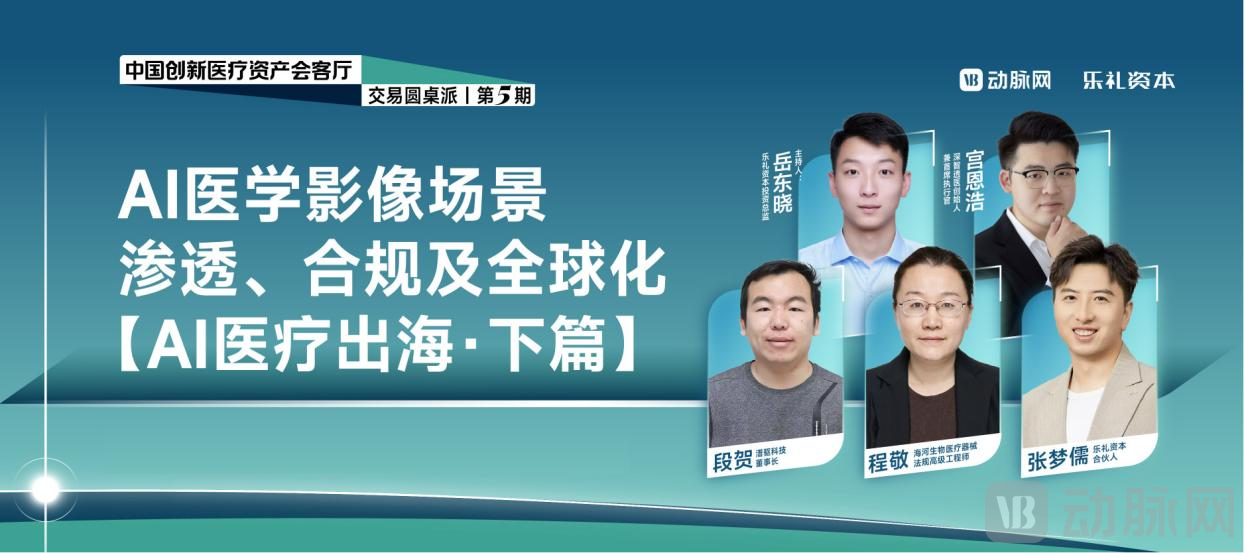
To clarify the industry’s development trajectory and address core challenges in global expansion, VCBeat and Le Li Capital recently jointly hosted the fifth episode of the “China Innovative Medical Assets Living Room” Transaction Roundtable. The event featured four distinguished guests from key nodes across the industry chain, who engaged in an in-depth dialogue on “Scenario Penetration, Regulatory Compliance, and Global Expansion of AI Medical Imaging.” The discussion aimed to deconstruct the underlying logic of international market entry, share practical experience, clear up industry uncertainties, and chart a path forward.
1Compliance First, Value-Driven: AI Medical Imaging Goes Global, Entering a New Phase
In 2025, the AI medical imaging industry is undergoing comprehensive structural transformation, with technology, commercialization pathways, and supply chain systems mutually reinforcing each other to collectively accelerate global expansion.
On the technical front,Generative AI and Foundation Models Become Core Driving ForcesGong Enhao, founder of DeepWisdom AI Healthcare, pointed out that the industry has shifted from early product models focused on single diseases, single anatomical sites, and single modalities toward multimodal integration based on large models such as Transformers and diffusion models. This transition not only reduces R&D and regulatory approval costs but also enhances the clinical value density of products, laying the foundation for commercial implementation. Meanwhile, AI technology is evolving from a mere algorithmic tool into an intelligent infrastructure spanning the entire workflow of image acquisition, quality control, and diagnosis, even incorporating generative AI agent technologies to become an indispensable component of clinical diagnosis and treatment.
The rapid iteration of technology has placed unprecedentedly high demands on the hardware that supports it. On the supply chain side,“Reliability” and “Intelligence” of Core Components Become Standard for Global ExpansionDuan He, Chairman of Puqu Technology, stated that as Chinese OEMs accelerate their global expansion, upstream core components are facing a dual upgrade in demand: on one hand, they must be “more reliable” by strictly controlling failure rates and optimizing production processes to reduce overseas maintenance costs; on the other hand, they must be “smarter,” featuring self-diagnosis and lifespan prediction capabilities, as well as data interoperability with the overall equipment system, thereby enabling predictive maintenance and significantly reducing after-sales service costs abroad. This demand is, in turn, driving the localization upgrade of the supply chain and the establishment of technological barriers.
This technology-driven, supply chain-supported industrial upgrade has also profoundly influenced the judgment logic of the capital market. Zhang Mengru, founder of Leli Capital, pointed out that from an investment perspective, AI medical imaging’s“Going Global” Is Essentially a Manifestation of a Company’s “Internationalization DNA”He emphasized that investment should focus on achieving domestic substitution of core components, which is not only a strategic necessity for mitigating supply chain risks but also the fundamental pathway to creating long-term value for healthcare systems by enhancing manufacturing processes and yield rates.
However, whether it involves the domestic implementation of technology or the global expansion of products, the critical step of achieving “compliance” must ultimately be completed within the global regulatory framework. In the field of compliance certification,Full-Lifecycle Regulation and Mutual Recognition Agreements Are Gradually Becoming Key Variables. Cheng Jing, a senior engineer specializing in medical device regulations at Tianjin Haihe Biopharmaceutical Technology Group, analyzed that global regulatory authorities are continuously tightening their requirements for AI-based medical devices. The focus has shifted from pre-market approval of individual products to full lifecycle regulation, with cybersecurity and data compliance emerging as new key priorities.
In terms of market access, she emphasized that the essence of international mutual recognition agreements should be correctly understood as a means to streamline review processes, rather than to directly recognize regulatory approvals. Companies must first obtain certifications from mainstream markets such as the U.S. FDA, EU CE, or China’s NMPA before leveraging this mechanism to efficiently expand into emerging markets.
Furthermore, successful global expansion requires robust localization capabilities and compliant data support. Companies should consider how to adapt to clinical processes in different countries during the R&D phase, striking a balance between the quality control of self-built databases and the efficiency of adopting third-party databases, thereby enhancing compliance and localization capabilities as core competencies.
Amid this series of transformations, the four dimensions of technology, industry, capital, and compliance are intertwined, jointly driving Chinese AI medical imaging companies’ global expansion into an era characterized byClinical Value, Global Adaptability, and Sustainable Business Modelas the core of a brand-new stage of development.
2Clinical Validation and Ecosystem Collaboration Are Key to Breaking the Deadlock
The global expansion of AI medical imaging is not a solitary endeavor for enterprises; rather, it requires the synergistic efforts of regulatory service providers, investment institutions, and upstream and downstream partners to form an ecosystem that reduces trial-and-error costs and enhances expansion efficiency.
Clinical Validation Requires Deep Localization and Value QuantificationGong Enhao emphasized, drawing on corporate practice, that clearing the compliance hurdle is merely the first step in going global; the real challenge lies in demonstrating the product’s clinical value locally—specifically, proving that it can deliver a clear return on investment for hospitals. He outlined a key pathway to breakthrough: conducting multicenter clinical studies with top-tier medical institutions to obtain quantitative evidence. For instance, his company’s product was shown to reduce scanning time by more than 50%, directly enhancing equipment throughput. Once such value is quantitatively validated, AI can transition from being an “optional tool” to an “indispensable component” of clinical workflows.
The recognition of clinical value is inseparable from the foundational support of matching hardware performance and system stability. At the other end of the industry chain,Collaborative Global Expansion Between Core Component Suppliers and OEMs Is Building New Competitive Barriers. Duan He introduced that Puqu Technology has established in-depth collaborations with multiple OEMs planning to expand overseas. Citing the model of international giants like “GPS,” which develop core components in-house rather than sourcing them externally, he pointed out that highly integrated systems far surpass piecemeal solutions in terms of performance and reliability, serving as the key to building “technical barriers” and “brand effects” and forming long-term competitive advantages.
At the global compliance level, Cheng Jing pointed out that professional consulting firms play a critical role in helping AI medical device companies expand overseas. Many AI companies lack experience with medical device regulations, whereas consulting firms, leveraging their deep understanding of global regulatory dynamics and practical expertise, can accurately grasp audit requirements. Their value is reflected in two aspects: first,Delivering Cutting-Edge Regulatory Updates(e.g., upgrades to FDA cybersecurity requirements), clearly defining document granularity and review criteria; second,Control Key Regulatory Milestones, guiding enterprises to avoid futile disputes and accelerating the certification process.
In addition to product strength and compliance,Investors are more focused on a company's comprehensive operational capabilities to support long-term global expansion.From the perspective of investment institutions, Zhang Mengru cautions that the AI medical imaging industry is entering a new era of specialized division of labor, with operational capabilities becoming key to sustainable development. A company’s ability to establish a robust compliance system and rapidly adapt to the clinical needs of overseas markets directly determines the success or failure of its global expansion. Investment firms will closely evaluate a company’s compliance team structure, experience in overseas regulatory registrations, and resources for localized partnerships. These “implicit indicators” are critical in assessing whether a company can achieve sustainable operations in international markets.
From regulatory certification and market access to clinical validation, and from technological integration to operational management, the global expansion of AI medical imaging requires companies to advance simultaneously across multiple dimensions, thereby establishing a comprehensive international capability framework.
3Navigating Cycles with Core Competencies to Build Global Competitiveness
Regarding the overseas prospects of AI medical imaging in the next 1-3 years, four guests unanimously agreed that “opportunities and challenges coexist,” only byAdhering to Long-Termism and Focusing on Building Core Capabilities, thereby securing lasting competitiveness in the global market.
Gong Enhao believes that a differentiation strategy is key to global expansion. Regional market strategies vary significantly: Europe and the United States prioritize value validation, while the Asia-Pacific region offers substantial untapped market opportunities. Companies must adopt flexible deployment strategies and establish a complete value loop—from technological innovation to commercial returns—to stand out in this diverse landscape.
Duan He pointed out that establishing a technological foundation requires long-term investment and patience. The core competitiveness of medical devices is built upon solid technological accumulation. The advantages of Chinese manufacturing in supply chain efficiency and iteration speed will play a decisive role in long-term competition.
Cheng Jing advises companies to maintain strategic focus. Enterprises should pay attention to uncertainties in the external environment, such as potential shutdowns of the FDA due to fiscal issues, while leveraging the benefits of mainstream certifications and flexibly positioning themselves in emerging markets like Southeast Asia.
Zhang Mengru believes that external technological pressure is driving domestic companies to accelerate the independent R&D and localization of core components. He pointed out that, combined with China’s engineer dividend and industrial foundation, the next 1–3 years represent a strategic window for Chinese enterprises to “strengthen their internal capabilities” and achieve import substitution.
Based on the forward-looking assessments of the four panelists, a clear path has emerged: the globalization of China’s AI medical imaging sector is by no means a simple matter of product exports or technology transfer; rather, it is a “value expedition” that tests comprehensive capabilities.
This global expansion means that companies need to open up markets through value evidence, build trust through reliability data, manage risks through multi-line compliance management, and improve efficiency through ecosystem collaboration. Only by calming down in this process, doing every clinical verification well, overcoming every technical difficulty, and meeting every regulatory requirement can enterprises steadily build continuous competitiveness across cycles and finally occupy a place in the global market.