

Bangoo Tech Leverages AI Health Robots to Address Primary Diagnosis Challenges in Grassroots Healthcare, Serving Over 100,000 Users Across 80+ Pharmacies
According to the 2024 Statistical Communiqué on National Economic and Social Development, the total number of medical consultations reached 10.11 billion in 2024, with primary healthcare institutions handling the majority of initial visits. Primary care outlets—including community hospitals, township health centers, village clinics, community health service stations, as well as pharmacies and traditional Chinese medicine (TCM) clinics distributed across urban and rural areas—collectively constitute the “nerve endings” of the healthcare system.
However, primary healthcare institutions generally face the dilemma of insufficient diagnostic capabilities: inadequate decentralization of high-quality medical resources, a limited number of general practitioners, and relatively basic diagnostic and treatment equipment. How to solve the problem of “accurate initial diagnosis” at the primary care level is precisely the starting point for Shanghai Bangu Intelligent Technology Co., Ltd. (hereinafter referred to as “Bangu Tech”) in exploring the “Healthcare + AI” model.
Bangu Technology was born out of the personal experience of its founder, Zhang Fei. In the early stages of the 2020 pandemic, Zhang Fei’s father suffered from “cholecystitis complicated by gallstones” and was shuffled between multiple hospitals; the entire process, from initial diagnosis to surgery, took nearly a month. This experience made him realize that what primary healthcare lacks most is not treatment modalities, but accurate and efficient preliminary diagnostic capabilities.
Meanwhile, Zhang Fei observed another practical issue within the healthcare system: prior to seeking medical care, patients often face information overload and difficulty in making informed judgments. Although various health monitoring devices and science popularization applications are already available on the market, most of these tools only provide basic data monitoring and general health education, falling short in addressing the specific problems users encounter in real-world scenarios.
When experiencing physical discomfort, users may find abundant information through online searches, yet they struggle to derive professional and reliable judgments from fragmented data. What users truly need is expert interpretation of these data and actionable guidance, rather than mere presentation of numerical values.
Guided by this insight, Zhang Fei decided to focus his entrepreneurial efforts on developing an “AI Diagnostic Assistant for Pre-Hospital Care,” dedicated to building an intelligent platform that connects patient symptoms with professional medical advice. To achieve this goal, Bangu Technology assembled a unique interdisciplinary team and established the company in collaboration with the Lingang Nanqiao Science and Technology City Enterprise Incubator, a subsidiary of Lingang Group. The incubator platform provided services related to business matchmaking, financing, and policy support.
Zhang Fei himself combines a background in electronic engineering with a decade of experience in the industrialization of medical research projects. Sixty percent of the core team holds PhDs in computer science, while the remaining 40% come from the fields of clinical medicine and bioengineering. This structure ensures that the team’s R&D efforts remain firmly oriented toward clinical needs, leveraging deep collaboration between medicine and engineering to translate professional expertise into practical, deployable AI products.
Currently, Bangoo Tech’s core product, the “Suikangbao AI Health Robot,” has achieved large-scale deployment in primary healthcare settings. As a solution integrating both Traditional Chinese Medicine (TCM) and Western medicine diagnostic and therapeutic capabilities, the Suikangbao series includes not only a standard robotic version but also a TCM-specific version focused on TCM syndrome differentiation, enabling tailored adaptation to the needs of various primary care scenarios such as pharmacies and TCM clinics.
In terms of tangible outcomes, the product has been successfully deployed in over 80 chain pharmacies in Xi’an and approximately 10 traditional Chinese medicine (TCM) clinics in Hangzhou, cumulatively serving more than 100,000 users. This further validates the demand for such AI-powered health diagnostic tools in the primary care market.
End-to-End AI Diagnostic Architecture: Synergy Between Seamless Experience and Precise Diagnosis
Bangu Technology's product architecture is based on"Intelligent Hardware (Edge Computing) + Big Data Cloud Platform + AI Models" Technical Framework. The diagnostic process is as follows:
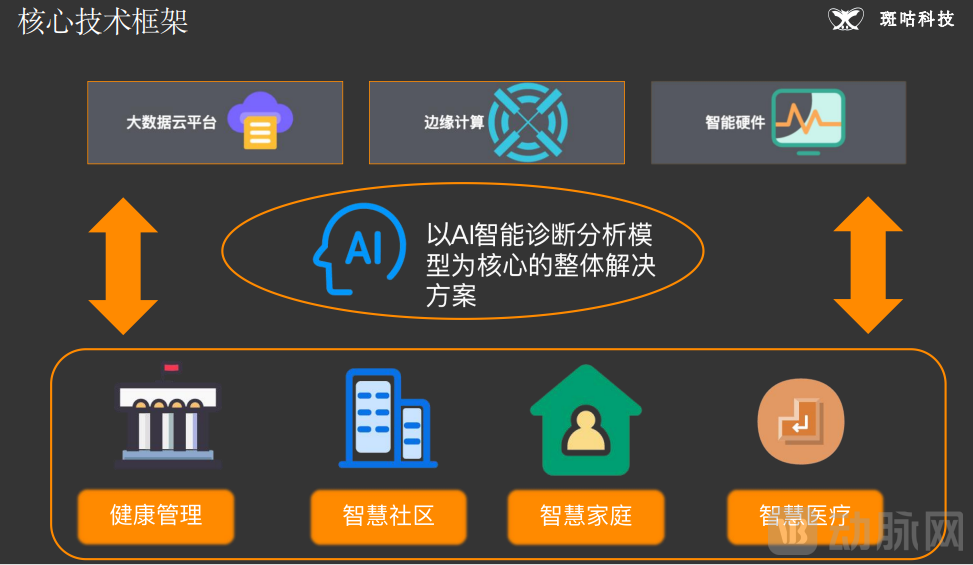
Sui Kangbao AI Health Robot Core Technology Framework
At the smart hardware level, the device is closely aligned with the usage habits of primary care users. Users interact via the “Suikangbao Robot,” which collects blood pressure and temperature data through sensors, performs non-contact facial and tongue diagnosis via a camera, while users describe their symptoms verbally.
On this basis, the edge processing module leverages a built-in Natural Language Processing (NLP) model to convert users’ colloquial descriptions into structured symptom information and dynamically generates personalized follow-up questioning logic, thereby effectively reducing ineffective interactions and ensuring a smooth experience in primary care settings.
After local processing, the encrypted data is uploaded to the cloud for analysis. Leveraging a vast knowledge graph and diagnostic model encompassing 30,000 symptoms and 8,000 diseases, the system performs in-depth analysis and probability calculations to generate a health risk assessment report detailing “potential diseases, risk levels, and recommended actions,” which is then pushed to the user’s mobile app.
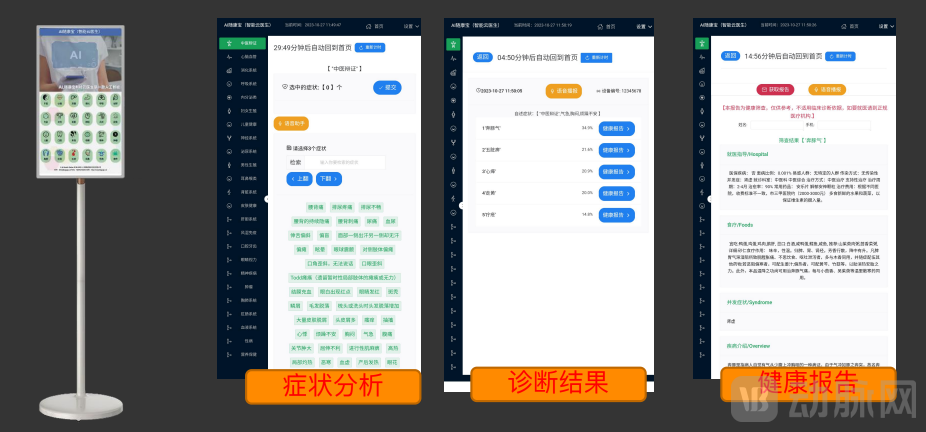
Suikangbao AI Health Robot Operation Guide
This integrated workflow ingeniously combines the seamless experience of edge computing with the powerful computational capabilities of the cloud, enabling rapid and convenient preliminary diagnosis in primary care settings.
Technical Path: Upholding the Determinism of Knowledge Graphs
Despite the rapid advancement of large language model technology, Bangoo Tech has consistently adhered to the principle thatKnowledge Graph Based on CNN (Convolutional Neural Network) as the Core Diagnostic Model。
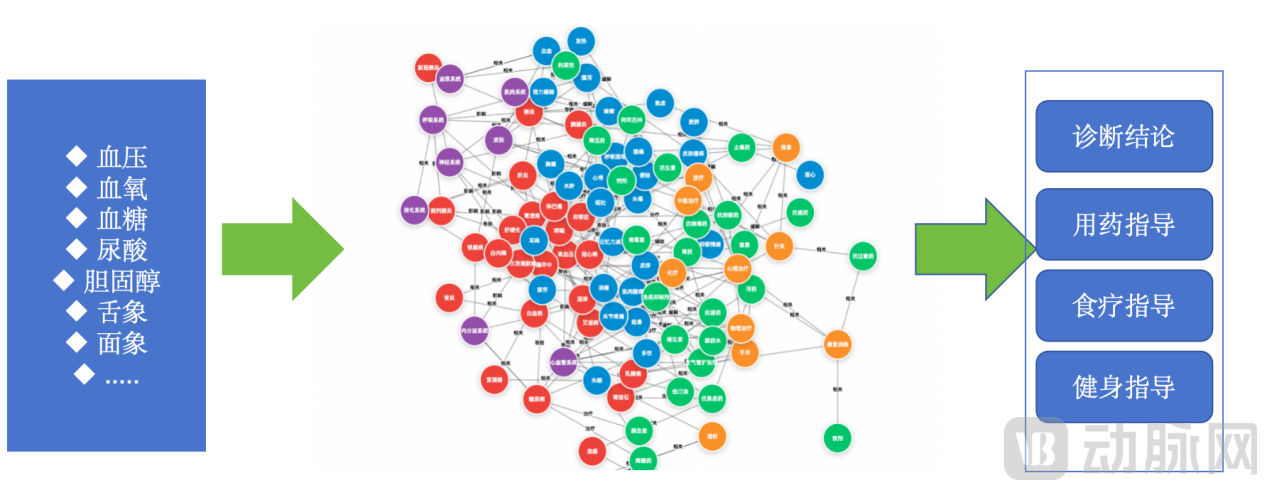
Sui Kangbao AI Health Robot Core Model Atlas
“Diagnostic results must be unique and interpretable,” explained Zhang Fei. Knowledge graphs possess three irreplaceable advantages: first,Precise and Controllable, it defines medical relationships as structured relationships; second,Traceable, Explainable, can clearly indicate which key symptoms point to a specific disease; thirdly,Efficient Inference, rapidly identify key pathways in the differential diagnosis of complex symptoms.
In contrast, large language models are based on probabilistic generation and may produce confusion, outputting information that appears plausible but is medically incorrect, which poses a fatal risk in the healthcare sector. Therefore, Bangu Technology’s strategy is “Knowledge Graph as the Core, Large Language Models as the Auxiliary”, applying large models to auxiliary functions such as intelligent Q&A on the app side, while upholding the determinacy and reliability of knowledge graphs in core diagnosis.
To ensure the accuracy and timeliness of its knowledge graph, Bangu Technology has established a “human-in-the-loop” iterative mechanism. The system preprocesses and quantitatively scores diagnostic results; those with low scores are automatically routed to a team of licensed physicians for manual review and annotation. Leveraging this feedback data, the knowledge graph undergoes continuous optimization, adhering to an iteration schedule of minor monthly updates and major quarterly updates, thereby ensuring alignment with the latest clinical practice guidelines.
Compliance Assurance: Strictly Adhering to Medical Red Lines
In terms of compliance, Bangu Technology has established strict operational guidelines: the system is strictly limited to recommending only OTC (over-the-counter) medications. For non-OTC drugs, the frontend displays only diagnostic results, while recommendation actions are handled by partnered physicians via the app, thereby isolating the risk of AI directly prescribing prescription medications.
Meanwhile, all interactive interfaces and voice prompts clearly display the warning: “AI-assisted suggestions are for reference only and cannot replace treatment at tertiary hospitals.” The hardware device features a video window authorized for pharmacy use during standby mode; however, no pharmaceutical advertisements are embedded in the product’s diagnostic workflow or within the app, thereby ensuring its neutrality and professionalism.
Facing fierce competition in the AI healthcare sector, Zhang Fei believes that Bangoo Tech’s core competitiveness lies in the “deep integration of medical knowledge systems”Scenario-Based Implementation Capability”. Looking ahead, he identified two key breakthroughs:Multimodal Fusion and Personalized Proactive Health Management Based Thereon。
Next, Bangu Technology plans to develop smaller, low-cost multimodal physiological signal acquisition hardware to capture richer health data. Meanwhile, the company will continue to refine its technology architecture, which is “knowledge graph-centric and large language model-supported,” to create a more precise intelligent diagnostic assistant. These technological upgrades will also support its expansion from pharmacies and traditional Chinese medicine clinics to community hospitals, residential neighborhoods, and even home settings, bringing “precise initial diagnosis” services deeper into the daily lives of more users.
This strategic layout is now benefiting from favorable policy tailwinds. According to the “Implementation Opinions on Promoting and Standardizing the Development of ‘AI + Healthcare’ Applications” recently issued by the National Health Commission, intelligent clinical decision support systems are expected to achieve near-universal coverage at the primary care level by 2030. Bangu Technology’s development path aligns closely with this policy direction, as its personalized health management services directly respond to the document’s call for developing “end-to-end intelligent healthcare services.”
As public health awareness rises in the post-pandemic era, health management is transitioning from extensive to refined approaches. From alleviating individual patients’ suffering during medical consultations to empowering primary healthcare through technological innovation, Bangu Technology is deeply integrating AI with medicine to make health management accessible and user-friendly, thereby realizing its corporate vision of “Awakening Life, Healthy Living.”
About Shanghai Lingang United Co., Ltd.
Shanghai Lingang United Development Co., Ltd. is a leading provider and master operator of integrated innovation ecosystems for industrial parks, specializing in park investment promotion and operations, professional corporate services, and sci-tech innovation industry investment. As a subsidiary of Lingang Group, a Shanghai municipal state-owned enterprise focused on urban support services, it constitutes a key component of the listed entity “Shanghai Lingang (600848).”
The industrial parks under the Lingang United Company have gathered more than 250 upstream and downstream enterprises in the fields of medical devices and biopharmaceuticals, covering multiple sectors such as high-value consumables, medical equipment, in vitro diagnostics (IVD), cell and gene therapy, immunotherapy, and synthetic biology. The parks are home to industry leaders including Lepu Xintai, Dunhui Medical, E-Don Medical, Huakan Bio, Starday, and Linkang Times. Furthermore, the parks provide a range of resource and service platforms for inspection and testing, animal experimentation, CRO, and CDMO services. By introducing the Shanghai Yangtze River Delta Medical Device Industry Development Promotion Association and optimizing the full-lifecycle service system, the parks deliver in-depth support to resident enterprises and empower the development of the healthcare industry.