

From Carpet Bombing to Precision Guidance: Spherical Nucleic Acid Technology Redefines Chemotherapy
Acute myeloid leukemia (AML) is a rapidly progressing and difficult-to-treat hematologic malignancy. According to statistics from the American Cancer Society, approximately 22,010 Americans are diagnosed with AML each year, of whom 11,090 will die from the disease. Although the chemotherapy drug 5-fluorouracil (5-FU) has been used clinically for decades, its efficacy remains unsatisfactory—The crux of the problem lies not in the chemical activity of the drug itself, but in its inability to "reach where it needs to go."
This seemingly simple delivery challenge, in factReveals the core dilemma facing modern chemotherapy: drugs struggle to precisely target cancer cells while easily damaging healthy tissues.Conventional 5-FU suffers from poor solubility, low cellular uptake efficiency, and non-selective cytotoxicity, forcing clinicians to make difficult trade-offs between efficacy and toxicity. Consequently, patients endure severe side effects, including nausea, fatigue, and even cardiotoxicity.
To address this long-standing clinical challenge that has persisted for decades, Professor Chad A. Mirkin’s team at Northwestern University in the United States has taken a novel approach,Innovatively reconstituted traditional 5-Fu into spherical nucleic acid (SNA) nanostructures.This ingenious design not only overcomes the bottleneck of drug delivery but also achieves a perfect combination of precise targeting and efficient cytotoxicity.
On October 29, 2025, the team published exciting research findings in *ACS Nano*:SNA technology increased the cytotoxic potency of drugs by 10,000–20,000-fold and enhanced antitumor efficacy by 59-fold, with no significant side effects observed.This breakthrough brings revolutionary hope for the treatment of refractory tumors such as leukemia.
(Source: ACS Nano)
1Challenge 1: The Woes of Solubility
The solubility of 5-FU in many biological fluids is less than 1%. As Professor Mirkin stated:"Many people are aware of the severe toxicity of chemotherapy, but often overlook its fundamental issue of poor solubility."If a drug fails to dissolve in the bloodstream, it will clump together or remain in solid form, rendering it impossible for the body to absorb effectively. This is akin to throwing a stone into a river; no matter how swift the current, the stone will never reach downstream.
2Dilemma 2: Non-Selective Cytotoxicity
Traditional chemotherapy drugs are like "indiscriminate bombing"—They kill cancer cells while also destroying a large number of healthy cells.This leads to a range of distressing side effects for patients, including nausea and fatigue, and may even trigger heart failure in extreme cases. Moreover, due to the extremely narrow therapeutic window, clinicians are often forced to make difficult trade-offs between efficacy and toxicity.
3Challenge 3: Inefficient Delivery
Even if the drug can dissolve and enter the bloodstream, it still faces numerous barriers to truly penetrate cancer cells and exert its therapeutic effect. Under traditional drug administration methods,Drug delivery rates are extremely low, as the majority of drugs are metabolized or excreted before reaching their target.
Mirkin’s team’s innovation did not simply improve packaging methods, but fundamentally redesigned the molecular structure of the drug.
Spherical Nucleic Acids (SNAs) are a unique nanostructure invented and developed by Professor Mirkin at Northwestern University, representing a new paradigm in nanomedicine. They consist of a liposomal core composed of biocompatible phospholipids, with the outer layer densely packed with DNA or RNA strands, forming a spherical structure with a diameter of approximately tens of nanometers.This design itself is a clever "Trojan horse" strategy—appearing as ordinary nanospheres, yet concealing hidden complexities.
In this study, the team chemically linked ten 5-fluoro-2'-deoxyuridine units into an oligonucleotide chain and modified the 3' end with hexaethylene glycol and cholesterol moieties to enable anchoring onto the liposome surface. The key breakthrough lies in:The drug is no longer "encapsulated" within a carrier but is directly "woven" into the DNA strand, becoming an integral part of the nanostructure.This structural reconfiguration brings not only a change in physical form, but also a qualitative transformation in function.
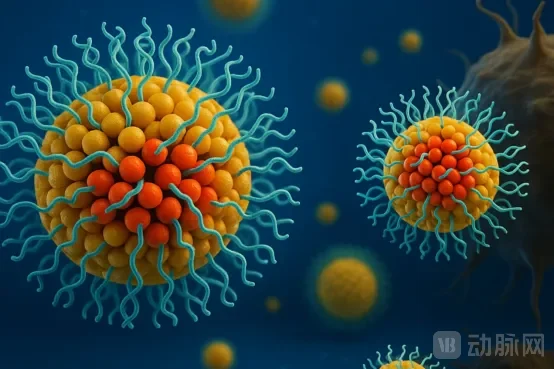
Figure: Schematic diagram of the SNA structure (Source: Northwestern University)
Why is this structure so effective? The answer lies in the scavenger receptors on the cell surface. Professor Mirkin explains, “Most cells express scavenger receptors on their surfaces, but bone marrow cells overexpress these receptors.” These receptors act as “gatekeepers” for the cells, specifically recognizing and actively internalizing molecules with particular structures. SNA happens to possess the “passport” that these receptors favor—a densely packed DNA shell. More importantly, as a malignancy of bone marrow origin, acute myeloid leukemia (AML) cells exhibit an even higher density of scavenger receptors on their surfaces, thereby providing a natural biological basis for selective targeting.Unlike traditional drugs that need to "force their way into" cells, SNAs are "invited in."Efficiency is naturally significantly improved.
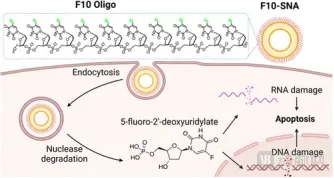
Figure: The process by which SNAs exert their effects (Source: ACS Nano)
Upon entering the cell, the ingenious design of SNA begins to reveal its third advantage. Intracellular enzymes recognize and degrade the DNA shell, gradually releasing the drug molecules,This process is akin to unwrapping a package, ensuring that the drug exerts its therapeutic effect at the right time and in the right place.Because release occurs inside cancer cells, drug concentrations can reach extremely high levels locally, thereby achieving a potent cytotoxic effect. The entire process is tightly interlinked:Structural Recognition → Active Uptake → Precise Release → Efficient Killing,Constitutes a complete "precision-guided" system.
To validate this ingenious theoretical design, the research team conducted rigorous comparative tests between SNA-formulated 5-Fu and free 5-Fu in in vitro cell experiments, revealing a remarkable leap in efficacy:Cellular uptake efficiency increased by 12.5-fold, which means that the amount of drug entering cancer cells within the same time frame has increased by an order of magnitude; even more strikingly,Enhanced Cytotoxicity — Up to 10,000–20,000-Fold (4 Orders of Magnitude), equivalent toIt originally took 10,000 drug molecules to kill a single cancer cell; now, only one is required.This exponential increase in potency marks a fundamental breakthrough in drug design philosophy.
Of course, the success of in vitro experiments does not guarantee reproducibility in complex living organisms. The transition from in vitro to in vivo studies represents a critical threshold that all new drug development programs must overcome. The research team observed even more encouraging results in a human AML model using immunodeficient mice:The antitumor efficacy was 59 times higher than that of conventional 5-Fu; leukemia cells in the blood and spleen were "almost completely eliminated," survival time in mice was significantly prolonged, no obvious side effects were detected, and healthy tissues remained intact.The significance of this data set extends far beyond the numbers themselves—it demonstrates that, in living organisms, spherical nucleic acids (SNAs) not only retain the high efficacy observed in in vitro experiments but also achieve selective targeting, an ideal state that remains elusive for conventional chemotherapy.
To comprehensively validate the performance of SNA, the research team also conducted biodistribution and stability studies. The data showed that SNA exhibited good stability in serum and DNase I environments, indicating that the drug would not degrade prematurely during systemic circulation and could reach the target site intact. Biodistribution studies further confirmed thatThe drug indeed accumulates in the target tissue rather than being randomly distributed throughout the body.—This is precisely the core essence of precision medicine.
From structural design to functional validation, from in vitro to in vivo, and from efficacy to safety, every step points to the same conclusion:SNA technology has achieved a revolutionary transformation in chemotherapy drugs, shifting from "carpet bombing" to "precision guidance."
The significance of this study extends far beyond the treatment of leukemia itself; it represents a successful paradigm of an emerging field—structural nanomedicine. Unlike traditional nanomedicine, which focuses solely on material composition, structural nanomedicine emphasizes fine-tuning interactions with biological systems by precisely controlling the geometry, surface chemistry, and physical properties of nanostructures.
As Professor Mirkin pointed out:"The structure of nanomedicine can profoundly influence the delivery and cellular targeting of chemotherapeutic drugs."The spherical symmetry of SNAs, the density and arrangement of the DNA shell, and the spatial distribution of drug molecules—each structural parameter has been meticulously engineered to collectively determine their superior performance. This marks a profound shift in the philosophy of drug development:Structure Is Function; Design Determines Efficacy.
The most intuitive manifestation of this shift in philosophy isA Fundamental Shift in Chemotherapy: From "Carpet Bombing" to "Precision-Guided"The philosophy of traditional chemotherapy is “better to kill a thousand by mistake”—using high-dose drugs systemically in the hope of destroying a sufficient number of cancer cells. In contrast, SNA technology has brought about a paradigm shift. As Professor Mirkin stated, “Today’s chemotherapy drugs kill everything they encounter, whereas our structural nanomedicine preferentially targets bone marrow cells, delivering higher, more concentrated doses precisely where needed.”
Moreover, the versatility of SNA technology lays the foundation for its widespread application.Currently, seven SNA-based therapies have entered clinical trials, covering areas far beyond leukemia treatment, including cancer, infectious diseases, neurodegenerative diseases, and autoimmune diseases.
Its versatility lies in its programmable design logic: by altering DNA sequences, modifying functional groups, and conjugating drug molecules, therapeutic regimens can be customized for different diseases and target cells. This functions as an open nanoplatform with limitless potential for expansion.
From the successful case of SNA, we can also clearly gain insight into the future direction of nanomedicine development. First isThe Shift from Passive Delivery to Active Targeting.Traditional drug delivery relies on passive diffusion and random distribution, whereas spherical nucleic acids (SNAs) achieve "active targeting" through receptor-mediated active uptake. Future nanomedicines will increasingly leverage biological recognition mechanisms to design "smart drugs" capable of autonomously locating diseased tissues.
Secondly,From Single-Function to Multi-Functional Integration.SNAs simultaneously serve as drug carriers, targeting ligands, and protective shells, achieving a perfect unity of structure and function. Future nanomedicine will evolve toward multifunctional integration, consolidating diagnostic, therapeutic, and monitoring capabilities onto a single nanoplatform to realize true "theranostics." This integration represents not a mere superposition of functions, but a systematically designed approach for synergistic enhancement.
The third trend isFrom Empirical Design to Rational Design.The success of SNA is predicated on a profound understanding of cell biology and nanomaterials science, marking a paradigm shift from "trial-and-error" to "rational design." As our comprehension of the mechanisms governing nano-bio interface interactions deepens, the integration of computational simulations and artificial intelligence will enable more precise prediction and design of nanomedicine performance, significantly shortening R&D cycles and reducing failure rates.
Finally,Accelerating Translation from Laboratory to Clinic.As regulatory pathways become increasingly clear, manufacturing processes mature, and clinical data accumulate, the timeline for translating nanomedicine from basic research to clinical application is expected to be significantly shortened. This represents not only technological advancement but also the synergistic evolution of regulatory frameworks, industry development, and clinical practice.
Returning to the study itself,Professor Mirkin’s team is also planning to advance the research to large-scale animal studies, with the ultimate goal of entering human clinical trials.“If this can be translated to human patients, it will mean more effective chemotherapy, better response rates, and fewer side effects,” he said. “This has always been the goal of any cancer treatment.”
In the era of precision medicine, spherical nucleic acid (SNA) technology represents an exciting direction—enabling drugs to know not only “what to target” but also “how to deliver.” This may well be the greatest value that nanomedicine brings to human health.