

Hangzhou-Based Biotech Secures ¥300 Million Deal for Next-Gen XPO1 Inhibitor BIOS-0629, Files IPO Prospectus
Bio-S
Comprehensive pharmaceutical technology R&D provider
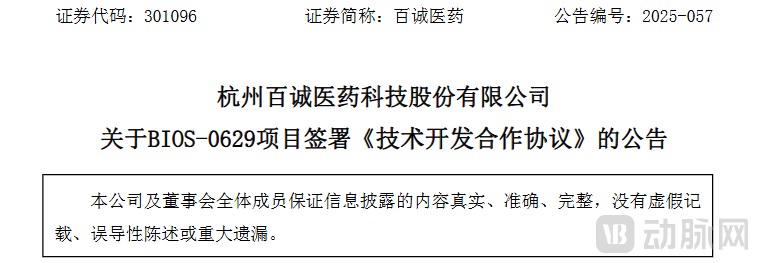
On November 12, Hangzhou Bio-Sincerity Pharma-Tech Co., Ltd. (Stock Code: 301096.SZ, hereinafter referred to as “Bio-Sincerity”) announced that it had signed a “Technical Development Cooperation Agreement” with Zhejiang Zhongshen Innovative Pharmaceutical Technology Co., Ltd. (hereinafter referred to as “Zhongshen Innovation”), reaching an exclusive licensing cooperation agreement for the innovative oncology drug BIOS-0629 project in the Greater China region (including mainland China and the Hong Kong, Macao, and Taiwan regions).
Under the terms of the agreement, Zhongshen Innovation will pay Bio-S milestone payments totaling RMB 300 million based on R&D progress; after the collaborative products are launched, Bio-S will also receive a 10% ongoing royalty share based on sales revenue.
BIOS-0629: Breaking the Activity-Safety Dilemma of XPO1 Inhibitors
BIOS-0629 is a Class 1 novel small-molecule drug independently developed by Bio-S. As a potential best-in-class second-generation XPO1 inhibitor, it is currently in the preclinical candidate compound (PCC) stage, with its core indication focused on the treatment of solid tumors.
To understand the significance of BIOS-0629, it is essential to first recognize the common challenges within the XPO1 inhibitor landscape. XPO1 is a nuclear export transporter responsible for shuttling various tumor suppressor proteins (such as p53 and p21) out of the nucleus, leading to their degradation and thereby weakening the cell’s antitumor capabilities. The mechanism of XPO1 inhibitors lies in blocking this tumor-protective pathway, allowing tumor suppressor proteins to remain within the nucleus and restore their tumor-suppressive functions.
However, while the first-generation XPO1 inhibitors have successfully validated their mechanism of action, they commonly face challenges in clinical practice, including significant hematologic toxicity, pronounced gastrointestinal adverse reactions, and poor tolerability. Dose-limiting toxicities prevent the full realization of therapeutic efficacy, constituting a key bottleneck to the commercialization of this class of drugs.
The development of BIOS-0629 is centered on addressing this challenge. In terms of molecular design, BIOS-0629 incorporates a reversible covalent binding mechanism, enhancing drug controllability and widening the safety window. Meanwhile, its low blood-brain barrier permeability effectively reduces the risk of central nervous system (CNS) toxicity. BIOS-0629 demonstrates improved pharmacokinetic properties, with increased Cmax and exposure in vivo. In multiple murine efficacy studies (covering multiple myeloma, prostate cancer, and colon cancer), BIOS-0629 exhibited significant antitumor efficacy superior to that of the positive control, showing a clear dose-response relationship and a wider therapeutic window compared to the positive control. In rat dose-range finding (DRF) studies, BIOS-0629 demonstrated better tolerability and a higher safety window.
End-to-End R&D Meets Commercialization Empowerment
This collaboration is, in essence, a precise alignment of the core competencies of two enterprises—Zhongshen Innovation’s expertise in innovative drug intellectual property operations complements Bio-S’s end-to-end R&D capabilities, jointly driving BIOS-0629 from the laboratory to clinical development and the market.
Zhongshen Innovation, established in August 2025 with a registered capital of RMB 10.755 million, has rapidly garnered industry attention despite its youth, positioning itself as an “M&A, incubation, and trading platform for innovative drug intellectual property.” Its core team hails from leading global pharmaceutical companies and intellectual property institutions, possessing extensive expertise in the full-chain value assessment of innovative drugs from R&D to commercialization.
Unlike traditional pharmaceutical companies that are primarily R&D-driven,Zhongshen Innovation focuses on an IP M&A + industrialization empowerment model: instead of directly engaging in drug R&D, it leverages capital, industrialization resources, and commercial channels to connect promising innovative achievements with downstream markets.
Under this collaboration, Zhongshen Innovation will be responsible for R&D translation, manufacturing, and commercialization in the Greater China region, providing financial, resource, and channel support to facilitate the regional launch of BIOS-0629.
In contrast,Bio-S's advantage lies in its vertically integrated R&D system, spanning from target design to commercial-scale production.According to the company’s official website, its business covers the full spectrum of drug R&D and industrialization services, including target design, target validation, compound preparation, druggability assessment, efficacy evaluation, pharmaceutical studies, clinical trials, data management and statistics, patent strategy, global regulatory registration, and CDMO/CMO services. As of April 2025, Bio-S has obtained clinical trial approvals for one Class 1 innovative drug and ten Class 2 innovative drugs, and has laid out more than 15 innovative projects in fields such as oncology, respiratory diseases, and neurological disorders.
In terms of collaboration, Bio-S has intensified its efforts in recent years. In early 2025, it partnered with XtalPi to leverage the “AI + Robotics” platform for new drug development. Later that year, Bio-S signed a strategic internationalization agreement with Sinovac Biopharma to advance the global registration and layout of innovative drugs.
XPO1 Therapeutic Area Enters a Window of Clinical Gap
The collaboration between Bio-S and Zhongshen Innovation is not only a natural extension of the companies’ strategic layouts, but also reflectsThree Major Trends Taking Shape in the Innovative Drug Industry: Accelerated Adoption of R&D Outsourcing and Licensing Collaboration Models, Differentiated Targets Becoming the Focus of Competition, and Novel-Mechanism Drugs for Solid Tumors Entering a Critical Phase of Value Realization.
First, from the perspective of industry background, global innovative drug R&D is entering a new stage characterized by "high investment, high risk, and high return."According to Deloitte’s annual report, the average R&D cost for innovative drugs worldwide exceeded $2 billion in 2024, while clinical failure rates remained persistently high, resulting in an expected return on investment of only 5.9% for pharmaceutical R&D. In this landscape, it is difficult for a single company to bear the full-cycle pressure from R&D to commercialization, making the “R&D outsourcing + commercialization licensing” model increasingly mainstream.
Against this backdrop, the treatment of solid tumors has become a key arena for innovative breakthroughs.According to data from the International Agency for Research on Cancer (IARC) of the World Health Organization, there were 20 million new cancer cases and 9.7 million cancer-related deaths globally in 2022. Lung cancer, breast cancer, and colorectal cancer, the three major subtypes of solid tumors, consistently rank among the highest in incidence, constituting the primary source of the global cancer burden. However, existing targeted therapies and immunotherapies still face challenges such as strong drug resistance, narrow indications, and significant variability in efficacy, while traditional chemotherapy struggles to balance therapeutic effectiveness with safety.
This opens up new possibilities for XPO1 inhibitors. According to data from the "2024 Global Exportin 1 Market Research Report," the market size for XPO1 inhibitors was estimated at approximately $70 million in 2023. The market is projected to grow at a compound annual growth rate (CAGR) of 8.5% from 2024 to 2032.
Currently, Selinexor (brand name XPOVIO®) is the first globally approved XPO1 inhibitor for the treatment of relapsed/refractory multiple myeloma (hematologic malignancies) and has received conditional approval in China. Meanwhile, international pharmaceutical companies are actively advancing the development of “second-generation” XPO1 inhibitors to address the limitations of first-generation agents, such as dose-limiting toxicities, hematologic toxicity, and gastrointestinal adverse reactions.
For Chinese pharmaceutical companies, this also presents two key opportunities: first, the large patient population with solid tumors and the strong unmet therapeutic need; second, the absence of significant commercial leadership by domestic enterprises in XPO1 inhibitor indications for solid tumors.In other words, the XPO1 therapeutic area is at a critical stage characterized by a "clinical gap."
Viewing the aforementioned trends in the context of this collaboration: the partners have chosen to enter the XPO1 track, which is characterized by “differentiated targets + solid tumors + pending breakthroughs.” Bio-S assumes responsibility from early-stage research through to the preclinical candidate (PCC) stage, aiming to seize the first-mover advantage in mechanistic innovation. Meanwhile, Zhongshen Innovation focuses on commercial licensing and regional implementation. This partnership represents a powerful combination of technological accumulation, licensing monetization, and regional deployment.
In the future, as BIOS-0629 advances through clinical trials, its safety and efficacy data will become a focal point for the industry. If successfully validated, this drug is not only expected to provide new treatment options for patients with solid tumors but also marks a pivotal milestone in China’s transition from following to leading in the development of XPO1 inhibitors.