

KingMed Diagnostics, Tencent, and The First Affiliated Hospital of Guangzhou Medical University Collaborate to Develop a Multimodal Pathology-Genomics AI Foundation Model for Precision Oncology
KingMed Diagnostics
Third-Party Medical Testing and Pathological Diagnosis Service Provider

Tencent
Internet Comprehensive Service Provider
Recently, these research findings were published in the prestigious international clinical oncology journal The Lancet Oncology. Additionally, the DeepGEM pathology large model has recently been granted an invention patent by the China National Intellectual Property Administration.
To further promote the widespread adoption of the DeepGEM pathology large language model, The First Affiliated Hospital of Guangzhou Medical University and the Guangzhou Institute of Respiratory Health, Tencent, and KingMed Diagnostics announced a partnership on October 11 to jointly build an AI-based precision medicine research platform.
Leveraging the DeepGEM large model, the three parties will further develop a multimodal large model integrating tumor pathology and genomics, providing cancer patients with accurate, timely, and cost-effective new technologies for predicting gene mutations.
Lung cancer, the "king of cancers" with the highest incidence and mortality rates worldwide, can be effectively treated with targeted therapy. In standardized cancer diagnosis and treatment protocols, pathological biopsy serves as the foundation for definitive diagnosis, while genetic sequencing is a prerequisite for targeted therapy.
However, traditional gene sequencing typically requires a waiting period of up to 1–2 weeks and often necessitates multiple biopsies to obtain sufficient samples. This poses the challenges of being “slow, expensive, and difficult” for precision treatment of lung cancer, particularly in regions with scarce medical resources, where patients struggle to receive timely precision therapy.
A joint research team, comprising Professor He Jianxing, Director of the National Center for Respiratory Medicine and Dean of the Guangzhou Institute of Respiratory Health at the First Affiliated Hospital of Guangzhou Medical University; Professor Liang Wenhua, Director of the Comprehensive Thoracic Oncology Ward and Assistant to the Dean of the Guangzhou Institute of Respiratory Health at the First Affiliated Hospital of Guangzhou Medical University; Dr. Yao Jianhua, Chief Scientist of Tencent AI Lab for Life Sciences; and Senior Researcher Dr. Zhao Yu, among others, is leveraging AI technology to address the challenges of precision treatment for lung cancer, with the aim of developing a faster, more cost-effective, and more accessible novel cancer detection method.
The research team leveraged routine histological images obtained at the time of lung cancer diagnosis to establish associations between pathological image features and gene mutations using AI technology. They developed DeepGEM, a large-scale deep learning model that operates without manual annotation, enabling the prediction of gene mutations from conventional pathological slide images.
This study, which integrated data from 3,637 patients across 16 medical centers in China and 473 patients of diverse ethnic backgrounds from the international TCGA cancer genomics database, employed a large-scale, multicenter retrospective design. The research team ultimately validated that the DeepGEM large language model demonstrates robust and powerful predictive performance for lung cancer gene mutations, achieving an accuracy of 78%–99% across different datasets, comparable to that of conventional genetic testing.
This means that the DeepGEM large language model can serve as an effective complement to current genetic testing, and even act as an alternative for rapid gene mutation analysis in scenarios such as emergency treatment.
With the assistance of AI, the DeepGEM large language model also generated spatial distribution maps of gene mutations, enabling intuitive visualization of mutational profiles across different regions within the same tumor. This provides clinicians with a novel auxiliary tool for formulating treatment plans and further investigating tumor characteristics.
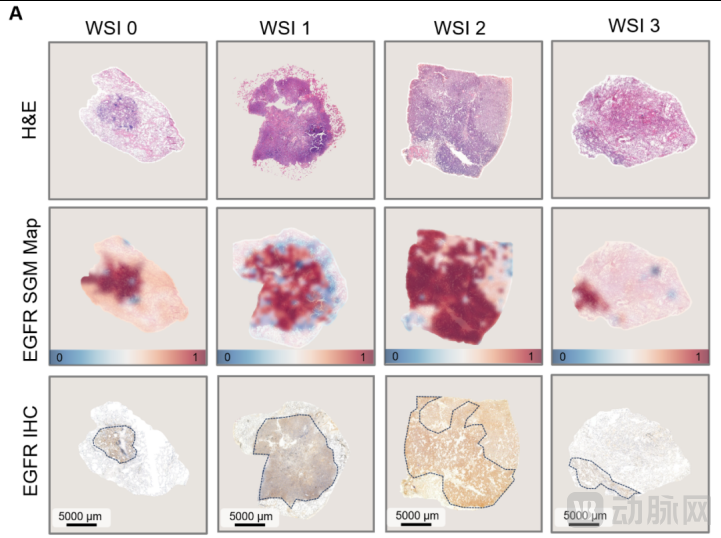
DeepGEM Large Model Showcases Spatial Distribution of Gene Mutations
Leveraging its extensive data on tumor pathology and molecular pathology diagnostic samples, KingMed Diagnostics included 4,260 lung cancer patient samples (comprising 8,520 digital slides) from medical institutions at various levels across 30 provinces in China in the validation study of the DeepGEM large model in 2025, conducting assessments by combining multi-gene next-generation sequencing technology with pathological image analysis.
The results indicate that the DeepGEM large language model demonstrates exceptional performance in predicting common lung cancer driver gene mutations, such as EGFR, KRAS, and ALK. Its key performance metrics have reached the reference level for clinical auxiliary diagnosis, exhibiting strong applicability and compatibility.
Professor Liang Wenhua stated in the interview, “In this study, we employed several innovative approaches. First, we used AI to analyze medical record images to directly predict mutations. Second, we applied unlabeled methods to certain pathological images, achieving comparable results while effectively reducing manual labor.”
Dr. Zhao Yu stated, "Traditional genetic testing struggles to meet the critical need for 'timeliness' in critically ill patients, and existing genetic testing technologies are unable to provide spatial maps of gene mutations."
Today, the DeepGEM large model’s ability to deliver rapid predictions within minutes enables patients with severe conditions to formulate treatment decisions more quickly and cost-effectively, allowing them to receive targeted therapy in a timely manner. This provides patients in regions where genetic testing is prohibitively expensive with the possibility of undergoing multi-gene mutation detection and receiving precision medicine. Meanwhile, the model is also expected to break through technical bottlenecks in future research, achieving end-to-end prediction of gene mutations.
Regarding future research directions for large pathology models, Li Yinghua, Vice President of KingMed Diagnostics, stated: “First, we must expand the predictive capabilities of large models to cover a broader range of cancer types, extending from lung cancer to liver cancer and gastrointestinal tumors. Second, by integrating multi-omics data, we aim to gain a deeper understanding of disease pathogenesis and trends in disease progression, thereby determining at which stage specific tumor treatments are most effective.”
Building on the research achievements of the DeepGEM large language model, KingMed Diagnostics, Tencent, The First Affiliated Hospital of Guangzhou Medical University, and the Guangzhou Institute of Respiratory Health will further expand their research on identifying tumor mutation genes, promote the clinical application of the DeepGEM large language model in predicting lung cancer gene mutations, and extend the validation of DeepGEM’s capabilities to other cancer types, jointly developing a multimodal large language model for pathological genomics.
Yao Jianhua, Chief Scientist at Tencent Life Sciences Lab, introduced that to address the clinical pain points of traditional genetic testing—namely high costs, long waiting times, and stringent sample requirements—the research team has demonstrated multiple core innovations in the application of artificial intelligence technology. By employing Multiple Instance Learning (MIL) and adopting an advanced “end-to-end” architecture that does not require manual annotation of tumor regions, the approach captures global information more effectively than traditional two-stage methods reliant on tumor segmentation, thereby enhancing prediction accuracy. Furthermore, the DeepGEM large model is applicable to various types of biopsy samples, including excisional and needle biopsies, and can generate spatial distribution maps of gene mutations to intuitively visualize their distribution within tissues.
Liang Yaoming, Chairman and CEO of KingMed Diagnostics, stated that the strategic collaboration with The First Affiliated Hospital of Guangzhou Medical University and Tencent to drive the development of a multimodal large model for pathological genomics represents one of KingMed Diagnostics’ key directions in exploring “AI + Medical Laboratory Services.” KingMed Diagnostics possesses massive data resources, having established a “data treasury” that covers common lesions and rare genetic mutations, while also offering abundant application scenarios for new technologies. “We aim not only to advance tumor diagnosis but also to collaborate with more partners across disciplines to jointly pioneer a new paradigm of smart medical laboratory services. Our goal is to deliver more intelligent and inclusive clinical diagnostic solutions for the precise diagnosis of non-cancerous conditions, as well as rare and complex diseases.”
He Jianxing, Director of the National Center for Respiratory Medicine at the First Affiliated Hospital of Guangzhou Medical University, stated that the successful deployment of the DeepGEM large model at KingMed Diagnostics marks a milestone in the exploration of pathology-genomics multimodal AI large models. In the future, AI-driven intelligent medicine will become the norm. The collaboration in clinical research among healthcare institutions, KingMed Diagnostics, and Tencent will help accelerate the translation and implementation of medical AI research achievements. “We hope to provide a demonstrative model for collaborative translation of research outcomes, promoting the genuine translation of clinical research into practical clinical applications, thereby benefiting public health.”
In the future, the three parties will develop a multimodal large model for pathological genomics. By integrating information from pathological morphology, proteomics, and metabolomics, they aim to achieve generalized AI-assisted diagnosis across multiple anatomical sites, cancer types, and omics dimensions.