

Huazhong University of Science and Technology Union Hospital to Transfer Soft Tissue Repair Technology for RMB 1 Million
Recently, Union Hospital, Tongji Medical College of Huazhong University of Science and Technology, released a public notice on the transformation of scientific and technological achievements, proposing to transfer a“Preparation Method and Application of a Supramolecular Co-assembly Gel Based on α-Helical Amphiphilic Peptides”Transfer of Invention Patents, with Pricing Determined by AgreementRMB 1 million。
This achievement was jointly accomplished by a research and development team from the Department of Plastic Surgery at Union Hospital, Tongji Medical College, Huazhong University of Science and Technology, comprising Wu Yuanhao, Zhang Guo, Su Shanshan, Yu Zhiquan, Xiong Lingyun, Yang Jie, and Professor Sun Jiaming.
The invention team has long been dedicated to research in soft tissue engineering and regenerative medicine. Professor Sun Jiaming serves as the Director of the Department of Plastic Surgery, Director of the Institute of Plastic Surgery, and academic leader at Union Hospital affiliated with Huazhong University of Science and Technology. He is a chief scientist for the National Key R&D Program and has long been committed to basic research in stem cell-based bio-tissue engineering and clinical research on the reconstruction of body surface organs. Professor Wu Yuanhao is an Associate Chief Physician in the Department of Plastic Surgery at Union Hospital affiliated with Huazhong University of Science and Technology. His research interests include de novo design of supramolecules and AI-driven prediction, in situ structural analysis of self-assembled architectures, engineering applications combining additive manufacturing, and clinical applications in soft tissue regeneration.
The assignee of this patented technology, Suzhou Yiyuan Biotechnology, is a regenerative medicine company, whose controlling shareholder is Hangzhou Baimai Biotechnology. The latter is a genetic testing company with precision medication as its core business, and its products mainly involve personalized medication for cardiovascular and cerebrovascular diseases. It is worth mentioning that,Yiyuan Biotech and its three shareholders are all under the control of a single actual controller.
According to the patent specification, this patent proposesAn Innovative Method for Preparing Supramolecular Co-assembly Gels. Its core technology lies in the preparation of specific α-helical amphiphilic peptides using Fmoc solid-phase peptide synthesis, followed by palmitoylation modification and purification. These peptides are then mixed with collagen-rich components extracted from soft tissues such as human adipose tissue, undergoing a reaction that leads to self-assembly into a gel with a three-dimensional network structure.
This material is designed to address the currentAutologous Fat Grafting in the Repair of Soft Tissue Defects on the Body SurfaceThe core challenges currently faced include high absorption rates of adipose tissue post-transplantation, unstable survival rates, and poor maintenance of contour due to insufficient mechanical support.
Superficial Soft Tissue Defects, has always been a significant challenge in the field of plastic surgery. To address this issue,Autologous Fat Grafting Technology Emerges as NeededThis technique achieves repair by aspirating excess autologous fat and grafting it into areas with soft tissue defects. Due to its wide availability, ease of procedure, and excellent biocompatibility, autologous fat transplantation has been widely applied in various plastic and reconstructive surgical procedures.
However, autologous structural fat grafting is limited by high rates of in situ resorption and low graft survival, which compromises its ability to provide effective mechanical support and hinders contour shaping, thereby significantly adversely affecting long-term surgical outcomes.How to Improve the In Situ Survival Rate of Autologous Fat Grafts and Ensure Adequate Mechanical Support, becoming a pressing scientific challenge in plastic surgery.
To address the issue of low fat graft survival rates, some early studies incorporated bioactive components such as platelet-rich plasma (PRP) or adipose-derived stem cells into autologous fat grafts to promote in situ vascularization, thereby improving fat survival to a certain extent. However, the low survival rate of stem cells continues to limit the application of this technology.
In addition, based onEnhancing the Bioactive Components of Autologous Fatconcept, Patrick Tonnard and colleagues from the Department of Plastic Surgery at Brussels University Hospital in 2013First Proposed the Nanofat Grafting Technique. This technique effectively disrupts mature adipocytes by repeatedly pushing and aspirating the extracted fat, thereby concentrating bioactive components within the fat (such as adipose-derived stem cells and growth factors), which significantly promotes soft tissue regeneration and skin rejuvenation. Therefore,NanofatIt has been widely used in cosmetic surgery. However, due to the lack of mature adipocytes, nanofat cannot provide large-volume filling effects with mechanical support.
To address the issue of insufficient structural support in transplanted adipose tissue, the solution lies inModification of Fat Structure. Professor Lu Feng's Team at Nanfang Hospital, Southern Medical UniversityFirst to report the preparation method of adipose acellular matrix/stromal vascular fraction gel. Injectable fat gel can be formed through simple syringe-based emulsification and centrifugation. This fat gel not only concentrates bioactive components to promote in situ regeneration, but also retains the extracellular matrix, providing certain mechanical support, thus offering an innovative approach to addressing this challenge.
Furthermore, the semi-autologous tissue transplantation approach involves mixing adipose tissue with biomaterials and subjecting them to chemical modification, enabling the adipose tissue to provide bioactivity while hydrogel-based biomaterials such as collagen and hyaluronic acid serve as scaffolding support. However, the application of this approach is constrained by several factors, including a limited selection of biomaterials, poor tissue compatibility, and significant challenges in achieving a homogeneous mixture with adipose tissue.
To address the limitations of the aforementioned prior art, the research team proposedPreparation Method and Application of Supramolecular Co-assembly Gel Based on α-Helical Amphiphilic PeptidesThis method utilizes widely available autologous fat as the raw material and modifies the extracellular matrix structure of Nanofat through supramolecular co-assembly technology to prepare an injectable co-assembled gel. This gel not only replaces simple fat grafting by providing adequate mechanical support but also retains the ability of Nanofat to promote adipose tissue regeneration, effectively addressing the bottlenecks of low survival rates and weak mechanical support associated with autologous fat filling.
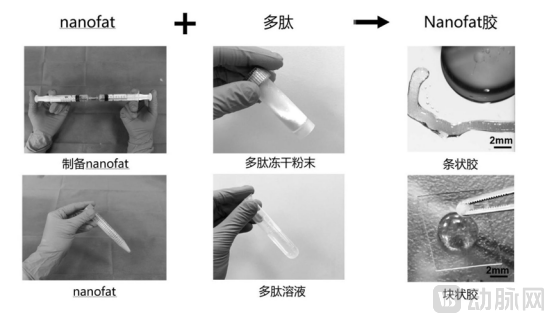
Figure from the patent specification
Soft tissue regeneration refers to the process by which damaged soft tissues in the body (such as skin, muscle, and blood vessels) restore their original structure and function through cellular proliferation, differentiation, and tissue remodeling. Its core mechanism isThe process by which repair cells are recruited via inflammatory signals following injury, gradually restoring the tissue’s original structure and function through cell proliferation, differentiation, and extracellular matrix remodeling.. This technology is widely applied in both conventional medicine and medical aesthetics, serving as a key technical direction that combines clinical therapeutic value with aesthetic enhancement, including tissue repair, tissue improvement, and anti-aging interventions. Therefore, tissue repair remains a prominent topic in both conventional medicine and medical aesthetics.
Serious Medical Field,Neural Repairrepresents the highest barrier. Academician Gu Xiaosong of Nantong University has accumulated extensive expertise in this fieldOver 30 years, proposed“Construction of Biodegradable Tissue-Engineered Nerves”His academic perspectives have been included in textbooks at the University of Cambridge. Furthermore, the biodegradable artificial nerve grafts he invented have been applied in clinical practice.
Certainly, soft tissue repair also holds significant technical and market potential in the fields of vascular repair, uterine repair, and corneal repair. In these areas, Professor Dai Jianwu from the Institute of Genetics and Developmental Biology, Chinese Academy of Sciences, has obtained multiple product registration certificates, and his proposed“4S Shop for the Human Body”The theory encompasses the regeneration and repair of virtually all soft tissues in the human body, including neural restoration.
On the other hand, the industry is alsoGene Editing, Cell Cultureempowered by such technologies, it has embarked on differentiated exploration.
For instance, “BioTendon,” an allogeneic tendon repair material developed by Beijing Kejian Bio, is the only approved product in China for repairing tendon defects. Regend Therapeutics has strategically focused on organ regeneration; its REGEND001 product has completed Phase II clinical trials for the treatment of idiopathic pulmonary fibrosis, while REGEND003 is being developed for type 2 diabetes complicated by chronic kidney disease. Humacyte specializes in vascular regeneration, and its off-the-shelf bioengineered human acellular vessel, Symvess, has entered the early commercialization stage in the United States, where it is used for vascular trauma repair and the creation of hemodialysis vascular access.
Diverse applications and breakthroughs signify that soft tissue repair is gradually transitioning from science fiction to reality. Today, this field is experiencing a dual acceleration in technological iteration and clinical translation. Each breakthrough in basic research opens new possibilities for clinical application, while precise strategic positioning by the industry is clarifying the pathway for technological implementation.
However, achieving widespread adoption of soft tissue regeneration still requires overcoming numerous obstacles. Key challenges that the industry urgently needs to address include further improving the functional compatibility between regenerated and native tissues, avoiding immune rejection and ethical controversies, and reducing the costs of technologies and products.
It is promising that the deepening interdisciplinary integration, coupled with the precision enhancement of gene-editing technologies, innovative development of biomaterials, and mature application of 3D bioprinting, is providing solutions to these bottlenecks. In the future, when soft tissue regeneration technologies can serve clinical practice more safely, efficiently, and accessibly, they will not only enable countless patients who have lost health due to tissue damage to regain their vitality but also open up new and vast possibilities for safeguarding human health and improving quality of life, truly achieving a leap from “repairing damage” to “optimizing life.”