

Sand-Grain-Sized 'Couriers': Magnetically Guided Microrobots Usher in a New Era of Precision Drug Delivery
Imagine a “courier” no larger than a grain of sand swimming upstream through human blood vessels, precisely delivering medication to the site of disease, and then dissolving and disappearing after completing its task. This is not a science fiction movie, but rather the latest breakthrough just published in Science by a research team at ETH Zurich.

(Source: Science)
On November 13, 2025, a research team led by Fabian Landers announced that their magnetically guided microrobot system achieved a drug delivery success rate of over 95% in large-animal experiments. This technology is expected to enter clinical practice within 5–10 years, bringing about a revolutionary transformation in precision medicine.
Each year, 12 million people worldwide suffer from stroke, with many dying or sustaining permanent disabilities. During treatment, physicians administer thrombolytic drugs to dissolve blood clots obstructing the vessels. However, these drugs disseminate throughout the body via the bloodstream. To ensure sufficient drug concentration reaches the clot site, clinicians are compelled to use higher doses. This is akin to scattering packages throughout an entire building just to deliver one to a single room—resulting not only in waste but also posing risks of serious side effects, such as internal bleeding.
This is not an isolated case. Statistics show that approximately one-third of developed drugs fail to reach the market due to excessive toxicity. Systemic drug therapies often cause unnecessary side effects due to off-target exposure, accounting for nearly one-third of clinical trial failures. The root of the problem lies in the fact that drugs typically need to act only on specific areas of the body, yet traditional administration methods allow them to circulate "aimlessly" throughout the entire system.
The medical research community has long been seeking a solution: Can drugs be delivered with the precision of a courier service, going “door-to-door” directly to the sites requiring treatment? For decades, scientists have tried various approaches, including ultrasound-guided microrobots and bacteria-mimicking rotary devices, but none have fully addressed the complex challenges of clinical application.
The research team at ETH Zurich has achieved significant breakthroughs across multiple levels. They have developed a modular magnetically guided microrobot platform that seamlessly integrates an electromagnetic navigation system (Navion), a customized delivery catheter, and drug-loaded dissolvable capsules, forming a complete clinical-ready system.
At the core of this technology is a gelatin-based spherical capsule, no larger than a grain of sand. Encapsulated within are three key components: magnetic iron oxide nanoparticles, radiopaque tantalum nanoparticles, and the therapeutic agent to be delivered.
“Because the blood vessels in the human brain are extremely small, there are strict limits on the size of the capsule. The technical challenge is to ensure that such a tiny capsule still possesses sufficient magnetic properties,” explained Fabian Landers, lead author of the paper and a postdoctoral researcher at the ETH Laboratory for Multi-Scale Robotics.
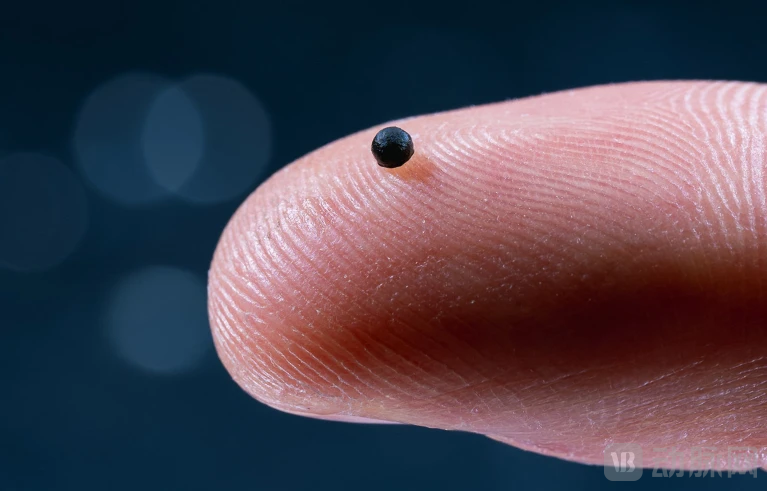
Figure: Microrobots loaded with drugs (Source: Luca Donati/lad.studio Zürich)
This seemingly simple combination actually requires perfect synergy between materials science and robotics engineering. Although tantalum nanoparticles can provide good X-ray contrast effects, their higher density and weight make them difficult to control. The research team spent many years developing precise iron oxide nanoparticles, achieving a delicate balance between magnetic functionality, imaging visibility, and precise control.
"Integrating magnetic functionality, imaging visibility, and precise control into a single microrobot requires perfect synergy between materials science and robotics engineering, which took us many years to successfully achieve," said Bradley Nelson, an ETH professor who has been researching microrobots for decades.
To maintain controllable motion within complex vascular systems, microrobots must adapt to varying speed requirements, ranging from precise positioning to rapid counteraction of blood flow. The research team has developed three complementary magnetic navigation strategies that can be intelligently switched according to situational needs.
Scroll Navigation:A rotating magnetic field is used to roll the capsule along the vessel wall, akin to a small ball rolling forward along the inner surface of a pipe. This approach offers extremely high precision, with speeds reaching up to 4 mm per second, making it suitable for fine localization in relatively straight segments of blood vessels.
Gradient Traction:Magnetic field gradients—i.e., spatial variations in magnetic field strength—are used to “pull” microrobots toward target locations. This approach generates substantial force, enabling capsules to move against the flow and operate stably even in blood vessels with flow velocities exceeding 20 cm/s.
Downstream Navigation:When encountering complex structures such as vascular bifurcations, the system adjusts the direction of the magnetic field gradient to guide the capsule into the correct branch vessel with ease.
By integrating these three navigation strategies, researchers achieved precise control over microrobots across diverse flow conditions and anatomical scenarios. In more than 95% of test cases, the capsule successfully delivered the drug to the target location.
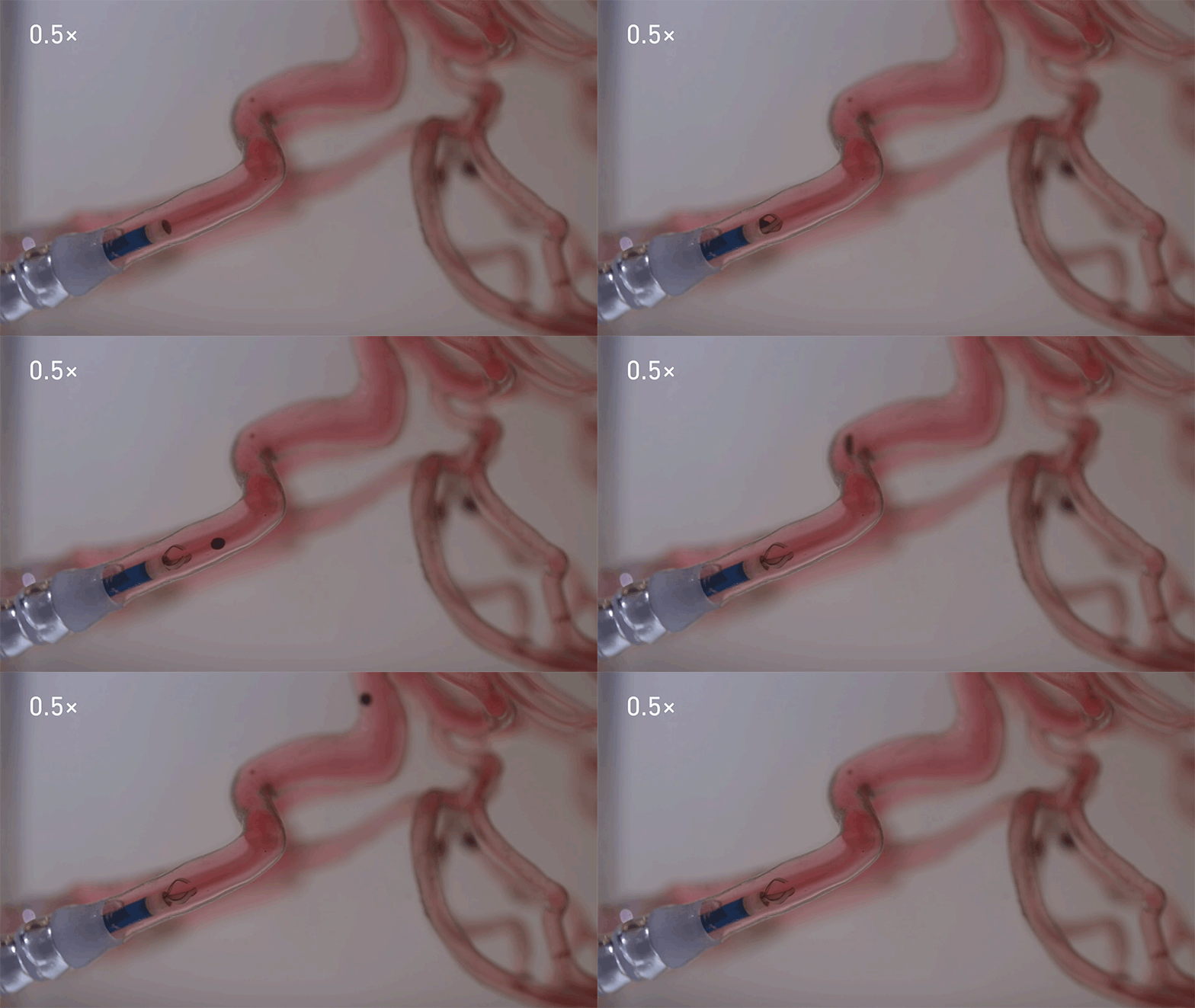
Figure: Demonstration of robot motion (Source: ETH Zürich)
Once the microrobots reach the target location, the system activates a high-frequency magnetic field to heat the magnetic nanoparticles within the capsule. The generated heat dissolves the gelatin shell, enabling precise drug release. The entire process is fully controllable, allowing physicians to monitor in real time via X-ray imaging to ensure drug delivery at the correct site.
To validate the clinical feasibility of this technology, the research team conducted rigorous, multi-level testing. They developed silicone models that accurately replicated the vasculature of both patients and animals, and after extensive optimization, performed animal experiments under real-world clinical conditions. In porcine studies, all three navigation methods were proven effective, with the microrobots remaining clearly visible throughout the procedures. More notably, the team successfully navigated microrobots within the cerebrospinal fluid of sheep—an extremely complex anatomical environment—paving the way for precise treatment of neurological disorders.
This study represents a significant milestone in the field of microrobot-based drug delivery. In recent years, this area has witnessed rapid development: in June 2025, Science Robotics reported on the use of magnetic microrobots to treat deep sinus infections; by late 2024, another study demonstrated a combined ultrasound- and magnetic-controlled targeted delivery technology. These advances collectively point to a clear trend: microrobots are transitioning from the laboratory to clinical practice, emerging as important tools for precision medicine.
Compared with traditional nanodrug carriers, the core advantage of magnetically guided microrobots lies in their active navigation capability—precisely controlled by external magnetic fields rather than passively relying on blood flow diffusion—thereby enabling them to reach deep tissues, narrow blood vessels, and other sites that are difficult to access using conventional methods. This capability allows the technology to demonstrate broad application prospects in areas such as stroke treatment, local infections, precise tumor therapy, and neurological disorders.
The research team’s next goal is to initiate human clinical trials as soon as possible. Wei Gao, a medical engineer at the California Institute of Technology, commented, “These demonstrations are compelling. If further research progresses smoothly, remotely controlled drug-delivery robots could be deployed in initial medical applications within five to ten years.”
The significance of this study lies not only in its technological breakthroughs but also in providing new strategies to mitigate the off-target toxicity associated with conventional systemic administration. Precision drug delivery technologies hold the promise of transforming the current landscape, where severe side effects are often caused by high-dose regimens. From materials science to robotics engineering, and from in vitro models to animal studies, multidisciplinary collaborative innovation is ushering in a new era of precision drug delivery.
“What drives us is the knowledge that we possess a technology capable of helping patients more quickly and effectively, offering them new hope through innovative therapies,” said Landers. Although there is still a long way to go before clinical application, this technology has already outlined a future of healthcare that is more precise, safe, and effective—one in which drugs no longer wander “aimlessly,” but instead deliver their “packages” precisely to every required “address,” much like well-trained couriers.