

GentleFlow Bio Files IPO Prospectus: Breaking Import Monopoly with AI-Driven Modular Large-Scale Lab Automation Platforms
gentleflow
Developer of Laboratory Equipment and Consumables in Biological and Chemical Fields
In recent years, the concept of the “AI scientist” has moved from science fiction to reality: with the emergence of FutureHouse’s AI scientists in the United States and China’s general-purpose scientific research agent, SciMaster. Algorithms can now generate hundreds or even thousands of experimental protocols within minutes. However, the execution of these experiments still relies on manual pipetting and repetitive sample loading.The acceleration of thought stands in stark contrast to the slowness of action.
Despite years of development in laboratory automation in China and a surge in financing since 2020, most existing solutions remain limited and singular, failing to meet the demands of laboratory scenarios accelerated by AI-driven research.
“The speed at which AI generates proposals is incredibly fast, but experimental execution still relies on humans—this is the greatest contradiction in scientific research efficiency,” pointed out Tan Xiaoshan, founder of Gentleflow Biochemical Technology (Guangzhou) Co., Ltd. (hereinafter referred to as “Gentleflow”). “The true bottleneck of AI-driven scientific research lies not in algorithms, but in experimental execution. What we aim to do is ensure that ideas generated by AI can be truly validated in the laboratory.”
This insight has not only propelled Gentleflow’s transformation from a manufacturer of laboratory consumables into an AI-plus-automation platform service provider, but also marked a significant step forward in breaking the import monopoly in China’s laboratory automation sector.
Targeting the Pain Points of “Manual Workshops” and Precisely Filling the Gap in “Large-Scale Workstations”
GentleFlow Bio, established in 2018, initially operated as a manufacturer of life science consumables. Its early clientele included multiple automation equipment manufacturers and research institutions, with its core business focusing on pipette tips, assay kits, and consumable components.
During the pandemic, domestic demand for scientific research and medical testing surged. While supplying upstream automation companies, Gentleflow keenly identified a widening gap: the execution phase in research laboratories remained stuck in the “manual workshop” stage.
“At that time, we discovered that the barrier to laboratory automation was not just capital, but also the flexibility to adapt to local conditions and specific needs,” recalled Tan Xiaoshan. “Imported equipment was too expensive, too slow, and too rigid. Scientific research evolves rapidly, yet those machines were simply too ‘unresponsive to human needs.’”At that time, the high-end laboratory automation market was nearly monopolized by four major imported brands—Tecan, Hamilton, Beckman, and Revvity—which collectively accounted for approximately 90% of the market share in the field of large-scale workstations in China.Although there are 20 to 30 domestic manufacturers, Chinese competitors are mostly concentrated in the small and medium-sized equipment segment (where domestically produced products account for approximately 30% to 40%). Large-scale equipment largely relies on customized development, resulting in long delivery cycles and limited applications.
In the early years, the industry widely adopted fixed multichannel pipette designs (which met basic experimental needs at the time), and thus did not prioritize the development of flexible eight-channel technology. This provided Gentleflow Biochem with a fair competitive landscape. Today, complex research scenarios such as synthetic biology and drug screening have driven demand for more advanced experimental capabilities. Traditional domestically produced fixed multichannel designs are no longer adequate to support the efficient execution of such complex workflows.
"We“It was clear from the outset in 2024 that we would focus on mid-range and large workstations, particularly high-end large workstations.”Tan Xiaoshan stated bluntly, “The share of domestically produced products in this field is less than 5%, indicating enormous potential.” Consequently, Gentleflow abandoned the generic imitation route and opted to build an “AI + Modular Automation” platform. “We are not competing on price; instead, we are leveraging technology to break price monopolies. We believe that only through modularity and intelligence can automation achieve true widespread adoption.”
In just over a year, Gentleflow has built a comprehensive product matrix covering “small-scale tools – mid-sized platforms – large-scale systems.”: The MiniAssist/FlowHT series (RMB 50,000–80,000) focuses on PCR system setup and sample concentration normalization, addressing basic liquid handling needs akin to intelligent multichannel pipettes; the SmartBench series (RMB 180,000–600,000) achieves full-process automation of molecular biology experiments with a single robotic arm, suitable for scenarios such as NGS library preparation and protein purification; the flagship Outstanding large-scale automation platform (RMB 700,000–2.5 million) leverages dual robotic arms and high-degree-of-freedom integration capabilities to support complex tasks such as synthetic biology strain construction and high-throughput drug screening, with performance benchmarked against imported equipment.
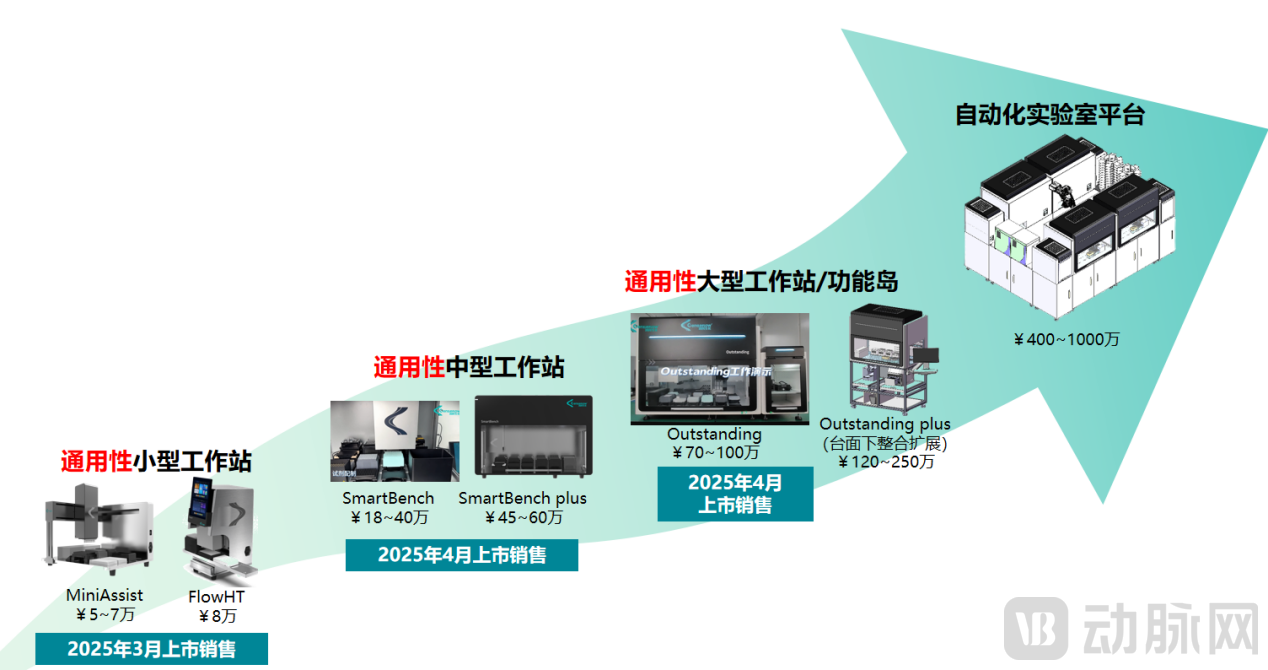
Overview of Gentleflow Biochemical's Product Matrix
As of July 2025, Gentleflow’s意向 orders reached RMB 130 million., with clients including the State Key Laboratory of the University of Science and Technology of China, Guangzhou National Laboratory, and multiple centers for disease control and prevention across various regions. Notably, it secured a large workstation order worth nearly RMB 2 million, marking the first time a domestic company has directly competed against and won a bid from imported brands in this field. “Previously, it was unimaginable for domestic companies to win multi-million-yuan orders for large workstations when competing alongside overseas enterprises,” Tan Xiaoshan admitted. This breakthrough has turned the slogan of high-end domestic substitution into reality.
Proprietary Core Modules + AI-Driven: Chinese Laboratories Accelerate Toward Automation and Intelligence
The ability to secure letters of intent is attributable to Gentleflow’s laboratory automation capabilities.
The Breakthrough in Laboratory Automation from 0 to 1 Requires the Synergy of Hardware and Intelligence,GentleFlow has not only overcome challenges in technology commercialization and achieved autonomous control over core modules, significantly breaking the monopoly of overseas technologies, but also promoted the upgrade of equipment from mechanical execution to intelligent response by establishing an AI-plus-automation closed loop.
1Core Modules 100% Domestically Produced, Breaking Industry Technological Monopolies
“China’s industrial automation is already quite mature, but what is lacking in the transition from industrial to laboratory automation is the adaptation of technology to scientific research applications,” pointed out Tan Xiaoshan. Leveraging the talent pool in the Greater Bay Area, Gentleflow has integrated industrial automation technologies with the needs of scientific research, rapidly achieving breakthroughs in core modules.
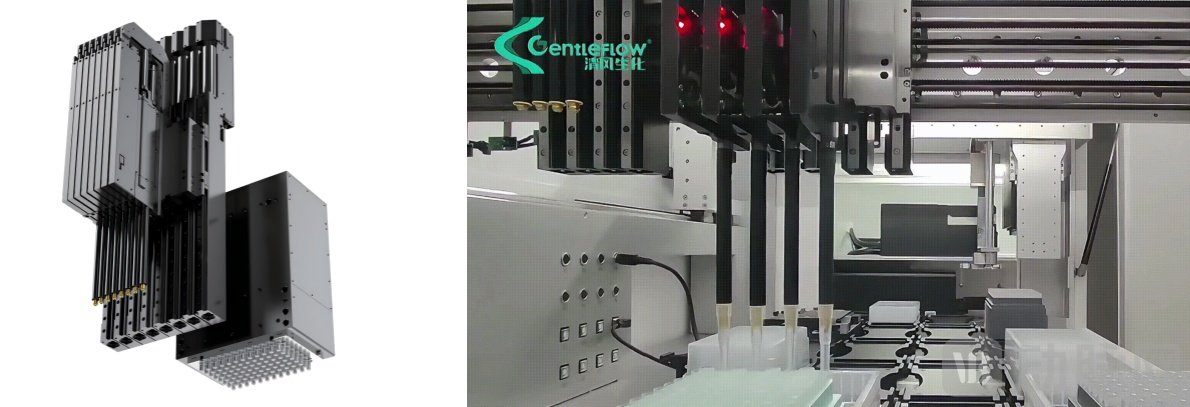
Actual Photo of Gentleflow’s Self-Developed Non-Uniform Spacing Flexible 8-Channel Pipetting Module
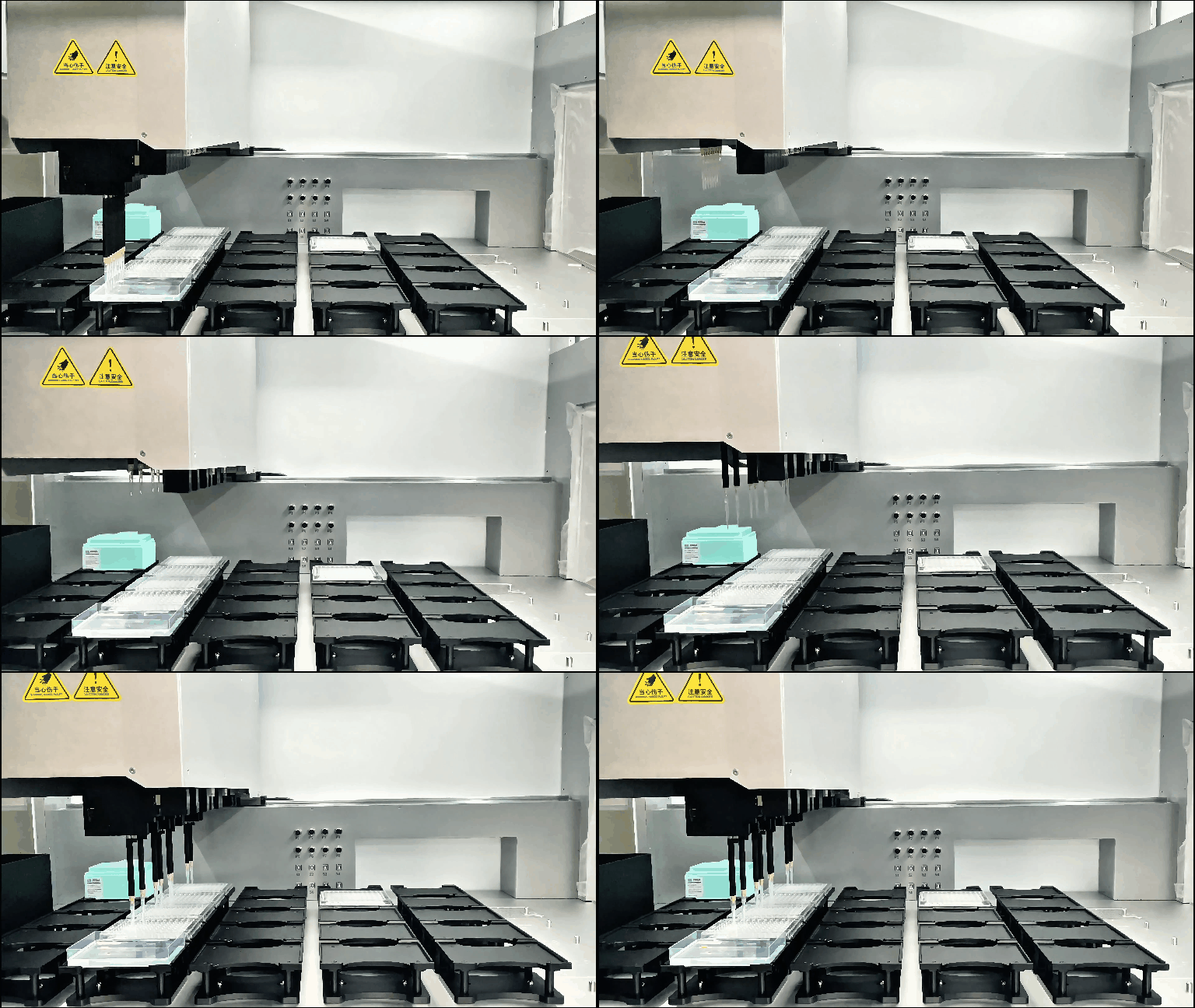
Non-equidistant Flexible Channel, Processing Four Plates Simultaneously in the Vertical Direction
As a core component of laboratory automation, the performance of pipetting modules directly determines experimental efficiency. Traditional imported equipment mostly adopts a fixed-pitch "multichannel" design, which is only compatible with standard plate formats. When encountering containers of different specifications or multi-plate parallel tasks, stepwise operations are required, significantly reducing efficiency.GentleFlow's self-developed non-uniform flexible eight-channel pipetting module enables independent control of each channel's spacing (up to 42 cm), height, and liquid level detection.——This technology is achievable by only a very small number of imported manufacturers. Gentleflow, however, is a rare domestic manufacturer capable of independent mass production and commercial deployment of large-scale multi-arm, multi-pipetting module workstations equipped with this pipetting module.
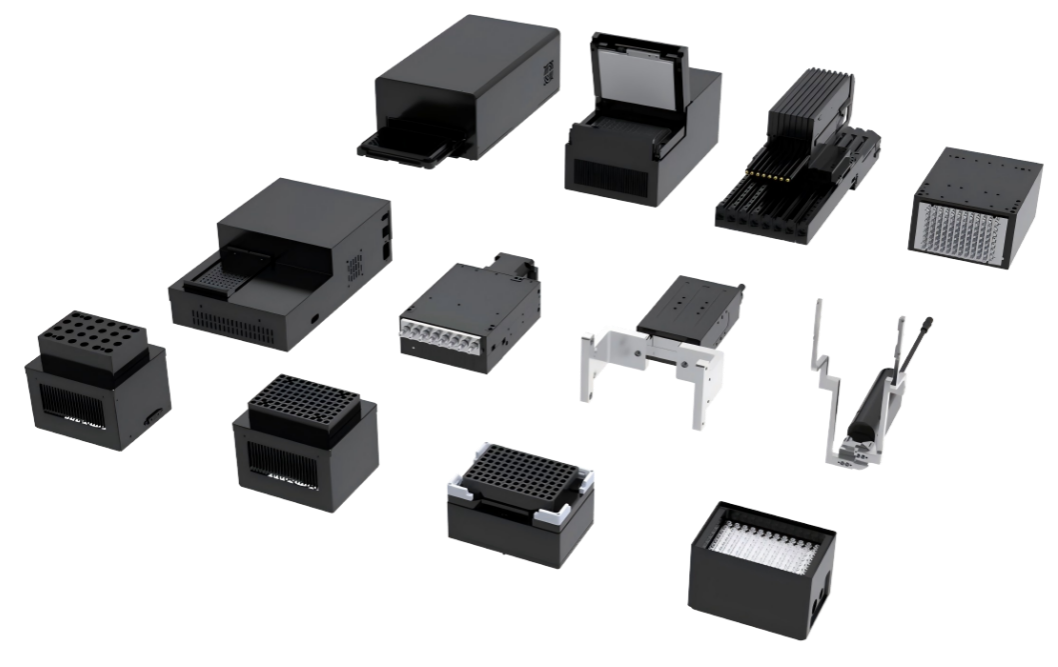
GentleFlow Biochemistry Module and Consumables Overview
More importantly,Gentleflow has achieved full end-to-end independent control over its core modules.“We should achieve 100% domestic production of core components,” introduced Tan Xiaoshan. From temperature control modules and automated PCR instruments to 96-channel fluidic modules and protein positive-pressure extraction modules, all are independently developed. Even for non-core but critical equipment such as automated centrifuges, GentleFlow Biochem engages in joint development with upstream suppliers, with GentleFlow defining product specifications based on application requirements to ensure compatibility with its own platform. This autonomy and controllability not only mitigates the risk of supply chain bottlenecks but also accelerates product iteration. Between the product launch in February 2025 and July, GentleFlow Biochem completed four iterations within five months. Based on 24/7 aging test standards, the equipment’s stability has reached a validation level equivalent to 4–5 years of normal customer use.
2AI + Automated Closed Loop: Build the “Infrastructure” First, Then the “Brain”
On the integration of AI and automation, Gentleflow adopts a pragmatic implementation approach: “With AI plus automation, automation serves as the infrastructure, while AI constitutes the superstructure. We first solidify the infrastructure, then gradually build intelligent capabilities.”
Currently, Gentleflow has completed the comprehensive setup of its automated infrastructure.On the hardware side, modular design allows customers to flexibly combine modules for pipetting, temperature control, detection, and more according to experimental needs—much like building with LEGO bricks—eliminating the need for full-process customization. On the software side, automated control software packages, script generation tools, and data tabulation features have all been fully implemented, with open API interfaces available for integration into customer-built systems.
For the planned AI modules, Gentleflow also has a clear division of labor:BioFlow AI is responsible for "command translation"”, translating scientists’ natural language into experimental requirements, thereby addressing the pain point of researchers lacking programming skills;Supervisor AI focuses on "experiment optimization", predict optimal experimental conditions and analyze complex results based on public literature data and customers' historical experimental data, thereby reducing trial-and-error costs.
“AI is not meant to replace scientists, but to help them expand the boundaries of cognition.” Tan Xiaoshan emphasized, “Humans may only be able to devise five experimental protocols, whereas AI can propose 100 based on massive datasets; however, final decision-making and disruptive innovation still rely on scientists.”
At this stage, Gentleflow has completed its foundational AI infrastructure. Upon securing subsequent financing, it will deploy AI laboratory robots and plans to initiate overseas market expansion in 2026. “We will first accumulate and validate use cases domestically to refine stability before addressing overseas market demands,” disclosed Tan Xiaoshan.
Flexible Adaptation + Rapid Response: Breaking Through Market Competition
In the untapped segment of domestically produced large-scale automated workstations, there is potential for multi-fold expansion. According to a report by Grand View Research, the global laboratory automation market size is projected to grow from approximately $8.2 billion in 2024 to $18.4 billion by 2033, representing a compound annual growth rate (CAGR) of 9.3%. Meanwhile, the Chinese market maintains a double-digit growth trend. A report by Market Research Future predicts that China’s laboratory automation market will increase from approximately $377 million in 2024 to around $1.5 billion by 2035, with a CAGR as high as 13.4%.
Faced with decades of technological accumulation by imported brands, Gentleflow did not blindly benchmark against them but instead leveraged differentiated advantages to carve out a market niche. “We acknowledge the gap between us and imported brands, but in key dimensions, we have our own strengths,” Tan Xiaoshan analyzed objectively.
GentleFlow outperforms in terms of flexibility and modular compatibility in automated control.Its platform adopts an open underlying design, allowing customers to flexibly combine modules according to experimental needs without the need for full-process customization; in contrast, most imported equipment relies on closed systems, where module expansion depends on the original manufacturer, resulting in long lead times and high costs.
The rapid response to customer needs is another major advantage of gentleflow.Tan Xiaoshan cited an example, noting that a client once requested optimization of the underlying code to accommodate a specialized board type, which Gentleflow completed within one week; in contrast, industry feedback indicates that imported brands typically require more than six months to address similar requests. Furthermore,Gentleflow has established service centers in eight core cities across China, with after-sales service requests addressed within 48 hours.
The price advantage further amplifies gentleflow's competitiveness. The average price of gentleflow products is only 50%–60% that of imported brands.Taking the Outstanding large-scale platform as an example, imported devices of the same category are priced at over RMB 3 million, while Gentleflow’s equivalently configured product costs only RMB 1.7 million. The independent in-house development of core modules further avoids the cost markup associated with external procurement, making high-end automated equipment more accessible. “We do not compete for market share through low prices, but rather reduce costs through technological optimization,” emphasized Tan Xiaoshan.
Anchoring on Three High-Growth Tracks to Seize the First-Mover Advantage in Research Automation
Regarding the future of China's smart laboratory market, Tan Xiaoshan predicts that the core growth drivers over the next five years will be concentrated in three major areas:First, synthetic biology, “There will be a significant number of large-scale automation projects in this field,” with an urgent demand for end-to-end automation spanning gene assembly, colony screening, and protein purification;Second, the construction of biobanks, as the sample size surges, automated storage, processing, and analysis have become essential;3. Drug Development and Organoid Research“Drug screening efficiency and the standardization of organoid culture are both inseparable from automated support.”
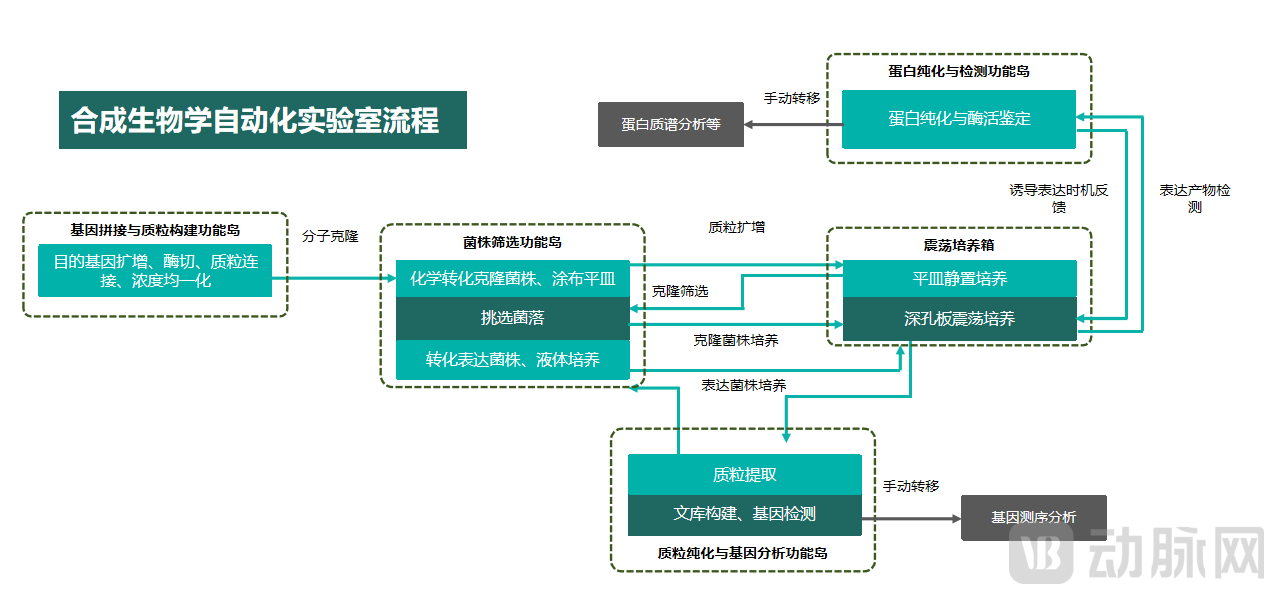
Synthetic Biology Automation Platform
GentleFlow has strategically focused on three key sectors. In the field of synthetic biology, its Outstanding platform enables full-process automation covering “target gene amplification–plasmid extraction–colony picking–cultivation–protein purification,” which, combined with parameter optimization, can significantly shorten the strain screening cycle. In drug development scenarios, its high-throughput pipetting and detection modules can increase the sample throughput per experiment by dozens of times. Even for routine testing in disease control systems, GentleFlow’s equipment can be rapidly adapted through modular configurations.
As AI redefines the imagination of scientific research, the execution capability of experiments has become a new focal point of competition. The explorations by industry players such as Gentleflow Biochemical have not only broken the monopoly of imported brands in the high-end laboratory automation market but also reshaped the value logic of scientific research—liberating scientists from repetitive tasks so they can focus on hypothesis generation and innovative breakthroughs.
“Our goal is to return scientific research to thoughtful inquiry, rather than being bogged down by repetitive tasks.” Tan Xiaoshan’s summary highlights a critical pain point in the industry. As scientific research enters an era of “AI agent competition,” experimental automation has become the key to breaking through this bottleneck. Gentleflow Biochemistry is driving the transformation of research from “labor-intensive” to “intelligent and unmanned” operations through its proprietary technologies and intelligent closed-loop systems, offering products that combine universal standard large-scale workstations with AI capabilities.