

From Artificial Organs to Advanced Batteries: Breakthrough Stretchable PEG Material Opens New Pathways
On October 29, 2025, a study published by the Soft Biological Matter Laboratory at the University of Virginia in the journal Advanced Materials brought about breakthrough progress in the fields of biomedical materials and energy technology.
This study, led by Liheng Cai, Associate Professor of Materials Science and Engineering and Chemical Engineering, with doctoral student Baiqiang Huang as the first author, demonstratesA Novel Manufacturing Method for Polyethylene Glycol (PEG) Materials, successfully transforming this widely used biomaterial from brittle toHighly Stretchable Elastomers, while achieving3D Printing Capabilities。
(Source: Advanced Materials)
With its excellentStretchability and Biocompatibility, this material is poised to become an ideal choice in biomedical fields such as artificial organs, tissue engineering, and medical implants. Its 3D printability not only enables the design of complex, personalized structures but also drives the development of customized medical devices and intelligent flexible electronics. Meanwhile, the material also demonstrates significant potential as a high-performance solid-state electrolyte in the new energy sector, contributing to the advancement ofNext-Generation Flexible Batteries and Energy Storage Devicesthe research and development of.
Polyethylene Glycolis a star material in the biomedical field, widely used in tissue engineering and drugIt has been widely used in applications such as drug delivery. Its excellent biocompatibility and biodegradability make it an ideal choice for in vivo applications. However, traditional PEG materials have long been plagued by a fatal flaw:Brittleness.
The current standard method for producing PEG networks involves forming a network structure by cross-linking linear PEG polymers in water, followed by water removal. Although this approach is straightforward, the resulting structures are brittle and prone to crystallization, rendering them unable to withstand stretching without compromising their integrity.
This brittleness severely limits the use of PEG in many critical applications—such as large structures requiring flexibility and motion, scaffolds needed for synthetic human organs, and medical devices that must withstand a certain degree of deformation.
“A breakthrough in elasticity is a key feature, as stretchability will enable PEG networks to be used in larger structures or those requiring a certain degree of flexibility and movement.”The research team pointed out in the paper.
University of Virginia GroupThe team’s solution did not simply improve the crosslinking method; instead, they redesigned the material at the molecular architecture level. They drew inspiration fromThe Core Philosophy Behind Manufacturing Elastic and Tough Rubber:Storage length in the internal structure at the molecular level.
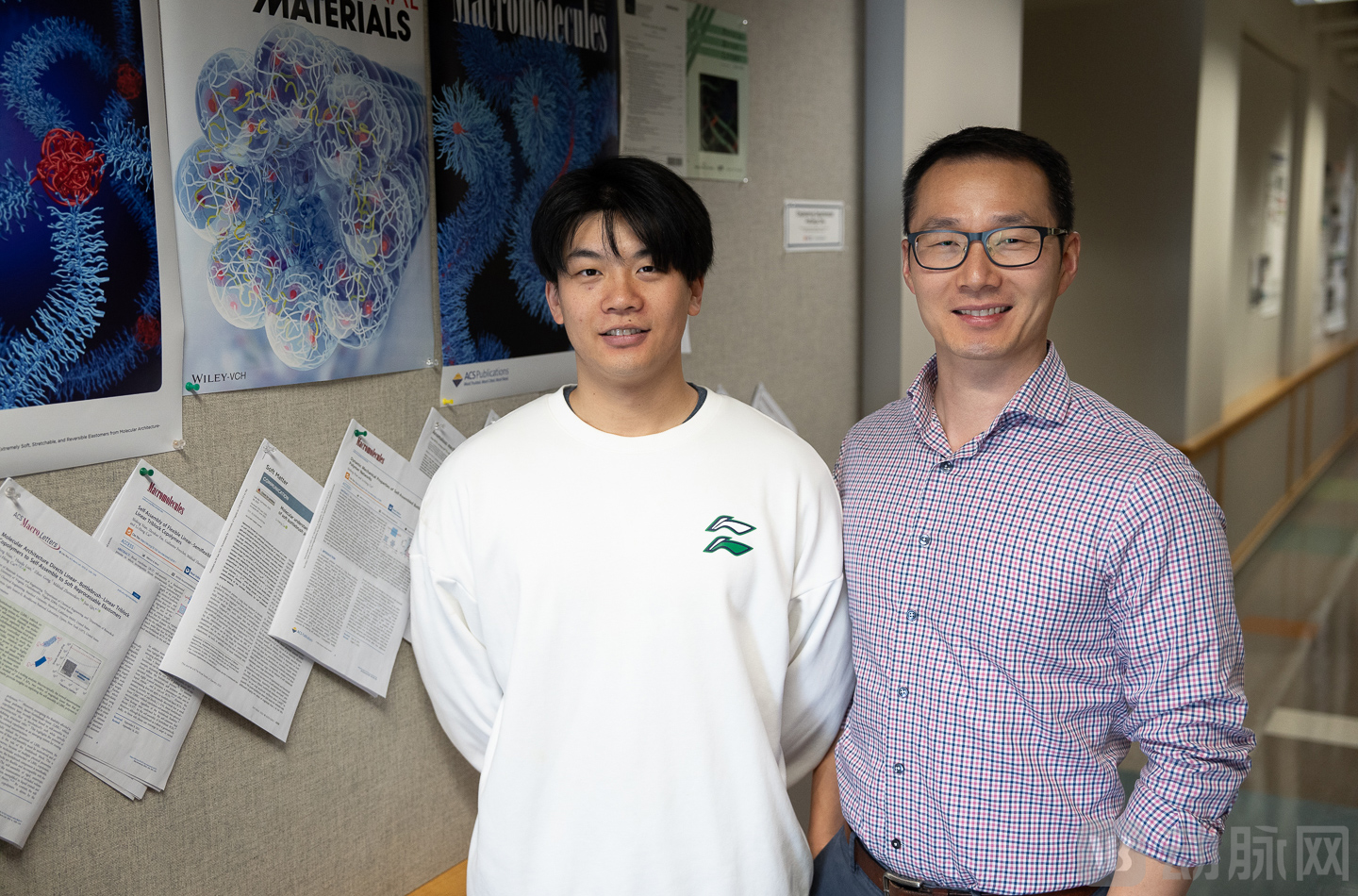
Figure: Baiqiang Huang, a Ph.D. student at the University of Virginia School of Engineering and Applied Science (left), and Associate Professor Liheng Cai (right) (Source: Matt Cosner, UVA Engineering)
This innovative design is called“Foldable Bottlebrush Polymer Architecture”In this structure, the polymer molecules possess multiple flexible side chains radiating from a central backbone, with the entire architecture resembling a bottlebrush. The key feature is that these side chains can fold and unfold like an accordion,Stores extra length in the folded state,When the material is subjected to tensile stress, it unfolds and releases, thereby achieving high stretchability.
“Our team discovered this polymer and used this structure to demonstrate that any material fabricated in this manner exhibits exceptional elasticity,” explained Professor Liheng Cai. This molecular architecture design renders the material both highly robust and exceptionally elastic, fundamentally altering the mechanical properties of PEG-based materials.
In terms of preparation methods, Baiqiang HuangApplication of the Concept of Foldable Bottlebrush Polymers to PEG, a concise and efficient manufacturing process has been developed. First, the research team synthesized PEG precursor molecules with a bottlebrush architecture and added a photoinitiator to prepare the precursor mixture. Subsequently, exposing this precursor mixture to ultraviolet light for just a few seconds initiates polymerization, forming a three-dimensional network with a bottlebrush structure.
The advantages of this process lie not only inSimple and Fast, but also in itsA perfect integration with 3D printing technology.“We can shape the ultraviolet light to create many complex structures,” introduces Baiqiang Huang. By controlling the UV light pattern and exposure parameters, layer-by-layer curing can be achieved to construct complex three-dimensional structures, with a printing resolution reaching the micron level.
This process can produce two main types of materials:Highly Stretchable PEG-Based Hydrogels Containing Water,Suitable for biomedical applications; andFully Cured Solvent-Free Elastomer, making it suitable for applications such as batteries. More surprisingly, by adjusting parameters like crosslinking density, bottlebrush side-chain length, and density, it is possible to fabricate structures that are both soft and rigid yet remain elastic, and even achieve this within a single structureGradient Performance.
The new material has achieved a qualitative leap in performance. Compared with the traditional PEG network, which typically exhibits an elongation at break of less than 50%, the new material can reachElongation of hundreds to thousands of percent, tensile properties improved>10- to 100-fold or more. The material successfully transitioned from brittle to ductile, enabling it to absorb substantial energy without fracturing during tensile deformation and to fully or partially recover its original shape after stretching.
While maintaining high stretchability, the material retains sufficient strength (ranging from several MPa to tens of MPa), and its Young's modulus can be tuned through design, with a rangeFrom soft (<1 MPa) to hard (>100 MPa). This tunability lays the foundation for the extensive application of the material.
In terms of biocompatibility, the research team conducted rigorousValidation of Cell Culture Experiments。
“Researchers cultured cells alongside the material to ensure coexistence and biocompatibility,” said Baiqiang Huang. Experimental results showed that cell viability was comparable to that of the control group (typically >90%), and the cells were able toNormal proliferation and morphology were maintained, with no toxic reactions observed.This biocompatibility makes it suitable for use in materials that enter the body, such as organ scaffolds.
The application prospects of new materials span multiple fields.
InBiomedicineIn terms of its high stretchability, biocompatibility, and 3D printability, the combination providesArtificial Organ Manufacturingbringing new possibilities. Materials can serve as scaffolds for synthesizing human organs, providing necessary structural support and flexibility while being compatible with the human immune system. 3D printing technology also enables personalized customization, allowing organ structures to be designed according to patients’ specific needs.
InDrug Delivery Systemsaspects, customizable 3D structures can be used to precisely control drug release rates, enabling targeted drug delivery, improving therapeutic efficacy while reducing side effects. InTissue EngineeringIn this field, the excellent mechanical properties and biocompatibility of materials can support the growth of various cell types and promote the recovery of tissue function.
Surprisingly, the materialEnergy Sectoralso demonstrates significant potential. The paper indicates that, compared with existing solid-state polymer electrolyte materials, the new material exhibits higher ionic conductivity and greater stretchability at room temperature.“This characteristic highlights the new material as a promising high-performance solid-state electrolyte for advanced battery technologies,”said Liheng Cai.
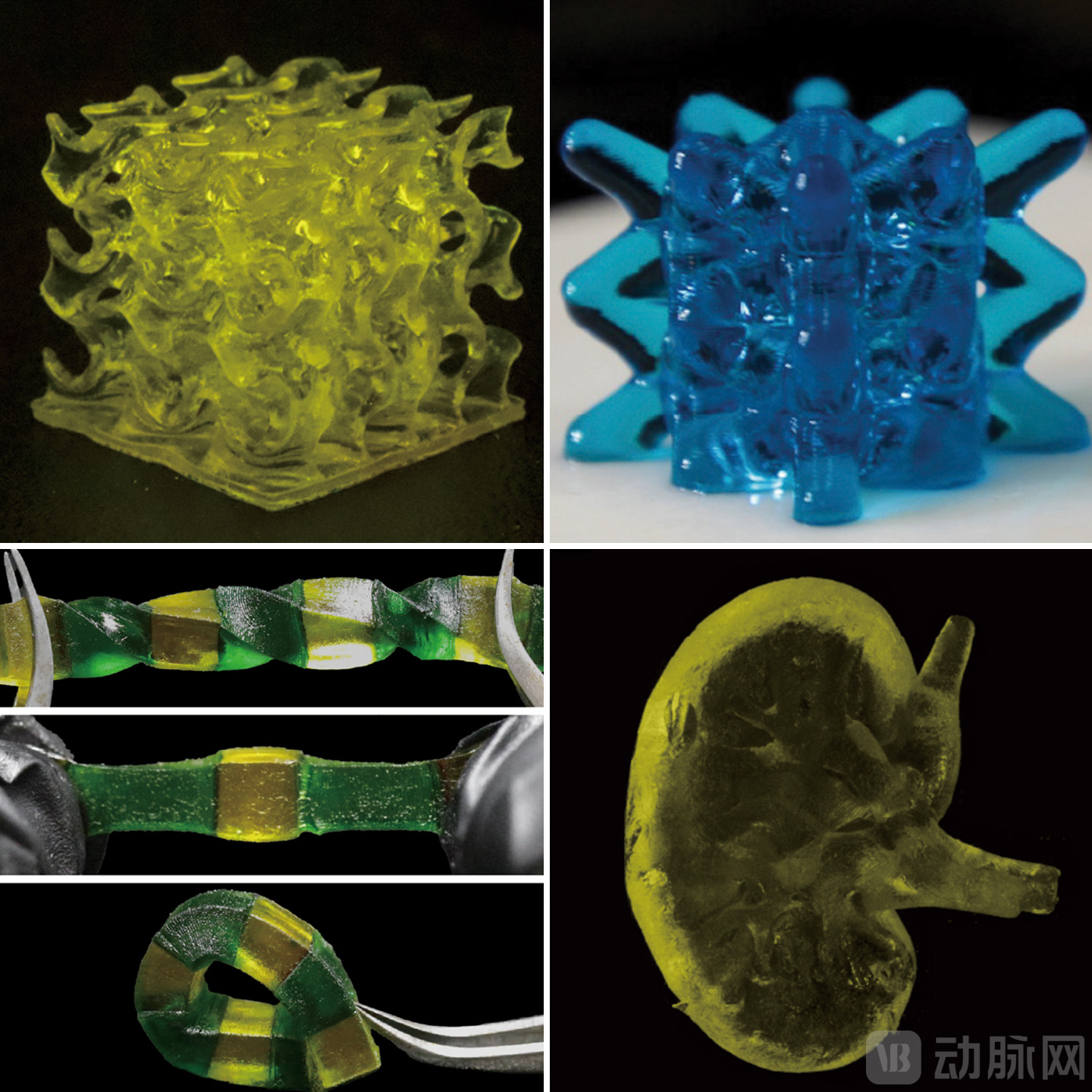
Figure: This new material can generate various structures with different properties, holding promise for applications ranging from organ transplantation to battery technology (Source: UVA Engineering)
Material'sHigh electrical conductivity (on the order of 10^-4 to 10^-3 S/cm)It can enhance the power density of batteries, while its high stretchability accommodates volume changes during charge and discharge cycles, providing better interfacial contact, thereby improving battery safety and cycle life. More importantly, the material maintains its conductivity even when stretched to several times its original length; thisMechanical-Electrochemical Coupling PerformancePaves the way for flexible batteries and high-performance solid-state batteries.
Cai Liheng’s team is also exploring the possibility of combining PEG with other materials, “"Creating 3D printing materials with different chemical compositions opens the door to many potential applications."
From the laboratory to industrialization, this material still requires optimization of its synthesis and printing processes to achieve scalable production, along with further long-term experiments to verify its stability. Nevertheless, this breakthrough undoubtedly brings new hope to multiple fields, ranging from artificial organs to advanced batteries, and opens up new directions for the development of materials science.
“Our team continues to explore potential expansions in solid-state battery technology research,”Liheng Cai stated. As research deepens, this breakthrough material is expected to move out of the laboratory in the near future, bringing about substantial changes to healthcare and clean energy technologies.