

Extracellular Vesicle-Mediated Gene Editing Breakthrough: A Novel Platform for Treating Genetic Disorders
Hearing loss affects more than 450 million people worldwide, with up to 50% of cases having a genetic origin.Although interventions such as hearing aids and cochlear implants can partially improve hearing loss, they do not address the underlying causes of the disease. In recent years,Gene Editing TechnologyIt has brought hope for the treatment of monogenic deafness, but the limitations of existing delivery methods have consistently constrained the progress of clinical translation.
On November 12, a study published in Science Translational Medicine by Associate Professor Mei He’s team at the University of Florida College of Pharmacy brought breakthrough progress to this field. The research team developed aMicrofluidic Droplet-Based Electroporation System for Extracellular Vesicles (μDES), successfully delivered gene-editing tools to cochlear hair cells in mice, achieving hearing protection in a mouse model of hereditary progressive hearing loss, with the effect still observable six months after injection.

(Source: Science Translational Medicine)
This study not only provides proof of concept for non-viral gene editing delivery platforms but also demonstrates broad prospects for clinical translation.
The μDES system developed by the research team represents a major innovation in gene editing delivery technology.The system is capable of efficientlyLoading Single-Guide RNA-Guided CRISPR-Cas9 Ribonucleoprotein Complexes (sgRNA:Cas9 RNP) into Extracellular Vesicles. Compared with the traditional high-voltage pulsed electroporation method, the μDES system achieves significant performance improvements in loading efficiencyIncreased 10-fold, while processing throughput increasesOver 1,000-fold.
The core advantage of this technology platform lies in its unique working principle. The μDES system utilizesMicrofluidics TechnologyGenerateHomogeneous Microdroplets Containing Extracellular Vesicles and Ribonucleoprotein Complexes, and achieves instantaneous membrane permeabilization through direct current-controlled low voltage (up to 60 volts), thereby efficiently encapsulating gene-editing tools into vesicles. Compared with the high voltages used in conventional methods, μDES requires only approximately 30 volts to maintain effective loading efficiency, which significantly reduces Joule heating effects and the risks associated with high voltage.
The research team emphasized in the paper,Microfluidic Droplet ElectroporationFully leverages efficient mass transport within confined spaces,Maximized the loading capacity of extracellular vesicles, thereby achieving optimal gene editing efficiency both in vitro and in vivo. The rapid, continuous flow of droplets prevents direct contact between extracellular vesicles and the electrodes, avoiding thermal damage to the vesicles and preserving their native integrity and stability. Within the confined droplet space, the electric field can be precisely controlled to ensure uniformity, which significantly enhances consistency and transfection efficiency.
More importantly, the system operates at both the protein and morphological levelsMaintained the integrity of extracellular vesicles. Extracellular vesicles are nanoscale, bubble-like packages released by cells, through which cells communicate with each other. Their membranes consist of a lipid bilayer, their protein composition is similar to that of the donor cells, and they can be transiently permeabilized via electroporation. Compared with viral vectors, extracellular vesicles offer unique advantages:They are made from natural biomaterials, posing no toxic risk to the human body. Due to their ease of cellular uptake, they can penetrate deeply into tissues, thereby delivering superior therapeutic efficacy.
To validate the efficacy of the μDES system, the research team selected Myo7aWT/Sh1 mice as the disease model. This model carries a mutation in the Myo7a gene and exhibits autosomal dominant progressive hearing loss, potentially mimicking human MYO7A-related DFNA11 hearing loss.
In humans, the MYO7A gene encodes the unconventional myosin VIIA protein in auditory and vestibular hair cells, whichIn the Development and Signal Transduction of Sensory Hair CellsPlays a critical role. Mutations in this gene account for 39% to 55% of cases of the most common form of Usher syndrome, which is associated with severe congenital deafness. Furthermore, MYO7A mutations are also linked to autosomal dominant and recessive hearing loss without other accompanying symptoms, as well as familial age-related hearing loss.
In 4-week-old Myo7aWT/Sh1 mice, the research team injected extracellular vesicles loaded with sgRNA:Cas9 RNP into the posterior semicircular canal. Through cross-sectional and whole-mount confocal imaging, the researchers confirmed thatRibonucleoprotein complexes were successfully delivered to cochlear hair cells via extracellular vesicles.
The experimental results are encouraging. Compared with untreated ears and mice injected only with blank extracellular vesicles, mice treated with RNP-EVs exhibited multiple positive changes. First, the expression level of mutant Myo7aSh1 messenger RNA was significantly reduced, indicating successful gene editing; second, auditory brainstem response (ABR) measurements demonstrated that hearing function was preserved in the treated mice.
Notably, the research team observed that mice treated with extracellular vesicles achieved restoration of hearing function, with outcomes nearly comparable to those of age-matched wild-type mice with normal hearing. This result demonstrates the feasibility of effectively protecting against hearing loss in vivo through gene editing, and this protective effect remained observable six months after injection, indicating the durability of the treatment.
Furthermore, the research team evaluated the safety of the treatment. The results showed that μDES-generated extracellular vesicles loaded with sgRNA:Cas9 RNPs exhibited a low off-target editing rate, and according to auditory brainstem response testing,There is also no evidence of ototoxicity.. These data provide critical support for the safety of this platform.
The significance of this study is primarily reflected in itsOvercoming the Key Limitations of Existing Gene Therapy MethodsCurrently, adeno-associated virus (AAV) vectors are the most commonly used delivery tools in gene therapy, but their limited packaging capacity (approximately 4.7 kb) severely restricts their application in delivering large gene-editing systems. In particular, for the CRISPR-Cas9 system, the coding sequence of the Cas9 protein alone approaches or exceeds the packaging capacity of AAV, making it extremely challenging to package the complete gene-editing system into an AAV vector.
Extracellular vesicle platforms offer an elegant solution. As natural mediators of intercellular communication, extracellular vesicles possess a greater loading capacity, enabling them to accommodate intact ribonucleoprotein complexes. Professor Mei He emphasized, “Extracellular vesicles have a high loading capacity, which allows for more effective therapeutic dosing, and are composed of natural biomaterials, thereby posing no toxicity risk to the human body.”
Second, the research team encapsulated ribonucleoprotein complexes, rather than DNA or RNA, into extracellular vesicles. The researchers pointed out in their paper: “Cas9-based gene editing is a promising approach to correct the underlying genetic defects of autosomal dominant hearing loss. Encapsulating sgRNA:Cas9 RNPs in extracellular vesicles provides a method for precise, transient yet potentially durable genomic modification targeted to the inner ear.”This transient effect can reduce the off-target risks potentially associated with long-term expression of gene-editing tools.
Third,The Customizability of the μDES Platform Opens Up Possibilities for Personalized Therapy. “The platform can load gene-editing mechanisms targeting specific mutations into extracellular vesicles, thereby enabling therapies to be customized according to patients’ heterogeneous mutational backgrounds. This offers potential for overcoming some of the current challenges in gene therapy,” researchers stated.This means that the technology can be tailored to the specific genetic mutations of individual patients, enabling precision medicine.
Another prominent value of this study lies in itsSignificant Potential for Clinical TranslationUnlike many systems that operate only at the laboratory scale, the μDES platform is inherently scalable and compatible with Good Manufacturing Practice (GMP) pipelines. Professor Mei He emphasized:“Unlike other small-scale systems built specifically for laboratories, our platform is inherently scalable and compatible with Good Manufacturing Practice (GMP) pipelines, which will make the transition to human clinical trials and large-scale production faster and easier.”
With the support of a $1.3 million grant from the U.S. National Institutes of Health, the team plans toWithin Approximately Three YearsInitiation of human clinical trials. This relatively short timeframe reflects the advantages of this technology platform in process development and quality control. High throughput and scalability enable the system to meet the demands of clinical-grade production, while low-voltage operation and the preservation of extracellular vesicle integrity help ensure product consistency and stability.
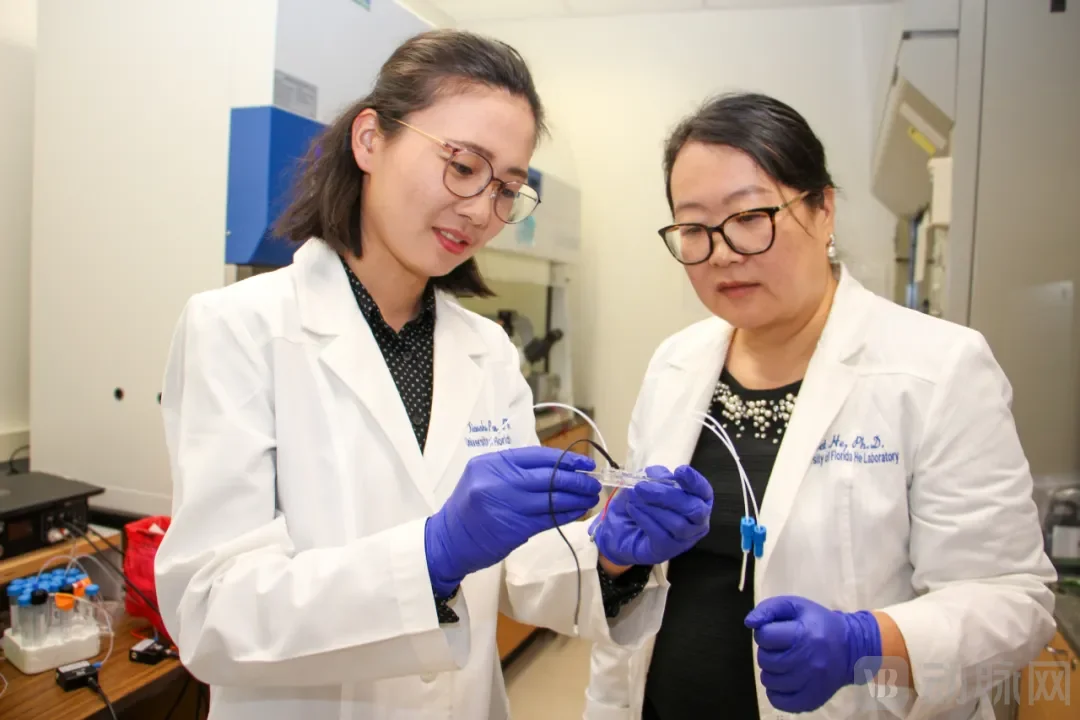
Figure: Associate Professor Mei He and her team member Dr. Xiaoshu Pan (Source: University of Florida College of Pharmacy)
Furthermore, the application potential of this technology platform extends far beyond the treatment of hearing loss. The extracellular vesicle platform developed by the research team can be paired with various gene-editing materials to treat other genetic disorders. Professor Mei He stated:“Our technology can be applied to any disease amenable to gene therapy, including breast cancer and muscular dystrophy. This represents a highly exciting breakthrough contribution to our field of research.”This versatility significantly expands the technology’s scope of application and commercial value.
Researchers believe that these results lay the conceptual proof-of-concept foundation for the platform’s specific applications in delivering gene-editing tools, and potentially other cargoes, to the inner ear. For progressive nonsyndromic hearing loss—a disease area that has hitherto lacked effective treatments—this technology offers a therapeutic option that truly targets the root cause of the disease.
This study, published in Science Translational MedicineDemonstrating the Great Potential of Extracellular Vesicle-Mediated Gene Editing in the Treatment of Hereditary Hearing LossBy developing an efficient, safe, and scalable μDES technology platform, the research team not only achieved significant hearing protection effects in mouse models but also provided an innovative solution to overcome the limitations of existing delivery methods in the field of gene therapy.
From the perspective of technological innovation, the μDES system stands out among numerous gene editing delivery methods due to its significant advantages in loading efficiency, processing throughput, safety, and scalability.
From the perspective of clinical value, this technology offers hope for a cure to millions of patients with hereditary hearing loss and provides new tools for the treatment of other genetic disorders. From the standpoint of translational medicine, the platform’s compatibility with Good Manufacturing Practice (GMP) standards and its relatively short timeline for clinical translation make it likely that this laboratory innovation will benefit patients in the near future.
With further technological optimization and the advancement of clinical trials, extracellular vesicle-based gene editing delivery platforms are poised to play an increasingly pivotal role in the era of precision medicine, paving new pathways for humanity’s fight against genetic diseases.