Xia Jianye of CAS Tianjin Institute: Pilot-Scale Testing Is the Critical Battle for China's Bio-Manufacturing Success | Top 100 in Chinese Bio-Manufacturing #9
Editor's Note:Top 100 in China’s Biomanufacturing Industry,Witnessing the “Power of 100” in China’s Biomanufacturing
At this moment, biomanufacturing is ushering in a wave that is profoundly reshaping the global industrial landscape. Leveraging robust innovation momentum and strategic ambition, China is striving to take the lead in this future-oriented competition. To clearly document this historic process, we have specially curated“China’s Bio-manufacturing100"People" Series Reports。
Our Focus: “100people” are the core force driving the development of China’s biomanufacturing industry:They are scientists and pioneers at the frontier, illuminating key technologies such as synthetic biology and gene editing with their wisdom; they are also entrepreneurial and managerial explorers who translate laboratory breakthroughs into industrial transformation; furthermore, they include investors and policymakers with keen insights into trends, injecting critical resources and strategic direction into the industrial ecosystem. They are the backbone of technological innovation, the driving force behind industrial implementation, and the shapers of a thriving ecosystem.
This series aims to provide an in-depth portrayal of the vision, breakthroughs, and practices of these key figures, analyze the trajectory of China’s biomanufacturing sector as it transitions from technological catch-up to innovation leadership, and reveal its immense potential to drive industrial upgrading, safeguard public health, and achieve green development.We believe that this “100“People” stories and insights are not only a tribute to current achievements but also serve as important coordinates for understanding the future landscape of China’s bioeconomy.Stay tuned. (Zhu Ping)
Click to read the article series:Top 100 in China’s Biomanufacturing Industry
“Over the past five years, approximately2000a domestic biomanufacturing startup, with cumulative financing reaching as high as2000“...hundred million yuan, a surge of innovation and entrepreneurship that is rare in other industries.”
“However, during the critical pilot-scale stage of translating laboratory achievements into industrial applications, domestic pilot platforms generally face three core bottlenecks: insufficient scale, inadequate services, and difficulties in intellectual property protection. These issues directly impact whether biomanufacturing can achieve breakthroughs in scalability.”
Recently, Xia Jianye, a researcher at the Tianjin Institute of Industrial Biotechnology, Chinese Academy of Sciences, toVCBeataspects.

Xia Jianye2008He received his Ph.D. from East China University of Science and Technology, studying under Professor Zhang Siliang. He proposed a fermentation process optimization and scale-up method based on the integration of reactor flow fields and cellular physiology, which has been successfully applied in numerous biomanufacturing enterprises across China. He is a recipient of the Chinese Academy of Sciences’ “Hundred Talents Program,” a Tianjin Leading Talent, and Vice Chairman of the Professional Committee on Biochemical Process Modeling and Control under the Chinese Society for Microbiology. He currently serves as Director of the Pilot Platform for Intelligent Biomanufacturing at the Tianjin Institute of Industrial Biotechnology, Chinese Academy of Sciences.
China’s biomanufacturing industry leads the world in scale, driving the formation of upstream and downstream industries worth over ten trillion yuan. Its products span multiple sectors critical to national economy and people’s livelihoods, including energy, environmental protection, chemicals, food, and pharmaceuticals, indicating significant potential for China’s biomanufacturing industry.
“Particular attention should be paid to issues in bioprocess engineering.“, which is the key to advancing the level of biomanufacturing. It is essential to conduct in-depth research on how to enable microbial strains to more efficiently exhibit their characteristics in specific environments, thereby overcoming the bottlenecks in translating laboratory achievements into industrial applications,” said Xia Jianye.
01
The “Amplification” Dilemma Behind the Industry’s Boom
“The importance of the biomanufacturing industry has reached a global consensus, with international competition becoming increasingly pronounced; China must pursue a path of independent development.”
In Xia Jianye's view, China possesses significant advantages in the field of biomanufacturing.
First, this is reflected in the robust industrial foundation, with China's total annual output of fermentation products exceeding300010,000 tons, ranking first in the world and accounting for approximately70%fermentation production capacity.China has assumed a global leadership position in major categories of fermentation products, including amino acids, organic acids, and vitamins. Furthermore, in the field of separation and purification, China boasts a robust chemical engineering foundation and a vast pool of engineers. These professionals are transitioning into the biomanufacturing sector, providing critical support for industrial development.
“However, we must also recognize that our shortcomings are equally prominent, primarily concentrated in the fields of basic research and core equipment.”
Xia Jianye pointed out that in the area of high-end instruments and equipment, importsRaman SpectrometerHigh costs persist; although domestically produced equipment has begun to emerge, it remains relatively backward in terms of technology. There is still a gap between domestic and imported products in terms of price and stability for high-end instruments such as gas chromatography-mass spectrometry (GC-MS) systems. In particular, core equipment such as high-throughput bioreactors remains largely unavailable in China, with the market dominated by imports.24High-throughput reactor systems can cost tens of millions of yuan. We still have significant shortcomings in the support system for bioreactor process monitoring and software engineering equipment, which is centered on big data and artificial intelligence technologies.
However, overall, China is witnessing a booming trend in the development of synthetic biology R&D institutions.
"Since2019“Since the Tianjin Institute of Industrial Biotechnology, Chinese Academy of Sciences, took the lead in establishing the National Center for Technological Innovation in Synthetic Biology, various regions—particularly provinces and cities along the eastern coast—have successively established innovation consortia and R&D centers focused on synthetic biology. The intensity of strategic deployment has continued to increase, and the development of R&D systems is advancing vigorously. This institutional advantage of mobilizing resources to accomplish major tasks will provide a crucial guarantee for addressing our weaknesses and achieving technological breakthroughs.”
Xia Jianye further stated that the current fervent development of synthetic biology R&D institutions is primarily driven by breakthroughs in core technologies. In particular, the emergence of automated strain construction systems and large-scale facilities has made it possible for a single laboratory to produce tens of thousands of mutant strains annually, far surpassing the capabilities of traditional laboratories.
This has brought unprecedented challenges: in the past, it was reasonable for a professor to spend decades cultivating a high-quality strain and then one or two years optimizing the process;However, large-scale high-throughput strain construction facilities can now generate up to one million mutants annually. Even with a selection rate of one in ten thousand, this yields hundreds of high-yielding strains. We simply lack sufficient process optimization laboratories and experts to conduct individual process optimization and scale-up studies for such a vast number of strains.
This creates two critical bottlenecks: Can we achieve high-throughput strain screening and process optimization? Can we rationally scale up laboratory-scale processes to industrial levels? Although we have a high-throughput strain construction platform, we lack the corresponding capabilities for high-throughput process development and scale-up.
It is precisely for this reason that the establishment of pilot-scale testing platforms has become particularly urgent. The national government has attached great importance to this issue, successively issuing policies to support the development of such platforms.
02
Where Exactly Is the Bottleneck in the “Last Mile” from Lab to Factory?
“The reason pilot-scale platforms have been elevated to the level of national strategy is that they are currently addressing the most critical bottleneck in industrial development.”
Xia Jianye stated that, when examining the entire process from R&D to industrial-scale mass production, the current true bottlenecks do not lie in strain engineering—a sector that has become relatively mature due to a significant influx of talent and capital—but rather in upstream product selection and downstream process development. This is precisely the root cause why many technologically advanced products struggle to achieve low-cost mass production: insufficient investment in downstream process development and weak technical capabilities.
However, whether in terms of technology or platform construction, pilot-scale testing in China still needs to overcome many challenges.
According to Xia Jianye's analysis, the pilot-scale testing phase faces three major technical bottlenecks: the complexity of intracellular metabolism, the complexity of the extracellular environment, and challenges in detection technologies.
At the intracellular level, although modern systems biology can capture numerous details within cells through techniques such as transcriptomics, proteomics, and metabolomics, it remains challenging to fully elucidate the intricate regulatory relationships among these components.
“Using Saccharomyces cerevisiae’sEMPPathway (Glycolytic Pathway) as an example, even for this classic pathway, there are still gaps in our understanding. Studies have found that when cellsSpecific Growth Ratewhen increased,EMP“Metabolic flux through the pathway indeed increases, yet the expression levels of most enzymes within it actually decrease—contrary to conventional wisdom. It took the research team years to elucidate this single pathway, underscoring that the complexity of intracellular metabolic networks far exceeds imagination.”
“Our understanding of cellular metabolism remains very limited. Due to the incomplete elucidation of metabolic regulatory mechanisms, we are unable to establish precise cellular models to rationally guide process optimization and must instead rely on empirical trial and error.”
At the extracellular level, it is necessary to address the complexity of the flow field environment within the bioreactor.
As German physicist Werner Heisenberg questioned on his deathbed—what is the essence of turbulence? This question remains unanswered to this day. In industrial-scale bioreactors, we cannot precisely describe the turbulent phenomenon, characterized by disordered temporal variations in material concentration and flow velocity within three-dimensional space, using analytical mathematical solutions; instead, we can only approximate it through engineering computational methods such as mesh discretization.
“Moreover, the laboratory5“Laboratory-scale bioreactors differ drastically from industrial-scale tanks of hundreds of tons in terms of mixing time and mass transfer efficiency. This disparity in environmental conditions prevents direct scale-up of laboratory processes, rendering the current stepwise scale-up approach both time-consuming and fraught with uncertainty,” pointed out Xia Jianye.
“Furthermore, detection methods for biological processes remain to be further developed.”Xia Jianye stated that most companies still rely on manual sampling and testing, which takes at least half an hour, such asHPLC(High-Performance Liquid Chromatography) The detection of such critical metabolites requires 40 to 50 minutes to yield results, and the severe data lag makes online real-time regulation difficult to achieve.
It is precisely these two complexities—the unclear regulatory mechanisms of intracellular metabolic networks and the complexity of the extracellular bioreactor environment—that together constitute the core bottlenecks in the optimization and scale-up of fermentation processes.
“This is precisely why the leap from laboratory to industrial-scale production is so challenging, underscoring the critical value of pilot-scale platforms in addressing these complexities. It also fully explains why the nation is vigorously fostering such platforms—only by overcoming these technical bottlenecks can we bridge the ‘last mile’ from the lab to the factory,” said Xia Jianye.
03
Quantity, Capability, and Trust: The Triple Dilemma Urgently Facing Pilot-Scale Platforms
In addition to technical aspects, China still needs to address three major issues in the development of pilot-scale platforms.
First, the number and scale of pilot-scale platforms are severely insufficient.
According to research by VCBeat, the definition of “pilot-scale testing” is currently not unified in China—some consider50Scaling up is considered as pilot-scale production, while others believe it needs to reach30Tonnes—there are significant discrepancies in the data under different statistical scopes. However, nationwide, there are no more than platforms that truly possess service capabilities and can undertake industrialization projects.20Home, use this20Home Platform for Services2000a startup, it was simply “a drop in the bucket.”
This is precisely the key reason why the state is vigorously promoting the development of pilot-scale testing platforms, and it also represents the most urgent need for enterprises.
Secondly, the service capabilities of existing pilot-scale platforms urgently need to be enhanced.
The current scale of service teams actively operating on the front lines is limited. Although technical forces represented by the Shanghai University of Science and Technology alumni team have achieved significant results by leveraging Professor Zhang Siliang’s technological framework, such professional teams remain scarce. We observe that many synthetic biology cases emphasize product innovation and cost control, yet lack the professional service capabilities necessary to ensure stable and mature fermentation processes for every enterprise. Therefore, the reliability characterized by “successful implementation at each client site” is precisely the critical support currently needed by the industry.
Furthermore, the protection of intellectual property rights for microbial strains remains an unresolved challenge.
Startups are hesitant to entrust their core microbial strains to pilot-scale platforms, a concern that is entirely understandable. However, the reality is that even within companies, there is a risk of strain leakage. Although pilot-scale platforms have implemented stringent security measures, including allowing enterprises to participate in the entire operational process, replicating professional strains is not difficult. Therefore, relying solely on technical safeguards cannot fundamentally resolve the issue; breakthroughs must be sought at the policy level. For instance, manufacturers could be required to register the source and genetic information of their strains, with production permitted only after passing review. However, implementing this approach in the short term remains challenging.
In addition to the aforementioned issues, currently, with theAIRapid technological penetration across industries has made intelligent pilot-scale platforms a key development trend.
As early as2022In [year], Professor Xia Jianye, Professor Zhuang Yingping, and others published the article “Opportunities and Challenges for Fermentation Optimization and Scale-up Technologies in the Era of Artificial Intelligence,” pointing out that:The application of artificial intelligence technologies, particularly digital twins and knowledge graphs, will provide a significant impetus for the disruptive advancement of traditional fermentation technology.
Moreover, a clear implementation pathway was proposed at the time: first, classify the variables in the biomanufacturing process to identify which are adjustable, which can only be monitored but not manipulated, and which constitute the ultimate objectives, ultimately categorizing them into three major groups: manipulated variables, state variables, and physiological variables.
“The core objective of fermentation optimization is to identify the functional relationship between operational variables and physiological variables, ultimately enhancing the cells’ ‘individual combat effectiveness’ by adjusting operational parameters such as agitation speed and feeding rate,” Xia Jianye told VCBeat.
Based on this rationale, the pilot-scale platform for intelligent biomanufacturing is of particular importance. Xia Jianye emphasized that specific considerations must be given to how such an intelligent pilot platform should be constructed, what its constituent components are, what foundational conditions are required for optimizing and scaling up intelligent biomanufacturing processes, and whether having basic hardware infrastructure alone is sufficient to achieve intelligent pilot-scale production.
Analysis indicates that the construction of the final intelligent pilot-scale platform encompasses multiple key dimensions.
In terms of process optimization capabilities, it is necessary to be equipped with a comprehensive system that includes strain fermentation medium optimization, culture process optimization, performance studies, metabolic flux analysis, and process omics analysis.Among these, culture medium optimization is particularly critical; “if you do not feed the ‘horse,’ even a ‘thousand-li horse’ cannot unleash its potential to travel a thousand li.”
In terms of hardware facilities, the platform needs to establish a complete pilot-scale production line for fermentation processes, including a full set of equipment such as ingredient tanks, feed tanks, seed tanks, and fermenters, equipped with automationDCS(Distributed Control System), but hardware facilities alone are insufficient to achieve intelligent pilot-scale production.
At the software and data levels, the core challenge facing the platform is how to effectively transfer pilot-scale data to industrial-scale production facilities.
"Furthermore, the separation and purification stage may be more complex than fermentation, involving multiple unit operations such as solid-liquid separation, liquid-liquid separation, chromatographic purification, and drying and refinement. It requires the processing of various substances, including macromolecules, small molecules, intracellular and extracellular components, and polar and non-polar compounds."Technical talent in this field is particularly scarce.“Xia Jianye pointed out.
The Fifth Edition of Biomanufacturing Pilot-Scale Training Makes a Grand Return!
November 26–27, Changshu, Jiangsu
Lock in 150 seats—first come, first served
This training session focuses on the core challenges in building pilot-scale production platforms, with special invitation toXia Jianye, Tianjin Institute of Industrial Biotechnology, Chinese Academy of Sciences; Zang Hengchang, Shandong University...and other authoritative experts provide in-depth analysis of key technical modules, including high-throughput fermentation, separation and purification, and digitalization and intelligence.
Leveraging proven expertise from the first four editions and incorporating real-world case studies from industry leaders such as Bloomage Biotech and Morimatsu Life Sciences Technology, this training program provides local governments and enterprises with a one-stop solution spanning from process scale-up to operational mechanisms.
Exclusive benefits such as immediate discounts for group registrations and 50% off for returning students are now available, empowering you to bridge the “Valley of Death” in biomanufacturing and seize first-mover advantage in this trillion-dollar industry.
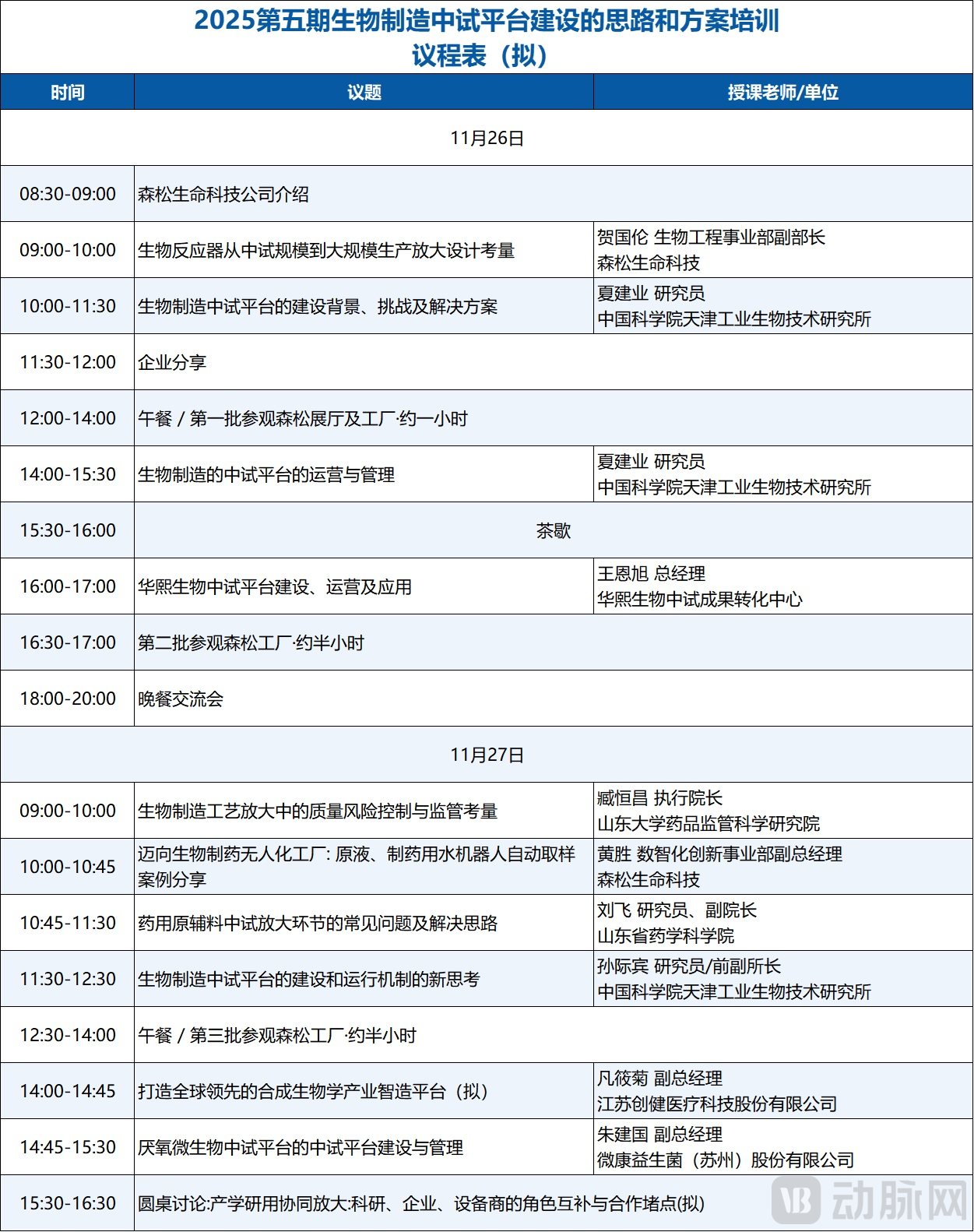
Due to venue constraints, only 150 seats are available on-site.
First Come, First Served
Scan the mini-program QR code below to register immediately.
We will contact you to help you secure your spot.


If your company/institution has completed# Significant Developments
Including the latest financing, business development (BD), principal investigator (PI)-led patient recruitment, and clinical trials.
WelcomeScan the QR code at the end of the articleContact Us for YouFree [Exclusive]