

Zhongke Jingcui Files Prospectus: Pioneering Water-Based Enzymatic Process Enables Industrial-Scale Production of High-Performance Natural Saponin Surfactants
In an era where health and beauty have become central consumer demands, natural, gentle, and non-irritating personal care products are increasingly favored by the market. As a core ingredient in cleansing and care products, surfactants not only perform the functions of cleansing the skin and removing sebum but also directly influence the user experience, such as foam richness and skin feel smoothness.
However, most surfactants currently on the market still rely on chemical synthesis. Although they offer strong cleaning power, long-term use may cause skin irritation, allergies, and other issues, prompting a growing number of consumers to turn to gentler, natural alternatives.
“Chemically synthesized surfactants have a relatively simple structure. While they can achieve basic cleansing, they are also prone to causing side effects such as skin itching and increased dandruff,” Dr. Wang Kongjiang, founder of Zhongke Jingcui, pointed out to VCBeat. “This is precisely why daily chemical products typically require complex formulation designs, incorporating various auxiliary ingredients to compensate for the shortcomings of the primary raw materials. This is also the reason why product ingredient lists are often lengthy.”
Addressing this market pain point, Zhongke Jingcui has successfully transformed natural plant extracts into biosurfactants suitable for scalable production, leveraging its innovative “aqueous enzymatic method” technology. In February 2025, Guangdong Jingcui Biotechnology Co., Ltd.Secured tens of millions of yuan in exclusive investment from CAS Star; In June of the same year, the company relocated its headquarters and R&D center to Beijing and was officially renamed Zhongke Jingcui (Beijing) Biotechnology Co., Ltd.; by September,Completed a tens-of-millions-yuan Angel++ round of financing invested by Hunan Caixin Industrial Fund.
In terms of market performance, sales of Zhongke Jingcui’s flagship product have continued to grow since its launch in 2021, currently surpassing the RMB 10 million mark.The company has established stable collaborations with domestic beauty brands such as Botanee, Shuiyang Group, Florasis, and Little Dream Garden, as well as OEM enterprises including Nox Bellcow, Bawei Biology, and Aobao.
Furthermore,Zhongke Jingcui has recently entered into a partnership with Brenntag, the world’s leading chemical distributor, for raw material distribution and joint formulation development., and withJapan, Spain...and other regions, actively engaging with daily chemical enterprises to gradually open up international markets.
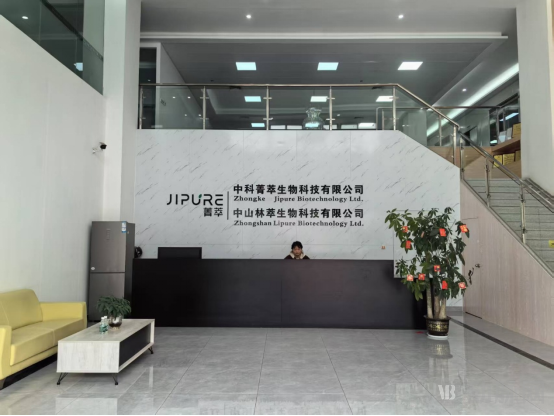
Dr. Wang Kongjiang, the founder of Zhongke Jingcui, is an entrepreneur with a strong scientific research background. He earned his Ph.D. in Applied Chemistry from the Department of Technical Physics at Peking University in 1995, and subsequently conducted postdoctoral research in the laboratory of Prof. James P. Ferris in the Department of Chemistry at Rensselaer Polytechnic Institute in the United States. In 2002, he returned to China to join the Institute of Biophysics of the Chinese Academy of Sciences, where he engaged in fundamental research in life sciences.
The inception of Zhongke Jingcui stemmed from a discussion among Wang Kongjiang, Academician Wang Zhixin, and a professor from Tsinghua University. This professor, who had studied in France, observed that the French preferred non-chemical cleaning products, often wrapping Sapindus (soapberry) peels in gauze and soaking them in water to clean kitchen utensils. Most of these Sapindus peels were imported from China. Upon returning to China, the professor attempted to investigate the cleaning efficacy of Sapindus. Academician Wang Zhixin then proposed that Wang Kongjiang undertake related research.
Natural raw materials such as soapberry peel, tea seed cake, and honeylocust pod are rich in saponins, making them ideal biosurfactants. However, their complex composition makes it difficult to ensure consistency in industrial production. Despite years of research by companies in China, Japan, and South Korea, no breakthroughs have been achieved in purity and stability, preventing large-scale application.
Under the guidance of Academician Wang Zhixin, Wang Kongjiang led the core team in developing an aqueous separation and extraction technology, ultimately establishing the proprietary “Aqueous Enzymatic Method” by CAS Jingcui.This technology uses pure water as the reaction medium, leveraging China’s abundant forestry by-products—namely, tea-seed cake (the residual waste after oil extraction from Camellia oleifera seeds), Sapindus mukorossi pericarp, and Gleditsia sinensis pod husks—as raw materials. By eliminating organic solvents and employing an aqueous system combined with enzymatic catalysis and purification processes, it achieves the green extraction of high-purity saponins.
Building on this foundation, the R&D team conducted systematic research and optimization of key parameters, including raw material particle size after milling, extraction temperature, retention rate of active ingredients, residual content, and microbial control, thereby gradually establishing a standardized system encompassing all process parameters from raw material processing to final production.This technology not only mitigates the risk of skin allergies caused by organic residues such as alcohols, but also enhances the purity and stability of the extract. Furthermore, it significantly reduces overall costs compared to traditional organic solvent methods, establishing a green, safe, and scalable pathway for natural extraction.
Zhongke Jingcui's Current Flagship OfferingsFour types of raw materials: Sapindus extract, two types of Camellia oleifera seed cake extracts, and Gleditsia sinensis extract, primarily applied inDaily Chemicals such as Shampoo, Facial Cleanser, and Body WashProducts. Sapindus extract offers cleansing, anti-dandruff, and detangling benefits, making it suitable for shampoos and facial cleansers. Camellia oleifera seed cake extract is mild and non-irritating, ideal for skincare products for infants and young children, sensitive skin, and feminine care. Gleditsia sinensis extract is well-suited for hair and body care products. These pure natural plant-based surfactants combine the properties of both base and active ingredients, helping brands simplify formulations, reduce functional additives, and enable clean-label products, thereby achieving a win-win in terms of cost and safety.
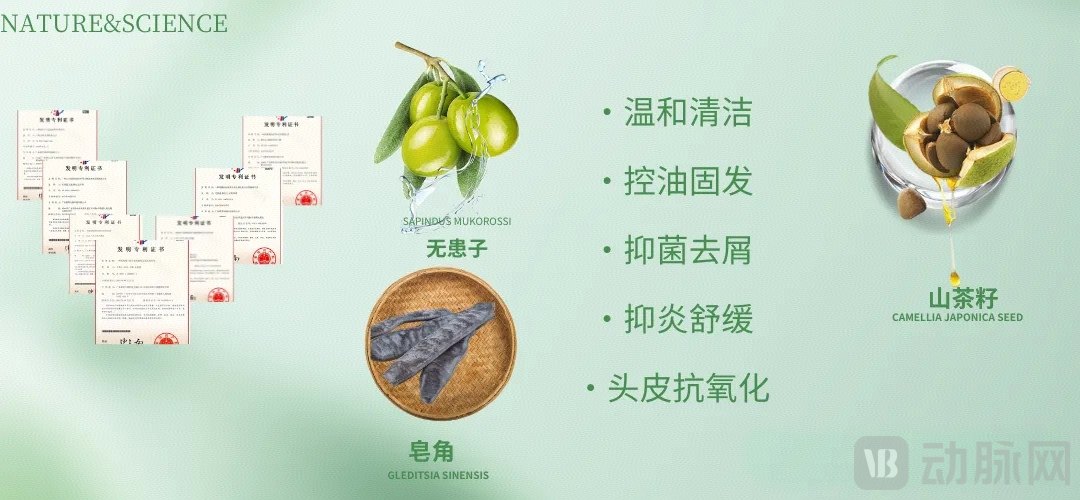
In recent years, the Chinese government has continuously intensified its efforts to promote the development of the camellia oleifera industry. The No. 1 Central Documents for both 2023 and 2024 explicitly mentioned advancing the growth of this sector. Furthermore, the Three-Year Action Plan for Accelerating the Development of the Camellia Oleifera Industry (2023–2025), jointly issued in 2023 by the Ministry of Finance, the National Development and Reform Commission, and the National Forestry and Grassland Administration, set forth the goals of “ensuring that the national planting area of camellia oleifera reaches over 6 million hectares and tea oil production capacity attains 2 million tons by 2025,” as well as “promoting the replacement of low-yield camellia oleifera forests with high-yield ones.”
As China’s largest woody oilseed crop, camellia oleifera has its by-product, camellia seed cake, successfully converted into high-value-added raw materials by Zhongke Jingcui.This not only provides Zhongke Jingcui with a stable and sustainable source of raw materials, but also closely aligns with the national strategic direction for ecological agriculture and rural revitalization. Meanwhile, it identifies a second growth point for China’s camellia oil industry.
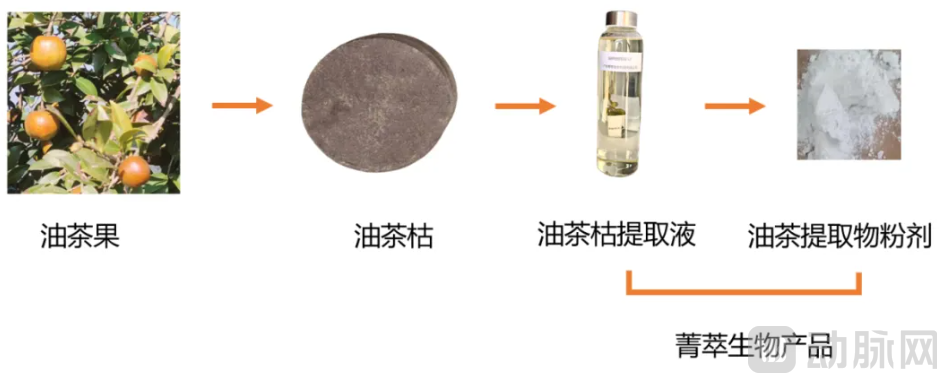
Basic Raw Materials and End Products (Extracts and Powders) of Zhongke Jingcui; Image Source: CAS Star
From a resource perspective, China possesses unique advantages in raw materials for natural surfactants. The camellia seed cake, soapberry peel, and Chinese honeylocust fruit pod selected by Zhongke Jingcui are all derived from high-saponin plants widely cultivated domestically. As the scale of the camellia oil industry continues to expand, the supply of by-products such as camellia seed cake will become more abundant. Leveraging this raw material advantage, Zhongke Jingcui is actively promoting the expansion of natural saponin applications from the daily chemical sector into broader dimensions.
In the agricultural sector, the company has established a joint laboratory with Dabeinong.We are exploring the applications of saponin-based products in agriculture, such as seed coating, pesticide emulsification, and antibiotic-free animal feed, while continuously expanding into new areas for saponin product utilization. Meanwhile, significant progress has been made in the joint development by both parties to utilize the waste residue generated from this project’s production in the field of agricultural fertilizers.
Meanwhile, Zhongke Jingcui is alsoExpansion into Industrial Sectors Including Firefighting Foam Agents, striving to extend the green value of natural saponins to more scenarios requiring cleanliness and safety.
Today, Zhongke Jingcui has successfully completed its full-chain layout, spanning from laboratory R&D and pilot-scale amplification to industrial implementation: the Zhongshan base undertakes pilot validation, the Beijing headquarters focuses on R&D innovation, and an industrial production base with an annual output value exceeding RMB 200 million is currently under construction in Changsha.
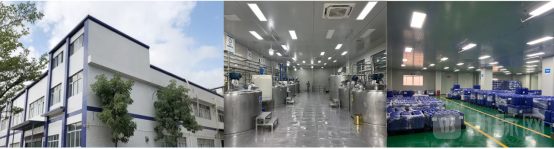
In terms of business model, the company positions itself as a core B2B raw material supplier and operates laboratories to support customers in formula optimization. Since launching its first product in 2021, Zhongke Jingcui has achieved leapfrog growth in sales revenue, rising from hundreds of thousands of yuan in the initial stage to the tens of millions of yuan level in 2024.
In terms of market expansion, the company has established in-depth partnerships with numerous well-known enterprises, including Botanee, S&G Group, Florasis, Little Dream Garden, Nox Bellcow, Baywin, Aobo, and Liby Group. It also collaborates with Brenntag from Germany for raw material distribution and joint formula development, while actively advancing project cooperation with daily chemical companies in Japan and Spain, thereby steadily accelerating its internationalization efforts.
Currently, the global daily chemical industry is undergoing a transition from “chemical synthesis” to “natural, green, and renewable” solutions. Moving forward, Zhongke Jingcui will continue to drive technological iteration, further enhancing the performance of its extracts in terms of purity, stability, and visual clarity, thereby consolidating its leading position in the field of biosurfactants and helping Chinese green ingredients reach a broader global stage.
Reference: “CAS Star Angel+ Round Exclusive Investment in ‘Jingcui Biotech’”, CAS Star