

Peking University Licenses Breakthrough m6A Detection Technology GLORI 2.0/3.0 to Hangzhou Xinshi Biotech for Commercialization
Recently, the Technology Development Department of Peking University issued a public notice on the transformation of scientific and technological achievements, proposing to“A Method and Kit for Detecting N6-Methyladenine”Patents by“Sales Commission of 300,000+”of the transaction amount for a non-exclusive license. The patent stems from a research finding published in *Nature Methods* in May 2025 by Professor Yi Chengqi’s team at the School of Life Sciences, Peking University, in collaboration with Professor Wang Xiujie’s team at the Chinese Academy of Sciences.
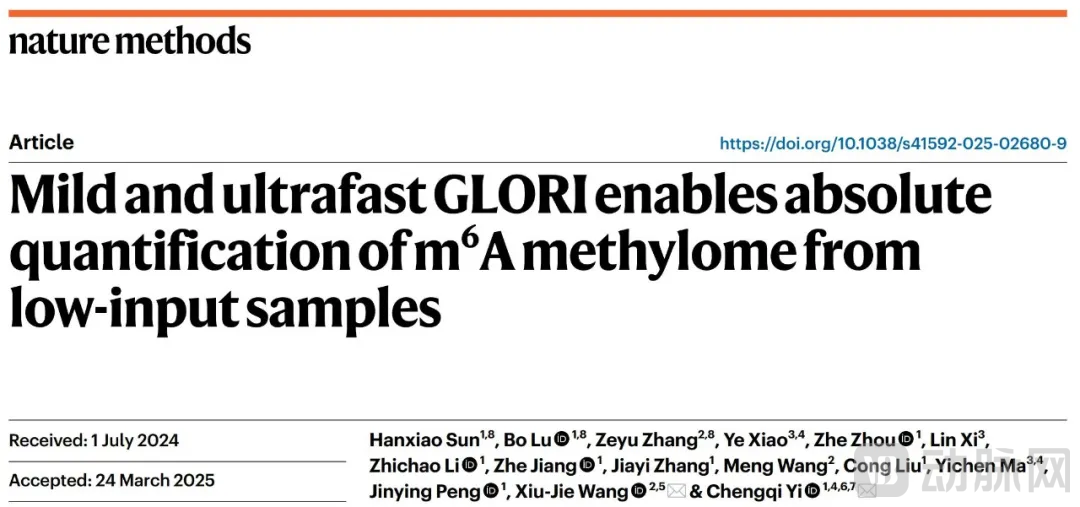
Image from Nature Methods
Hangzhou Xinshi Biotechnology Co., Ltd., the patent assignee and a company focused on the biotechnology sector, is introducing this patented technology, likely to bolster its technological portfolio in nucleic acid modification detection and expand its pipeline of related bioassay products.

Yi Chengqi(Born in June 1983), Boya Distinguished Professor at the School of Life Sciences, Peking University; Jointly Appointed Professor at the College of Chemistry and Molecular Engineering, Peking University; concurrently Researcher at the Peking-Tsinghua Center for Life Sciences and Researcher at the Beijing RNA Research Center.
Research focuses on the dynamic regulatory mechanisms of nucleic acid modifications and the development of gene editing technologies, establishing a technical system for the detection and manipulation of DNA/RNA modifications, and leading research in the field of epitranscriptomics. Received in 2018National Science Fund for Distinguished Young Scholars, received in 2022Chinese Chemical Society Young Innovator Award in Life Chemistryand serves as Vice Chair of the Science and Technology Sector Working Committee of the Beijing Youth Federation, receiving in 2023Zhongyuan Union Life Medical Innovation Breakthrough Award, successively obtained in 2024The Science Exploration Award and the Shulan Medical Youth Award。
He leads the National Key R&D Program of the Ministry of Science and Technology and serves as Deputy Director of the State Key Laboratory of Protein and Plant Gene Research. His laboratory is dedicated to investigating the biological pathways, functions, and mechanisms of RNA/DNA modifications, as well as developing novel gene-editing methodologies. To achieve these objectives, we employ an interdisciplinary approach integrating chemical biology, epigenetics, gene editing, single-cell omics, and genomics, with the aim of elucidating the novel functions and regulatory mechanisms of nucleic acid epigenetic modifications.
The core patents of the transaction focus on the precise detection of N6-methyladenine (m6A).As one of the most prevalent chemical modifications in eukaryotic mRNA, N6-methyladenosine (m6A) plays a pivotal role in RNA metabolism as well as physiological and pathological processes. However, conventional detection techniques are limited by their reliance on antibody specificity, unstable enzymatic activity, inability to perform absolute quantification, or high costs.
This patented technology, throughInnovative Development of Two Novel Detection Methods: GLORI 2.0 and GLORI 3.0, which resolves the severe RNA degradation issue of the previous generation technology (GLORI 1.0).
N6-methyladenosine (m6A), as one of the most abundant and functionally critical chemical modifications in eukaryotic mRNA, is closely associated with dynamic regulatory mechanisms governing RNA metabolism (such as alternative splicing, translation efficiency, and RNA stability), cellular physiological activities (such as cell differentiation and stress response), and disease pathogenesis (such as cancer and neurodegenerative diseases), thereby significantly driving“Epitranscriptomics”The Rapid Development of This Emerging Research Field.
Since 2012, transcriptome-level m6A detection technologies have become core tools in this field; however, existing techniques continue to face persistent limitations that remain difficult to overcome.
1. Antibody-Dependent Detection Technologies: Bottlenecks in Specificity and Sample Size
Technologies represented by m6A-seq, MeRIP, and miCLIP, theirThe core principle is to enrich m6A-modified RNA fragments using m6A-specific antibodies and perform sequencing.. However, such technologies have significant drawbacks.
On one hand, the accuracy of detection results is highly dependent on antibody specificity, where cross-reactivity can easily lead to false positives or false negatives; on the other hand, the antibody enrichment process requires a substantial input of RNA (typically at the microgram level). This makes it difficult to meet the detection needs for rare samples, such as clinical biopsy specimens and rare cell subtypes.
2. Enzyme-Dependent Detection Technologies: Activity Stability and Detection Bias
Techniques such as DART-seq, MAZTER-seq, and m6A-REF-seq enable the discrimination between m6A and unmodified adenosine through engineered enzymes (e.g., adenosine deaminase variants). However, enzymatic activity is susceptible to influence by RNA secondary structure and sequence context, resulting in variable detection efficiency across different sites.
Furthermore, fluctuations in enzyme activity across different batches can introduce systematic errors, thereby making it difficult to achieve precise quantification of m6A modifications.
3. Enzyme-Assisted Chemical Labeling Techniques: Environmental Interference and Limitations in Applicability
Techniques such as m6A-SEAL-seq and m6A-SAC-seq employ a combination of enzymatic catalysis and chemical labeling for detection. However, their labeling efficiency is significantly influenced by local RNA structures and reaction conditions (e.g., pH and temperature), and the operational procedures are relatively complex. More critically, similar to other enzyme-dependent methods, these techniques cannot provide absolute quantitative data on m6A modifications; they only allow for comparisons of relative abundance, thereby limiting the precise elucidation of m6A dynamics.
4. “Next-Generation” Sequencing Technology: The Challenge of Balancing Cost and Accuracy
Next-generation sequencing technologies, such as nanopore sequencing, enable direct detection of m6A at the single-molecule level without relying on antibodies or enzymatic assistance. However, this technology faces three core challenges: First, the error rate for single-base detection is relatively high (typically exceeding 5%), necessitating substantial sequencing data for correction to ensure result accuracy. Second, the data analysis pipeline is complex and requires specialized algorithms to interpret modification signals. Finally, the high cost of sequencers and reagents hinders the widespread adoption of this technology in routine laboratories.
In addition to the four aforementioned technologies, the research team previously developed GLORI 1.0, a technique based on chemical reaction pathways. This method achieves the deamination of unmodified adenosine (converting it to inosine) through glyoxal catalysis and nitrite-mediated chemical reactions, thereby effectively distinguishing m6A from unmodified adenosine and yielding significant breakthroughs in quantitative accuracy.
However, this technology still needs to undergo“Guanine Protection–Adenosine Deamination–Guanine Deprotection”Three-step reaction process. Among these, the “guanosine protection” step leads to severe RNA degradation and can only process RNA samples from ≥100,000 cells (approximately 50 ng of mRNA), making it unsuitable for low-input samples (such as single subcellular tissue components or small numbers of sorted cells). This significantly limits its broad applicability in basic research and clinical applications.
The limitations of the aforementioned traditional technologies and the previous-generation GLORI 1.0 have jointly led to challenges in the field of m6A detectionLong-standing dual challenges of “difficulty in balancing high sensitivity with RNA integrity” and “difficulty in reconciling low-sample compatibility with quantitative accuracy”—It neither meets the detection requirements for rare biological samples (such as clinical micro-samples and tissue subcellular components) nor provides the absolute quantitative data needed for refined research. These limitations severely constrain the in-depth application of epitranscriptomics in fields such as elucidating physiological mechanisms and screening disease biomarkers.
To this end, the research team conducted targeted R&D to address the pain points of existing technologies. By reconstructing the chemical reaction system and innovating carrier RNA design, they successfully developed two core technologies, GLORI 2.0 and GLORI 3.0, aiming to fundamentally resolve issues inherent in first-generation technologies, such as RNA degradation, incompatibility with low-input samples, and unstable quantitative results.
1. One-Step Deamination Reaction Solves the "RNA Degradation" Problem
In addressing the issue of “RNA degradation,” GLORI 2.0 has achieved a key innovation through its one-step deamination reaction. ItsThe core breakthrough lies in eliminating the independent guanosine protection step required in previous-generation technologies, thereby establishing a “one-pot” deamination reaction system.—— Simply mix the carbonyl compound (preferably glyoxal), nitrite, and the target RNA directly in a weakly acidic environment at pH 4.0–6.5 (MES buffer is preferred) to complete the reaction.
Mechanistically, glyoxal plays a dual role in this process: it forms an intermediate (A*) with adenosine, significantly enhancing the reactivity of adenosine with nitrite and driving the rapid deamination of unmodified adenosine to inosine; meanwhile, it forms a transient adduct (G*) with guanosine, which can be reversed under subsequent mild conditions (e.g., heat treatment at 80–95°C for 5–30 minutes), thereby preventing permanent modification of guanosine or RNA strand cleavage.
Experimental data further corroborate the advantages of this technology: following GLORI 2.0 processing, RNA integrity was significantly improved, with clear 18S and 28S rRNA bands and no evident degradation; meanwhile, the conversion efficiency from adenosine to inosine exceeded 99%, and the non-specific deamination rate of guanosine remained below 5%, thereby completely overcoming the RNA degradation issues associated with GLORI 1.0.
2. GLORI 3.0: Addressing the Challenge of Small Sample Size Adaptation
To address the challenge of easy loss of low-input RNA during purification, GLORI 3.0 provides a targeted solution by innovatively introducing reverse transcription-silent carrier RNA (RT-silent carrier RNA).
The carrier RNA is constructed through a two-step reaction involving “adenosine deamination” and “cyanoethylation,” ultimately forming a specialized RNA molecule enriched with N1-cyanoethyl inosine (ce1I). The ce1I effectively blocks the extension process of reverse transcriptase, preventing the carrier RNA from serving as a template for cDNA synthesis. This allows it to focus solely on its function of “protecting the target RNA from adsorption loss.”
This design offers significant technical advantages: the addition of carrier RNA prior to purification substantially reduces the loss of target RNA during procedures such as centrifugation and column-based purification. Furthermore, the carrier RNA is automatically excluded during subsequent library preparation, thereby avoiding any interference with detection results. Experimental findings confirm that GLORI 3.0 enables whole-transcriptome m6A detection on samples containing as little as 10 ng of total RNA, representing a more than 100-fold improvement in sensitivity compared to GLORI 1.0.
3. Multi-dimensional System Optimization to Address the Issue of “Quantitative Accuracy and Robustness”
To further ensure the reliability of test results, the patented technology also implements a series of detailed optimizations around the experimental workflow.In terms of reaction condition control,The technical protocol specifies the concentrations of core reagents and reaction parameters: the nitrite concentration is set at 0.5–2.0 M (preferably 1.0 M), the glyoxal concentration must be ≥1.0 M (preferably 2.3 M), the reaction temperature is controlled at 45–95°C (preferably 50°C), and the reaction time is 3–12 minutes (preferably 10 minutes). These standardized parameters ensure consistent reaction efficiency across different samples and batches.
To address guanosine adducts that may form during the reaction, the technical protocol incorporates a reversal strategy involving “alkaline buffer + heat treatment.” For instance, incubation in a TEAA–formamide buffer at pH 8.6 and 95°C for 10 minutes can completely convert guanosine adducts back to guanosine, thereby preventing interference with subsequent sequencing steps.
In the sample processing phase,The technical solution also provides supporting pre-processing and post-processing workflows: the RNA to be tested can undergo pre-processing through purification and fragmentation, while the reaction products can be detected after reverse transcription and specific amplification.
This design is compatible with m6A analysis at the whole-transcriptome level and also supports precise quantification at specific sites, such as in scenarios involving m6A site detection for low-abundance mRNA.
Based on the above triple breakthroughs,It thoroughly addresses the core pain points of traditional m6A detection technologies, providing critical technical support for the transition in epitranscriptomics research from “bulk cells” to “trace samples” and from “relative qualitative analysis” to “absolute quantification.”
The clinical translation potential and research demands of m6A detection technologies have fostered a competitive landscape with diverse technological approaches. Currently, similar technologies in the market and research sectors are mainlyFocusing on four major directions: antibody-dependent, enzyme-assisted chemical labeling, third-generation sequencing, and computational prediction., with relevant research teams and enterprises at different stages of technological iteration or commercial implementation.
1. Antibody-Dependent Technologies: Mature Commercialization and Dominance of Research Tools
Among current m6A detection technologies, antibody-dependent approaches represent the most mature solution. Benefiting from early development and standardized operational procedures, this technology has established a stable market for research tools, with core participants predominantly being major corporations in the biological reagents sector. Overall, the technology is at a stage of large-scale commercial application.
From the perspectives of core technologies and product forms,Such technologies, typified by MeRIP-seq and m6A-seq, operate on the principle of enriching modified RNA fragments using m6A-specific antibodies, followed by high-throughput sequencing for detection. The associated products primarily include specific antibodies and standardized kits.
For example, Abcam has launched several m6A-specific monoclonal antibodies, such as ab314476 and ab284130, which are compatible with various experimental applications including Dot blot and FRET. Thermo Fisher Scientific, leveraging its mature sequencing platform, has developed an integrated MeRIP-seq kit that covers the entire workflow from antibody-based enrichment to library construction, widely used for mapping transcriptome-wide m6A profiles in basic scientific research.
In terms of market entities and application limitations,Globally renowned biological reagent companies are the leading forces in this technology. In addition to Abcam and Thermo Fisher, other enterprises such as Sigma-Aldrich and Cell Signaling Technology also have relevant product portfolios.
However, despite a high degree of commercialization, all antibody-dependent technologies require microgram-level RNA input, which fails to meet the clinical demand for testing trace samples; consequently, their current applications are primarily confined to the research sector.
2. Enzyme-Assisted Chemical Labeling Technology: Transitioning from Scientific Breakthroughs to Commercialization
Enzyme-assisted chemical labeling technology leverages engineered enzymes to distinguish N6-methyladenosine (m6A) from unmodified adenosine, offering superior quantitative accuracy compared to antibody-dependent methods. Currently, advancements in this field are primarily driven by technical breakthroughs from research teams, while some companies have begun to engage in technology translation, facilitating the practical application of these innovations.
From the perspective of representative technologies and research teams,DART-seq is a representative technique developed by Samie R. Jaffrey’s team at Cornell University in the United States. This technology utilizes an engineered adenosine deaminase to specifically bind m6A and introduce mutation signals, thereby enabling m6A detection at single-base resolution.
To date, multiple research findings on this technology have been published in top-tier academic journals such as Nature. The technology is currently in the laboratory optimization phase, and the team is actively collaborating with biotechnology companies to explore pathways for the development of related assay kits.
Another important technique is MAZTER-seq, developed by Reuven Agami’s team at the Hubrecht Institute in the Netherlands. It distinguishes m6A sites through TET enzyme-catalyzed chemical modifications, achieving a detection sensitivity three times higher than earlier enzymatic methods, and its efficacy has been validated in studies mapping m6A in tumor cells.
3. “Next-Generation” Sequencing Technology: Parallel Pursuit of Technological Exploration and Cost Reduction
Next-generation sequencing technologies, represented by nanopore sequencing, can directly detect m6A modifications on single-molecule RNA without relying on antibodies or enzymatic assistance. This approach is widely recognized as a highly promising next-generation technical route for m6A detection and is currently in a critical development phase focused on technical validation and cost optimization.
Regarding the Core R&D Entities and Progress,As a leader in the field of nanopore sequencing, Oxford Nanopore Technologies (ONT) has achieved direct detection of m6A modifications using its MinION sequencer. This is accomplished by analyzing current signal variations during sequencing to distinguish modified sites. In 2024, the company launched its latest algorithm, Bonito-methyl, which increased the accuracy of m6A detection to over 85%. However, the technology still has limitations: the single-base error rate remains as high as 6%–8%, necessitating extensive sequencing data for correction. Consequently, it is currently primarily applied in long-read m6A analysis within scientific research.
Another key player is Pacific Biosciences (PacBio), which has developed a proprietary m6A modification analysis module leveraging the single-molecule real-time detection capability of its SMRT sequencing technology, enabling simultaneous acquisition of RNA sequence and modification information during detection. However, the high sequencing cost of this technology—5 to 8 times that of conventional next-generation sequencing—has limited its large-scale adoption, restricting its current use to a few high-end research projects.
4. Computational Prediction Technologies: Auxiliary Tools and Research Supplements
Computational prediction technologies leverage machine learning algorithms to predict m6A sites based on nucleic acid sequence features, effectively reducing experimental detection costs. However, this technology is currently still in the stage of research-assisted application and has not yet formed independently usable detection products.
Represented by the GLORI series of technologies, the chemical sequencing approach achieves differentiation between m6A and unmodified adenosine through specific chemical reactions, marking key breakthroughs in detection sensitivity and quantitative accuracy. Currently, this technology is in the early stages of patent licensing and commercialization. Peking University’s licensing of this technology patent to Hangzhou Newshi Biotechnology Co., Ltd. signifies its formal transition from the laboratory to commercial development. It is poised to become the first standardized kit product to simultaneously overcome the two major technical bottlenecks of “low sample input compatibility” and “absolute quantification,” thereby filling a gap in the relevant market.