

Zhejiang University Team Achieves Breakthrough in Needle-Free Insulin Delivery via Transdermal Polymer Platform
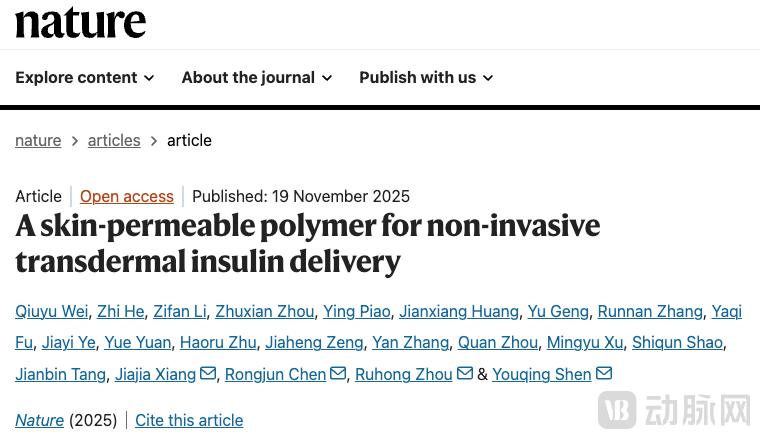
On November 19, 2025, a research team led by Zhejiang University published groundbreaking findings in the prestigious international academic journal Nature.For the first time, a skin-permeable polymer, OP, was reported to successfully achieve non-invasive transdermal delivery of insulin.
This study was co-led by Professor Youqing Shen from the College of Chemical and Biological Engineering at Zhejiang University, Professor Ruhong Zhou from the College of Life Sciences at Zhejiang University, Professor Rongjun Chen from Imperial College London, and Researcher Jiajia Xiang from the College of Chemical Engineering at Zhejiang University. Qiuyu Wei, Zhi He, Zifan Li, and Zhuxian Zhou served as co-first authors.
(Source: Nature)
The significance of this achievement lies inShattering the “500 Dalton Rule” That Has Plagued the Pharmaceutical Community for Decades——For a long time, the academic community has generally believed that macromolecular drugs with a molecular weight exceeding 500 Daltons cannot penetrate the intact skin barrier via non-invasive methods. As a protein-based macromolecule, insulin has a molecular weight several times higher than this threshold. Through ingenious molecular design, the research team enabled OP polymers to leverage the skin’s inherent pH gradient: they become positively charged and accumulate in the stratum corneum under acidic conditions, transform into polyzwitterions for rapid diffusion under neutral conditions, and avoid enzymatic degradation through “hopping motion,” ultimately delivering insulin into the bloodstream.
In diabetic mouse and minipig models, the transdermally administered OP-insulin conjugate demonstrated glucose-lowering efficacy comparable to that of subcutaneous injection. In the mouse model, blood glucose levels returned to the normal range within just 1 hour, with the therapeutic effect lasting for over 12 hours, and no skin damage was observed.
This breakthrough not only brings hope of "saying goodbye to needles" to more than 500 million diabetes patients worldwide, but also pioneers a novel technological pathway for the transdermal delivery of biomacromolecules.The research team has successfully extended this technology to the delivery of various macromolecular drugs, including GLP-1 receptor agonists (semaglutide, liraglutide), therapeutic proteins, monoclonal antibodies, and siRNA. It has been reported that the relevant technology has been licensed to enterprises and is advancing toward clinical translation.
Richard Guy, a pharmaceutical scientist at the University of Bath in the UK, described this work as “very exciting” and “elegant,” because it works in synergy with the natural properties of the skin rather than attempting to force drugs through. This is a vivid example of how basic research drives technological innovation and ultimately benefits human health.
For the more than 500 million people with diabetes worldwide, daily insulin injections—ranging from one to four times a day—have become an indispensable yet painful part of life. Pain from needles, skin complications caused by repeated injections, persistent needle phobia, and the ever-present risk of hypoglycemia have long plagued clinical diabetes management and patients’ quality of life.
Is it possible to find a painless and convenient method for insulin administration?This seemingly simple question has remained an intractable challenge for the medical and pharmaceutical community for decades.
Transdermal Drug Delivery Has a Long History in the Pharmaceutical Field.From ancient topical plasters to modern patches containing certain anesthetics and cardiovascular drugs, transdermal drug delivery has been widely adopted due to its convenience and painless nature. However, nearly all drugs that successfully penetrate the skin are small molecules with a molecular weight of less than 500 Daltons (Da), a principle known as the “500-Dalton rule” in the field of transdermal drug delivery. Insulin, as a protein-based macromolecule, not only far exceeds this molecular weight threshold but also possesses an extremely complex structure. For a long time, the scientific community has generally believed that such biological macromolecules cannot penetrate the intact skin barrier through non-invasive means.
To understand the root of this challenge, it is essential to comprehend the intricate defense system of human skin. Although the outermost layer, the stratum corneum, is only 10–15 micrometers thick, its structure is exceptionally dense: dehydrated, dead keratinocytes are embedded within highly ordered lipid layers, forming a barrier that is both hydrophobic and difficult to penetrate. This resembles a sturdy “city wall” constructed from bricks (keratinocytes) and mortar (lipids). Beneath the stratum corneum, the viable epidermis and dermis feature tight junctions between cells, further reinforcing this defensive line. While this multilayered defense system effectively prevents the intrusion of external substances and protects the body from pathogens and harmful agents, it also poses a significant obstacle to drug delivery.
To overcome this barrier, researchers have explored various approaches. Chemical penetration enhancers improve permeation by fluidizing the lipid bilayers of the stratum corneum, but their efficacy is limited and they may cause skin damage. Although microneedle technology is less invasive than injections, it still requires piercing the stratum corneum to reach the dermal tissue. Electrical devices, ultrasound, and jet injectors attempt to create transient channels on the skin surface.
These invasive techniques all share a common problem:They more or less compromise the integrity of the skin, causing inconvenience, risk of infection, and safety concerns.As Richard Guy, a pharmaceutical scientist at the University of Bath in the United Kingdom, commented: “Traditional methods attempt to force drugs through the skin rather than working in synergy with the skin’s natural properties.”
Major scientific discoveries often begin with a seemingly simple question.
Professor Shen Youqing’s team at Zhejiang University has long been dedicated to research on polymer-based drug delivery. In their previous studies, they discoveredA zwitterionic polymer OP—poly[2-(N-oxide-N,N-dimethylamino)ethyl methacrylate], it exhibits superior penetration in tumor tissues, enabling efficient delivery of antitumor drugs.
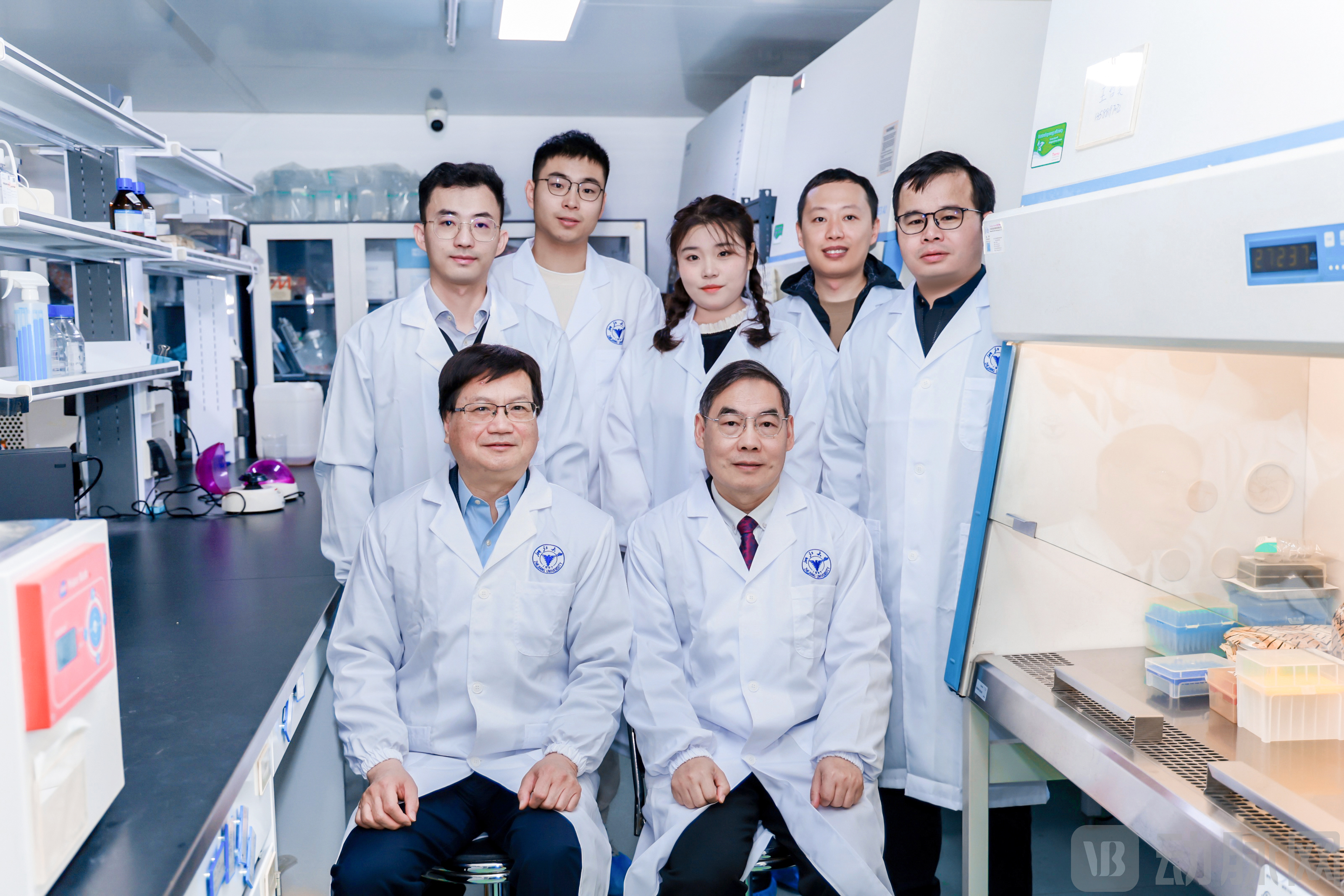
Figure: Research Team (Source: Zhejiang University)
"Thus, we hypothesize: can OP also efficiently penetrate skin tissue?"This flash of insight allowed Shen Youqing to keenly identify a potential research direction. Subsequent experimental results greatly surprised the entire team: OP also demonstrated high permeability in the skin. “This challenges our conventional understanding that ‘macromolecules cannot penetrate the skin barrier,’” said Shen Youqing. The team then collaborated with the teams of Zhou Ruhong and Chen Rongjun to conduct systematic research, thoroughly analyzing the specific pathways and mechanisms by which OP penetrates the skin.
The key to the successful penetration of the skin barrier by OP polymers lies in their clever exploitation of the skin’s own physiological characteristics—pH Gradient.
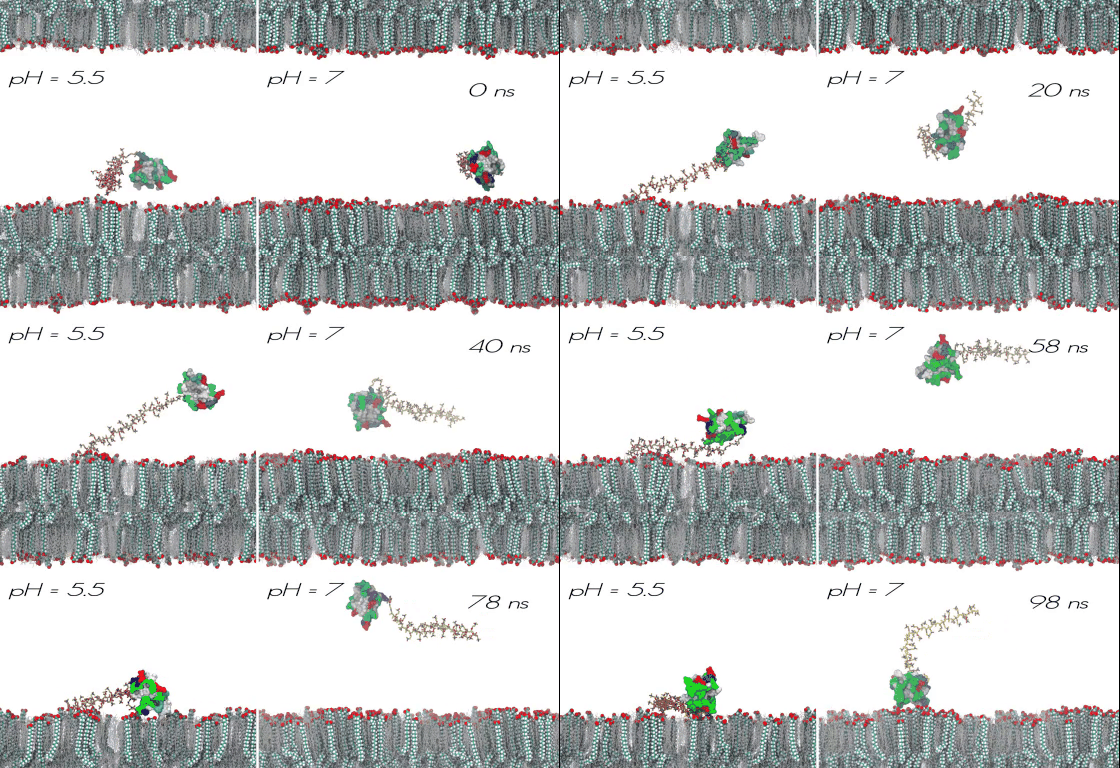
Figure: Molecular dynamics simulation of OP-I diffusion in the stratum corneum (Source: Zhejiang University)
During natural evolution, human skin has developed a unique pH gradient: from a weakly acidic microenvironment (pH ≈ 5) on the surface (the sebum film and the outer layer of the stratum corneum) to a neutral environment (pH ≈ 7) in the deeper layers. The design of OP polymers precisely aligns with this physiological characteristic. They contain tertiary amine oxide groups, a chemical structure that confers unique pH responsiveness:Protonation occurs in acidic environments, resulting in a positive charge and forming polycations; whereas deprotonation takes place in neutral environments, converting the species into electrically neutral polyzwitterions.
This pH-responsive characteristic enables OP to function as a flexible, shape-shifting "courier."
Professor Zhou Ruhong’s team elucidated this at the atomic level through molecular dynamics simulations and binding free energy calculations,"Smart Drug Delivery Mechanism Adapted to the Physiological pH Gradient of the Skin"
What is even more astonishing is that OP has another unique skill.After chemically conjugating with insulin to form OP-I, this complex undergoes “hopping motion” along the cell membrane surface as it penetrates the viable epidermis and dermis.The research team directly observed this phenomenon using total internal reflection fluorescence microscopy.
This “jumping delivery” strategy is exceedingly ingenious: by moving across the cell membrane surface without entering the intracellular space, OP-I effectively evades degradation by intracellular enzymes. Ultimately, it enters the systemic circulation via lymphatic vessels in the dermis, achieving systemic insulin delivery. This is akin to enabling OP, a flexibly deformable “courier,” to carry the insulin “package” through the skin’s “wall” and deliver it into the bloodstream.
To gain a deeper understanding of this mechanism, the research team employed various advanced technologies for validation. The team labeled OP with 5-nm gold nanoparticles and directly observed the penetration pathway of OP in the stratum corneum using high-angle annular dark-field scanning transmission electron microscopy (HAADF-STEM). Using confocal laser scanning microscopy, the researchers also directly visualized the transfer process of OP-I between human keratinocytes, confirming a cell contact-mediated transfer mechanism. These rigorous experiments and simulations validated the transdermal mechanism of OP from multiple perspectives, providing a solid scientific foundation for this technology.
To verify the practical efficacy, the research team conducted a systematic pharmacodynamic evaluation in two animal models of diabetes. In the streptozotocin-induced type 1 diabetes mouse model, the team administered OP-I at a dose of 116 U/kg via topical application to the dorsal skin.The results showed that blood glucose levels could be rapidly reduced to the normal range within just one hour, with a hypoglycemic effect comparable to subcutaneous insulin injection. The therapeutic effect lasted for more than 12 hours, with no risk of hypoglycemia.
The skin structure of miniature pigs is more similar to that of humans, making them an important model for evaluating the applicability of transdermal drug delivery technologies to humans. In experiments involving diabetic miniature pigs, the research team successfully normalized blood glucose levels by applying OP-I at a dose of 29 U/kg over a skin area of 100 cm². OP-I successfully penetrated all skin layers without causing any damage. Notably, the dose required for miniature pigs was significantly lower than that for mice, which may be attributed to differences in skin structure and metabolic characteristics across species. These findings provide valuable references for dose design in future human clinical trials.
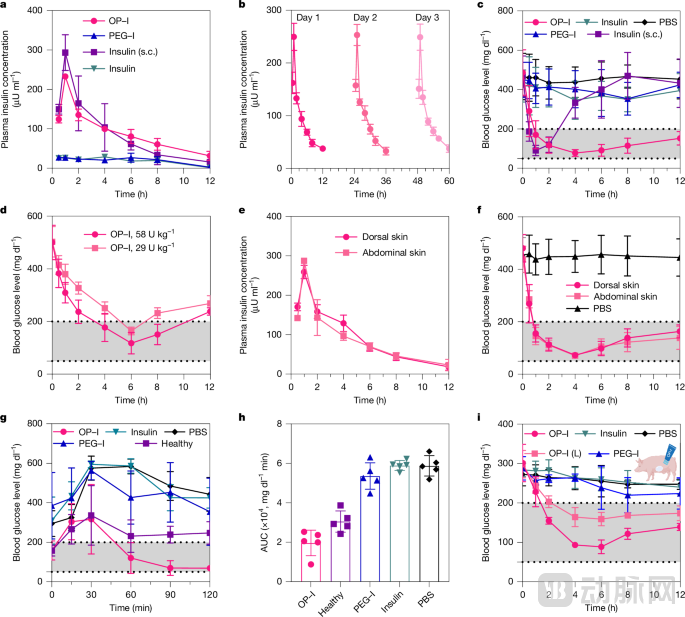
Figure: Hypoglycemic effect of transdermal administration of OP-I (Source: Nature)
The research team also conducted a comprehensive safety assessment. Histological examination of the skin revealed that, after continuous administration, the structure of the stratum corneum remained intact, with no dilation of intercellular spaces and no observed inflammatory response. Systemic toxicity evaluation indicated that hematological parameters, biochemical indices, and hepatic and renal function markers were all within normal ranges, and histopathological examination showed no abnormalities. These data suggest that, unlike traditional chemical penetration enhancers, OP-I does not achieve permeation by disrupting the skin barrier; instead, it leverages the physiological properties of the skin to "intelligently traverse" it, thereby offering a higher safety profile.
A key question is whether insulin retains its biological activity after conjugation with OP.
The research team confirmed through surface plasmon resonance experiments that the binding affinity of OP-I to the insulin receptor is comparable to that of native insulin. Molecular dynamics simulations further elucidated the complete binding process between OP-I and the insulin receptor. Additionally, tissue distribution studies demonstrated that OP-I efficiently targets key tissues involved in glucose regulation, including the liver, adipose tissue, and skeletal muscle, thereby providing a clear mechanistic basis for its potent glucose-lowering effects.
From molecular design to mechanistic elucidation, and further to validation in animal experiments, this study establishes a complete and rigorous chain of scientific evidence.
The significance of this study extends far beyond insulin delivery itself, holding substantial value across multiple dimensions.
From a scientific perspective, this represents a significant breakthrough in traditional understanding.This study provides the first evidence that polymers with a molecular weight of up to 4.5 kDa can penetrate intact skin via non-invasive means, challenging the long-standing theoretical constraint known as the "500 Dalton rule." More importantly, it proposes a novel mechanism by which pH-responsive polymers leverage physiological skin gradients for penetration. This includes a dynamic transition strategy from polycations to polyzwitterions, as well as an ingenious "hop-on-hop-off" delivery design that avoids enzymatic degradation, thereby offering entirely new design concepts for future transdermal delivery of macromolecules.
As ScienceNews noted in its report, Professor Richard Guy described the work as “very exciting” because its approach is “elegant”—working in synergy with the skin’s natural properties rather than attempting to force drugs through.
For the more than 500 million people with diabetes worldwide, this technology could bring about a revolutionary change.Inside Precision Medicine quoted the research team as saying, “OP represents a promising non-invasive transdermal insulin delivery system, offering an ideal alternative to subcutaneous injections for diabetes management.”
Moreover, as stated in the research paper, OP conjugation is universally applicable for the transdermal delivery of biological macromolecules such as peptides, proteins, and nucleic acids, offering broad therapeutic potential. Currently, the research team has successfully extended this technology to GLP-1 receptor agonists (including liraglutide and semaglutide, the active ingredient in Ozempic), therapeutic proteins, monoclonal antibodies, and siRNA. This universality indicates that OP is not merely a specific solution for insulin but rather a general-purpose platform for the transdermal delivery of biological macromolecules. Potential applications also include growth hormone, vaccines, and the treatment of chronic conditions requiring long-term injections, such as rheumatoid arthritis.
It is reported that the relevant technology has been transferred to enterprises and its clinical translation is being advanced, with the research team collaborating with companies to develop the technology for clinical applications. If it successfully passes clinical trials, it will reshape the drug delivery system for biological macromolecules, generating substantial economic and social value.
From ancient topical plasters to modern transdermal patches, humanity has long explored the potential of drug delivery through the skin. Through ingenious molecular design that leverages the skin’s own physiological properties, a research team at Zhejiang University has achieved what once seemed an impossible breakthrough. For hundreds of millions of diabetes patients worldwide, “saying goodbye to needles” is no longer an unattainable dream. From a sudden insight in the laboratory, to a landmark paper published in Nature, and potentially to future clinical applications—this serves as a vivid example of how basic research drives technological innovation and ultimately benefits humanity.