

Elevidys Receives FDA Black Box Warning Update Amid Safety Concerns in DMD Gene Therapy
In the field of Duchenne muscular dystrophy (DMD) treatment, the gene therapy Elevidys (delandistrogene moxeparvovec-rokl) has garnered significant attention.
On November 14, 2025, the FDA announced that it was taking action to approve the new labeling submitted by Sarepta Therapeutics (hereinafter referred to as “Sarepta”), which includes the addition of a boxed warning to Elevidys.
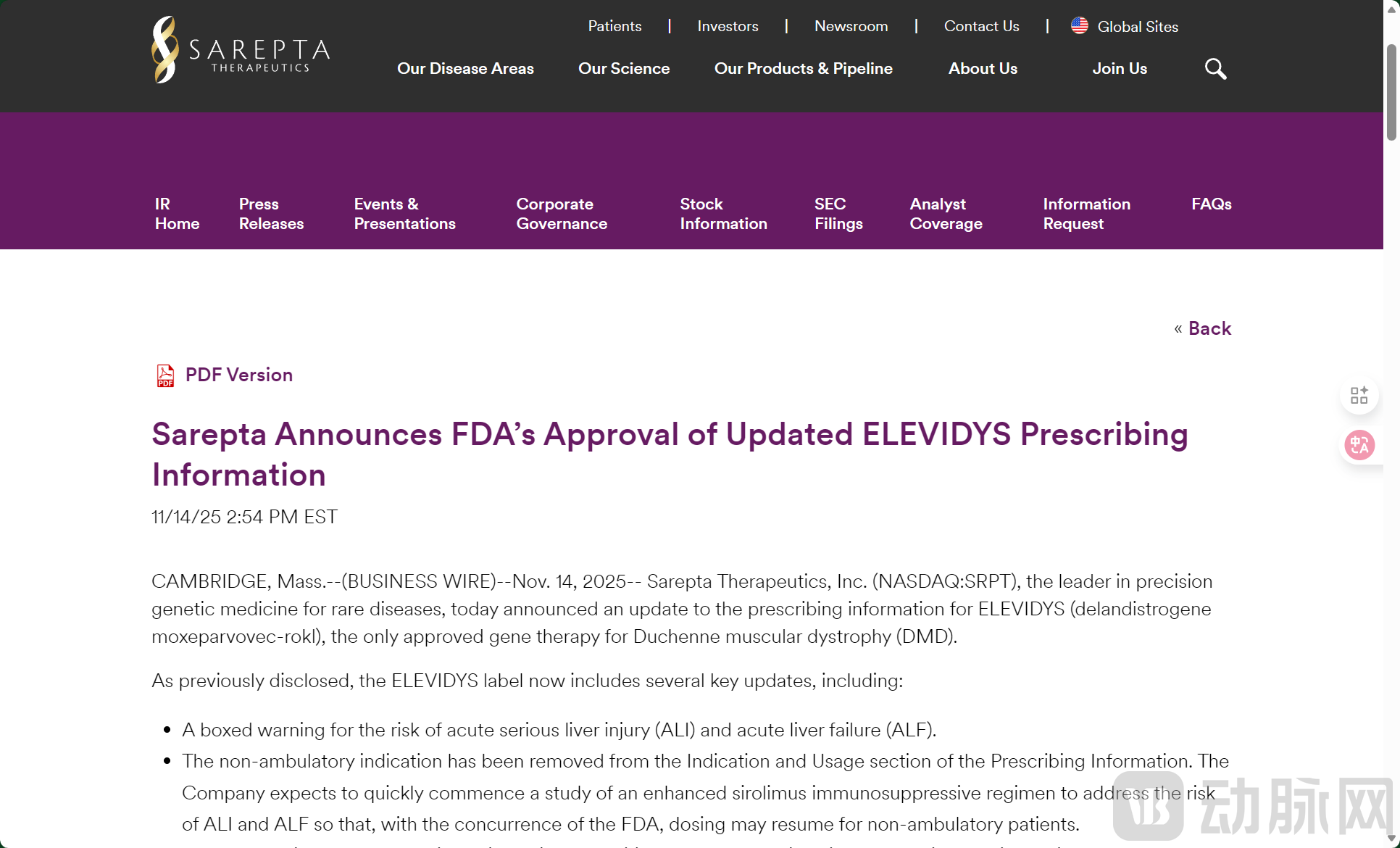
Source:Sarepta Therapeutics Announcement
Elevidys is a single-dose, adeno-associated virus (AAV)-based intravenous infusion gene transfer therapy designed to address the underlying genetic cause of Duchenne muscular dystrophy (DMD)—mutations or alterations in the DMD gene that lead to dystrophin deficiency—by delivering a transgene encoding ELEVIDYS micro-dystrophin targeted for production in skeletal muscle.
The labeling updates emphasized by the FDA this time stem from reports of fatal acute liver failure in ambulatory patients treated with this product.
Updated label content includesAdd a boxed warning describing the risks of severe liver injury and acute liver failure; restrict the indication to ambulatory patients aged 4 years and older with confirmed DMD gene mutations; remove the indication for non-ambulatory DMD patients; add limitations of use statements to guide clinical decision-making; update the Warnings and Precautions, Dosage and Administration, Adverse Reactions, Use in Specific Populations, Clinical Studies, and Patient Counseling Information sections; provide new Medication Guides for patients and caregivers.
On the same day, Sarepta also announced updates to the prescribing information for Elevidys, recommending against its use in the following patients: those with pre-existing hepatic impairment (defined as γ-glutamyl transferase [GGT] > 2 times the upper limit of normal or total bilirubin > the upper limit of normal not caused by Gilbert’s syndrome) or active liver viral infections due to the high risk of acute severe liver injury and acute liver failure. Additionally, due to immunogenicity and potential safety concerns, it is not recommended for patients who have recently received vaccinations (within 4 weeks after treatment).
The revised label also includes specific safety information and monitoring recommendations. For example, it is recommended that liver function tests be performed weekly for at least three months following treatment. After infusion, patients should remain within proximity to an appropriate medical facility for at least two months. Patients should contact their healthcare provider immediately if they experience yellowing of the skin or eyes, miss or vomit a corticosteroid dose, or experience changes in mental status.
Furthermore, corticosteroid therapy may suppress immune function, increasing susceptibility to infections and serious complications, including death. The FDA recommends weekly monitoring for cardiac injury (troponin-I) for one month following treatment. It is also clearly stated that Elevidys should not be used in patients with deletions involving DMD exons 8 and/or 9, and is not recommended for patients with pre-existing hepatic impairment, recent vaccination, or recent/active infections.
Duchenne muscular dystrophy (DMD) is a rare and severe genetic disorder caused by gene defects that lead to abnormal or absent dystrophin. Dystrophin is a key protein for maintaining the integrity of human muscle cells. Due to this genetic defect, patients experience symptoms such as difficulty walking and running, frequent falls, fatigue, and learning disabilities/difficulties. Additionally, weakened respiratory muscles and impaired cardiac function expose patients to cardiac and respiratory complications.
According to data disclosed by the FDA, symptoms of Duchenne muscular dystrophy (DMD) typically begin in childhood (between ages 3 and 6), primarily affecting males, with rare cases also occurring in females; approximately 1 in every 3,300 boys is affected.
To further assess the risk of serious liver injury, the FDA has required manufacturers to conduct post-marketing observational studies. These studies will enroll approximately 200 patients with Duchenne muscular dystrophy (DMD) and include at least 12 months of follow-up after Elevidys administration, with regular assessments of liver function.
Earlier, in June 2025, the FDA issued a CBER safety communication following two reports of fatal acute liver failure in non-ambulatory pediatric male patients with Duchenne muscular dystrophy (DMD) after receiving Elevidys. In these two fatal cases, patients exhibited significantly elevated liver enzymes and required hospitalization within two months after Elevidys infusion. Another severe, non-fatal case of acute liver injury involved complications such as mesenteric venous thrombosis, intestinal ischemia and necrosis, and portal hypertension.
In response, the manufacturer voluntarily suspended distribution of Elevidys for ambulatory patients.
In July 2025, the FDA announced that it was investigating the death of an 8-year-old boy who had received Elevidys gene therapy; the death occurred on June 7, 2025. The FDA requested and obtained a voluntary suspension of product distribution to investigate safety concerns. Several days later, on July 28, 2025, the FDA concluded its investigation, determining that the boy’s death was not related to the gene therapy product itself. Meanwhile, the FDA stated that it would continue to listen to and respond to the perspectives of the patient community affected by Duchenne muscular dystrophy (DMD).
From a market perspective, Elevidys remains the only approved gene therapy for DMD worldwide.
In the field of DMD treatment, Pfizer has also actively pursued gene therapy. In 2024, Pfizer announced the results of the Phase III CIFFREO study of its investigational gene therapy for Duchenne muscular dystrophy (DMD), fordadistrogene movaparvovec (PF-06939926). The results showed that motor function did not improve in subjects receiving the gene therapy compared with those in the placebo group, and the trial failed to meet its primary and key secondary endpoints.
For the patient population, they may be willing to assume manageable risks in exchange for hope of survival. It is widely believed within the industry that a relatively lenient standard was applied when approving Sarepta’s Duchenne Muscular Dystrophy (DMD) gene therapy, Elevidys. The efficacy of Elevidys remains controversial, as it failed to meet its primary endpoint in Phase 3 trials.The development of the now-discontinued competitor drug PF-06939926 was also overshadowed by the deaths of two clinical trial participants.
Furthermore, an adult patient with Duchenne muscular dystrophy (DMD) died eight days after receiving CRISPR therapy delivered via adeno-associated virus (AAV) vectors; a vector-associated innate immune response led to acute respiratory distress syndrome and cardiac arrest.
Because AAV vectors naturally tend to distribute to the liver in vivo, the liver remains one of the primary organs of enrichment, even though Elevidys utilizes AAVrh74 to reduce the risk of central nervous system exposure. With Pfizer’s exit from this field, the performance of future competitors’ gene therapy products warrants close attention.
Solid Biosciences also announced the suspension of SGT-001 development to focus on its next-generation gene therapy product, SGT-003. This product utilizes a novel muscle-tropic AAV capsid (AAV-SLB101), which is rationally designed to target integrin receptors, thereby enhancing transduction in skeletal and cardiac muscle while reducing liver targeting.
Elevidys’ journey in the field of DMD treatment has been fraught with twists and turns. Whether it will break through the current predicament to bring greater hope to patients or face further challenges remains to be seen.
Source of Information
https://investorrelations.sarepta.com/news-releases/news-release-details/sarepta-announces-fdas-approval-updated-elevidys-prescribing
https://www.fiercepharma.com/pharma/fda-restricts-sarepta-elevidys-gene-therapy-use-after-duchenne-patient-deaths
https://www.fda.gov/news-events/press-announcements/fda-approves-new-safety-warning-and-revised-indication-limits-use-elevidys-following-reports-fatal
https://www.roche.com/media/releases/med-cor-2019-12-23
https://endpoints.news/pfizer-details-results-from-failed-phase-3-trial-of-duchenne-muscular-dystrophy-gene-therapy/
https://investorrelations.sarepta.com/news-releases/news-release-details/sarepta-therapeutics-provides-statement-elevidys?_ga=2.92737181.160626044.1753073361-2101100171.1753073361
https://www.fda.gov/news-events/press-announcements/fda-requests-sarepta-therapeutics-suspend-distribution-elevidys-and-places-clinical-trials-hold
https://investorrelations.sarepta.com/news-releases/news-release-details/sarepta-announces-fdas-approval-updated-elevidys-prescribing
https://www.fda.gov/news-events/press-announcements/fda-approves-new-safety-warning-and-revised-indication-limits-use-elevidys-following-reports-fatal
https://investorrelations.sarepta.com/news-releases/news-release-details/sarepta-provides-safety-update-elevidys-and-initiates-steps?_ga=2.69258901.462862694.1752594812-379294735.1738021796
https://www.fda.gov/news-events/press-announcements/fda-investigating-death-8-year-old-boy-who-received-elevidys
https://www.fda.gov/news-events/press-announcements/fda-requests-sarepta-therapeutics-suspend-distribution-elevidys-and-places-clinical-trials-hold
https://www.nature.com/articles/s41434-025-00561-6