

Billion-Dollar Market Beckons: When Will the Dark Horse Emerge in China's MSSC Sector?

STERI GUARD
Provider of Medical Disinfection and Sterilization Products
107! This is the number of medical sterile supply centers built as of the end of October 2025, according to statistics from VCBeat.
According to the Basic Standards for Medical Sterile Supply Centers (Trial), a Medical Sterile Supply Center (MSSC) refers to an independently established medical institution specializing in the cleaning, disinfection, sterilization, and supply of sterile items such as reusable diagnostic and therapeutic instruments, devices, clean surgical gowns, and surgical drapes used by medical institutions. It does not include sterile supply centers or rooms established within medical institutions, nor does it include sterile supply entities serving manufacturers and distributors of medical devices.
In June 2018, the National Health Commission issued the "Notice on Issuing the Basic Standards and Management Specifications (Trial) for Three Types of Medical Institutions, Including Medical Sterile Supply Centers" (Guo Wei Yi Fa [2018] No. 11), requiring all Medical Sterile Supply Centers (MSSCs) to complete adjustments in facilities, equipment, personnel, and other aspects in accordance with the provisions of the two documents, namely the "Basic Standards for Medical Sterile Supply Centers (Trial)" and the "Management Specifications for Medical Sterile Supply Centers (Trial)," and obtain the "Medical Institution Practicing License" by June 1, 2019. Since then, MSSCs have entered a stage of standardized and specialized development.
Supported by national policies, the importance of sterile supply services is becoming increasingly prominent as healthcare institutions advance toward high-quality development and the prevalence of diseases heightens societal awareness of medical safety. Meanwhile, the continuous growth in demand for medical device sterilization and supply has driven rapid expansion of the sterile supply market.Zhiyan Consulting’s “Research and Development Prospects Report on China’s Third-Party Disinfection Industry (2022–2028)” points out that in 2021, the market size of China’s third-party sterile supply centers (the report covers regional sterile supply centers established by benchmark hospitals to serve themselves and their affiliated medical institutions, as well as medically outsourced sterile processing centers [MSSC] operated by social capital) reached RMB 56.28 billion, and is expected to grow to RMB 125.24 billion by 2028.
In the “third-party sterile supply center” sector, where demand is robust and the market size is approaching RMB 100 billion, socially operated MSSCs are playing an increasingly important role. What is the current status of the 107 MSSCs operated by social capital? How will the industry develop in the future? Through discussions with industry practitioners, VCBeat seeks to reveal emerging trends in the sector’s development.
Historically, healthcare institutions have primarily met their sterilization and supply needs for medical devices and consumables through two approaches: first, by relying on in-house sterile supply departments (CSSDs); and second, by utilizing services provided by third-party sterile supply centers, which include regional CSSDs established by hospitals to serve affiliated medical facilities, as well as market-oriented sterile supply centers (MSSCs) operated by social capital.
Currently, adopting third-party sterile supply services is becoming a common choice for an increasing number of hospitals. This trend is driven by two main factors. On one hand, under increasingly stringent regulatory oversight, the control of healthcare-associated infections (HAIs) has become a key indicator in hospital accreditation, prompting more hospitals to prioritize sterile supply management. On the other hand, due to constraints in space and funding, coupled with higher prioritization of clinical medical equipment upgrades, many hospitals lack the capacity to establish their own central sterile supply departments (CSSDs). Therefore, third-party sterile supply services, which not only ensure sterilization and reduce the risk of HAIs but also enhance operational efficiency and alleviate financial burdens, have emerged as the optimal solution for hospitals.
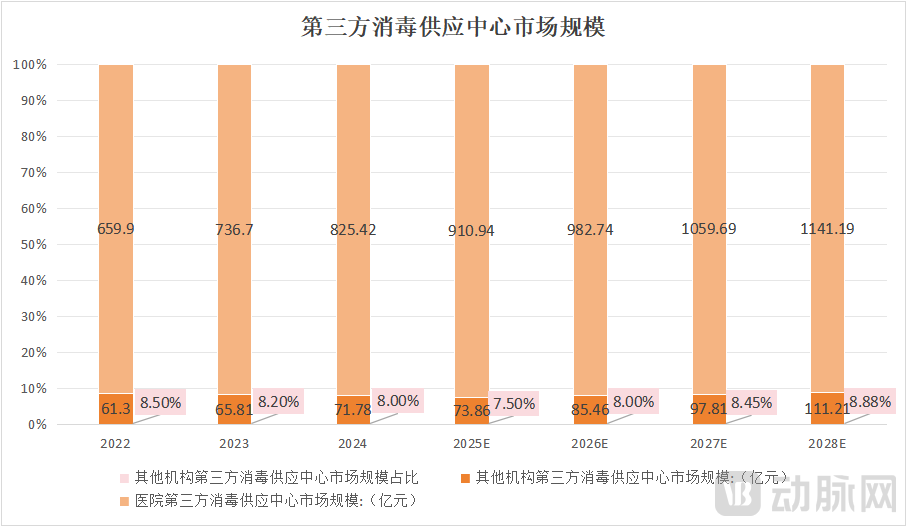
The market size of third-party sterile supply centers is expected to exceed RMB 100 billion around 2027. Data source: Zhiyan Consulting; Chart compiled by VCBeat
Meanwhile, regional sterile supply centers (MSSCs) established and operated by leading hospitals are similarly constrained by staffing, spatial configuration, and specialized accreditation requirements. In response, some local governments are encouraging and supporting the engagement of third-party MSSC providers to meet regional demands for medical sterilization and supply services. Consequently, the socially operated MSSC model is showing signs of gradually replacing the hospital-built and -operated model, with the potential to become a new development trend. According to the “2022–2028 China Third-Party Sterilization Industry Research and Development Prospects Report” by Zhiyan Consulting, the share of MSSCs in the market size of third-party sterile supply centers has been increasing year by year.
SteriGuard Medical Management Group (hereinafter referred to as “SteriGuard”), one of the first domestic providers of third-party disinfection and sterilization services, stated in an interview that with the deepening division of labor in modern society, the proportion of outsourced hospital disinfection services is continuously increasing, and the industry’s service scope has expanded from linen laundering to multiple areas, including cleaning, disinfection, and sterilization of medical devices. Since its inception, SteriGuard has focused exclusively on cleaning, disinfection, and sterilization services for medical devices, cultivating extensive expertise in this field over many years.
The growth in demand has directly driven an increase in the number of companies operating in the industry.According to data from the National Health Commission, as of the end of October 2025, a total of 107 Medical Shared Service Centers (MSSCs) had been established across 24 provinces (municipalities/autonomous regions) in China. This represents a significant growth rate compared to the 22 MSSCs built in 2020.Among them, Guangdong Province (13), Shandong Province (12), and Jiangsu Province (11) rank in the top three for the number of MSSCs. Meanwhile, a number of companies have emerged within the industry to expand their markets nationwide, including STERI GUARD, Antesu Medical, and Laoken Medical.
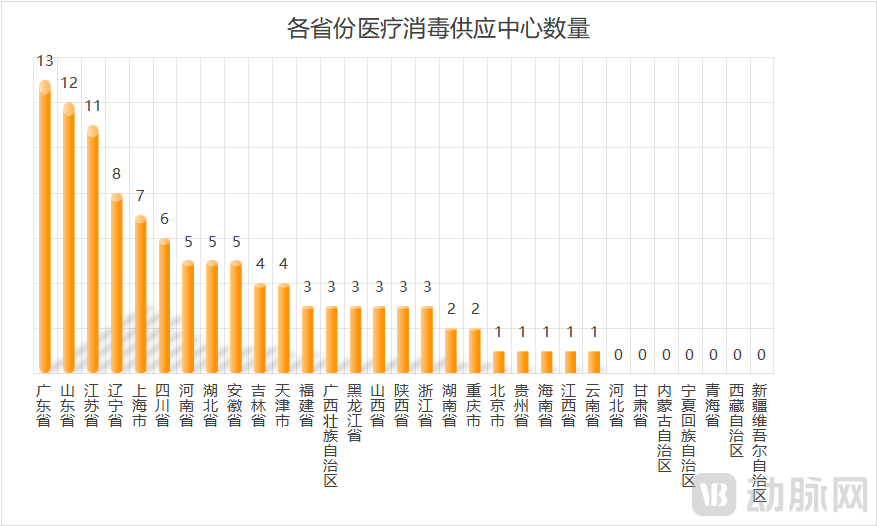
Data source: National Health Commission, as of2025Late October; Chart compiled by VCBeat
However, in the face of the enormous demand underlying a market size worth hundreds of billions of yuan, the 107 MSSCs currently established are clearly insufficient to fully meet this demand. This also implies that MSSCs need to continue their development, pursuing iterative upgrades alongside scale expansion to address more diverse and deeper market needs.
In this market valued at hundreds of billions, the steady development of MSSC is underpinned by three core fundamental elements—
First is service quality.Some medical institutions and patients remain skeptical about Medical Sterile Supply Centers (MSSCs), particularly concerning the quality of outsourced sterilization services. Healthcare providers are concerned that, even if the sterilization of instruments and consumables meets standards, there may still be hidden risks of cross-contamination during transportation and logistics. Consequently, hospitals exercise greater caution when selecting MSSC service providers. Enterprises with early industry engagement and substantial professional expertise are more likely to earn the trust of medical institutions. In short, the fundamental driver of MSSC development lies in implementing refined operational management for sterile supply services, ensuring rigor and accuracy at every stage, thereby gaining the confidence of healthcare providers.
Next is supply assurance.For healthcare institutions, disinfection and sterilization represent only one component of the workflow; ensuring the timely supply of instruments and consumables post-sterilization is equally critical. Beyond routine disinfection and supply services for standard instruments and consumables, healthcare institutions may also have diverse needs, such as long-term leasing of medical equipment and guaranteed availability of instruments and consumables for emergency surgeries. A key challenge within Medical Supply Service Center (MSSC) operations is to meet these demands and ensure reliable supply while maintaining high-quality disinfection and sterilization standards.
Next is sustainable operational capability.On the basis of service quality and supply assurance, continuous and stable sterile supply services are also a key focus for healthcare institutions. This depends on the long-term sustainable operational capability of MSSC, which is closely related to its cost-reduction and efficiency-enhancement initiatives as well as its level of scaled operations.
In brief, high-quality services, guaranteed supply, and sustainable operations underpin the development of MSSC.
Industry leaders also emphasized to VCBeat: “When hospitals outsource their sterile supply services, they strictly evaluate the service quality of MSSCs. Only when an MSSC can help healthcare institutions achieve high-quality disinfection and sterilization, reduce management and operational costs, and allow hospitals to focus on clinical diagnosis and treatment, can both parties establish a stronger relationship of trust. And thisMSSC is required to possess exceptional specialized capabilities.”
Based on the construction cases of 107 MSSCs, industry enterprises are pursuing innovative exploration through diverse pathways—
At the level of service quality, medical sterile supply centers are addressing the primary concerns of healthcare institutions by providing high-quality sterilization services, process visualization, and data traceability.
On one hand, leading industry players are actively adopting the most advanced sterilization and disinfection technologies and participating in the development of relevant standards to regulate the service quality of Medical Sterilization Service Centers (MSSCs) by raising entry barriers. For instance, STERI GUARD, while providing standardized sterilization and disinfection services, is also actively involved in formulating group standards such as the Hygiene Specifications for Socialized Supply Services of Hospital Disinfection and the Cleaning, Disinfection, and Maintenance of Rigid Sterilization Containers, thereby promoting the standardized development of the industry.
On the other hand, leading enterprises represented by STERI GUARD are leveraging digital and intelligent technologies to achieve end-to-end tracking and documentation of service processes, ensuring that served medical institutions can access various data at any time. By establishing an intelligent sterile supply information traceability system, the processing workflow and quality control checkpoints for each instrument can be recorded in real time, enabling “homogenized management” across institutions and regions. The effectiveness of these digital and intelligent measures is reflected in two aspects: For the MSSC (Medical Sterile Supply Center), the system can track the real-time status of each instrument (pack) during cleaning, disinfection, and sterilization, recording operational information and monitoring results of personnel and equipment to facilitate data query and retrospective analysis. Meanwhile, key performance indicators such as average instrument turnover time and equipment utilization rates can be monitored through reports, allowing further efficiency improvements via process optimization. For medical institutions, the system covers all links in the sterile item supply chain, providing an informational query platform. Additionally, it offers online customization of instrument packs to meet the personalized needs of medical institutions.
At the level of supply assurance, in addition to leveraging digital and intelligent technologies to enable process traceability and ensuring timely delivery through conventional smart logistics, leading industry enterprises are further meeting the diversified needs of healthcare institutions by integrating industry resources, thereby achieving more comprehensive supply security.
First, in response to the growing demand for medical device usage and leasing in hospitals, the industry is actively exploring solutions through resource integration. For instance, some practitioners have chosen to establish sterile supply centers via joint ventures with upstream medical device manufacturers. A notable example is the collaboration between Laoken Medical and Sinopharm Medical Devices, which jointly invested in building a medical sterile supply center in Chengdu. Other companies are leveraging their own strengths to accelerate partnerships with third-party device manufacturers, thereby expanding the range of equipment options available to healthcare institutions. For example, STERI GUARD has partnered with leading global surgical medical device manufacturers to meet the equipment needs of healthcare facilities.
Second, in response to emergency response needs, companies within the industry are also actively exploring more rapid and high-quality solutions. For instance, in Shanghai, where the low-altitude economy is rapidly developing, STERI GUARD is exploring solutions for the delivery of surgical instruments using low-altitude logistics and has jointly established an emergency support system with Fudan University Shanghai Cancer Center. Through the “dedicated aircraft express” low-altitude logistics model, critical instruments can be deployed across regions within one hour, enabling emergency supplies to reach operating rooms directly and securing the “golden window for treatment” for critically ill patients.
At the level of sustainable operations, the industry is promoting standardized management and cost reduction with efficiency improvement for MSSCs through chain-based models, thereby achieving growth in the benefits of individual MSSCs.
Among the 107 MSSCs, multiple enterprises, including Antesu Medical and STERI GUARD, are accelerating their market presence through chain operations. Their specific models vary: some companies have adopted a “connecting points to form a surface” strategy, establishing dense locations in adjacent regions to achieve regional coverage. For instance, Antesu Medical has established a presence in Jiangsu, Anhui, Qingdao, and other areas. Other enterprises choose to first define core regions and establish anchor points to lay the foundation for subsequent grid-based expansion. For example, STERI GUARD has set up initial anchor points in East, North, Central, and South China, establishing MSSCs in central cities such as Shanghai, Tianjin, Wuhan, and Guangzhou. These anchor points will play a significant role in its nationwide chain expansion.
On one hand, the chain operation model enables unified management and operational standards, ensuring that all affiliated Medical Sterile Supply Centers (MSSCs) strictly adhere to the headquarters’ quality management protocols. Real-time, precise oversight is achieved through cloud-based systems, thereby safeguarding service quality. On the other hand, the economies of scale generated by chain operations enhance the efficiency of intensive management, allowing MSSCs to further reduce costs and improve efficiency, thus achieving sustainable operations.
These innovative explorations are driving the continuous penetration and sustained expansion of MSSC in the third-party sterile supply services market.
From the demand side, constrained by factors such as insufficient trust in Medical Sterile Supply Centers (MSSCs), some hospitals currently outsource only linen laundering services while keeping the core sterilization and supply of medical devices in-house. However, as acceptance of MSSCs grows, market penetration is expected to increase further, with more hospitals outsourcing medical device sterilization and supply services to third-party providers in the future. Amid this trend, leading companies such as STERI GUARD have established partnerships with over one hundred medical institutions, approximately 50% of which are Grade A tertiary hospitals.
The diverse formats of medical service industries have also provided MSSC with broader market expansion opportunities.Beyond the vast hospital market, community health services, dental care, and medical aesthetics institutions will also emerge as new growth drivers. Taking community health services as an example, according to the China Health and Family Planning Statistical Yearbook 2024, the number of community health service centers (stations) in China reached 37,177 by the end of 2023, making sterile supply services for these facilities a significant potential market.
“The current number of 107 is far from meeting market demand. More MSSCs need to be built in the future,” summarized a senior executive with over two decades of industry experience.“The focus of MSSC development is not to replace traditional hospital sterile supply departments, but to achieve resource intensification, enabling sterile supply centers to operate with high efficiency around the clock, thereby reducing operational and maintenance costs for healthcare institutions. Currently, leveraging the opportunities presented by the advancement of artificial intelligence, the overall operational efficiency of the industry is expected to improve further.”
MSSCs that possess high-quality service capabilities and strengthen operations through digital intelligence, chain expansion, and resource integration are poised to stand out in a gradually expanding market. For enterprises seeking further market expansion, building brand image, establishing a nationwide presence, and actively tapping into lower-tier markets will be key to future revenue growth.
We believe that with the rapid development of MSSC and the improvement in the quality and efficiency of medical sterile supply services, healthcare institutions will be able to focus on clinical diagnosis and treatment. Freed from concerns about non-medical administrative matters, these institutions will further enhance the quality of medical care. As the industry continues to evolve, this progress will ultimately yield mutual benefits for hospitals, physicians, and patients.
----------------------------------------------------------------------------------------------------------------
The following is the attached table: Sterile Supply Centers in All Provinces of China, as of the end of October 2025
