

Jocasta Neuroscience Secures $35M Series A to Advance α-Klotho Therapy JN-0413 for Cognitive Decline

Jocasta
Protein Therapy Researcher
This August,Jocasta Neuroscience, a young U.S. biotechnology company, has completed a $35 million Series A financing round.Amid the current tightening of biopharmaceutical investment and financing, particularly given the exceptionally high R&D risks associated with neurodegenerative diseases, this news has quickly drawn significant attention. Why are investors choosing to double down on this “high-failure-rate” sector? The answer may lie in the research direction steadfastly pursued by Jocasta.
Cognitive Decline: A Major Challenge in Global Population AgingAccording to data from the World Health Organization (WHO), as of 2021, there were more than 57 million people with dementia worldwide, with nearly 10 million new cases each year. An epidemiological study indicates that, barring significant breakthroughs, this figure could rise to over 150 million by 2050.[1]
Even in the United States, where drug development is most active, drugs that can significantly alter the course of disease remain few and far between.Current treatment options, such as the small-molecule drugs donepezil and memantine, primarily alleviate symptoms by modulating neurotransmitter systems but struggle to halt disease progression.; In recent years, innovative drugs targeting β-amyloid and Tau proteins have also sparked considerable controversy regarding the stability of their efficacy, pricing, and risk of side effects.
Against this backdrop, the emergence of Jocasta stands out as particularly distinctive. It has chosen a path divergent from the mainstream, shifting its focus away from “clearing brain waste” and instead aiming to enhance cognition by unlocking the brain’s inherent potential.
From UCSF Lab to $35 Million Series A: Collaborative Incubation of Longevity Proteins Across Industry, Academia, and Research
From molecular discoveries in the lab to an innovative pharmaceutical company that has raised $35 million in financing,Jocasta completed the commercialization of its scientific research achievements in four years., with its core support being α-Klotho, known as the “longevity protein.”
The story begins in the laboratory of Dena Dubal, a professor of neurology at the University of California, San Francisco (UCSF). While investigating the relationship between aging and cognitive function, Dubal’s team discovered that α-Klotho is not only a key molecule for extending lifespan but also regulates synaptic plasticity, thereby enhancing learning and memory capabilities.
Scientific discoveries confined to academic papers are destined to have limited impact. The Dubal team’s findings were initially acquired by Unity Biotechnology, a biotech company focused on treating age-related diseases, which sought to assess their potential for drug development. However, this direction was temporarily shelved as Unity shifted its strategy toward other age-related conditions. It was not until the establishment of Jocasta in 2021 that α-Klotho regained opportunities for commercialization. In a sense, Jocasta is not a “startup novice” starting from scratch, but rather a “successor” that takes over scientific achievements and focuses on their translation into practical applications.
Jocasta’s Core Team Is a “Gold Standard” Combination of Academia and IndustryProfessor Dena Dubal, the discoverer of α-Klotho, provides academic leadership for R&D; CEO Albert Agro leverages his extensive experience in biopharmaceutical R&D management to precisely steer the pace of product pipeline advancement; and Chairman of the Board Michael Davidson outlines the company’s long-term strategic roadmap from an entrepreneurial perspective.

Figure 1: Team Profiles of Jocasta Neuroscience
(Left: Dena Dubal, Center: Michael Davidson, Right: Albert Agro)
At the capital level, Jocasta’s growth has also drawn significant attention. On August 12, 2025, the company announced the completion of a $35 million Series A financing round, led by True Ventures and participated by Moore Strategic Ventures, SC8 Investments, Glentura, and the Yagan Family Foundation, thereby bringing a broader network of entrepreneurial and industry resources to support Jocasta’s growth.
The convergence of scientific research expertise, industry experience, and capital strength has been realized in Jocasta. Against this backdrop, Jocasta explicitly outlined a timeline in its financing announcement: it plans to initiate clinical trials within the next 18 months and submit an Investigational New Drug (IND) application to regulatory authorities in the fourth quarter of 2026. For a company still at the Series A stage, this schedule is ambitious, reflecting Jocasta’s confidence in its scientific foundation and clinical potential.
JN-0413: Subcutaneous α-Klotho Therapy Sprints Toward Human Clinical Trials
In the human body, the synthesis of α-Klotho protein is controlled by specific genes. Under normal conditions, this protein circulates through the bloodstream and plays a crucial role in maintaining brain health, including protecting against neurotoxicity and supporting synaptic function. However, Klotho levels gradually decline with age or the accumulation of long-term chronic stress.
Interestingly, approximately one-quarter of the population carries the KL-VS allele. This genotype is associated with higher levels of Klotho protein and not only correlates with superior cognitive performance but also demonstrates a reduced risk of Alzheimer’s disease and other neurodegenerative disorders in epidemiological studies. More notably, among individuals carrying APOE4 (apolipoprotein E4)—a well-established genetic risk factor for Alzheimer’s disease—elevated Klotho levels appear to mitigate its adverse effects to some extent, resulting in better preserved cognitive function.
Animal experiments have further validated this potential. In mouse models, supplementation with physiological doses of the Klotho protein enhanced learning and memory performance; in non-human primate studies, a single injection significantly improved working memory, with effects lasting for several weeks.[2]。
These consistent cross-species findings suggest that the role of Klotho may be related to universal synaptic regulatory mechanisms in the mammalian brain.A 2024 clinical observational study also found that Klotho levels in the cerebrospinal fluid of patients with Parkinson’s disease were positively correlated with cognitive function (Figure 2).[3], which provides further evidence for its role as a biomarker and potential therapeutic target.
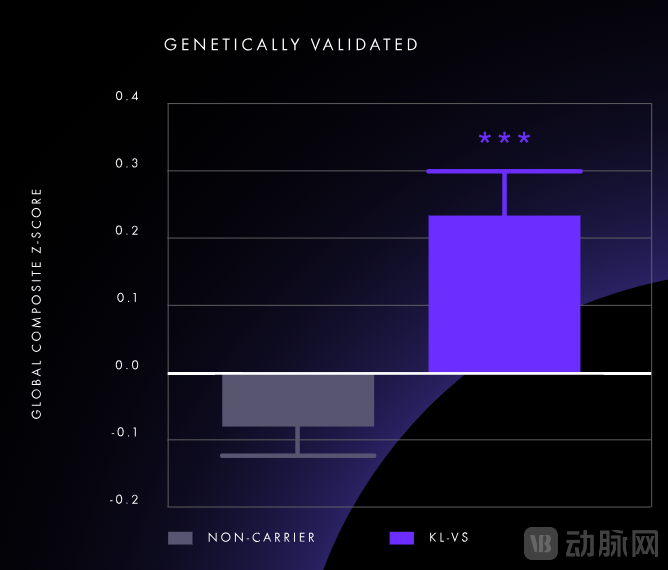
Figure 2: Comparison of mean cognitive test results between KL-VS Klotho carriers (n=188) and non-carriers (n=530)
Built on this scientific foundation, Jocasta’s star candidate drug, JN-0413, was developed. Unlike existing medications for cognitive impairment—which typically work by inhibiting cholinesterase, blocking N-methyl-D-aspartate (NMDA) receptors, or clearing β-amyloid plaques, with the core rationale of “mitigating damage”—JN-0413 takes a different approach.
In contrast,JN-0413 is designed to directly enhance the functional state of the brain. By augmenting synaptic plasticity and signal transmission between neurons, it enables the declining brain to regain more efficient operational capacity."Like a gradually aging car, the traditional approach is to clean up oil stains and replace parts, while Jocasta's path is to upgrade the engine, making its overall operation smoother."
The credibility of this concept stems from multiple layers of validation. According to publicly available information on Jocasta’s official website, the efficacy of a-Klotho has been independently replicated in five laboratories, covering 11 cognitive tasks, with all results demonstrating trends toward improvement. This consistency across different laboratories and models significantly enhances the persuasiveness of its clinical translation.
Regarding the route of administration, JN-0413 utilizes subcutaneous injection rather than high-risk intracranial delivery. Unlike many drugs that must directly cross the blood-brain barrier, Klotho protein’s mechanism of action allows it to exert effects on the central nervous system through peripheral injection. This feature not only reduces the complexity of drug development but also enhances future patient compliance and accessibility.
Currently, JN-0413 remains in the preclinical stage. Jocasta plans to utilize its Series A financing to complete critical toxicology and safety assessments, with the aim of initiating human clinical trials within the next 18 months.
Leveraging the Momentum of “Healthy Aging,” α-Klotho-Targeted Therapies Enter a Golden Era of Translation
China Accelerates Its Transition to a Deeply Aging SocietyAccording to data from the Seventh National Population Census, the population aged 60 and above has reached 264 million, accounting for 18.7% of the total population. With the prevalence of cognitive impairment rising significantly with age, drug development for diseases such as Alzheimer’s has become not only a frontier in medical science but also an urgent public health priority. Jocasta’s unconventional approach serves as a “refreshing remedy,” offering breakthrough strategies for domestic companies entrenched in traditional R&D pathways.
Against this backdrop, domestic Alzheimer’s disease (AD) drug development continues to focus primarily on traditional targets such as β-amyloid and Tau proteins. For instance, Hengrui Medicine’s anti-Aβ monoclonal antibody SHR-1707 has entered Phase I clinical trials, demonstrating favorable safety and tolerability. Meanwhile, novel mechanistic innovations are also emerging: GV-971 (sodium oligomannate capsules), based on the “gut–brain axis” theory, alleviates neuroinflammation by reshaping the gut microbiota, thereby improving cognitive function.
At the policy level, the Outline of the “Healthy China 2030” Plan and the National Medium- and Long-Term Plan for Actively Responding to Population Aging explicitly support the prevention and treatment of cognitive disorders. The National Major Project for New Drug Innovation and Development promotes a priority review mechanism, providing institutional safeguards for the regulatory review of new Alzheimer’s disease drugs, particularly by offering fast-track support for novel-target therapies with significant clinical value.
For Chinese enterprises, breaking through the predicament of homogenization requires leveraging policy dividends and accelerating the translation of academic research achievements. The exploration of α-Klotho-based “function-enhancing” targets may pave new pathways for the treatment of cognitive disorders.
References:
[1] GBD 2019 Dementia Forecasting Collaborators. Estimation of the global prevalence of dementia in 2019 and forecasted prevalence in 2050: an analysis for the Global Burden of Disease Study 2019. Lancet Public Health. 2022 Feb;7(2):e105-e125. doi: 10.1016/S2468-2667(21)00249-8. Epub 2022 Jan 6. PMID: 34998485; PMCID: PMC8810394.
[2] Castner SA, Gupta S, Wang D, Moreno AJ, Park C, Chen C, Poon Y, Groen A, Greenberg K, David N, Boone T, Baxter MG, Williams GV, Dubal DB. Longevity factor klotho enhances cognition in aged nonhuman primates. Nat Aging. 2023 Aug;3(8):931-937. doi: 10.1038/s43587-023-00441-x. Epub 2023 Jul 3. PMID: 37400721; PMCID: PMC10432271.
[3]Zimmermann M , Fandrich M , Jakobi M ,et al.Association of elevated cerebrospinal fluid levels of the longevity protein α-Klotho with a delayed onset of cognitive impairment in Parkinson's disease patients[J].European Journal of Neurology, 2024, 31(10):8.DOI:10.1111/ene.16388.