

University of Michigan's RPESC-RPE Stem Cell Therapy Demonstrates Unprecedented Visual Improvement in Phase 1/2a Trial for Advanced Dry AMD
Age-related macular degeneration (AMD) is the leading cause of irreversible vision loss in individuals aged 60 and older,Approximately 196 million people worldwide are affected by this disease.
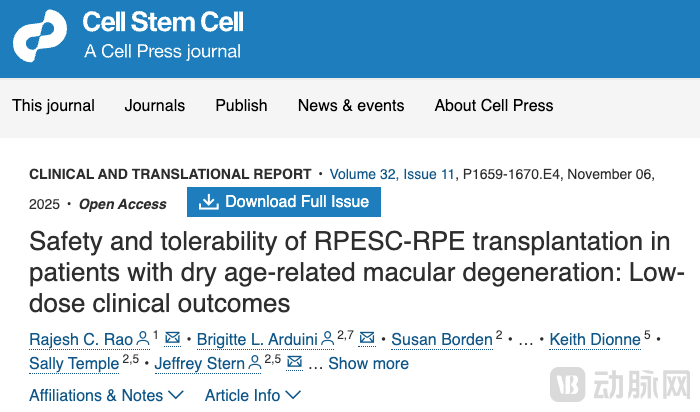
Not long ago, a research team from the University of Michigan Medical Center published the results of their first-in-human clinical trial in the journal Cell Stem Cell. Corresponding author Dr. Rajesh C. Rao and his team used retinal pigment epithelium stem cells (RPESCs) derived from adult eye bank tissues to treat patients with advanced dry age-related macular degeneration (AMD). With safety confirmed,In the group with poorer visual acuity, the mean visual acuity improved by 21.67 letters at 12 months,Unprecedented Magnitude of Improvement Observed in Patients with Advanced Dry AMD
(Source: Cell Stem Cell)
Macular degeneration is classified into two types: dry and wet.Over 90% of AMD patients have the dry form.. The core pathological mechanism of dry AMD is the dysfunction and eventual loss of retinal pigment epithelium (RPE) cells, which are located beneath the retinal photoreceptor cells and are responsible for key functions such as providing nutritional support to photoreceptors, clearing metabolic waste, and maintaining the visual cycle.
During disease progression, RPE cells exhibit dysfunction in the early stages and undergo irreversible death in the late stages. The extensive loss of RPE cells results in the formation of geographic atrophy (GA) regions, which appear as pale lesions on the fundus. The normal RPE cell layer disappears in these areas, and the loss of RPE cells deprives the overlying retinal photoreceptor cells of support, leading to their dysfunction and subsequent death, thereby impairing central vision. While patients retain normal peripheral vision, their central visual field is compromised, making daily activities that rely on central vision, such as reading and face recognition, difficult.
Current treatment methods can slow disease progression, but none can restore vision that has already been lost.
In recent years, stem cell-based cell replacement therapy has become a research hotspot, aiming to implant new RPE cells into atrophic areas to replace lost cells. Transplantation of retinal pigment epithelial (RPE) cells derived from pluripotent stem cells (PSCs) has demonstrated certain safety profiles and modest visual improvement. However, due to the need for extensive differentiation of PSCs to minimize tumor risk, there remains room for improvement in both engraftment efficiency and visual recovery outcomes.
The adult RPE stem cells employed in this study offer distinct advantages. Derived from the native RPE layer of eye bank-donated tissues, these cells are already committed to the RPE lineage and do not require differentiation from a pluripotent state. Consequently, they lack tumorigenic potential and can be transplanted at a less differentiated progenitor stage.
Dr. Rao pointed out in his research: “The uniqueness of adult RPESCs lies in their commitment to the RPE lineage, which enables transplantation at an earlier progenitor stage characterized by enhanced motility and engraftment capacity.”
This study is a first-in-human, open-label, Phase 1/2a dose-escalation clinical trial primarily evaluating safety and tolerability. The research team used retinal pigment epithelial stem cells (RPESCs) derived from a single donor (a 73-year-old male), which were cultured in the laboratory for two passages and then further differentiated for four weeks to obtain the RPESC-derived RPE (RPESC-RPE-4W) cell product.
Preclinical study data indicate that intermediate progenitor cells differentiated for four weeks exhibit superior performance in engraftment efficiency and vision rescue compared to other developmental stages, a finding consistent with results from transplantation studies of other cell types in the central nervous system.
The trial enrolled six patients with advanced dry AMD,The mean age was 76 years. Patients were divided into two subgroups: Cohort 1a included three patients with poorer baseline visual acuity (20/200–20/800), and Cohort 1b included three patients with better baseline visual acuity (20/70–20/200). All patients received transplantation of the lowest dose (50,000 cells) of RPESC-RPE-4W cells into the eye with poorer visual acuity.
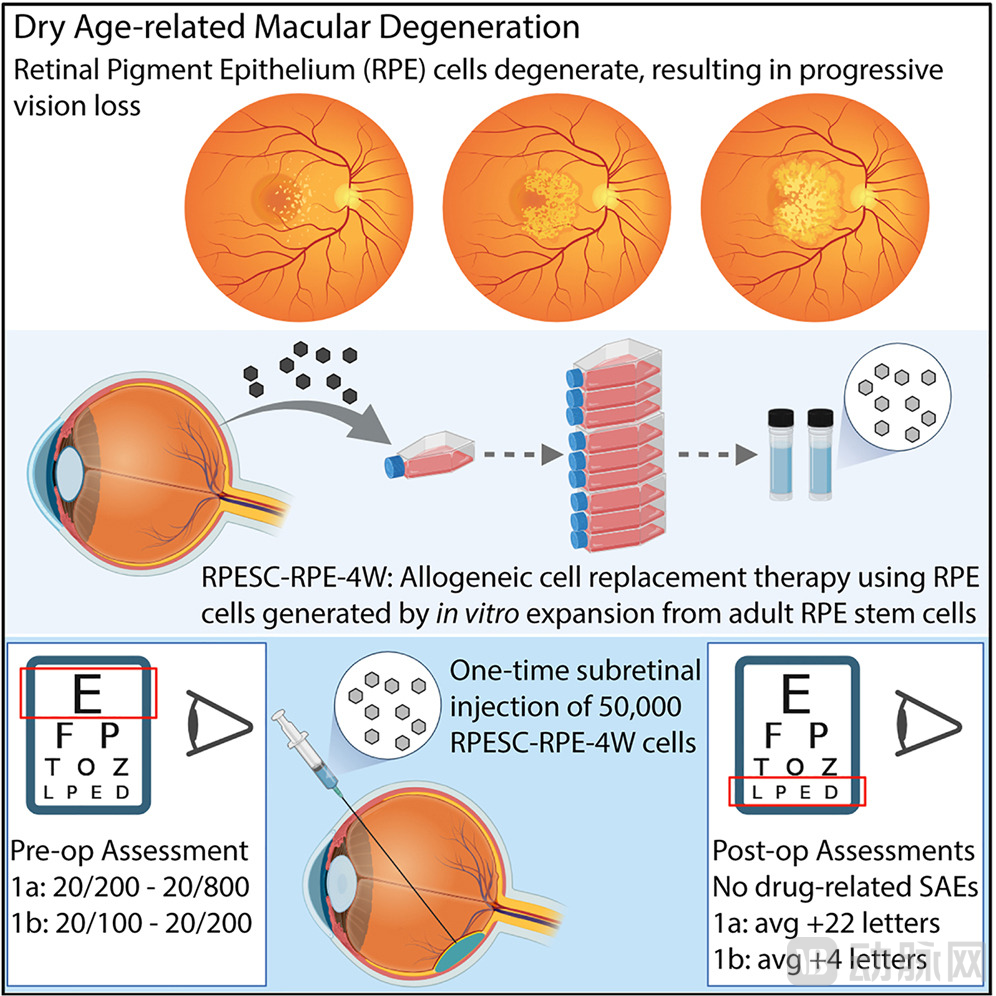
Figure: Schematic diagram of the treatment process (Source: Cell Stem Cell)
Safety results showed that,None of the 6 patients experienced tumor formation, significant inflammation, or serious adverse events related to the study product during the 12-month follow-up period.Postoperative mild inflammation was controlled with topical steroid therapy. All adverse events in the 18 study eyes were mild (Grade 1 or 2), including common surgical complications such as intraretinal hemorrhage and subconjunctival hemorrhage, all of which resolved spontaneously.
Notably, the study did not observe the formation of epiretinal membranes, a common complication associated with PSC-RPE transplantation. This may be attributed to the restricted potential of RPESCs to differentiate into non-RPE lineages and their lower propensity for epithelial-mesenchymal transition. The research team emphasized that this safety profile is particularly important for patients with dry AMD, as this population is typically older and has lower tolerance for treatment-related complications.
Regarding efficacy data,Patients in cohort 1a with poorer visual acuity showed significant improvement in vision.Results from the Early Treatment Diabetic Retinopathy Study (ETDRS) visual acuity chart testing showed that the mean best-corrected visual acuity (BCVA) in the treated eyes of these patients increased by 21.0 letters at 1 month, and this improvement was maintained at 21.67 letters at 12 months. During the same period, the untreated eyes experienced a mean decline of 1.33 letters, resulting in a difference of 23.0 letters between the two eyes.
Individual patient data showed that Subject 002 improved from 29 letters at baseline to 43 letters at 12 months, Subject 004 improved from 35 to 50 letters, and Subject 005 improved from 32 to 68 letters. In Cohort 1b, patients with better baseline visual acuity demonstrated a mean gain of 3.0 letters in the treated eye at the 6-month follow-up, while the untreated eye showed a loss of 1.0 letter.
The researchers noted that this degree of visual acuity improvement has not been previously reported in patients with late-stage dry AMD, surpassing the outcomes of other dry AMD RPE replacement trials. Dr. Rao commented, “We were surprised by the magnitude of visual acuity improvement observed in the most severely affected patients who received adult stem cell–derived RPE transplantation.”This level of visual acuity improvement has never been observed in patients with late-stage dry AMD,“This brings hope to patients who have lost nearly all of their central vision.”
The findings of this study have clinical implications in several aspects. First,Adult RPESC-RPE-4W cells exhibit a favorable safety profile,No tumor formation or significant inflammation was observed, nor was epiretinal membrane formation detected; these features distinguish it from PSC-based RPE replacement therapies; secondly,Visual acuity improvement data in patients with poor baseline vision provide new insights into the therapeutic potential for advanced-stage disease.
The researchers proposed that in advanced-stage disease, there is less accumulation of native RPE cells, providing more space for the implantation of transplanted cells and resulting in a higher proportion of RPE cell replacement. The research team analyzed that: “This finding challenges our understanding of the therapeutic potential for late-stage dry AMD.“Even in the late stages of disease, dormant photoreceptor cells may still be rescued and regain function through the provision of functional RPE cell support.”
The research team is currently following up with patients who received mid-dose (150,000 cells) and high-dose (250,000 cells) regimens to explore the dose-response relationship. The trial received approval from the U.S. FDA in early 2025.Regenerative Medicine Advanced Therapy (RMAT)Designated, with an independent review concluding that it holds “significant potential to address the unmet medical needs of patients with dry AMD.”
Dr. Rao stated, “Receiving RMAT designation is a significant recognition of our research potential. This indicates that the FDA believes this technology has the potential to deliver substantial clinical benefits to patients with dry AMD.” If the higher-dose cohorts continue to demonstrate favorable safety and efficacy profiles, the program will advance into subsequent pivotal clinical trials, which will expand the sample size and employ a randomized controlled design to determine definitive efficacy.
Future studies need to optimize cell delivery techniques, explore the impact of GA lesion coverage, disease subtypes, and morphological characteristics on treatment response, and determine the optimal timing for intervention and patient selection criteria. The research team noted that as more data accumulate, they will be better able to understand which patients are most likely to benefit from this therapy and how to optimize treatment strategies for the best outcomes.
As a small-scale, early-phase study, this first-in-human clinical trial conducted by the team at Michigan Medicine provides new data for the treatment of dry age-related macular degeneration (AMD). The results lay the foundation for subsequent larger-scale studies and offer a potential option for vision restoration to nearly 200 million AMD patients worldwide. With the ongoing release of data from the mid-to-high dose cohorts and the initiation of subsequent pivotal clinical trials, this innovative therapyPromising to Provide New Treatment Options for Patients with Dry AMD, thereby changing the current therapeutic dilemma in which disease progression can only be slowed without restoring lost vision.