

University of Utah Nobel Team Unveils Novel 'Accelerator and Brake' Mechanism in Brain Immunity for Anxiety Regulation
Anxiety disorders are the most common mental health problems globally. According to data from the World Health Organization, approximately 359 million people worldwide are affected by them, accounting for about 4.4% of the global population. However, for a long time,Scientists have a limited understanding of the neural origins of anxiety, and existing pharmacotherapies target neurons almost exclusively, yet many patients respond poorly to these treatments.
Not long ago, a study published by the University of Utah research team in the journal Molecular Psychiatry changed the understanding of anxiety regulation mechanisms.
This study, led by Nobel laureate Professor Mario Capecchi, found thatThe Key Players in Regulating Anxiety Are Not Neurons, as Traditionally Believed, but Immune Cells in the Brain—Microglia.Studies have shown that two distinct microglial populations work in concert, functioning as an accelerator and a brake to regulate anxiety levels.
Dr. Donn Van Deren, the study’s first author, stated, “This represents a paradigm shift, demonstrating that defects and poor health in the brain’s immune system can lead to very specific neuropsychiatric disorders.” This finding provides a theoretical foundation for developing novel treatments for anxiety.
(Source: Molecular Psychiatry)
Traditional views hold that,Anxiety is primarily regulated by neurons and their neural circuits., ranging from selective serotonin reuptake inhibitors to benzodiazepines,Nearly all anti-anxiety medications target neurons.
However, this neuron-centric therapeutic strategy overlooks another class of cells in the brain—microglia. Microglia are the immune cells of the brain, traditionally believed to be primarily responsible for clearing pathogens and cellular debris.
A research team at the University of Utah observed a phenomenon in their preliminary work: when a specific subset of microglia (Hoxb8 microglia) in the mouse brain was disrupted, the mice exhibited anxiety-like behaviors; however, when the activity of all microglia was simultaneously inhibited, the mice’s behavior returned to normal. This result suggests thatDistinct microglial populations may exert opposing effects in the regulation of anxiety.
The research team sought to understand this issue by tracing the developmental origins of microglia. Early studies revealed that murine microglia originate from two distinct pools of hematopoietic progenitors with different developmental timelines and migration pathways. The first category comprises non-Hoxb8 microglia, which are generated in the yolk sac at embryonic day 7.5 (E7.5) and subsequently migrate directly into the developing brain, accounting for approximately 75% of the total microglial population in the adult brain. The second category consists of Hoxb8 microglia, which emerge one day later and undergo a more complex migration process: they first migrate to the aorta-gonad-mesonephros (AGM) region and the fetal liver, where they undergo extensive expansion, before entering the brain starting at embryonic day 12.5 (E12.5), ultimately constituting approximately 25% of the population.
These two microglial populations are highly similar at the molecular level, with differential expression observed in only approximately 20 genes. Both express identical microglia-specific markers, such as Tmem119 and P2ry12, confirming that they are both genuine parenchymal microglia.
The functional differences between the two groups have become a key issue in research.
The research team’s focus on Hoxb8 microglia stemmed from an observation:When the Hoxb8 gene is disrupted, mice exhibit two pathological behaviors: chronic anxiety and pathological overgrooming.These excessive grooming behaviors, which resemble human trichotillomania, fall within the obsessive-compulsive disorder (OCD) spectrum. The only cells in the brain labeled by the Hoxb8 lineage are Hoxb8 microglia, raising a central question: Are defective Hoxb8 microglia the direct cause of these behavioral abnormalities?
To address this question, the research team designed cell transplantation experiments—transplanting purified specific microglial subsets into the brains of mice lacking microglia—to directly observe the causal role of these cells in behavioral regulation. Through these experiments, the team demonstrated that defective Hoxb8 microglia are the direct cause of pathological behaviors and uncovered an “accelerator/brake” mechanism by which microglia regulate anxiety.
Cell transplantation is an effective method to directly demonstrate the causal role of specific cells in disease.approaches. First, they used CRISPR-Cas9 technology to delete the FIRE enhancer element of the Csf1r gene, generating Csf1rΔFIRE/ΔFIRE mice. These mice completely lack detectable endogenous microglia but can survive to adulthood and reproduce, providing an ideal recipient system for transplantation experiments.
Researchers from different sourcesTwo types of microglia were purified from the sourceCell Populations: Hoxb8 microglial progenitors were extracted from embryonic fetal livers, while mature Hoxb8 and non-Hoxb8 microglia were isolated from the brains of neonatal mice. Using flow cytometry sorting and specific fluorescent labeling, the researchers separated these two cell populations and then bilaterally injected approximately 25,000 purified cells into the brains of neonatal mice. The neonatal period was selected for transplantation because the blood-brain barrier is not yet fully mature at this stage, allowing the transplanted cells to more readily enter and distribute across various brain regions.
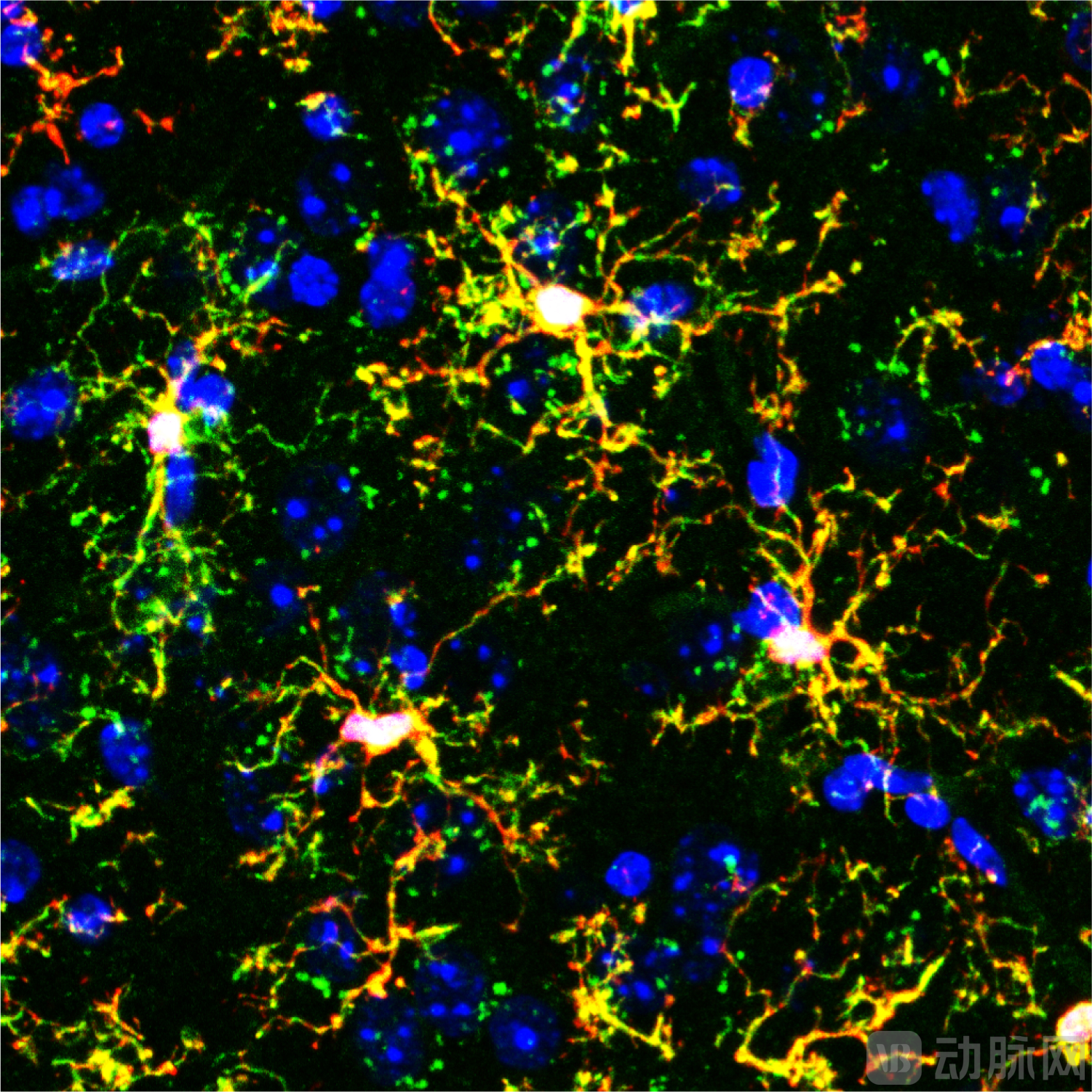
Figure: Fluorescence microscopy image of microglia (yellow branched structures) transplanted into the mouse brain (Source: University of Utah Health)
Post-transplantation observations revealed a clear causal relationship. The research team designed three experimental groups: sham surgery controls, wild-type Hoxb8 microglia transplantation, and mutant Hoxb8 microglia transplantation. After the mice reached maturity, only those receiving mutant cells exhibited significant hair loss, with a pattern similar to that observed in mice with naturally occurring Hoxb8 mutations. Behavioral tests further confirmed these findings: female mice receiving mutant cells spent 1,292 seconds grooming within two hours, compared to only 562 seconds in the wild-type transplantation group. In the elevated plus maze test, the mutant group spent only 25% of the time in the open arms, whereas the control group spent approximately 53%.
These data indicate that,Defective Hoxb8 microglia directly cause chronic anxiety and pathological overgrooming, providing the first definitive evidence of a causal role for brain immune cells in psychiatric disorders.
Based on preliminary clues, the research team proposed a hypothesis: two types of microglia may function as a binary antagonistic system,Hoxb8 microglia act as a “brake” to suppress anxiety, whereas non-Hoxb8 microglia act as an “accelerator” to promote anxiety.This model predicts that mice containing only wild-type non-Hoxb8 microglia (completely lacking the “brake”) should exhibit pathologically high levels of anxiety and grooming. To validate this prediction, they transplanted Hoxb8 cells alone, non-Hoxb8 cells alone, and a mixture of both (at a 25:75 ratio) into recipient mice, respectively.
Further experimental results supported the model predictions. Female mice in the non-Hoxb8-only group exhibited grooming durations of approximately 2,400 seconds, significantly higher than those in the Hoxb8-only group (approximately 600 seconds) and the mixed group (approximately 500 seconds). In the light-dark box test, mice in the non-Hoxb8-only group spent only about 60 seconds in the lit compartment, significantly less than the other groups (90–100 seconds). Mice receiving mixed transplants displayed normal behavior, indicating that the system achieved equilibrium when both the “accelerator” and the “brake” were present. These results suggest that mice regulate anxiety and grooming behaviors through a binary regulatory system composed of two microglial populations with opposing functions.
To validate the functionality of the transplanted cells, the research team conducted multi-level assessments. Immunohistochemical analysis revealed that the transplanted cells expressed all mature markers (Tmem119, P2ry12, Iba1) and exhibited typical ramified morphology. Optogenetic experiments provided more direct evidence: when the transplanted Hoxb8 microglia expressing channelrhodopsin were stimulated with blue light, grooming behavior in mice increased significantly and immediately, whereas the control group showed no response. This demonstrates that the transplanted cells are functional and indicates that they have established functional interactions with neurons.
Upon in-depth data analysis, the research team identified a phenomenon: mice containing only non-Hoxb8 cells exhibited pathological behaviors, albeit with lower severity than Hoxb8 mutant mice. Females in the non-Hoxb8-only group engaged in grooming for 1,050 seconds, whereas the mutant group groomed for 1,490 seconds, resulting in a difference of 440 seconds. This indicates that Hoxb8 gene mutations not only cause loss of function (due to cell absence) but also introduce a gain-of-function component (where mutant proteins interfere with other processes). Quantitative analysis revealed that loss of function contributed approximately 450 seconds to the increase in grooming time, while gain of function contributed approximately 440 seconds, making their contributions nearly equivalent. This finding suggests that an ideal therapeutic approach may need to address both loss-of-function and gain-of-function aspects simultaneously.
This study represents a paradigm shift in neuropsychiatric research—Shifting from a neuron-centric perspective to recognizing the central role of the immune system in regulating brain function and behavior.
Senior author Professor Mario Capecchi pointed out, “Humans also have two functionally similar populations of microglia.” If this hypothesis is confirmed,Therapeutic strategies targeting microglia may offer new options for patients.Potential therapeutic strategies include enhancing the function of Hoxb8-like microglia, suppressing the hyperactivity of non-Hoxb8-like cells, or restoring the balance between the two through pharmacological interventions.
In addition,This finding may also have implications for understanding other mental disorders.Can microglial dysfunction, which leads to anxiety and obsessive-compulsive behaviors, also contribute to the pathogenesis of diseases such as depression, autism spectrum disorder, and schizophrenia? Growing evidence indicates that many psychiatric disorders are accompanied by neuroinflammation and immune system abnormalities.
However, translating these findings into clinical applications still faces multifaceted challenges: How can specific microglial subsets in the brain be selectively modulated without affecting the peripheral immune system? How can therapeutic molecules be delivered across the blood-brain barrier? How can the safety of long-term immune system modulation be ensured?
Dr. Donn Van Deren, the first author, stated, “We are still far from a therapeutic solution, but in the future, it may be possible to target very specific populations of immune cells in the brain and correct them through pharmacological or immunotherapeutic approaches.”"This will represent a major shift in the approach to treating neuropsychiatric disorders."

Figure: Nobel laureate and corresponding author Professor Mario Capecchi annotating a schematic diagram of microglia in the brain (Source: University of Utah Health)
Future research questions include: How do the two microglial subtypes regulate neural circuits through molecular signaling? Do humans truly possess two functionally opposing microglial populations? How can their states be identified and assessed in vivo? Answers to these questions will lay the foundation for clinical trials.
Overall, the study conducted by the University of Utah and published in Molecular Psychiatry elucidates the role of the brain’s immune system in anxiety regulation through experimental design and technical approaches, proposing and validating a dual regulatory model of microglia as an “accelerator/brake.”This discovery deepens the understanding of the mechanisms underlying anxiety and provides direction for the development of novel therapeutic approaches.
Professor Mario Capecchi stated, “This knowledge will provide patients who have lost the ability to regulate their anxiety levels with means to regain control.” Although there is still a long way to go from basic research to clinical application, this study represents a milestone in the field of neuropsychiatry. It demonstrates that complex interactions exist between the immune system and the nervous system, and understanding these interactions may be key to overcoming psychiatric disorders such as anxiety disorders and obsessive-compulsive disorder.