

AI-Powered De Novo Monoclonal Antibody Design: MAGE Platform Ushers in a New Era of Therapeutic Development
When a new deadly virus suddenly emerges, can we design effective therapeutic antibodies within just a few weeks? It is important to note that traditional antibody development requires immunizing animals, screening large numbers of cells, and conducting countless experimental validations.This process often takes months or even years.But now, a groundbreaking study published in the top-tier journal Cell is rewriting this rule.
An artificial intelligence system named MAGE (Monoclonal Antibody Generator) was developed by a team led by Ivelin S. Georgiev from the Vanderbilt University Medical Center,"De Novo Design" of Human Antibodies Successfully Achieved.The related findings were published in the top-tier journal Cell on November 4, 2025.
(Source: Cell)
The most significant contribution of this study lies in its adoption of the core technologies of Transformer-based protein language models, their application to the biomedical and pharmaceutical fields, and the validation ofAI can accomplish the task of “designing life” by learning sequential patterns.
More importantly, the research team not only achieved this breakthrough in silico but also, through rigorous experimental validation, demonstrated that MAGE-designed antibodies can effectively combat multiple pathogens threatening human health, including severe acute respiratory syndrome coronavirus 2 (SARS-CoV-2), emerging avian influenza A (H5N1), and respiratory syncytial virus subgroup A (RSV-A).
Challenge 1: The Dilemma of Traditional Approaches
Antibody drugs are hailed as the “missiles” of the biopharmaceutical industry, capable of precisely identifying and eliminating pathogenic targets; however, traditional antibody development processes are extremely cumbersome—
High Time Cost:From target validation to obtaining candidate antibodies, it often takes months or even longer;
High Economic Costs:involves costly processes such as animal immunization, cell culture, and high-throughput screening;
Low success rate:A large number of candidate antibodies fail in subsequent validation, with very few advancing to clinical trials;
Weak emergency response capacity:In the face of sudden outbreaks, traditional methods struggle to respond rapidly.
Although existing AI-assisted methods can improve efficiency to some extent, they are mostly limited to optimizing existing antibodies or relying on initial templates, leaving a significant gap from true de novo design.
Challenge 2: The Complexity of Antibody Design
Antibodies are not single protein chains but complex molecules composed of two heavy chains and two light chains precisely paired together. This pairing is critical to antibody function—the light and heavy chains must match perfectly to form an effective antigen-binding site. It is akin to designing two keys that must work in concert to unlock the same lock.
Traditional AI methods often only design certain segments (such as the complementarity-determining regions, CDRs) and fail to generate complete, paired heavy-chain–light-chain combinations, which significantly limits their practical utility.
In the face of these challenges, MAGE has achieved three key breakthroughs:
First, MAGE achievedNovel design capability without the need for an initial template.Researchers need only input the amino acid sequence of a viral protein (antigen), and the model will automatically generate complete antibody sequences covering all variable regions of both the heavy and light chains, effectively constructing a matched molecular solution directly from antigen information.
Secondly, the modelSynchronously generate paired strands through a unique sequence encoding method,Ensure compatibility between heavy and light chains. The special separator tokens used in the training data enable the model to learn the synergistic relationships among light chains, heavy chains, and antigens, thereby generating sequences that better adhere to biological constraints.
Finally, MAGEFine-tuned on the basis of Progen2, a large protein language model.Progen2 was pre-trained on over 1 billion protein sequences, enabling a comprehensive understanding of the patterns governing protein sequences. The research team then performed targeted training using 18,507 antibody–antigen sequence pairs to equip the model with task-specific features for antibody design.
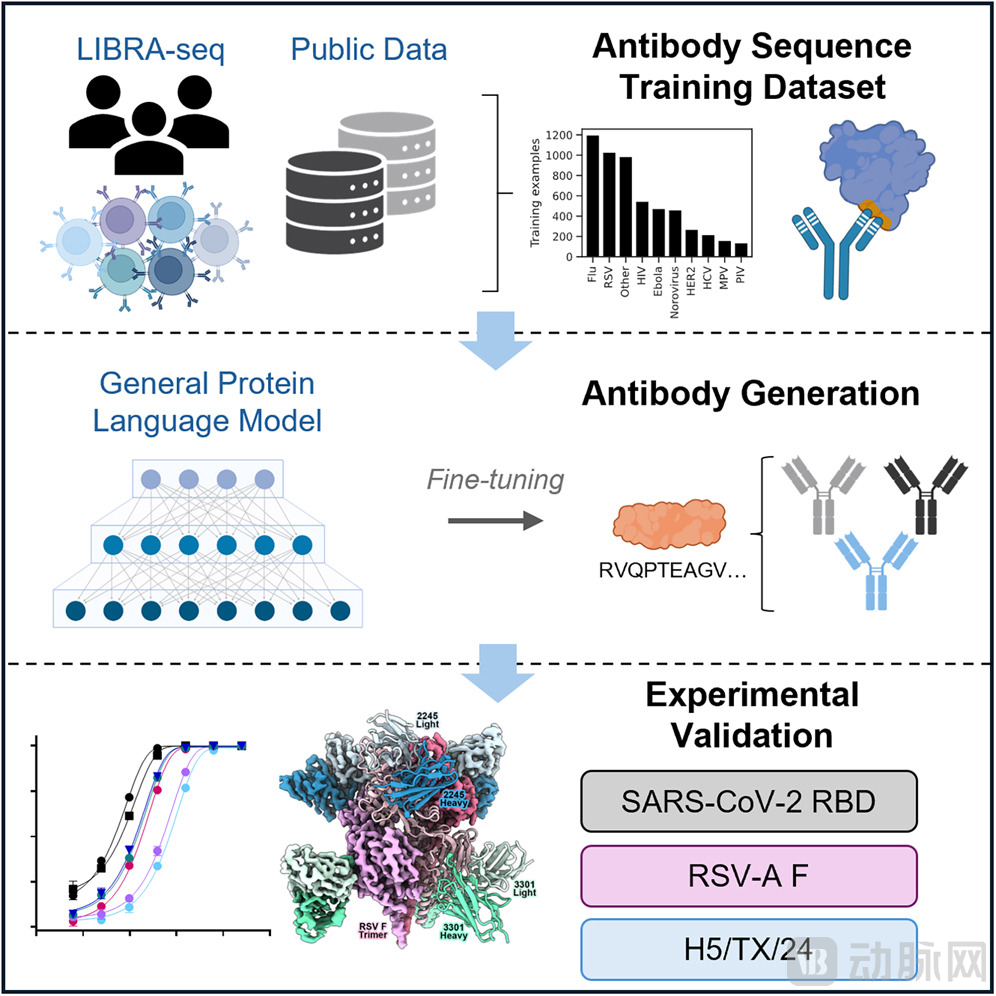
Figure: MAGE antibody design workflow (Source: Cell)
The working mechanisms behind these innovations can be understood through a layman’s analogy.
Traditional antibody discovery is more like a "blind date."——It is both time-consuming and expensive to screen thousands of candidate antibodies against the virus through experimental validation of their binding affinity;MAGE acts as a “matchmaker,”By analyzing a large number of successful pairing cases, we can summarize which types of antibodies are likely to match specific antigens, thereby enabling the direct proposal of potentially effective designs when presented with new viral proteins.
AI-driven antibody design is not new; the key lies in whether it can truly generate effective antibodies. The value of MAGE is that the research team conducted comprehensive and rigorous experimental validation.
For the novel coronavirus: 45% success rate
The research team first selected the receptor-binding domain (RBD) of SARS-CoV-2 as the target, which is a critical site for viral entry into human cells. MAGE generated 1,000 candidate antibody sequences, and after preliminary screening, the researchers selected 20 for experimental validation.
Experimental results showed that 9 antibodies (45%) exhibited detectable binding capacity, with 8 of them achieving binding affinities at the nanomolar or even sub-nanomolar level. Further functional assessments indicated that 4 antibodies possessed virus-neutralizing capabilities, among which RBD-409 was the most outstanding candidate. This antibody demonstrated an IC50 of 6.7 ng/mL, effectively inhibiting viral infection at low concentrations, and maintained neutralizing activity against multiple variants, including Delta, Gamma, and Omicron, thereby demonstrating broad-spectrum efficacy. Sequence alignment revealed an average of 13 amino acid differences between RBD-409 and the most similar antibody in the training dataset, indicating that MAGE is capable of generating molecular designs with novel sequence features rather than simply replicating existing samples.
# Successfully Combating Emerging Avian Influenza
In H5N1 avian influenza experiments, MAGE generated sequences targeting the novel H5/TX/24 (A/Texas/37/2024) strain that emerged in 2024. As this strain was not present during the model’s training phase, the evaluation constituted a zero-shot test. Researchers screened 18 candidate antibodies and identified five with strong binding affinity (28%), while seven others exhibited weaker binding. All strongly binding samples demonstrated IC50 values below 1 μg/mL, indicating substantial neutralizing activity, and displayed diverse neutralization patterns against different H5 and H1 influenza subtypes. This experiment demonstrates that the model can transfer existing knowledge to generate functional antibody sequences against emerging pathogens, even in the absence of direct training samples.
Challenging Low-Representativeness Targets: RSV-A Validation
To evaluate performance under data-scarce conditions, the team also selected RSV-A, whose representation in the training set was only one-tenth that of SARS-CoV-2, as a third target. Among the 23 validated antibodies, seven samples exhibited binding activity (30%), with three demonstrating potent neutralizing capacity. The IC50 of RSV-2245 was below 0.1 μg/mL, and cryo-electron microscopy structures revealed that it targets site V on the RSV fusion protein. RSV-3301 was the antibody with the highest degree of mutation in the validation set; structural analysis showed that it binds to site I in a manner distinct from previously reported mechanisms, thereby providing a novel binding mode for targeting the pre-fusion conformation of the RSV-F protein.
The direct value of MAGE isShorten Antibody Development Timelines and Reduce Costs: Traditional workflows often require more than six months to obtain candidate molecules, whereas MAGE can generate thousands of sequences within hours. After computational screening, only a small number of high-potential candidates require experimental validation, shortening the overall cycle to weeks or even days and reducing reliance on animal testing and large-scale screening.
The Model's "Zero-Shot" CapabilityProvides a New Pathway for Public Health Emergency Response. As soon as the genetic sequence of a novel pathogen is obtained, the antibody design process can be initiated immediately, buying time for the stockpiling of therapeutic antibodies in the early stages of a pandemic and, in theory, helping to enhance response efficiency during large-scale outbreaks.
In the long run,This technological approach is highly aligned with personalized medicine:By inputting sequences from diverse populations and disease targets, there is an opportunity to design bespoke antibodies for patients with rare diseases, cancer immunotherapy, or conditions affecting specific populations, thereby making antibody drug development more customizable and scalable.
However, MAGE still faces several challenges in transitioning from research findings to widespread application.
For instance, although the current binding rate of 28–45% outperforms some traditional workflows, it still implies that the majority of candidates need to be eliminated, indicating room for improvement in success rates; performance is influenced by the distribution of training data and may decline on targets that differ significantly from the training set; the generated sequences still rely heavily on extensive experimental validation and cannot yet bypass the experimental phase.
The research team also projects in the paper that, with data accumulation and technological advancements, future iterations of MAGE may truly learn the general principles governing antibody–antigen interactions, thereby enabling the effective design of antibodies against entirely unseen targets.
The emergence of MAGE marksAntibody Drug Development Enters a New Era Driven by AI.It demonstrates that the core technologies of large language models can understand not only human language but also the “language of life.”
Although there is still a gap before it can fully replace traditional methods, MAGE has already demonstrated high potential efficiency: it enables antibody design in a faster, more cost-effective, and more controllable manner, providing a new technological pathway for addressing current and future health threats.
When we discuss how artificial intelligence is changing the world, studies like MAGE demonstrate that the core value of AI lies in helping to solve complex problems in the life sciences. In this sense, MAGE represents not only a technological breakthrough but also provides new means for future disease prevention and control.