

CRISPR-Edited Wheat 'Hires' Soil Bacteria to Self-Generate Fertilizer, Reducing Reliance on Synthetic Nitrogen
Previously, we wrote an article titled“Breaking New Ground Amid Controversy: Gene-Edited Animals Lead the Way in Agricultural Commercialization”article, pointing out that against the backdrop of ongoing controversies surrounding gene-editing technologies and stalled clinical progress, some companies are attempting to apply this technology to the agricultural sector, ranging from modifying horses’ athletic performance to enhancing livestock productivity and disease resistance.CRISPR Gene-Edited Animals Are Ushering in a New Era of Applications in Agriculture and Livestock Farming.
Today, this biotechnology revolution has also extended to the realm of staple food crops, aiming to address a challenge that has plagued modern agriculture for over half a century: dependence on nitrogen fertilizers.
Recently, a team led by Eduardo Blumwald, Distinguished Professor in the Department of Plant Sciences at the University of California, Davis (UC Davis), demonstratedA gene-edited wheat capable of “hiring” soil bacteria to produce fertilizers for itself.
(Source: Plant Biotechnology Journal)
They utilized CRISPR gene-editing technology,Successfully enabled wheat to “learn” to secrete specific chemical signals that induce soil bacteria to form biofilms on the roots and fix nitrogen.This breakthrough not only promises to significantly reduce the use of synthetic nitrogen fertilizers and lower agricultural costs, but also opens up a novel biological pathway for mitigating the environmental footprint of global agriculture.
Nitrogen is an essential element for life and a building block of proteins and DNA. Although nitrogen gas (N₂) constitutes 78% of Earth’s atmosphere, making it theoretically “inexhaustible” for plants, the vast majority of plants cannot directly utilize this gaseous form due to the extremely stable triple bond between the two nitrogen atoms in the N₂ molecule. This phenomenon is known as the “nitrogen paradox”—Immersed in a sea of nitrogen, yet facing nitrogen starvation.
To address this issue, nature has evolved an exquisite symbiotic mechanism. Legumes (such as soybeans and peas) throughRhizobia(Rhizobia) to fix nitrogen. Rhizobia reside in specialized plant root organs called nodules, where they use an enzyme known as "nitrogenase" to convert atmospheric nitrogen into ammonia (NH₃) that plants can absorb.
HoweverMajor cereal crops such as wheat, rice, and corn do not possess this evolutionary advantage.They lack the ability to form root nodules and therefore can only rely on inorganic nitrogen in the soil.
In the grand narrative of modern agriculture, nitrogen fertilizer is undoubtedly the cornerstone of the “Green Revolution.” It has enabled exponential growth in grain yields, feeding billions of people worldwide. However, this cornerstone is increasingly becoming a heavy burden.The production of synthetic nitrogen fertilizers consumes approximately 2% of global energy, and their excessive use has led to severe water eutrophication and greenhouse gas emissions.For a long time, scientists have dreamed of endowing cereal crops with a remarkable ability: to directly obtain nitrogen from the air, just like leguminous plants.
However, a more challenging biochemical paradox exists here: nitrogenase is extremely sensitive to oxygen. Upon exposure to oxygen, nitrogenase rapidly loses its activity. The root nodules of leguminous plants function because they create a specialized low-oxygen environment, akin to a miniature “anaerobic chamber,” which protects the fragile nitrogenase. For wheat, which lacks root nodules, achieving nitrogen fixation in an oxygen-rich soil environment has remained a perplexing challenge for the scientific community for decades.
The breakthrough by Professor Blumwald’s team is preciselybypassed the extremely complex engineering challenge of "artificial root nodules,"Found a more ingenious path of "chemical diplomacy."
Rather than attempting to forcibly alter the morphological structure of wheat (i.e., by inducing nodule formation), Blumwald’s team focused on modifying the chemical communication between wheat and soil microorganisms. Since plant roots do not passively absorb nutrients but instead secrete various compounds (root exudates) into the soil to communicate with surrounding microbes, the research team first screened more than 2,800 naturally occurring metabolites in wheat, aiming to identify a specific signaling molecule capable of influencing the behavior of soil bacteria.
After multiple rounds of screening, they identified a type calledApigenin(Apigenin) is a flavonoid. Apigenin is not uncommon in the plant kingdom, where it typically functions as an antioxidant or pigment. However, within the rhizosphere microenvironment, researchers have discovered that it possesses a special function, namelyCapable of inducing soil bacteria to form biofilms(Biofilm)。
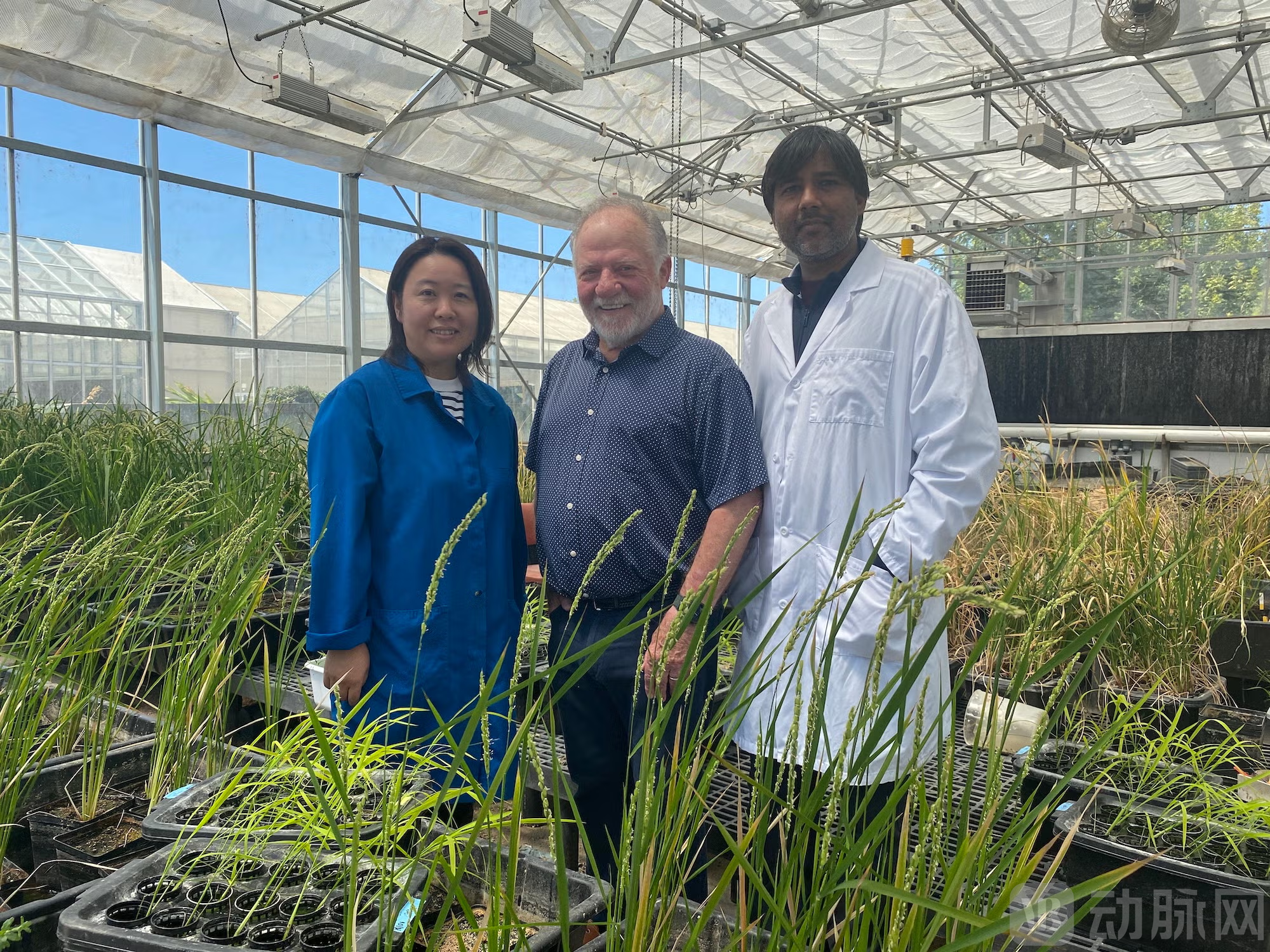
Figure: Professor Eduardo Blumwald (center) and his team (Source: UC Davis)
Identifying the signaling molecule is only the first step; the key lies in enabling wheat to secrete large amounts of this substance from its roots. Leveraging CRISPR-Cas9 gene-editing technology, the research team performed precise modifications to the wheat genome. Rather than introducing exogenous genes (i.e., employing gene editing rather than generating genetically modified organisms), they utilized polycistronic multiplexed CRISPR technology,The flavonoid biosynthetic pathway in wheat was reprogrammed.
Traditional CRISPR often targets only one gene for editing at a time, but metabolic engineering typically requires the simultaneous regulation of multiple enzymes’ expression. This new technology allows researchers to array multiple guide RNAs (gRNAs) in tandem on a single vector, acting like a “multiple-warhead missile” to simultaneously and precisely strike and activate multiple key genes responsible for apigenin synthesis (such as CHI and F3H), thereby channeling metabolic flux toward root transport. This system-level metabolic reprogramming is key to achieving “self-fertilization.”
This is also the most remarkable part of the entire technological roadmap. When the roots of gene-edited wheat release excessive amounts of apigenin into the soil, nitrogen-fixing bacteria in the soil (such as Klebsiella) receive this signal and, in response,Bacteria begin to proliferate extensively and secrete extracellular polysaccharides,A viscous, densely structured biofilm is formed on the surface of wheat roots.
This biofilm plays a crucial dual role: first,Physical Barrier, it acts like a protective shield, firmly adhering bacteria to the root surface to ensure that fixed nitrogen is directly absorbed by the plant rather than being lost to the soil; secondly,Physiological Barrier (Oxygen-Consuming Layer), bacteria within the biofilm consume large amounts of oxygen during respiration. Due to the dense structure of the biofilm hindering the diffusion of external oxygen, a microoxic or even anaerobic microenvironment rapidly forms within the biofilm.
Within this “micro-anaerobic chamber” constructed from biofilms, the inherently fragile nitrogenase is afforded optimal protection, enabling it to efficiently convert atmospheric nitrogen into ammonia.Wheat provides bacteria with carbon sources (photosynthates) and signaling molecules, while bacteria reciprocate by supplying nitrogenous fertilizers.This is a novel symbiotic relationship artificially constructed in non-leguminous plants.
Figure: Morphological comparison of wild-type wheat and three CRISPR gene-edited lines (L3, L12, and L25) at the flowering stage under control conditions (100% nitrogen) and nitrogen-limited conditions (50% and 30% nitrogen) (Source: Plant Biotechnology Journal)
Under controlled greenhouse conditions, the research team conducted rigorous testing on this “self-fertilizing” wheat. The results showed that in environments with extremely low nitrogen supply, the gene-edited wheat exhibited significantly better growth than conventional wheat, with edited plants displaying greener leaves and enhanced photosynthesis. Under low-nitrogen conditions, both the biomass and final grain yield of the edited wheat were substantially higher than those of the control group, approaching levels achieved under normal fertilization regimes. This demonstrates that the “chemical signal–biomembrane–nitrogen fixation” pathway is feasible and that the wheat indeed utilized nitrogen fixed by bacteria.
The potential impact of this technology is profound.
First isEconomic AnalysisProfessor Blumwald ran the numbers: “There are approximately 500 million acres of cropland in the United States. If we can reduce fertilizer use by 10%, a conservative estimate suggests that farmers could save more than $1 billion annually.” For agriculture, an industry with razor-thin margins, this represents substantial cost savings. More importantly, it reduces the sector’s sensitivity to the highly volatile prices in the fertilizer market.
Secondly,Environmental LedgerCurrent fertilization practices are highly inefficient, with crops typically absorbing only 30% to 50% of the nitrogen applied to the soil. The remaining half often causes severe environmental problems: excess nitrates are washed away by rainwater into rivers and oceans, triggering algal blooms that deplete dissolved oxygen and create “Dead Zones” where fish cannot survive; meanwhile, soil microbes convert residual nitrogen fertilizer into nitrous oxide (N₂O), a potent greenhouse gas with a global warming potential nearly 300 times that of carbon dioxide. The “on-demand nitrogen fixation” model enabled by gene-edited wheat reduces the need for excessive fertilization at the source, holding promise for fundamentally curbing agricultural non-point source pollution and agricultural greenhouse gas emissions.
Finally, it isGlobal Food Security, particularly in developing countries, the significance of this technology may be even greater. In many parts of Africa, smallholder farmers often cannot afford fertilizers due to high prices and fragile supply chains, resulting in persistently low crop yields. “Imagine if the crops you grow could naturally stimulate soil bacteria to produce the necessary nutrients,” said Professor Blumwald. “For African smallholder farmers with only six to eight acres of land, this would be a transformative change.” This not only reduces costs but also directly enhances food production capacity in impoverished regions.
Despite the tremendous success of greenhouse experiments, there is still a long way to go from the laboratory to the field.
First isComplexity of Field TrialsSoil is an extremely complex ecosystem teeming with hundreds of millions of diverse microorganisms. In the controlled soil environment of greenhouses, apigenin can precisely “recruit” target nitrogen-fixing bacteria. However, in field conditions, will apigenin be degraded by other microorganisms? Can the target nitrogen-fixing bacteria outcompete indigenous microbial communities? These questions require validation through large-scale field trials.
Secondly,Broad-Spectrum Applicability, Blumwald’s team conducted their research on wheat, but this mechanism (flavonoid-induced biofilm formation) exhibits a certain degree of universality across the plant kingdom. Currently, the team is extending this technology to rice and maize. If all three major staple crops could achieve “self-fertilization,” it would mark another revolution in agricultural history, following the advent of hybrid rice.
Finally, it isRegulation and Public Acceptance, although this technology employs gene editing (CRISPR) rather than traditional genetic modification techniques (which involve introducing exogenous genes), it may face less regulatory resistance (for instance, in the United States and some South American countries, gene-edited crops are not classified as GMOs). However, in regions with stringent regulations such as the European Union, its commercialization pathway remains uncertain. Furthermore, public acceptance of the concept of “induced bacteria” requires science popularization and education.
Although challenges remain on the road ahead, this study from the University of California, Davis, demonstrates to us a“A New Agricultural Technology Paradigm Inspired by ‘Following the Way of Nature’”, not by conquering nature through more powerful chemical synthesis industries, but by deciphering the ancient chemical language between plants and microbes to reactivate their latent cooperative potential. When we look at that gene-edited wheat thriving in barren soil, we see not only an increase in yield, but alsoA Cleaner, More Efficient, and More Sustainable Agricultural Future.This may well be synthetic biology’s most precious gift to humanity: using the tiniest molecular switches to address the grandest global challenges.