

"Hospital-Front, Factory-Back": The Surge of Cell Therapy Centers in Tier-3A Hospitals Driven by State Council Decree No. 818
As 2025 draws to a close, news of major developments at Grade A tertiary hospitals continues to emerge. From Shanghai Changhai Hospital on the eastern coast to the Affiliated Hospital of Qinghai University in the western inland, from Peking University Third Hospital in the north to the Gansu Hospital of Sun Yat-sen University Cancer Center, which shoulders regional missions, similar institutions are springing up within hospitals like mushrooms after rain. According to incomplete statistics from VCBeat, nearly 20 large hospitals across China have established such specialized institutions. In 2025 alone, nearly 13 hospitals sequentially launched these facilities, the majority of which are Grade A tertiary hospitals. Among them are large Grade A tertiary hospitals with significant regional influence, such as the Second Affiliated Hospital of Army Medical University (Xinqiao Hospital of Army Medical University) and the First Affiliated Hospital of Naval Medical University (Shanghai Changhai Hospital). Statistical Table of Hospitals Establishing Cell Therapy Centers and Outpatient Clinics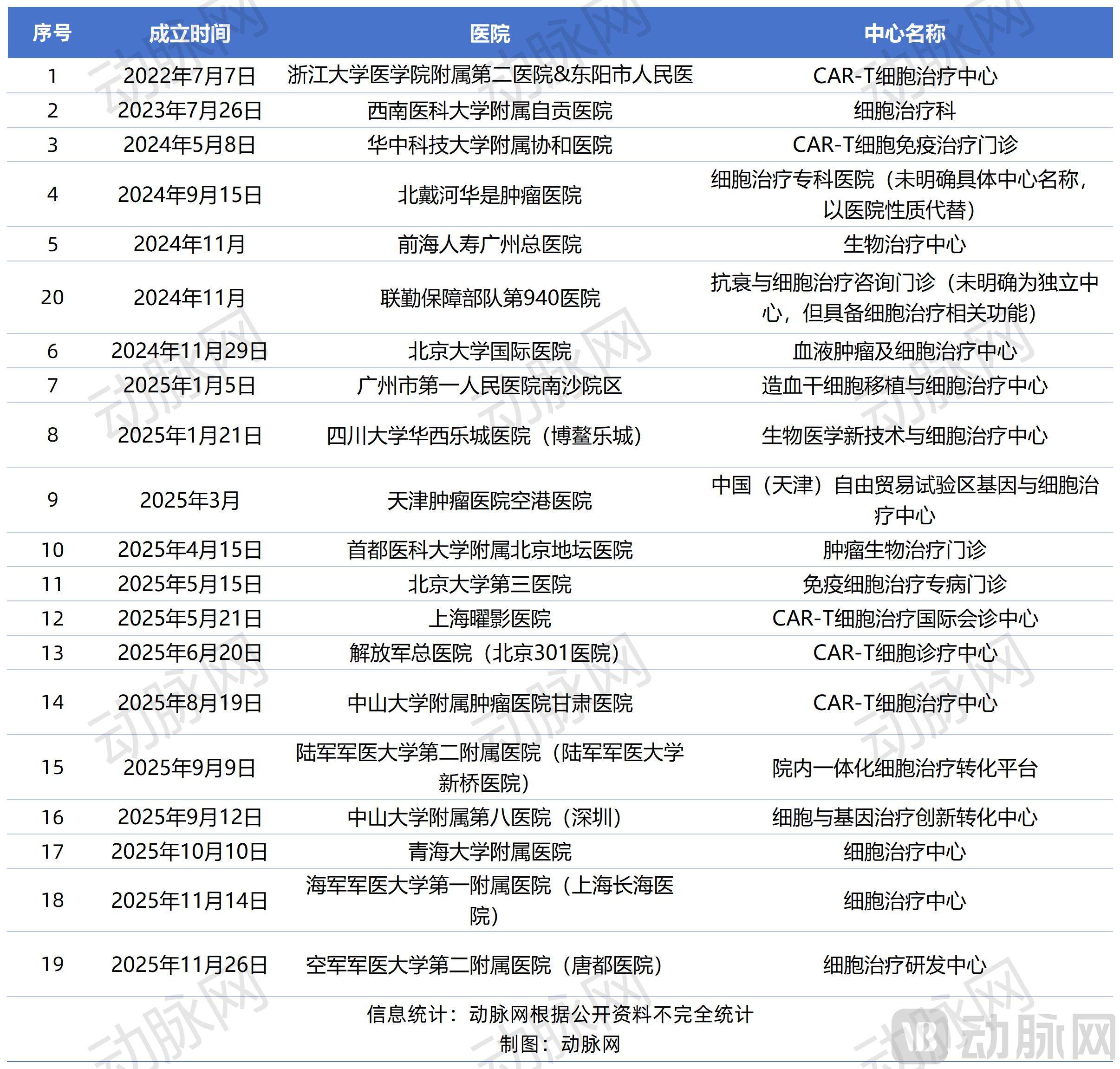
Why Now?
The clarification of the policy and regulatory framework has removed the biggest obstacle to bold hospital investment.
2025 can be regarded as the “Year One of Policy” for cell therapy in China. The Regulations on the Clinical Research and Clinical Translation Application of New Biomedical Technologies (also known within the industry as “Order No. 818”), with its full text released in October 2025, provides top-level institutional design for the entire industry.
The Regulation imposes multifaceted requirements on hospitals conducting clinical research and translational applications related to cell therapy:
Qualification Requirements: Must be a Grade 3A medical institution; have an academic committee and an ethics committee for clinical research that meet the requirements; possess the qualifications, premises, facilities, equipment, management bodies, professional technical personnel, and research capabilities appropriate to the proposed clinical research on new biomedical technologies.
Personnel Requirements:The project leader shall hold a practicing physician qualification and a senior professional title, demonstrate strong professional ethics, scientific research integrity, and clinical technical proficiency, possess the requisite professional knowledge, experience, and capabilities to undertake clinical research on new biomedical technologies, and have their primary place of practice at a clinical research institution. Other personnel involved in the clinical research of new biomedical technologies shall possess corresponding qualifications, professional knowledge, experience, and capabilities.
Policy Requirements:Management systems that ensure the quality and safety of clinical research, adhere to ethical principles, and protect the legitimate rights and interests of subjects.
Other:There are stable and sufficient sources of research funding.
Meanwhile, breakthroughs have also emerged on the payment front. On November 3, 2025, the 2026 “Beijing Puhui Health Insurance,” jointly guided by the Beijing Municipal Healthcare Security Administration and the Beijing Municipal Local Financial Regulatory Bureau, was officially launched. Amniotacel Injection (brand name: Ruibosheng), China’s first approved stem cell drug, has been formally included in the list of specialized drugs. Insured individuals receiving treatment with this drug at designated medical institutions can enjoy a reimbursement rate of up to 65%, providing strong financial support for the widespread application of cell therapy.
An analysis of cell therapy deployments over the past two years reveals a nationwide “diffusion effect” across China.
Early clinical research on cell therapy was highly concentrated in a very small number of top-tier, research-oriented hospitals, such as those in Beijing and Shanghai. However, nowadays,This wave has swept across major regions nationwide, including North China, East China, South China, Central China, Southwest China, and Northwest China.。
It is worth noting that,Western provinces such as Qinghai and Gansu have successively established their first provincial cell therapy centers.. This marks the beginning of this technology breaking through geographical and economic constraints, transitioning from being exclusive to high-end coastal regions to becoming accessible nationwide.
The deep involvement of tertiary hospitals signifies not merely the opening of a few new outpatient clinics, but rather a major shift in the overall development of cell therapy.
Historically, hospitals have primarily participated as sites for cell therapy clinical trials. Hospitals can rapidly generate large-scale “real-world evidence” (RWE) that is difficult to achieve through traditional clinical trials, thereby enabling more precise optimization of treatment regimens and identification of the patient populations most likely to benefit. This capability has the potential to accelerate overall technology maturation by 2–3 years.
Taking CAR-T therapy as an example, the drug is priced at nearly RMB 1 million per infusion, and it has not been included in the National Reimbursement Drug List for three consecutive years. The prohibitive cost has deterred many patients. AndThe emergence of in-house CAR-T products is driving the transformation of cell therapy toward a “front-hospital, back-factory” development model.
The Future of the “Front Clinic, Back Factory” Model and In-House Hospital Preparations
Moving “cell factories” into hospitals essentially transforms “biologics” into “in-house hospital preparations.”
In the past, hospitals mostly collaborated with external enterprises or laboratories to conduct clinical research, resulting in fragmented processes and low efficiency. The current trend is to establish an in-hospital closed loop of “research–production–treatment.”
Represented by Xinqiao Hospital, the “Cell Workshop,” as the core engine of the platform, features in-house cell preparation technologies with multiple internationally leading clinical capabilities. It works in close synergy with the hospital’s “Blood Ecosystem and Smart Cell Science Innovation Center” to establish a complete chain encompassing “basic R&D, standardized production, and clinical validation.”
Professor Zhang Xi, Director of the Hematology Medical Center and Director of the Cell Therapy Center at Xinqiao Hospital, pointed out that cell immunotherapies, represented by CAR-T, have become a new hope for refractory diseases such as hematologic malignancies.However, its clinical application still faces severe challenges, including prolonged manufacturing lead times due to personalized customization—often requiring patients to wait for several weeks—and limited accessibility constrained by high costs and complex processes. More critically, the severe adverse reactions unique to cell therapy, such as cytokine storm, impose stringent requirements for clinical safety monitoring.Therefore, these bottlenecks severely constrain the speed and breadth with which advanced technologies can benefit a broad patient population.
Currently, the development model for cell therapy has evolved from isolated collaborations to an integrated in-hospital platform.。The most representative example is the in-hospital integrated cell therapy translational platform unveiled at Xinqiao Hospital of Army Medical University in September 2025. This platform integrates basic research and development, standardized manufacturing (“cell workshop”), and clinical validation, and innovatively features a proof-of-concept ward equipped with intensive care capabilities.
Although each center adopts a distinct technological approach, they all target major disease areas where conventional medical treatments have reached a bottleneck.
As early as May 8, 2024, Union Hospital, Tongji Medical College, Huazhong University of Science and Technology, announced the launch of the first CAR-T cell immunotherapy outpatient clinic in Central China. Since the first patient received CAR-T therapy in 2015 up to the establishment of this clinic, 520 patients with relapsed or refractory hematologic malignancies have achieved successful outcomes at the hospital.
In the application and breakthrough of new biomedical technologies, Changhai Hospital has applied CAR-NK therapy to systemic lupus erythematosus.
On November 14, 2025, the First Affiliated Hospital of Naval Medical University (Shanghai Changhai Hospital) announced the official unveiling and establishment of its Cell Therapy Center. Concurrently, it was announced that clinical research findings on CAR-NK cell therapy for systemic lupus erythematosus (SLE), led by the team of Professors Zhao Dongbao and Gao Jie from the Department of Rheumatology and Immunology at the hospital, had been successfully published in The Lancet, a prestigious international medical journal.
Clinical data show that among the nine patients who completed one year of follow-up, two-thirds achieved complete remission or reached a state of low disease activity in lupus, with no cases of relapse. More importantly, the treatment significantly reshaped the patients’ immune systems by deeply depleting pathogenic B cells and promoting the reconstitution of naïve B cells, ultimately inducing durable immune tolerance and laying the foundation for long-term remission. In terms of safety, the therapy demonstrated an outstanding profile: only one instance of transient fever was reported, with no serious adverse events or infections occurring, thereby completely avoiding severe side effects associated with conventional glucocorticoid or immunosuppressive therapies, such as osteonecrosis of the femoral head. Multiple patients experienced marked improvements in quality of life after treatment, with some even returning to work.
The wave of cell therapy is surging, with numerous Grade A tertiary hospitals actively establishing cell therapy centers in preparation for the implementation of Order No. 818 after May 1 next year.
References
https://mp.weixin.qq.com/s/PVnouEUZP-FVDvth5bBIUw
https://news.bioon.com/article/f63d90e86515.html
https://mp.weixin.qq.com/s/j_zAyOpHM6DrKk16YBEIKw
https://www.whuh.com/info/1021/55441.htm