

Abbott and Samsung make strategic moves: a quiet US-China rivalry begins in the wearable health sector

Whoop
Developer of health tracking and sports wearable devices
Recently, wearable health company Whoop announced a Series G investment, with a staggering $575 million raised and a post-money valuation of $10.1 billion. The investor roster includes not only healthcare giants like Abbott and Mayo Clinic but also sovereign wealth funds such as the Qatar Investment Authority (QIA) and Mubadala Investment Company, and even legendary sports stars like Cristiano Ronaldo and LeBron James.
However, just last July, Whoop was publicly warned by the FDA . Why would a company warned by the FDA still attract such strong support from so many heavyweights?
At the same time, major brands like Apple and Samsung are making significant moves in wearable health functions . In China, the wearable industry has jointly launched the first group standard for blood pressure monitoring .
The global competition in the wearable technology sector is entering a new phase.
In terms of financing amount alone, $575 million is no small sum. It is significantly larger than the total of Whoop's previous seven funding rounds combined, and represents the largest financing in the global digital health sector so far in 2026. It is highly likely to set the record for digital health funding this year. Even in the years when investment activity was at its peak, this would still be a strong contender for the largest financing round of the year.
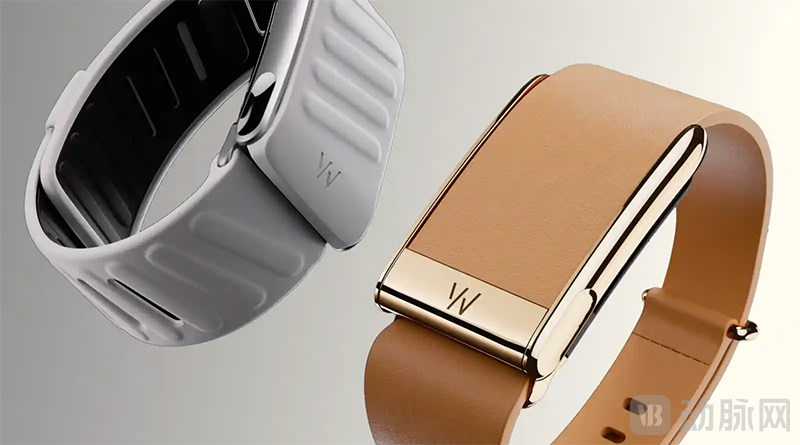
Whoop's Wearable Bracelet (Image from Whoop Official Website)
In fact, before this financing round, Whoop's name had been absent from the capital market for five years. Whoop's return could best be described as "silent for years, then stunning the world with a single move."
Beyond the record-breaking funding amount, the investor lineup in this round has truly captured the public's attention, featuring legendary sports stars such as Cristiano Ronaldo, LeBron James, and Rory McIlroy.
The institutional investors include healthcare heavyweights like Abbott and Mayo Clinic, as well as sovereign wealth funds with deep pockets such as the Qatar Investment Authority (QIA) and Mubadala Investment Company.
The strength of Whoop's appeal is clearly evident from this impressive roster.
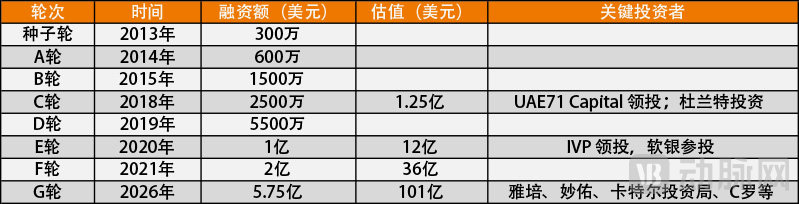
Whoop's Historical Financing Situation (Compiled by VCBeat)
Rolling back the clock to 2012, Will Ahmed, then an undergraduate at Harvard University and a member of the university's rowing team, founded Whoop with the goal of developing a tool that could continuously monitor body data. The idea itself was not particularly novel at the time, as Fitbit, Jawbone, and Nike had already launched similar products before him.
What truly made Whoop innovative was its subscription-based business model: hardware was provided for free (with five generations of products launched to date), and users paid a monthly subscription fee (later converted to an annual subscription). This model allowed Whoop to focus more intensively on data, with sensors continuously collecting various metrics and generating personalized recovery guidance through algorithms. As a result, a large number of professional athletes became its users, which in turn attracted investments from star athletes.
However, what really brought Whoop into the spotlight was its dispute with the FDA last year. In May of last year, Whoop launched a daily blood pressure insights feature exclusive to its flagship members (starting at $359 per year), which used heart rate, heart rate variability, and blood flow patterns during sleep to estimate the user's blood pressure range. In July of last year, the FDA issued a warning letter to Whoop, stating that the blood pressure monitoring function of the Whoop wristband had been marketed and promoted without obtaining medical device certification, violating relevant regulatory requirements.
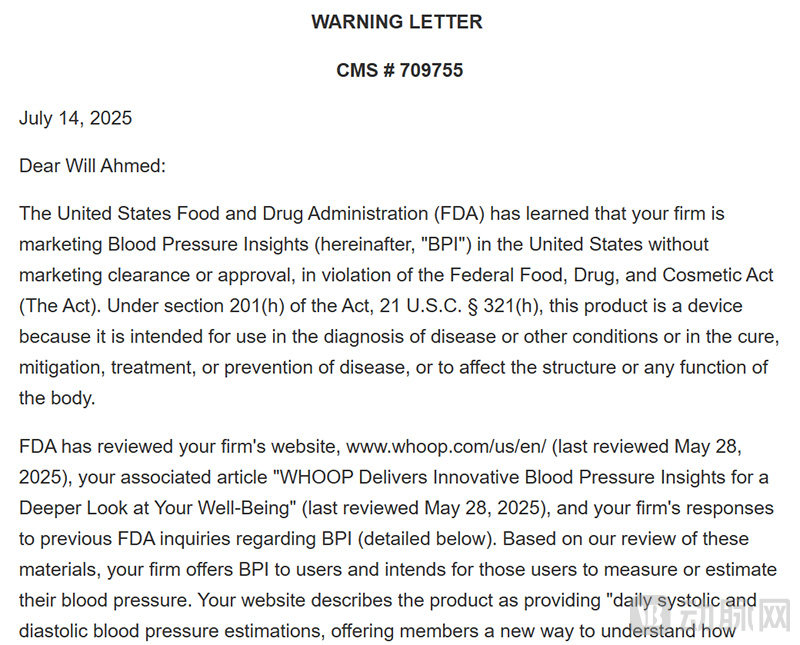
Screenshot of the FDA Website Regarding the Whoop Warning Letter
The FDA believes that blood pressure measurement is inherently related to the diagnosis of hypotension and hypertension, as it is intended for use in the diagnosis, treatment, or prevention of disease, and therefore falls squarely within the regulatory scope of medical devices. At the same time, blood pressure estimation is not without risks. Take the Apple Watch's hypertension risk notification function, which was approved by the FDA last September, as an example. This function does not provide specific blood pressure values but rather analyzes long-term patterns of heart rate and pulse wave, providing users with risk alerts when it identifies persistent trends associated with hypertension. This function also required FDA approval.
Whoop responded the day after receiving the warning letter, opposing the FDA's warning and arguing that the blood pressure insights feature it provides is merely a general wellness application, not intended for medical scenarios, and should not be regulated as a medical device.
Shortly before this incident, Robert F. Kennedy Jr., then Secretary of the U.S. Department of Health and Human Services, had been a strong advocate for expanding the application range of wearable devices. However, this incident raised concerns about privacy and potential conflicts of interest, and Kennedy himself was controversial due to his anti-vaccine stance and other actions. The debate quickly broadened, with various stakeholders holding differing opinions on when blood pressure monitoring functions in wearable devices should be subject to regulation.
Unexpectedly, less than six months later, the direction of the entire incident underwent a significant change.
In January of this year, without any prior notice, the FDA announced a series of updated regulatory guidelines at CES. Among them, the updated General Wellness: Policy for Low Risk Devices guidelines clearly state that products derived from certain measurements (such as blood pressure or blood glucose monitoring) will not need to be regulated as medical devices if they are used for general wellness purposes.
This represents nearly a 180-degree reversal from the FDA's previous position.
For wearable companies, this is certainly positive news, as it means reduced regulatory costs. Products can avoid regulation as long as they do not explicitly claim to target diseases or symptoms (for example, stating that they are intended only for sports health or entertainment) and do not include terms such as "abnormal blood pressure" in the display of their functions. Although the dispute between Whoop and the FDA is still ongoing, following this new framework, the path to resolution is clear.
Samsung, a major global wearable brand, quickly responded to the new guidelines. At the end of March, it launched a blood pressure monitoring function in the United States for certain models of the Galaxy Watch8. The function uses advanced sensor arrays in the Galaxy Watch8 to perform pulse wave analysis, thereby estimating blood pressure values, but requires calibration with a medical-grade blood pressure monitor every 28 days. In its disclaimer, Samsung explicitly states that the function is not intended for the prevention or diagnosis of hypertension, thereby meeting the conditions for regulatory exemption under the FDA's new guidelines.
However, for users, the new guidelines may cause more confusion. This is because the boundaries between "general wellness" and "medical use" in the new guidelines are not clearly defined. For example, although the new guidelines allow devices to recommend that users seek medical help when readings exceed a general wellness range, they cannot use any language that might be related to diseases, symptoms, or abnormalities. At the same time, the new guidelines specify that devices capable of predicting the risk of a cardiovascular event within 24 hours will be subject to FDA regulation, but they do not clarify whether devices that predict cardiovascular event risk over longer time scales (such as half a year or even a year) should be subject to the same regulatory oversight.
A Huawei wearable business expert believes that the meaning of values such as blood pressure and blood glucose is widely understood across the population. For example, in consumer perception, blood pressure values are used to determine whether hypertension exists or whether blood pressure control has failed to meet targets, and to guide interventions and even medication based on these values. Even if a product does not provide thresholds or descriptions of "normal" or "abnormal," and even if the blood pressure values it produces still require confirmation through formal testing, the numerical values alone could cause confusion and misunderstanding among consumers, potentially leading them to take incorrect actions and creating serious health risks. Therefore, responsible manufacturers should take indicators related to chronic disease management such as blood pressure and blood glucose seriously, conduct sufficient research, and obtain the relevant certifications.
It is foreseeable that after the release of the new guidelines, many wearable devices with blood pressure monitoring functions may seek to avoid medical device regulation by labeling their products as intended for general wellness purposes. The threshold for FDA regulation in this area will likely be significantly lowered.
On the other side of the Pacific, things have taken a subtle turn.
In mid-March, the group standard "Wearable Cuffless Blood Pressure Measurement Devices" (No. T/FDSA 0124-2026) officially came into effect (hereinafter referred to as the "Group Standard"). This is the first group standard for wearable cuffless blood pressure measurement devices in China. It was issued by the China Food and Drug Corporation Quality and Safety Promotion Association and jointly drafted by Guangdong Medical University, Goertek, OPPO, and other wearable technology companies. The standard establishes criteria for performance evaluation, validation processes, and acceptance standards for cuffless wearable devices such as watches, rings, and patches.
As one of the main contributors to the "Group Standard", the OPPO Health Blood Pressure Technology R&D team told VCBeat that its involvement primarily focused on formulating the standard's core technical indicators, providing real-world validation data through collaboration with medical institutions, and balancing factors such as product accuracy, user comfort, and power consumption — all of which are requirements for consumer-grade products.
"Participating in the development of China's first group standard for wearable cuffless blood pressure measurement is an important step in OPPO's health ecosystem strategy. On one hand, the group standard can help regulate industry practices and unify standards for device accuracy and reliability. On the other hand, we hope to use the standard to advance technology from consumer-grade to trusted and usable solutions, making seamless blood pressure monitoring truly accessible to the public, while also laying a compliance foundation for future clinical applications and global expansion," the team told VCBeat about OPPO's motivation for participating in the drafting of the group standard.
Regarding whether the "Group Standard" might be upgraded to a higher-level standard in the future, the team acknowledged that certain challenges remain: "First, measurement accuracy and interference resistance across diverse scenarios and populations still need significant improvement. Second, multi-center, large-sample clinical validation is required. Third, a quality and compliance system that meets medical device requirements must be established. There is currently no clear timeline. In the short term, over the next one to two years, the industry will continue to focus on group standard compliance and the accumulation of clinical data."
It is worth noting that, although the "Group Standard" does not explicitly or mandatorily require cuffless wearable devices to obtain medical device certification, its design logic, testing methods, safety requirements, and reference specifications are all based on medical device regulatory requirements.
On one hand, the "Group Standard" cites standards including IEC 60601-1 (safety of medical electrical equipment), IEC 60601-2-34 (particular requirements for invasively monitored blood pressure measurement equipment), and ANSI/AAMI SP10 (medical device standard for sphygmomanometers), all of which are exclusive to medical devices. At the same time, the "Group Standard" also applies medical electrical equipment requirements to its safety and communication sections.
On the other hand, the "Group Standard" imposes requirements for the clinical validation pathway of such devices, which is also a design feature unique to medical devices.
Furthermore, the "Group Standard" does not provide an exemption from medical device regulation for general wellness purposes. Combined with the fact that all devices that output blood pressure values or hypertension risk assessments are currently required to register as Class II medical devices in China, these indicators suggest that the "Group Standard" has a fairly clear inclination to treat the blood pressure measurement function of cuffless wearable devices as a medical device.
The OPPO Health Blood Pressure Technology R&D team told VCBeat that the FDA's new regulations and China's "Group Standard" are not opposed to each other but rather based on their respective practical considerations, and the two development paths can complement each other. The FDA's new regulations, in the context of a mature digital health landscape in the United States, focus on lowering barriers to innovation and promoting widespread civilian health applications. China's "Group Standard", at this stage, aims to emphasize rigor and trustworthiness, thereby guiding the industry toward clinical-grade upgrades.
"OPPO will adhere to a development path of 'grounding in clinical standards while delivering consumer-grade experiences.' This means developing underlying algorithms and accuracy according to clinical requirements, while designing product functions and interactions for daily use. At the same time, at this stage, we will clearly position our products as health reference tools and refrain from making medical diagnostic claims. We will continue to validate the value of our data through clinical studies, achieving a balance between user experience and trustworthiness," the team added.
The good news is that China has always been at the forefront of wearable technology. Taking blood pressure monitoring as an example, as early as 2021, the Huawei Watch D obtained Class II medical device certification. Since 2023, blood pressure measurement software compatible with smartwatches from Zepp Health, as well as blood pressure watches from Xiaomi and OPPO, have also received approvals.
In terms of technical approaches, blood pressure monitoring on wearable devices primarily includes PPG (photoplethysmography), ECG (electrocardiography), pressure waveform and mechanical sensing, ultrasound, and micro-airbag pressurization. Among these, micro-airbag pressurization is not considered a true cuffless blood pressure measurement technology, as it still uses the same principle as traditional cuff-based sphygmomanometers.
A search by VCBeat found that several wearable blood pressure monitoring hardware devices (wrist blood pressure recorders) currently approved in China all use the micro-airbag pressurization plus oscillometric method. The Huawei Watch D was the first product approved in China based on this approach. A Huawei wearable business expert believes that the oscillometric method has been fully validated in professional fields, with clear technical principles and guaranteed accuracy, making it suitable for blood pressure monitoring and management across different populations, including hypertensive patients, pre-hypertensive individuals, and those at risk of cardiovascular disease.
"In comparison, the current maturity of optical sensor-based solutions for accurately measuring blood pressure still falls short of expectations. Specifically, when blood pressure changes due to different factors, optical solutions cannot accurately track those changes, and further technical breakthroughs are still needed. However, in recent years, experts in Europe and Asia have published an ESH consensus statement proposing detailed protocols for accuracy validation of cuffless blood pressure measurements involving optical solutions, with particular emphasis on validation strategies for tracking blood pressure changes. This could help address the shortcomings of standards such as IEEE 1708 and ISO 81060-3, thereby establishing reasonable standards for cuffless validation," he explained to VCBeat.
The OPPO Health Blood Pressure Technology R&D team also stated that in the future, OPPO will promote continuous iteration of its proprietary pulse wave AI algorithm to further improve accuracy and stability. Combined with relevant patent strategies and clinical research conducted in collaboration with top-tier hospitals, OPPO will continue to break through the technical bottleneck of continuous, seamless blood pressure monitoring. Currently, the OPPO Watch series has already implemented health research features for hypertension risk assessment and daytime blood pressure fluctuation monitoring.
Generally speaking, the FDA often represents the highest technical standards in the medical device field. However, at least with regard to this regulatory update on wearable blood pressure monitoring, the FDA's adjustment has faced some controversy even abroad. While the original intention was to promote wider adoption of wearable technology, it is clear that from an implementation perspective, there are still areas to be improved, and certain loopholes may have been left.
In the wearable device field, China has a strong industrial foundation and a vast market. Taking airbag-based blood pressure watches as an example, products from China have achieved world-leading competitiveness. For instance, Huawei's blood pressure watches have undergone multiple clinical validations in accordance with ISO 81060-2 globally, and several studies have been published in leading international journals.
Furthermore, hypertension guidelines led by Chinese experts are also keeping pace with the times. The latest edition of the Chinese Guidelines for the Prevention and Treatment of Hypertension, published in 2024, took the lead in recommending oscillometric-based wearable blood pressure monitoring as a means of blood pressure measurement. This represents a significant step forward in global innovation in wearable-based hypertension monitoring and management.
Against this backdrop, it may not be a bad thing for China to establish high requirements and standards in this field. While a general wellness exemption pathway may allow for rapid user acquisition, it could also lead to problems where inferior products drive out good ones and erode public trust. Such issues are not uncommon in other fields. In contrast, the more rigorous medical device certification pathway, despite its long cycles and high costs, carries strong clinical endorsement and greater brand value.
On the other hand, as wearable devices become more deeply integrated into daily life, the risks to data security are also growing. Recently, China's Ministry of State Security released a case involving a security breach through a smart wearable device, in which the location of an aircraft carrier was exposed due to a sailor wearing a wearable device while running. Although such concerns might seem overly cautious, VCBeat believes that having a high-standard system that one can control is not a bad thing.
We also hope that, building on its current solid foundation, China's wearable health industry can play an even more important role in the future definition and application of wearable blood pressure management, take the lead in achieving widespread adoption of wearable blood pressure management, and pioneer model innovations in global hypertension management.