

25th China Private Equity Investment Conference Concludes Successfully, Steering the Industry Toward Innovation and Renewal
From December 2 to 5, 2025, the 25th China Equity Investment Annual Conference, hosted by Zero2IPO Holdings (01945.HK) and Pedaily, and co-hosted by Huitong Financial Holdings and Nanshan Strategic Emerging Industry Investment, was successfully held in Shenzhen. Themed “Towards the Future, Empowering Renewal,” the event was comprehensively upgraded to the “Zero2IPO·Nanshan Venture Capital Week” and innovatively integrated AI technology throughout, capturing the keen attention of all attendees with its high-tech presentation. The conference joined hands with leading industry investment institutions, industrial leaders, and technological innovators to diagnose the pulse of industry development and strategize for the future.
Currently, the equity investment market is showing positive momentum, with a more diversified fundraising structure and an accelerated focus on hard technology and strategic emerging industries. At this critical stage of rapid industry restructuring, this conference has created a comprehensive platform for trend insights, intellectual exchange, and resource matchmaking through multi-dimensional forums, thematic summits, and a series of networking events, injecting strong new momentum into promoting high-quality development in the venture capital industry and serving the national innovation-driven development strategy.
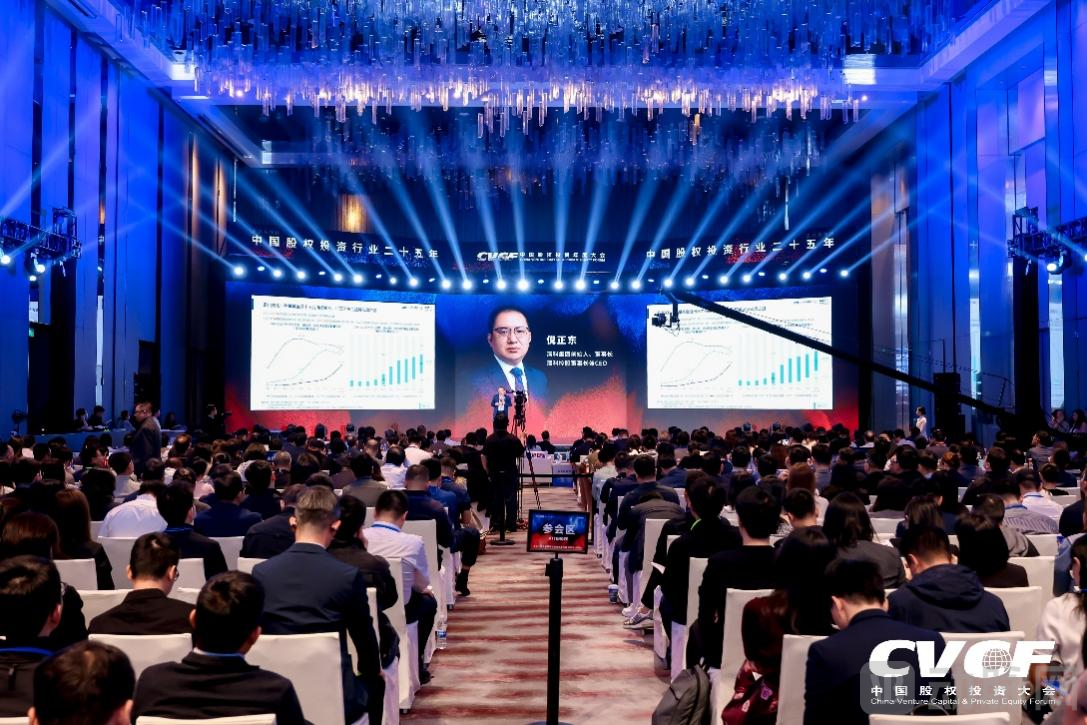
On the morning of December 3, the conference officially commenced. Ni Zhengdong, Founder and Chairman of Zero2IPO Group, as well as Chairman and CEO of Zero2IPO Holdings, delivered a speech on behalf of the organizer. He reviewed the 25-year development journey of China’s venture capital industry, stating, “Over the past two decades, capital has accelerated its shift toward hard technology, with more than 70% of funds flowing into hard-tech enterprises. Meanwhile, the investment activity of foreign-funded funds has declined; currently, 65% of market capital is managed by state-owned fund managers, making state-owned capital the main force in the market. Looking ahead, significant potential and wealth remain untapped in emerging sci-tech fields such as AI, innovative drugs, and nuclear fusion. Therefore, we believe the venture capital industry will continue to offer substantial opportunities.”
Jin Haitao, Chairman of Qianhai Fangzhou Asset Management Co., Ltd. and Chief Executive Partner of Qianhai Fund of Funds, analyzed the strategic value of venture capital from a global perspective. He stated, “With the support and impetus of venture capital, China’s technology industry is undergoing a historic transition—from initially learning to run, to keeping pace, to running side by side, and in some sectors, even taking the lead at this stage or in the near future—achieving a series of remarkable accomplishments.”
As the private equity industry enters a new phase characterized by high-quality development and the optimization of existing assets, the differentiated strategies adopted by leading firms have become a focal point of industry attention. This year’s conference features a special Core Influence Dialogue session, hosted by Ni Zhengdong, who engages in conversation with 12 distinguished guests, including Deng Feng from Northern Light Venture Capital, Fu Jixun from GGV Capital, Li Jiaqing from Legend Capital, Liu Zhou from Fortune Capital, and Zhou Kui from Sequoia China. The participants are divided into two camps: the “Exploration Task Force,” which focuses on frontier technologies and bets on disruptive innovation, and the “Value Cultivation Team,” which delves deeply into the real economy and seizes structural opportunities. The dialogue centers on key investment themes such as trends versus bubbles, time versus patience, and risk versus certainty. Through complementary perspectives and dynamic intellectual exchange, the discussion offers the industry multifaceted approaches to addressing current challenges.
As the market enters a new phase of refined operations, industry competition is shifting toward deep value cultivation. The “Innovation & Investment Trends Forum” constructed a multi-dimensional matrix of topics to comprehensively deconstruct the underlying logic of investment. Ying Wenlu, Chairman of Yida Capital, opened the discourse with the pivotal question for General Partners (GPs): “Go with the flow, or return to the original intent of marketization?” Tang Zhenyi, Vice President of HSBC China, focused on sharing insights regarding the empowering value of international financial institutions in scientific and technological innovation. The forum featured five core roundtable discussions addressing key industry pain points, including “Navigating Cycles and Fostering Internal Growth,” “Missed Opportunities vs. Heavy Bets: Lessons from Sector Selection,” “The Battle for Successful Exits,” “The Time Compound Interest of Early-Stage Investment,” and “CVC: The Rise and Challenges of Industrial Empowerment.” Senior investors such as Ma Dongjun from Haisong Capital, Fei Jianjiang from Yuanhe Yuandian, and Xu Cheng from Dongzheng Capital served as moderators, gathering over 100 guests including Cao Yonggang from Hony Capital, Gan Jianping from Ince Capital, and Mo Jianbo from Huitong Financial Holdings, creating a resonance of wisdom covering the entire investment chain from fundraising and investing to management and exit. Additionally, guests such as Chen Wei from Oriental Fortune Capital and Zhang Wei from Keytone Capital provided supplementary insights on investment trends and opportunities in the AI era during the sessions on the morning of the 4th, further enriching the forum’s substance.
On the topic of “Cyclical Gaming, Inward Growth,” Zhao Feng, Partner at Harvest Capital, shared, “The number of IPOs each year is currently low, but the backlog has cleared. The disappearance of this backlog is a typical signal of entering an upcycle, and we should maintain a certain level of confidence in the future cycles of the capital market.” Gan Jianping, Founding Partner of Yince Capital, stated, “During a cyclical recovery from the bottom, every investor must consider a key question: Should we enter industries that are highly sought after in both the primary and secondary markets, or should we seek out non-consensus, less hyped sectors to take significant positions in projects at relatively attractive valuations? This is a question I ponder daily.”
Exit, as a core challenge in the industry, was comprehensively addressed during the roundtable discussion on “The Battle for Exits.” Zeng Zhijie, Founding Managing Partner of Yuanhe Hopeful Ventures, shared his insights on the topic: “Exit is an industry-wide challenge that cannot be resolved by the efforts of a single fund alone. The prerequisite is a vibrant, healthy, and robust capital market; only when the main river flows abundantly can its tributaries benefit.” The M&A market remained active in 2025. Wang Wei, Managing Director at DH Capital, commented: “Regarding risk control in M&A investments, it boils down to two key factors: First, ensure reasonable valuation control; otherwise, post-investment value creation will be negated. Second, maintain strong cash flow to support leverage and dividend distributions, thereby safeguarding equity value from erosion.”
At the roundtable discussion titled “From ‘The Age of Discovery’ to ‘The New World’: The Paradigm Revolution of Chinese Companies Going Global,” Chen Shiyou from Youshan Investment moderated the dialogue. Guests, including Qu Tian, founder of ATM Capital, engaged in heated discussions on topics such as overseas expansion strategies and risk control. Qu Tian emphasized, “The greatest risk in going global is a deviation in strategic direction. Expanding into developed countries versus emerging markets represents two entirely different choices; neither is inherently correct—the key is suitability. As The Art of War states, ‘Secure victory before engaging in battle.’ Companies should conduct thorough research and proceed only when there is a high probability of success; otherwise, they should refrain from expanding overseas.” His insights offered new perspectives for institutional overseas exit strategies and market positioning.
The AI Summit and the Innovative Drugs & Life Sciences Summit have become key platforms for in-depth discussions on frontier sectors. Leading investors from top-tier institutions and benchmark portfolio companies in specialized fields are invited to engage in roundtable dialogues, fostering collaborative insights on industry-deepening topics such as technological iteration, market expansion, and supply chain synergy.
As artificial intelligence moves from the laboratory to industrialization, investment logic is shifting from model competitions to practical application deployment. Centered on “embodied AI,” the AI Summit focused on topics such as AI’s deployment in the physical world, China’s opportunities in embodied AI and AI hardware, and paradigm breakthroughs in the “brains” of embodied AI systems. Li Feng, Founding Partner of FreeS Fund, shared, “From an investment perspective, there is a simple yet often overlooked principle regarding the current robotics boom: the more significant a direction’s potential, the more frequently it tends to experience bubbles and downturns.”
The Innovative Drugs and Life Sciences Summit was equally packed with substantive insights. Xu Xiaolin, Founding Partner and Chairman of Huagai Capital, outlined the investment themes for the next decade: “First, invest in original ‘0-to-1’ innovations stemming from Chinese research institutes and pharmaceutical companies. Second, the fundraising, investment, management, and exit cycle for innovative drug investments has been successfully established, enabling bold investments in companies that lack revenue or profits but possess genuine innovation. Third, AI-plus-healthcare will see broader practical implementation. Fourth, future Chinese multinational corporations (MNCs) may become significant global buyers of innovative drugs.” Subsequently, panelists engaged in in-depth discussions on core issues such as R&D paradigm innovation and industrial ecosystem building, focusing on topics including AI-driven model innovation, the new era of exploration for innovative medical devices, and synergistic win-win collaboration between CXOs and venture capital firms.
At the “2025 VENTURE 50 Awards Ceremony” held concurrently with the conference, the Wind List, the New Sprout List, and the Top 50 companies in three major sectors—Artificial Intelligence, Hard Technology, and Life Sciences—were announced, providing capital markets with clear guidance on future investment directions and value targets. Among the selected companies, those in the artificial intelligence sector accounted for 49%, with embodied AI, generative AI, and “AI + vertical scenarios” emerging as focal points for investors, deeply resonating with the conference’s themes of industrial deep-dive and technology empowerment.
The conference fully leveraged its ecological aggregation advantages to create multi-dimensional, precise matchmaking scenarios. Carefully curated supplementary activities complemented the core forums. The “X-Day” Xili Lake Roadshow Community’s Kickstarter Special Session on Global Tech Innovation provided a platform for sci-tech projects to showcase their innovations and connect with investors. During the event in Nanshan, Shenzhen, the launch of the “Nanshan Sci-Tech Investment Partner Program” and the signing ceremony for “Early-Stage Investment Empowering University-Local Government Achievement Transformation” highlighted the upgrading and integration of the regional innovation ecosystem. Targeted events such as the Investment Circle’s Wonderful Night and the CEO Breakfast Meeting facilitated in-depth communication among attendees.
The all-day “Innovation & Investment Carnival” and “Innovation & Investment Talk” sessions at the conference created lightweight networking scenarios, while special events such as the investment community’s badminton friendly match helped bring industry peers closer together. Among the more than 20 booths featuring cutting-edge sci-tech enterprises and the INNO100 Global Innovation Flagship Store, innovative products—including embodied AI robots, heavy-lift launch vehicles, and AI-powered toys—drew attendees to stop and experience them firsthand. The interactive demonstrations between digital hosts and exhibits became a popular photo opportunity, fostering an industry exchange atmosphere that was both intellectually deep and warmly engaging. The investment community’s badminton friendly match brought the conference to a successful close.
The four-day 25th China Equity Investment Annual Conference concluded successfully amidst vibrant exchanges and industry consensus. The conference not only fostered a shared vision for industry development and established an ecosystem platform for precise resource matching, but also highlighted the pivotal role of venture capital and private equity in driving industrial upgrading and high-quality economic growth. Looking ahead, the conference will continue to collaborate with industry partners to inject sustained momentum into every innovation.