

Traditional Chinese Medicine Research Makes Historic Debut in CAS and Clarivate's 'Research Frontiers' Report
December 3,The Institutes of Science and Development, Chinese Academy of Sciences, the National Science Library, Chinese Academy of Sciences, and Clarivate held the “2025"Research Frontiers Release and Seminar," The "2025 Research Frontiers" report and the "2025 Research Frontiers Hotspot Index" report were released globally at the conference.Wang Dujin, Director of the Bureau of Academic Divisions of the Chinese Academy of Sciences (CAS), and Emmanuel Thiveaud, Senior Vice President for Global Affairs at Clarivate, attended the conference and delivered remarks. The meeting was chaired by Pan Jiaofeng, Dean of the Institutes of Strategic Consultation; Liu Xiwen, Director of the National Science Library; and Wang Li, Vice President for Global Affairs at Clarivate. Attendees in person included heads of relevant departments such as the Ministry of Science and Technology, the National Natural Science Foundation of China, the China Association for Science and Technology, the Bureau of Frontier Sciences and Basic Research, the Bureau of Scientific and Technological Infrastructure Capacity, the Bureau of Development Planning, and the Bureau of International Cooperation of the Chinese Academy of Sciences, as well as the Beijing Municipal Science and Technology Commission. Also present were representatives from national high-end think tank pilot and incubation units, including the Chinese Academy of Social Sciences, along with delegates from universities, research institutes, enterprises, and public institutions.
The “Trends in the Top 10 Hot Frontiers in Biological Sciences” chapter of Research Frontiers 2025 states: “The top ten hot frontiers in biological sciences can be categorized into four thematic areas: technological innovation, microscopic mechanisms, medical applications and translational research, and macro-level interactions and health impacts.”“Application of Network Pharmacology in the Modernization Research of Traditional Chinese Medicine” marks the first time that TCM research has entered the research frontier.
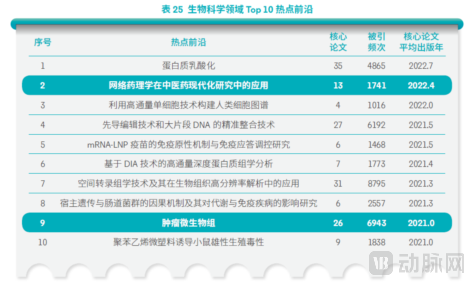
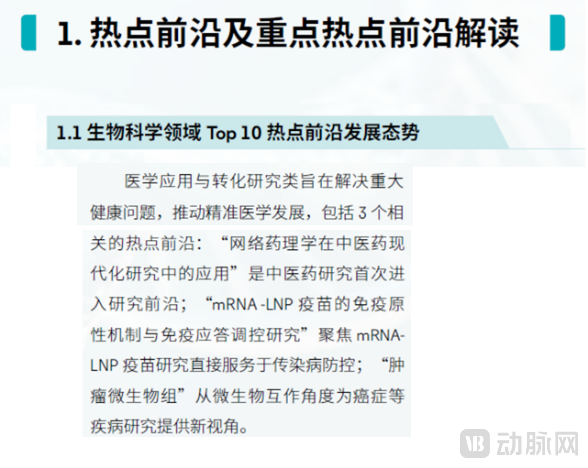
Figure 1. “Application of Network Pharmacology in the Modernization Research of Traditional Chinese Medicine” Selected as One of the Top 10 Hot Frontiers in the Field of Biological Sciences
Introduction to "Research Frontiers 2025": Network pharmacology is an emerging discipline that integrates systems biology, polypharmacology, computational biology, and network science. By constructing complex interaction networks among "drugs–targets–diseases," it elucidates the holistic mechanisms of drug intervention in diseases from a systems-level perspective. Traditional Chinese Medicine (TCM) is characterized by its holistic view, syndrome differentiation-based treatment, and the use of herbal formulas. Previous studies on TCM using reductionist and trial-and-error approaches have encountered significant challenges, such as the complexity of biological systems and chemical constituents. Since its inception, network pharmacology has been regarded as the "next-generation model for drug research." It plays a revolutionary role in the modernization of TCM research, as it aligns perfectly with the core philosophical tenets of holism and systemic thinking in TCM, providing powerful theoretical tools and research paradigms to understand the multi-component, multi-target, and holistic regulatory characteristics of TCM formulas. In summary, the extensive application of network pharmacology in the field of TCM is driving its transition from "empirical medicine" toward "evidence-based medicine" and "precision medicine."
In terms of the countries and institutions producing core papers, China contributed 76.9% of the core papers in this frontier, positioning it as a leader in this research direction. Other countries producing core papers include Pakistan, Egypt, Hungary, the United Kingdom, Ireland, Suriname, Germany, the United States, the Netherlands, and Saudi Arabia.
At the symposium, Professor Li Shao, a tenured professor at Tsinghua University and an academician of the European Academy of Sciences and Arts, was invited to deliver a report on the hot frontier topic “Application of Network Pharmacology in the Modernization of Traditional Chinese Medicine.”, introduces the origins of network pharmacology, algorithm design for its integration with artificial intelligence, and typical application cases in traditional Chinese medicine (TCM), and provides an outlook on the development trends of network pharmacology and TCM.

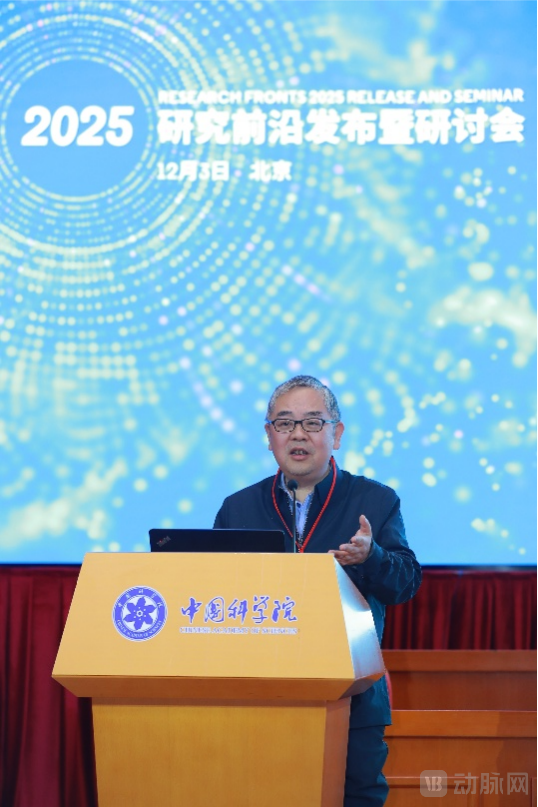
Figure 2. Li Shao delivers a thematic report
Li Shao pioneered the application of network pharmacology in traditional Chinese medicine (TCM) research and is a representative author of core papers at the forefront of this field. Thomas Efferth, an academician from Johannes Gutenberg University Mainz, Germany, and Editor-in-Chief of *Phytomedicine*, a top-tier international journal in botanical medicine, recently stated explicitly in an article:“Chinese scholar Li Shao and British scientistsHomeAndrew L. Hopkinsfor network pharmacologyFounding Father(founding fathers)”(Phytomedicine; 2025;148:157031), this international evaluation confirmsChinese ScholarsAtNetwork PharmacologyThe Core Status in the Establishment of the Discipline。
The "Research Fronts 2025" report employs co-citation analysis, a bibliometric method, to identify the top ten research hotspots and 18 emerging fronts across 11 major disciplines in natural and social sciences for 2025, based on publication data from 2019 to 2024. It analyzes the development trends of these research fronts and provides detailed interpretations of 31 key fronts (including both research hotspots and emerging fronts).
It is reported that the Institutes of Science and Development, Chinese Academy of Sciences (CAS), the National Science Library, CAS, and Clarivate have jointly released the annual Research Frontiers globally for 11 consecutive years. This initiative aims to reveal the current status and development trends of basic research and to identify new directions for future breakthroughs. Research Frontiers has become a flagship publication of the CAS National High-End Think Tank on Science and Technology, providing valuable insights to policymakers and professionals.