

ZhiXiang Jintai's Secukinumab Biosimilar 'Sailiqi' Included in China's 2025 National Reimbursement Drug List, Expanding Access for Patients

GENRIX BIO
Developer of Novel Monoclonal Antibody Drugs
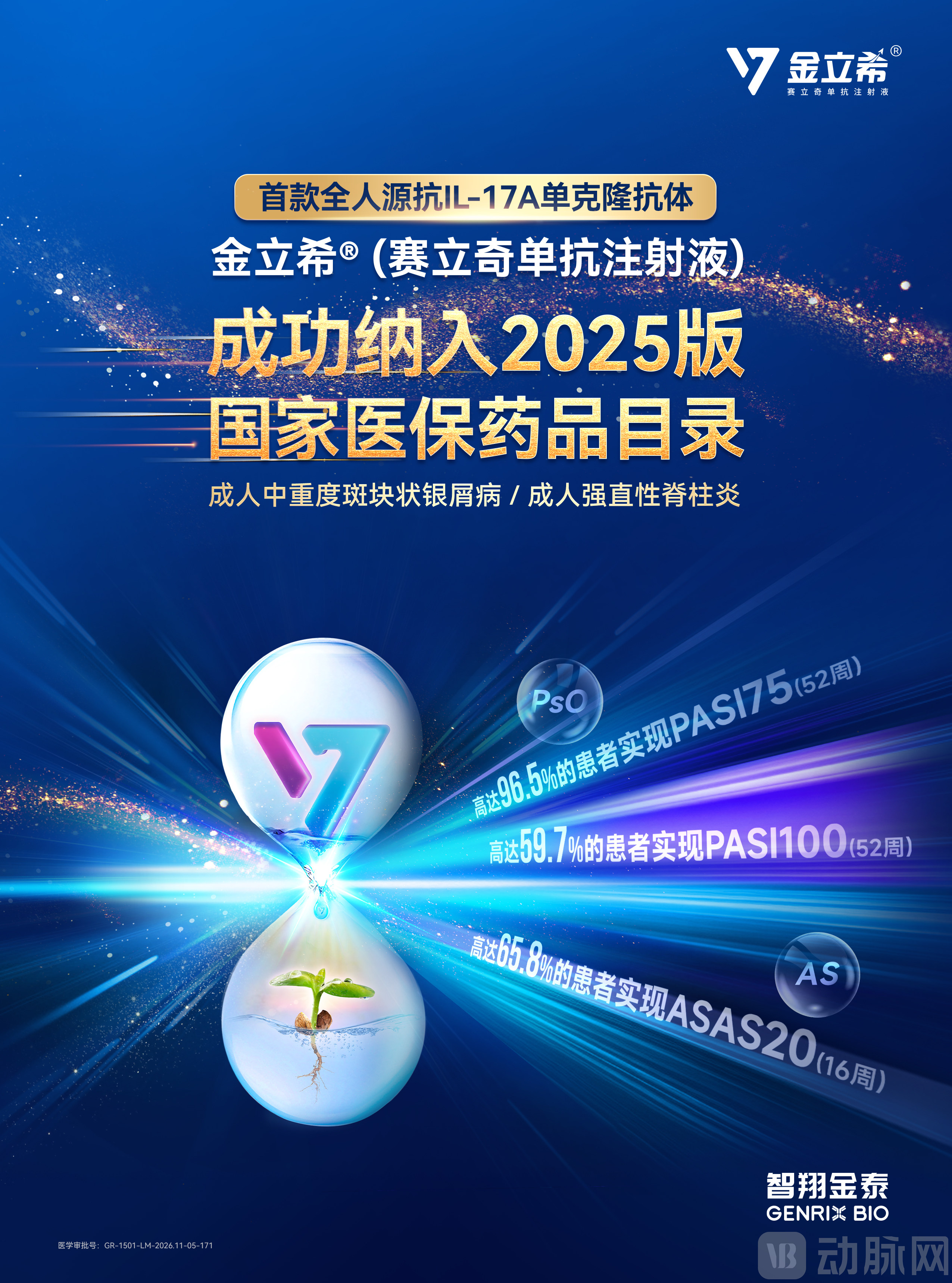
On December 7, 2025, the National Healthcare Security Administration officially released the “National Reimbursement Drug List for Basic Medical Insurance, Maternity Insurance, and Work-Related Injury Insurance (2025)” (hereinafter referred to as the “National NRDL”). Chongqing Genrix Biopharmaceutical Co., Ltd. (hereinafter referred to as “GENRIX BIO”) announced that its self-developed Class I biological innovative drug—Secukinumab Injection (Jinlixi®) was successfully included in the National Reimbursement Drug List (NRDL). The updated NRDL will officially take effect on January 1, 2026.
Source Innovation: Domestic Original Research Breaks the Monopoly
As an innovative biopharmaceutical company dedicated to the end-to-end research, development, and industrialization of antibody-based therapeutics, GENRIX BIO remains committed to technological innovation as its core driving force. By focusing on significant unmet clinical needs, the company strives to provide patients with high-quality, affordable treatment options.
Secukinumab Injection is a recombinant fully human anti-IL-17A monoclonal antibody developed by GENRIX BIO based on its proprietary dual-vector phage display technology platform. By specifically binding to the IL-17A cytokine in serum, this drug blocks the interaction between IL-17A and IL-17RA, thereby inhibiting inflammation and disease progression. As China’s first fully human anti-IL-17A monoclonal antibody, Secukinumab has been approved since August 2024 for the treatment of two indications: moderate-to-severe plaque psoriasis and ankylosing spondylitis (radiographic axial spondyloarthritis). This achievement has broken the monopoly held by foreign pharmaceutical companies on therapeutics targeting this pathway, providing Chinese patients with high-quality, domestically produced treatment options that align with international standards.
Robust Clinical Data, Innovative Outcomes Benefit the Public
Psoriasis and ankylosing spondylitis are both autoimmune diseases characterized by a prolonged course and a tendency to relapse. Patients require long-term, standardized treatment, facing dual pressures on their quality of life and financial burden. In clinical studies, secukinumab has demonstrated its therapeutic value with robust clinical data.
Phase III clinical study data in patients with moderate-to-severe plaque psoriasis demonstrated significant improvement as early as Week 2 after treatment initiation. By Week 12, the PASI 75 response rate reached 90.7%, the PASI 90 response rate was 74.4%, and the PGA 0/1 response rate was 74.4%. At Week 52, the PASI 75 response rate remained high at 96.5%, with a relapse rate of only 0.4%, demonstrating significant and durable efficacy.
In June 2025, the results of the Phase III clinical trial of secukinumab for the treatment of ankylosing spondylitis were presented as an oral report at the Annual European Congress of Rheumatology (EULAR). Efficacy data showed that at 16 weeks of treatment, the ASAS20 response rate was 74.0% in patients receiving the 200 mg dose of secukinumab and 65.8% in the 100 mg dose group, both significantly superior to the placebo group, with a favorable safety profile.
Upholding “Innovation for the People” to Continuously Enhance Drug Accessibility
Prior to its inclusion in the National Reimbursement Drug List (NRDL), secukinumab had already enhanced patient access through multiple channels. Within one year of its market launch, secukinumab achieved coverage in 30 provinces across China, benefiting over 10,000 Chinese patients. With its inclusion in the NRDL, the out-of-pocket expense ratio for patients will be further reduced, thereby improving drug accessibility and enabling more patients to access high-quality, domestically produced innovative medicines.
Secukinumab’s inclusion in the National Reimbursement Drug List signifies state recognition of the value of domestically produced innovative drugs and serves as a microcosm of the high-quality development of China’s innovative pharmaceutical sector. From its origins in Chongqing to its nationwide reach, and from breaking monopolies to benefiting patients, the trajectory of secukinumab attests to the rise of China’s innovative drug industry. Driven by the dual engines of policy support and innovation, the Chinese market is becoming a fertile ground for global pharmaceutical innovation.