

Shingles Vaccination Emerges as a Breakthrough Strategy to Prevent and Slow Dementia, Per Landmark Studies in Nature and Cell
Dementia has become a major challenge to global public health. As population aging intensifies, its incidence continues to rise, imposing a heavy economic and psychological burden on patients, families, and society at large. However, to date, we still lack effective means for prevention or cure.
A research team at Stanford Medicine published landmark findings in the top academic journals Nature and Cell in April and December 2025, respectively, bringing new hope to this field.
Researchers conducted a large-scale “natural experiment” leveraging Wales’s unique public health policies, finding thatVaccination against herpes zoster not only reduces the risk of incident dementia by approximately 20%, but also significantly slows disease progression in patients with established diagnoses.
This finding not only provides the strongest causal evidence to date for the theory that “viral infections may trigger dementia,” but also suggests that a readily available, low-cost preventive measure may already be within our reach.
For a long time, the scientific community has upheld a “viral hypothesis,” which posits that infection with neurotropic viruses, such as herpes simplex virus type 1 (HSV-1) or varicella-zoster virus (VZV), may be a significant trigger for dementias like Alzheimer’s disease (AD). These viruses remain latent in nerve cells after primary infection and can reactivate with advancing age or declining immunity, thereby inducing neuroinflammation and leading to cognitive decline.
If this hypothesis holds true, thenPreventing viral reactivation through vaccination should theoretically reduce the risk of dementia.However, although past observational studies have found an association between the herpes zoster vaccine and a lower risk of dementia, they have consistently been unable to rule out “Healthy Vaccinee Bias”—that is, individuals who proactively receive vaccination often already maintain healthier lifestyles, have better access to medical care, or possess higher health literacy, all of which can independently reduce the risk of dementia.
To crack this difficult problem, the research team at Stanford University keenly seized a once-in-a-lifetime research opportunity.
On September 1, 2013, Wales launched a shingles vaccination program but established extremely strict age eligibility criteria: only individuals who were exactly 79 years old on that day were eligible for free vaccination, while those who had just turned 80, even if by only a week, were permanently excluded from the program. This birthdate-based “one-size-fits-all” policy artificially created a clear cutoff within the population, providing researchers with a perfect “Natural Experiment.”
Under this design, individuals born one week before and one week after September 2, 1933, exhibit virtually no systematic differences in genetics, living environment, health status, and other aspects.The only difference is simply “eligibility for vaccination.”
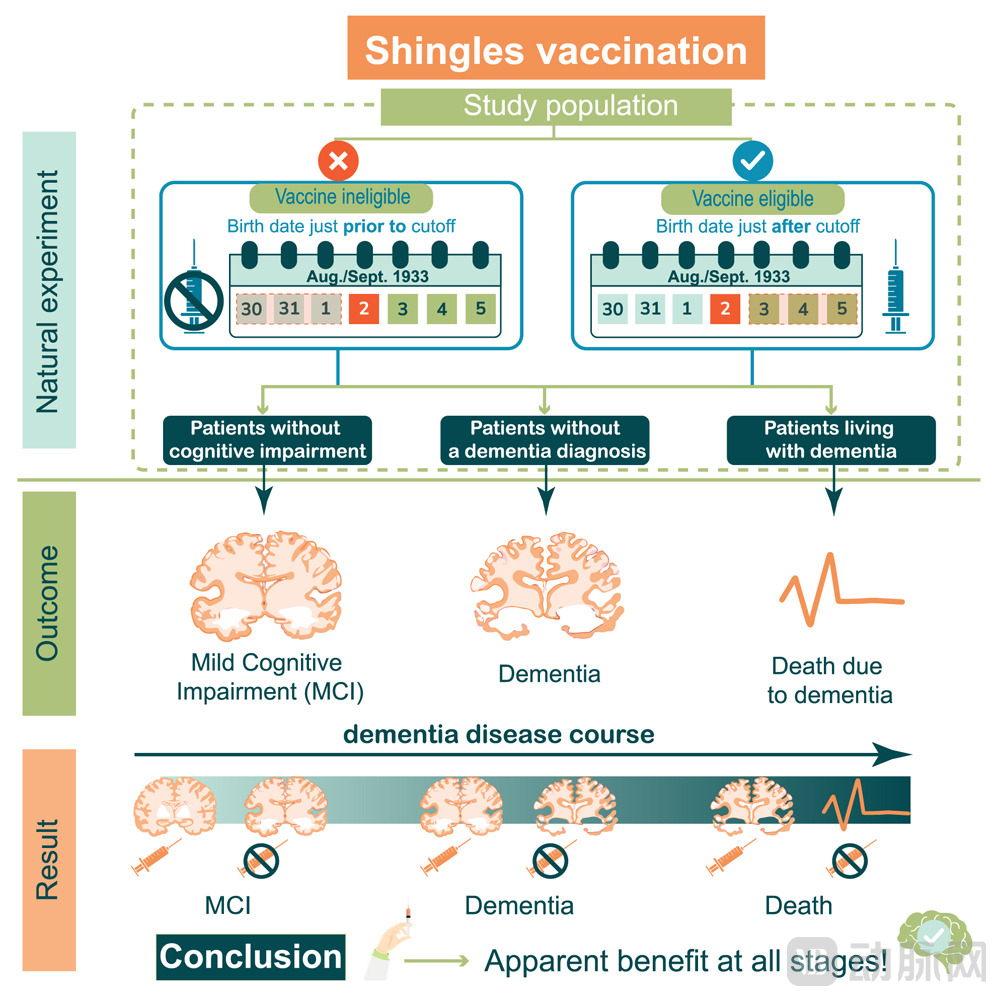
(Source: Cell)
This approach, known in statistics as “Regression Discontinuity Design” (RDD), is nearly as rigorous as randomized controlled trials (RCTs) and can effectively eliminate confounding factors, thereby revealing the true causal relationship between vaccination and dementia.
Based on electronic health record data from Wales, the research team conducted a seven-year follow-up analysis of more than 280,000 older adults, revealing the profound impact of vaccination in two phases.
In the first study published in Nature on April 2, 2025, the team initially focused on the vaccine's effects onPreventive Effect on Incident Dementia.
Data shows that,Among individuals who became eligible for vaccination solely due to a one-week difference in birth dates, the shingles vaccination rate surged from 0.01% to 47.2%.More strikingly, over the subsequent seven years, this intervention reduced the absolute incidence of newly diagnosed dementia by 3.5 percentage points, representing a relative reduction of approximately 20%. This means thatIf these results can be generalized, vaccinating five older adults could prevent one case of dementia.
As research deepened, the team further expanded the breadth and depth of this finding in their follow-up results published in Cell on December 2, 2025, shifting their focus to vaccines againstDisease Progressionimpact.
They found that the protective effect of the vaccine spans the entire course of dementia: on one hand, in the very early stages of the disease, vaccination significantly reduced the incidence of mild cognitive impairment (MCI), which is often a precursor to dementia; on the other hand, for patients already diagnosed with dementia before the start of the vaccination program, vaccination also showed unexpected “therapeutic” effects—it significantly reduced the risk of death due to dementia.
Data indicate that, among individuals with a confirmed diagnosis of dementia,The dementia-related mortality rate among vaccinated individuals was nearly 30 percentage points lower than that among unvaccinated individuals.This finding is highly impactful, as it suggests that the herpes zoster vaccine not only has preventive effects but also holds therapeutic potential to delay disease progression.
Furthermore, it is worth noting that the study also revealed an interesting gender difference:The vaccine provides significantly stronger protection for women than for men.This may be related to sex-specific differences in immune responses among women or the higher incidence of herpes zoster in women; the underlying mechanisms remain to be further explored.
This study not only provides robust evidence at the epidemiological level but also prompts profound reflection on the pathogenesis of dementia.
Pascal Geldsetzer, an assistant professor of medicine at Stanford University and the corresponding author of the study, pointed out that these findings support the central role of neuroinflammation in the development of dementia. Vaccines may exert their effects through two mechanisms: first, by directly suppressing the reactivation of the varicella-zoster virus via specific immunity, thereby reducing virus-induced neural damage and inflammation; and second, through the mechanism of “trained immunity,” a non-specific immune-enhancing effect generated by the vaccine that activates the immune system’s capacity to clear other pathogens or pathological processes, such as β-amyloid deposition.
The significance of this finding lies in the fact that itChallenging the traditional drug development paradigm that previously focused exclusively on β-amyloid (Aβ) and Tau proteins, this approach has brought antiviral and immunomodulatory strategies to the forefront.
If the shingles vaccine can indeed prevent dementia by reducing viral reactivation, then other interventions targeting neurotropic viruses (such as herpes simplex virus) may also be effective. Furthermore, this study utilized the traditional live attenuated vaccine (Zostavax), whereas the recombinant subunit vaccine (Shingrix), which is more potent and durable, is now widely available. It remains to be seen whether Shingrix offers superior protection against dementia, a prospect that warrants further anticipation.
Although “natural experiments” provide a high level of evidence, scientific rigor demands that we remain cautious. The Geldsetzer team is currently actively preparing for a large-scale randomized controlled trial to definitively confirm this conclusion.
If the trial is successful, it will be a milestone in the history of medicine—A widely used, proven-safe, and low-cost vaccine will become a powerful weapon in humanity’s fight against dementia, the century’s most challenging medical puzzle.
From a public health policy in Wales to the keen insights of Stanford scientists, this decade-long study has unveiled the intricate connections between the immune system and brain health. The shingles vaccine may be more than just a shield against “shingles”; it could also serve as an invisible guardian of cognitive function in older adults. As further research unfolds, we have reason to expect that these findings will be translated into concrete clinical guidelines, offering hope for changing the fate of hundreds of millions of elderly people worldwide.