

JunSai Bio Files for Hong Kong IPO as China's First TIL Therapy-focused Biotech
VCBeat has learned that Shanghai Junsai Biotechnology Co., Ltd. (“Junsai Biotech”) recently filed its prospectus with the Hong Kong Stock Exchange (HKEX). CITIC Securities served as the sole sponsor for Junsai Biotech’s initial public offering (IPO). As of the filing, the company had completed multiple rounds of financing totaling nearly RMB 800 million, with support from investors including Kaitai Capital, Yuanhe Yuandian, Furong Investment, Yuansheng Venture Capital, and Huangpu Medical Fund.
JunSai Bio was established in June 2019, focusing on the development of innovative cell therapies and cancer immunotherapies, with a commitment to becoming a leading enterprise in the field of solid tumor treatment. The company’s primary R&D efforts are concentrated on safe, effective, accessible, and affordable immune cell therapies targeting the most common or challenging solid tumors. Its core product is the world’s first tumor-infiltrating lymphocyte (Tumor Infiltrating Lymphocyte,TIL) therapy, is poised to become the first TIL therapy approved for market launch in China.
Focusing on the New Cornerstone of Cancer Immunotherapy, Advancing Clinical and Process Innovation
Tumor-infiltrating lymphocytes (TILs), as a core component of the anti-tumor immune response, have been proven to be the primary therapeutic target of PD-(L)1 antibodies. TIL therapy exerts its anti-tumor effects by extracting tumor-infiltrating lymphocytes from the patient’s autologous tumor tissue, expanding and restoring them in vitro, and then reinfusing them into the body. Clinical trial data show that,Single Dose Administration,TIL therapy can bring benefits to patients with various advanced solid tumorsDeep and Long-Lastingclinical benefits, with some patients even having the potential for a cure. Meanwhile, TIL cell therapy demonstrates good compatibility with various drug modalities, further enhancing therapeutic efficacy and holding promise to becomeFollowing PD-(L)1 antibodies, the cornerstone drugs of the new generation of cancer immunotherapy.
However, the challenges of TIL cell therapy lie in its cumbersome manufacturing process and complex clinical application protocols, which result in high treatment costs and limited accessibility. Junsai Bio has achieved innovation from production to clinical application in this field. By employing innovative manufacturing processes and simplified clinical protocols, Junsai Bio significantly reduces the cost and complexity of TIL cell therapy, ensuring higher safety and accessibility while maintaining therapeutic efficacy.
Core Pipeline Enters Critical Phase, Differentiated Layout for Next-Generation Products
JunSai Bio's core pipeline product, GC101, isThe World’s First Novel Natural TIL Cell Therapy Requiring Neither High-Intensity Lymphodepleting Chemotherapy Nor Combination with IL-2GC101 has delivered long-term benefits to patients with advanced metastatic solid tumors who have failed multiple lines of therapy. Patients with advanced tumors, including melanoma, non-small cell lung cancer, cervical cancer, endometrial cancer, and glioma, have demonstrated objective response rates following treatment with GC101.The longest disease-free survival has exceeded 4 years.
Currently, the clinical trial of GC101 for advanced melanoma that has failed PD-1 antibody therapy has entered a pivotal Phase II stage, with the Biologics License Application (BLA) expected to be submitted in 2026, laying the foundation for its future commercialization. In addition, the clinical pipeline of GC101 for the treatment of non-small cell lung cancer is currently in Phase Ib; early-line combination therapies and postoperative adjuvant therapies for multiple indications have also been strategically deployed.
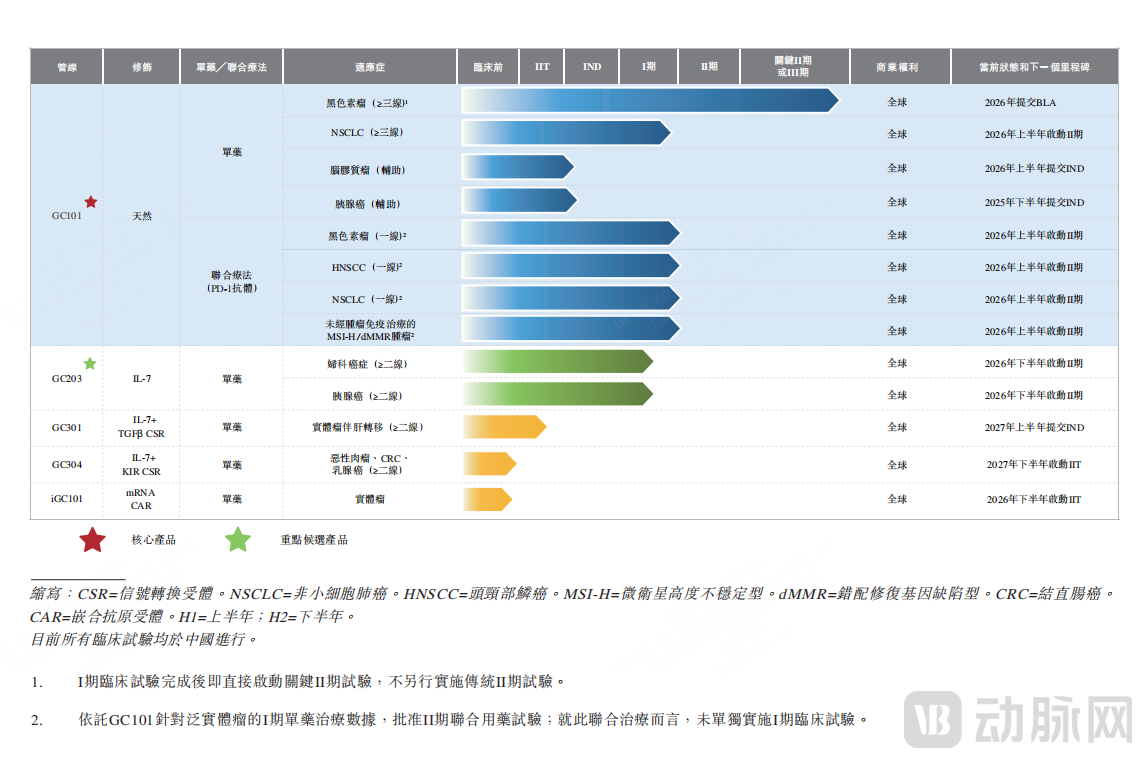
Image source: JunSai Bio's prospectus
Another important pipeline of JunSai Bio is GC203, which isThe World’s First Non-Viral Vector Gene-Modified TIL Cell Novel Drug.Building on GC101, this product effectively enhances the activity and adaptability of TIL cells by incorporating self-assembling membrane-bound IL-7, while also possessing the ability to mobilize endogenous immune cells. It has demonstrated promising response rates in studies of refractory solid tumors, including ovarian cancer.
The Company's LatestThe endogenous TIL pipeline iGC101 is also a global first-in-class:By pre-fabricating and cryopreserving TIL seed cells from patients’ previously resected tumor tissues, only transient genetic modification is required prior to clinical application. This approach enables TIL cells to self-expand within the patient’s body, thereby eliminating the traditional ex vivo expansion step. It is expected to significantly reduce production costs and further enhance the accessibility and affordability of TIL cell therapy.
Capital Markets Put Immune Cell Therapies for Solid Tumors Under Pressure
According to Frost & Sullivan, the global oncology drug market is expanding rapidly, reaching $253.3 billion in 2024 and projected to reach $452.5 billion by 2030 and $702.7 billion by 2035. In China, the market reached RMB 241.6 billion in 2024 and is expected to accelerate its growth in the coming years, more than doubling to RMB 527.3 billion by 2030 and reaching RMB 1.042 trillion by 2035.
Against the backdrop of this rapidly evolving market, Junsaibio possesses the potential to stand out in the global immunotherapy landscape with its innovative Tumor-Infiltrating Lymphocyte (TIL) cell therapy. As a leading enterprise in immune cell therapies for solid tumors, Junsaibio is leveraging science-driven innovation to advance TIL therapy from clinical trials to commercialization, bringing hope to more patients with solid tumors. By virtue of its breakthrough innovations in the field of TIL therapy, Junsaibio has secured a significant strategic position in the oncology immunotherapy market. With the clinical progression of its core pipeline, Junsaibio is poised to play a pivotal role in global cancer treatment, warranting continued attention to its future development.