

Wireless 'Optical Language' Directly Writes Perceptual Information into the Brain via Miniature Implant
Can we “write” information directly into the brain, akin to inputting instructions into a computer? While this may sound like a plot from science fiction, it represents an urgent scientific challenge that must be addressed for restoring vision in the blind, providing tactile feedback for prosthetic limbs, and treating neurological disorders.
Current brain-computer interface (BCI) technology has made significant strides in “reading” neural signals, yet it still faces substantial challenges in “writing” complex, meaningful information—namely, generating “artificial perceptions.” Most existing approaches either rely on rigid probes that penetrate brain tissue, causing damage, or require bulky external devices that restrict users’ freedom of movement.
On December 8, 2025, from Northwestern University in the United States,The research team in top neuroscience journalsin Nature NeurosciencePublished an article titledResearch findings on “Patterned wireless transcranial optogenetics generates artificial perception”This study was conducted byYevgenia KozorovitskiyProfessor andJohn A. RogersCo-led by professors, with the first author beingMingzheng Wu。
(Source: Nature Neuroscience)
The research team developed aFully Implantable, Wireless, and Battery-Freeof miniaturized optogenetic devices, this device is like a stamp affixed to the skull, capable of operating through no more than64 independently controlled micro-LEDs (μ-ILEDs), projecting specific light signal patterns onto the cerebral cortex through the skull.
Experiments have shown that mice can “decipher” these “light-based languages” directly written into the brain and make accurate behavioral decisions based on different artificial sensory signals. This technology marks a critical step forward in achieving seamless bidirectional communication between the brain and the external world.
Perception is the foundation of our understanding of the world, and its essence lies in the specific spatiotemporal patterns of neuronal activity in the cerebral cortex. For patients who are blind due to retinal diseases or have undergone limb amputation, bypassing the damaged sensory organs and directly delivering specific neural signals to the cerebral cortex may potentially restore vision or touch.
However, relying solely on simple stimulation of a single point is far from sufficient to generate meaningful perception in the brain. Just as displaying an image on a screen requires controlling the on/off states of thousands of pixels, reconstructing perception necessitates precise spatiotemporal control over large populations of neurons.
Current neuromodulation technologies face a “dilemma”: although traditional electrical stimulation is widely used, it lacks cell-type specificity and tends to activate irrelevant neurons; emerging optogenetic techniques, while capable of precisely controlling specific types of neurons, mostly rely on implanted optical fibers, which are not only invasive but also restrict animals’ natural movements, making them difficult to apply in complex behavioral tasks. Although wireless optogenetic devices have been developed previously, they often can only deliver single-point or simple-pattern stimulation, failing to generate sufficiently complex information to mimic realistic sensory inputs.
The innovation of this new study lies in its development of aProgrammable Micro-LED Array, and integrate it into aSoft, Stretchable Wireless ImplantsThis device does not require penetration into the brain like traditional probes; instead, it is attached to the surface of the skull and utilizes the favorable tissue-penetrating properties of red light (628 nm) to achieve transcranial stimulation.
More importantly, it can control the on/off state, intensity, and frequency of each micro-LED through programming, much like a display screen, thereby projecting dynamic patterns onto the cerebral cortex using light. This means that researchers finally have a “light pen” capable of flexibly writing neural codes, providing an unprecedented tool for exploring how the brain decodes artificial information.
To achieve this goal, the research team implemented sophisticated optimizations in the engineering design. The device employs near-field communication (NFC) technology for wireless power delivery and data transmission, thereby completely eliminating the weight and lifespan constraints associated with batteries. The entire implant is encapsulated in highly biocompatible materials, allowing it to remain subcutaneously in mice for extended periods without triggering immune rejection. The core component consists of aArray of 64 Micro-LEDs(The 2×4 configuration was primarily used for validation in the experiment), with each LED measuring only 300 × 300 × 90 μm³.
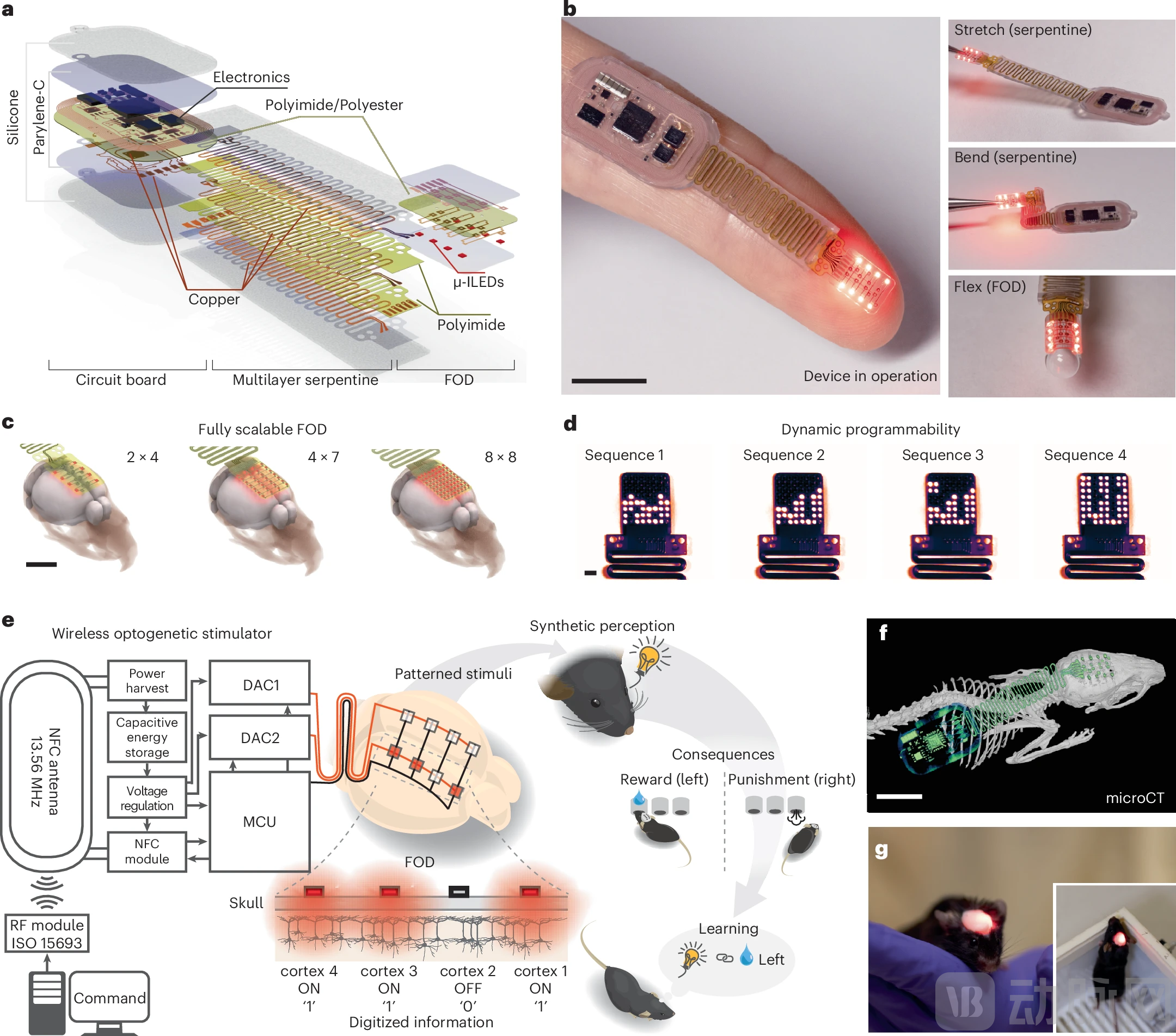
Figure: Wireless optogenetic encoder for dynamic transcranial control of large-scale cortical activation (Source: Nature Neuroscience)
To ensure safety and efficacy, the research team first employed Monte Carlo simulation to precisely model light propagation through the skull and brain tissue. The results demonstrated that red light emitted by micro-LEDs can penetrate the skull and effectively activate target neurons in layer 5 of the cerebral cortex, with the activation volume precisely controllable by adjusting light intensity (an intensity of 6.12 mW activates a volume of approximately 1 mm³).
In addition,Finite Element Analysis of Heat Conductionand empirical data demonstrate that even under high-intensity pulsed stimulation, the temperature rise in brain tissue is controlled within0.1°Cwithin this range, which is far below the safety threshold that could cause tissue damage, thereby eliminating concerns about thermal effects interfering with neural activity.
In subsequent animal behavior experiments, researchers issued “light-language” commands to mice expressing the red-light-sensitive protein ChrimsonR in their cerebral cortex. This was an operant conditioning task: the mice were required to move to corresponding ports to receive a sucrose solution reward, based on distinct light stimulation patterns received by the brain (for example, stimulation in the left anterior region signaled “turn left,” while stimulation in the right posterior region signaled “turn right”).
The experimental results are exciting:Mice can not only rapidly learn to associate simple artificial sensory cues with rewards but also distinguish complex sequences of dynamic signals.Data show that the ability of mice to discriminate between different light patterns is closely related to the spatial distance between stimulation sites on the cortex—the greater the distance, the easier it is for mice to distinguish them.
More intriguingly, temporal order also plays a critical role: mice assign greater weight to signals at the beginning of a sequence, indicating that the brain tends to leverage early cues for rapid decision-making when processing sequential inputs. This finding not only validates the functionality of the device but also provides important insights into how the brain integrates spatiotemporal information.
AsYevgenia KozorovitskiyThe professor stated, “This platform enables us to create entirely novel signals and observe how the brain learns to utilize them.” This indicates that the brain possesses remarkable plasticity, allowing it to learn and assign specific meanings to unnatural, artificial signals.
The significance of this study extends far beyond the invention of a new tool; it paves the way for futureNeural Repair and EnhancementThis technology has laid a significant theoretical and practical foundation. In terms of theoretical value, it demonstrates for the first time that freely moving animals can learn to interpret and utilize complex spatiotemporal pattern signals directly “written” into the cerebral cortex via wireless, non-invasive methods. This breakthrough overcomes the previous limitations of merely passively “reading” brain signals or performing simple “interventions,” thereby opening the door to actively “transmitting information” to the brain.
In terms of application prospects, this technology providesNew Generation of Sensory Prostheses(Sensory Prostheses) offers a clear pathway for research and development. Imagine that for blind individuals with damaged eyeballs but intact optic nerves or visual cortices, future implants could directly convert images captured by cameras into specific patterns of electrical or optical stimulation on the cerebral cortex, enabling them to “see” the outlines of the world. For patients using mechanical prosthetic limbs, sensors could transform the pressure from grasping objects into cortical signals, allowing them to regain their sense of “touch.” Furthermore, this non-invasive, high-precision neuromodulation technology also opens up new possibilities for post-stroke rehabilitation training, the treatment of Parkinson’s disease, and the management of intractable pain.
Another significant advantage of this technology lies in itsScalability and Compatibility. Owing to the adoption of mature flexible circuit manufacturing processes, this device can be mass-produced at low cost and is easily scalable in resolution by increasing the number of LEDs, or capable of integrating recording electrodes to achieveClosed-Loop Control—namely, reading brain activity while adjusting stimulation signals in real time as needed.
Of course, current devices remain in the animal experimentation stage. The human cerebral cortex is more complex, and the skull is thicker, posing greater challenges for transcranial photostimulation. Yet, just as radio technology has evolved from early Morse code to today’s broadband networks, this miniature implant that enables the brain to “read” light heralds a future in which brain–computer interfaces advance from unidirectional output to bidirectional integration.
From simple “marionette”-style control to the current ability to deliver meaningful, complex information to the brain, we are gradually mastering the “language” of communication with the brain. This wireless optogenetics technology, developed by a team at Northwestern University, has painted pictures of artificial perception on the cerebral cortex using tiny spots of light, demonstrating the brain’s remarkable adaptability and learning capabilities. As the technology continues to evolve, we may in the future not only repair damaged senses but also expand the boundaries of human perception in entirely new ways.