

Syntis Bio Files Prospectus for SYNT-101: An Oral Pill Mimicking Bariatric Surgery Developed from MIT Innovation

Syntis Bio
Biopharmaceutical Manufacturer
Bariatric surgery (also known as metabolic and bariatric surgery) is a medical intervention for the treatment of severe obesity. By altering the gastrointestinal anatomy—such as reducing gastric volume or modifying the digestive pathway—it fundamentally reduces caloric intake and absorption, yielding significant and sustained long-term weight loss.
Although the effects are significant, bariatric surgery is only suitable for individuals with severe obesity. It carries significantly higher risks than non-surgical approaches, and postoperative complications—such as malnutrition, gastrointestinal dysfunction, and gallstones—are common, necessitating long-term management.
Based on this, Boston-based SyntisBio is developing a once-daily oral tablet using its unique technological approach of “oral mimetic gastric bypass surgery (a type of bariatric surgery),” aiming to address the inherent limitations of GLP-1 drugs—namely, mitigating muscle loss and overcoming adherence challenges associated with injections.
Recently, SyntisBio announced the completion of a $38 million Series A financing round. The round was led by Cerberus Ventures, with participation from Mansueto Investments, Woori Venture Partners, and Apollo Labs.
Notably, SyntisBio has also received two Small Business Innovation Research (SBIR) awards from the National Institute of Diabetes and Digestive and Kidney Diseases (NIDDK), securing up to $5 million in funding from the National Institutes of Health (NIH) to support the commercialization of its SYNT (Synthetic Tissue Lining) platform and the SYNT-101 pipeline.
As the key to this clinical-stage biopharmaceutical company’s rise, what magic does this tiny pill hold?
1SYNT-101: Replicating “Surgical-Grade” Weight Loss Effects with an Oral Tablet
SyntisBio’s lead pipeline candidate is SYNT-101, a once-daily oral tablet. The core rationale behind SYNT-101 is“Replicating the Key Mechanisms of Gastric Bypass Surgery”。
The key mechanism of traditional bariatric surgery is the exclusion of duodenal nutrients. This is achieved by surgically altering the gastrointestinal anatomy to bypass the proximal small intestine, including the duodenum, and redirect nutrients to the distal small intestine. This process stimulates the natural secretion of satiety and metabolic regulatory hormones, such as GLP-1, thereby achieving weight loss and improving metabolic diseases.
Co-founder Dr. Robert Langer discovered that the polymeric chemical properties of mussels enable the formation of multifunctional coatings on the surface of specific tissues in the gastrointestinal tract. This coating acts as a “temporary barrier,” persisting for up to 24 hours before being naturally and safely cleared from the body. Inspired by this principle, he subsequently developed SYNT (SYNthetic Tissue-lining tech), a synthetic tissue lining technology.
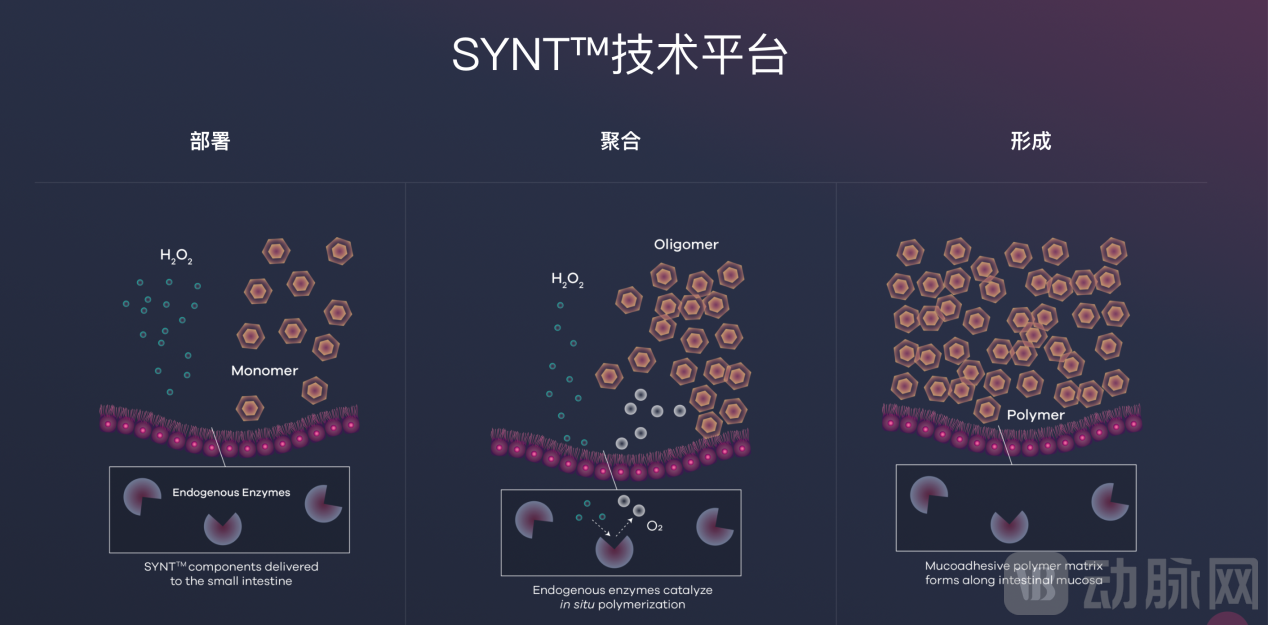
SYNT Technology Platform (Image source: Official website)
In the obesity treatment drug SYNT-101, this technology plays a pivotal role. By blocking nutrient absorption in the duodenum, the upper part of the small intestine, it redirects nutrients to the lower part of the small intestine, thereby stimulating the secretion of satiety hormones such as GLP-1 and PYY (a metabolic regulatory hormone associated with satiety signals). This mechanism mimics the effects observed after gastric bypass surgery, achieving weight loss and metabolic regulation.
Furthermore, this technology can be used to release and maintain enzymes confined to the intestinal tract within the small intestine, enabling targeted action in the gastrointestinal tract. This enhances the oral bioavailability of drugs while minimizing effects on other systemic tissues and organs, thereby reducing the risk of off-target effects and adverse reactions.
This process, known as “duodenal nutrient exclusion,” naturally stimulates the secretion of satiety hormones such as GLP-1, achieving metabolic regulation effects comparable to those of surgery while avoiding the risks associated with invasive procedures.
The first-in-human pilot study validated its safety and mechanistic efficacy: no adverse events were observed in nine subjects across three dose levels; biopsies revealed normal intestinal tissue architecture, and glucose tolerance tests along with changes in hormone levels (such as increased leptin and decreased growth hormone) confirmed nutrient redirection and enhanced satiety signaling.
This “safe, effective, and convenient” combination positions SYNT-101 as a promising “oral alternative” for obesity treatment, particularly suitable for patients who are averse to injectable therapies or concerned about muscle loss. Currently, SYNT-101 has completed its first-in-human study and is scheduled to submit an Investigational New Drug (IND) application to the FDA in the second half of 2025, bringing it one step away from entering formal clinical trials.
2Pipeline Strategy: From Breakthroughs in Major Diseases to Deep Engagement in Rare Diseases
SyntisBio’s pipeline strategy features a dual-track approach: “breaking through market perception in major disease areas while capturing policy dividends in rare diseases.” This not only ensures short-term commercialization potential but also lays the foundation for building long-term technological barriers and enriching its pipeline.
Leveraging the platform capabilities of its gut-targeting technology, SyntisBio has expanded into the field of rare metabolic diseases. Its pipeline candidates, SYNT-202 and SYNT-203, target homocystinuria and maple syrup urine disease, respectively—two rare pediatric conditions that previously lacked approved therapies, requiring patients to adhere to strict long-term dietary control.
SYNT-202: The Methionine Scavenger in the Gut
A proprietary oral enzyme therapy for the treatment of classic homocystinuria caused by cystathionine beta-synthase (CBS) deficiency.
Its mechanism of action involves replicating the therapeutic benefits of methionine-restricted diets by actively depleting methionine in the intestine. The enzyme is not systemically absorbed and is specifically engineered for optimal performance within the gastrointestinal tract.
Research from the Kruger Laboratory at Fox Chase Cancer Center demonstrates that administering SYNT-202 to mice with homocystinuria on a high-protein diet not only prevents surges in plasma homocysteine but also restores elevated plasma homocysteine levels to the baseline observed under methionine-restricted diets within just a few days. The pipeline is currently in the preclinical research stage.
SYNT-203: The Leucine Steward for Maple Syrup Urine Disease
This drug is designed to treat maple syrup urine disease (MSUD) by employing a proprietary leucine decarboxylase (LDC) to eliminate dietary leucine. Engineered for activity throughout the gastrointestinal tract, it aims to control leucine (Leu) levels and reduce dietary restrictions, and is currently advancing toward investigational new drug (IND)-enabling studies.
Its technical logic involves clearing specific dietary amino acids (methionine and leucine) using proprietary stabilizing enzymes (MGL and LDC), while leveraging gut-targeted design to minimize systemic exposure, thereby reducing the burden of dietary restriction. Both products have completed non-human primate studies and are advancing toward the Investigational New Drug (IND)-enabling stage.
The next-generation products, SYNT-212 and SYNT-213, leverage the DIGEST extended-release delivery platform to further enhance the persistence of activity in the gastrointestinal tract, aiming to strike a balance between “maximum control and maximum dietary freedom.” They are currently in the discovery phase.
SYNT-212: Promax Version of SYNT-202
SYNT-212 is the next-generation upgraded formulation of SYNT-202, leveraging the company’s proprietary SYNT delivery technology. By targeting methionine in dietary intake and parenteral circulation through sustained duodenal activity, this technology aims to provide patients with optimal disease control and dietary flexibility, achieving maximal regulation of methionine and total homocysteine levels while granting patients the greatest degree of dietary freedom.
SYNT-213: Extended-Release Technology Enables Long-Acting Leucine Regulation
For maple syrup urine disease, SYNT-213 employs a proprietary LDC (leucine decarboxylase) DIGEST extended-release delivery technology to target dietary and enterohepatically recycled leucine through sustained duodenal activity, aiming to achieve maximal leucine control and greatest dietary freedom; it is currently in the discovery stage.
This dual-track strategy of “breaking through market perceptions in major disease areas + capturing policy dividends for rare diseases” not only ensures short-term commercialization potential but also lays the foundation for building long-term technological barriers and enriching the pipeline.

SyntisBio's Pipeline Portfolio
3DIGEST: A Gut-Targeted Extended-Release Delivery Platform
SyntisBio’s competitive advantage lies in pioneering novel solutions for weight-loss therapy and in transforming the technological strengths of a single product into a reusable platform, thereby enhancing its appeal for financing and partnerships. Its unique DIGEST technology platform leverages the aforementioned SYNT technology, utilizing gut-targeting strategies and functional enzymes to achieve extended drug delivery.
DIGEST Platform viato specific sites in the gastrointestinal tract (e.g., the duodenum),Delivering specialized coatings or carriers to create a microenvironment conducive to maintaining enzyme activity.This coating or carrier can protect enzymes from being destroyed by gastric acid, digestive enzymes, and other factors in the gastrointestinal tract.Significantly Prolongs Enzyme Activity Duration in the Gastrointestinal Tract, by optimizing the intestinal stability and sustained activity of enzymes,Let the enzyme in24maintains high activity for hours or even longer,Exerts prolonged action in the gastrointestinal tract, thereby enabling effective digestion of nutrients and regulation of metabolism.
For metabolic disorders caused by enzyme deficiencies or insufficient enzyme activity, such as inherited metabolic diseases, the DIGEST platform can deliver functional enzymes to the intestine and maintain their activity, helping patients digest and metabolize nutrients normally and alleviating disease symptoms.
For certain digestive disorders, such as indigestion and malabsorption syndrome, the DIGEST platform maintains the activity of relevant digestive enzymes, thereby enhancing the gastrointestinal tract’s ability to digest and absorb nutrients. This improves patients’ digestive function and alleviates symptoms.
For example, building on SYNT-202, SYNT-212 leverages this platform to achieve sustained duodenal action, simultaneously targeting dietary intake and enterically circulating amino acids, thereby maximizing disease control efficacy.
Next isTargeted Precision, the DIGEST platform can precisely deliver enzymes to specific sites within the gastrointestinal tract where they are needed, thereby improving enzyme utilization efficiency, reducing unnecessary loss in other areas, and thus enhancing therapeutic efficacy. In addition, the coating or carrier materials used in the DIGEST platform possessGood Biocompatibility, does not cause significant irritation or adverse reactions to the gastrointestinal tract, and can be naturally and safely cleared from the body after exerting its effect.
For example, building on SYNT-202, SYNT-212 leverages this platform to achieve sustained duodenal activity, simultaneously targeting dietary intake and enterally circulating amino acids, thereby maximizing disease control efficacy.
this“Precision Targeting + Controllable Duration”Its technical characteristics endow it with broad expansion potential in the treatment of gut-related diseases. Whether as a complementary approach for obesity management or for co-development in the field of rare diseases, the platform’s modularity and scalability ensure effective adaptability.
4MIT Team Leads the Effort, with Academicians Supporting Technology Transfer
With its strong technical capabilities, SyntisBio has demonstrated impressive market performance. According to Crunchbase data, SyntisBio completed an oversubscribed Series A financing round of $38 million, led by Cerberus Ventures. To date, the company has undergone three rounds of financing, with a cumulative total of $53.4 million raised. The specific financing milestones are detailed in the table below:
Publication Date | Transaction Name | Financing Amount | Lead Investor |
July 1, 2025 | Series A Financing | $33 million | CerberusCapitalManagement |
July 1, 2025 | Grant Funding | $5 million | National Institutes of Health |
January 17, 2023 | Seed Round | $15.4 million | — |
SyntisBio Historical Financing Table (Source: Crunchbase)
Behind the favor from capital lies a dual recognition of its “technological differentiation + market potential.” This also stems from its strong technical foundation and talented team.
Rahul Dhanda is the Co-Founder, President, and Chief Executive Officer of SyntisBio. He holds an MBA from the MIT Sloan School of Management and previously served as Co-Founder and Chairman of BLASTID, a spin-off company of Harvard Medical School.
Prior to joining Syntis, Dhanda founded Sherlock Biosciences and led the company from its inception to the launch of the first-ever CRISPR-based diagnostic or therapeutic product authorized by the FDA. Dhanda is equally adept at both disease treatment research and the commercialization of products.
Robert Lange is the Co-founder and Board Director of SyntisBio, holds a Ph.D. in Chemical Engineering from the Massachusetts Institute of Technology (MIT), and is an elected member of the National Academy of Medicine, the National Academy of Engineering, the National Academy of Sciences, and the National Academy of Inventors.
He is one of eight Institute Professors at the Massachusetts Institute of Technology (MIT). He has published more than 1,500 articles in the fields of biological sciences and materials science, which have been cited over 422,000 times. In addition, his patents have been licensed or sublicensed to more than 400 companies.
Langer also serves as Chairman of the FDA Science Board. He has received more than 220 awards, including the National Medal of Science and the National Medal of Technology and Innovation; to date, only three individuals have been honored with both distinctions.
Furthermore, the Clinical Advisory Committee has invited Dr. Louis Aronne, a leading authority in the field of obesity and former president of The Obesity Society. His endorsement of SYNT-101, highlighting its ability to “prevent muscle loss with an outstanding safety profile,” provides professional validation of the product’s clinical value and indirectly demonstrates the team’s capability in integrating medical resources.

Left: Rahul Dhanda, Right: Robert Langer (Image source: official website)
As the GLP-1 arena descends into red-ocean competition, SyntisBio is carving out a differentiated path with its “surgical simulation” mechanism, directly confronting oral small-molecule challengers such as Viking and Structure. Bolstered by its MIT pedigree and NIH endorsement, SyntisBio’s 2025 IND submission will represent its first make-or-break milestone.