

Northwestern University's Portable PCR System Enables 15-Minute HCV Diagnosis, Paving the Way for 'Test-and-Treat' at Point of Care
Approximately 50 million people worldwide suffer from chronic hepatitis C virus (HCV) infection, which causes about 242,000 deaths annually. Although highly effective direct-acting antiviral agents are available, complex diagnostic processes often delay treatment, posing the greatest obstacle to eliminating hepatitis C.
A recent study published in *The Journal of Infectious Diseases* showed that a research team at Northwestern University has developed a rapid PCR detection system based on the DASH® platform.
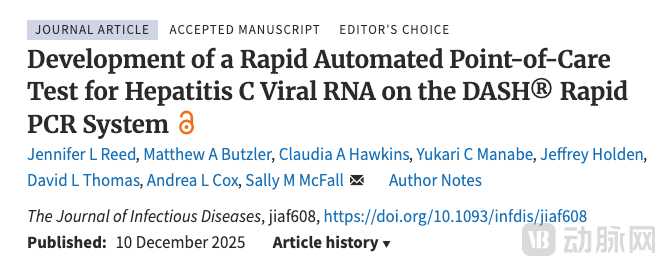
(Source: The Journal of Infectious Diseases)
This system can detect HCV RNA in just 15 minutes.The accuracy is comparable to that of central laboratory equipment (100% concordance), holding promise to break the bottleneck in hepatitis C diagnosis and truly realize “single-visit, immediate treatment.”
Hepatitis C virus (HCV) infection is a major global public health challenge. According to statistics, approximately 50 million people worldwide are infected with HCV, and up to 242,000 deaths occur annually due to complications such as cirrhosis and liver cancer.
Although existing direct-acting antivirals (DAAs) can cure the vast majority of patients within an 8- to 12-week treatment course,However, in reality, the treatment rate has remained persistently low. One of the core reasons for this situation lies in the complexity and inefficiency of current diagnostic processes, which result in significant patient attrition prior to confirmed diagnosis.
Current HCV diagnosis typically employs a cumbersome "two-step" strategy.
First, patients must undergo antibody screening to determine prior exposure to the virus. If the result is positive, a venous blood sample should be collected and sent to a central laboratory for polymerase chain reaction (PCR) testing to detect viral RNA and confirm active infection.
This process not only requires expensive specialized equipment and well-trained technicians, but the sample transportation and testing procedures often take several days or even weeks. Patients must return home after their initial visit to wait for results and then come back to the hospital to receive them, leading to a high rate of patients being lost to follow-up.
Although the U.S. Food and Drug Administration (FDA) has previously approved a point-of-care testing (POCT) device, its turnaround time of 40 to 60 minutes remains too long for busy outpatient clinics, hindering the realization of true “test-and-treat” immediacy.
Therefore, developing a molecular diagnostic tool that is extremely rapid, easy to operate, and offers accuracy comparable to laboratory standards has become a critical technical requirement for breaking the bottleneck in hepatitis C elimination. This addresses the core pain point that new methods aim to resolve: how to condense the diagnostic capabilities of high-end laboratories into a portable device and complete confirmation within the patient’s waiting time window.
To address the aforementioned challenges, the research team at Northwestern University applied their developed DASH® (Diagnostic Analyzer for Specific Hybridization) rapid PCR platform to HCV detection.
The platform was originally designed for SARS-CoV-2 testing, offering exceptional flexibility and adaptability. In this study, the team successfully validated the performance of an HCV test kit, which is designed to provide qualitative confirmatory results from fingertip whole blood or plasma samples within a very short timeframe.
In terms of methodological design, the DASH® HCV assay demonstrates remarkable efficiency and sensitivity.This test requires only a 100-microliter (μL) sample and, leveraging a highly automated microfluidic chip, completes the entire process—from sample lysis and nucleic acid amplification to signal detection—within 15 minutes.
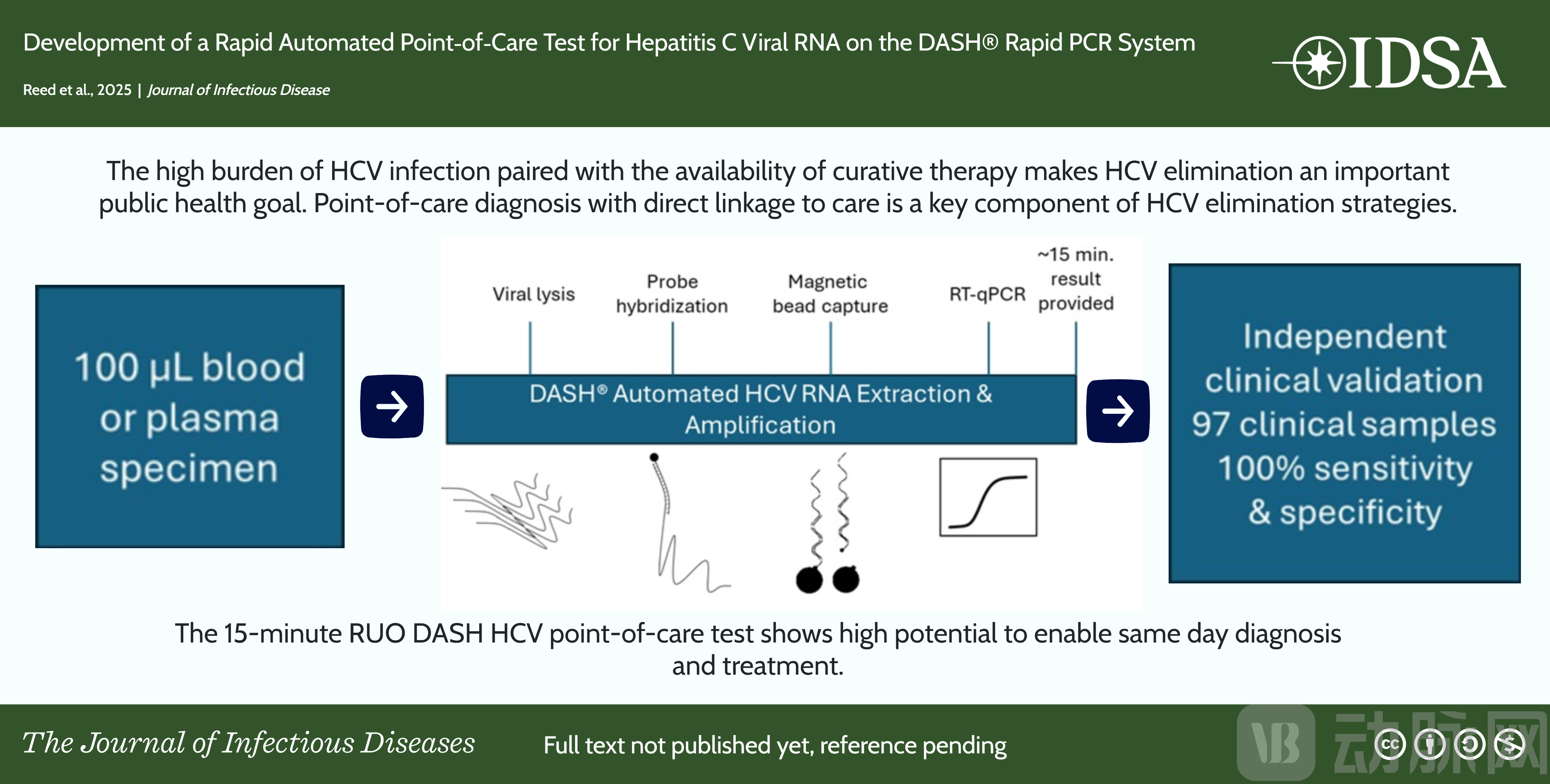
Figure: Rapid automated point-of-care testing method for detecting hepatitis C virus RNA (Source: The Journal of Infectious Diseases)
Research data indicate that the system features a wide dynamic range and can effectively detect all major hepatitis C virus (HCV) genotypes (1–6), with a limit of detection (LoD) as low as 200 IU/mL. This performance metric ensures that even individuals with low viral loads can be rapidly and accurately identified, thereby minimizing the risk of missed diagnoses.
To validate the clinical reliability of the system, the research team sent the DASH® analyzer and kits to Johns Hopkins University for independent evaluation. Collaborating researchers conducted a blinded comparative study using 97 retrospectively collected clinical plasma samples.
The results demonstrated that the DASH® HCV assay exhibited perfect accuracy compared with existing commercialized central laboratory platforms:Both the positive percent agreement (PPA) and negative percent agreement (NPA) reached 100%. These key data points strongly demonstrate that this portable device does not compromise accuracy for speed, and its diagnostic performance is fully sufficient to serve as a basis for clinical confirmation.
The advent of this technology holds profound theoretical and practical value for the global prevention and control of hepatitis C.
Sally McFall, Co-Director of the Center for Innovation in Global Health Technologies (CIGHT) at Northwestern University and one of the developers of this testing technology, pointed out:“Diagnostic tests that can be completed instantly during a patient’s visit will make ‘same-day diagnosis and same-day treatment’ possible, thereby strongly supporting efforts to eliminate HCV.”
This paradigm shift not only conserves medical resources but also fundamentally transforms patients’ healthcare experiences and prognoses, compressing the interval from diagnosis to treatment from weeks to merely fifteen minutes.
The success of this study also challenges the conventional wisdom that “high-precision molecular diagnostics must rely on large-scale laboratories,” demonstrating the significant potential of miniaturized PCR technology in resource-limited settings.The test’s high speed and ease of use enable its deployment in community clinics, mobile testing units, and even remote areas, significantly improving the accessibility of diagnostic services.
Dr. Claudia Hawkins, Director of the Center for Global Infectious Diseases at Northwestern University’s Institute for Global Health, emphasized: “By reducing delays and simplifying testing pathways, this test holds promise to save millions of lives worldwide—those at risk of devastating liver complications due to untreated conditions—by accelerating treatment.”
Looking ahead, this technology is poised to become a critical tool for the World Health Organization (WHO) in achieving its goal of eliminating viral hepatitis by 2030. With further clinical validation and commercialization efforts, the DASH® platform may be expanded to enable rapid testing for a broader range of infectious diseases.
The research team also stated that future efforts will focus on further validating its detection performance for whole blood samples in real-world clinical settings and accelerating regulatory approval, thereby truly benefiting tens of millions of hepatitis C patients worldwide.