

Fasting Boosts Breast Cancer Therapy Efficacy via Glucocorticoid Receptor Activation: A Pharmacological Strategy to Overcome Endocrine Resistance
Hormone receptor-positive (HR+) breast cancer is the most common subtype of breast cancer. Endocrine therapy is its primary treatment modality; however, the development of resistance remains a major clinical challenge.
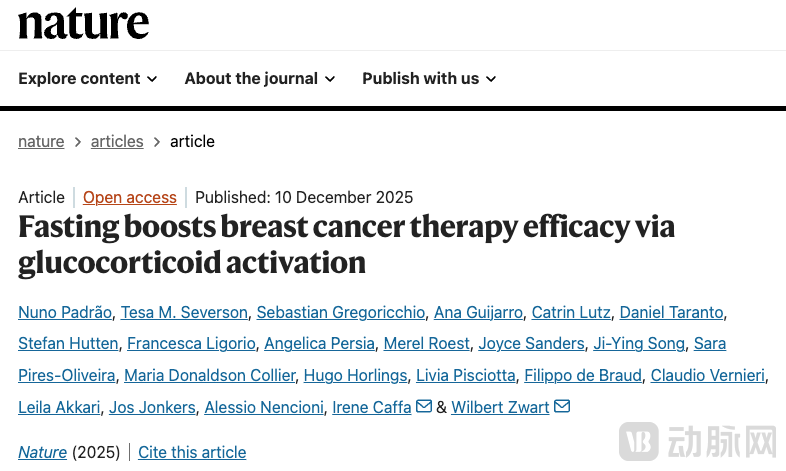
On December 10, 2025, a research team led by Nuno Padrão from the Netherlands Cancer Institute and the University of Genoa in Italy published a research paper titled “Fasting boosts breast cancer therapy efficacy via glucocorticoid activation” in the journal Nature.
(Source: Nature)
This study not only revealsEpigenetic Mechanisms by Which Periodic Fasting Enhances the Efficacy of Endocrine Therapy, even more excitingly, it was discovered thatPharmacological activation of the glucocorticoid receptor (GR) can mimic the anticancer effects of fasting,Provides a potential alternative treatment strategy for patients unable to adhere to strict dietary restrictions.
Hormone receptor-positive (HR+) breast cancer accounts for approximately 75% of all breast cancer cases, with its growth primarily driven by estrogen receptor alpha (ERα). Therefore, endocrine therapy that blocks the ERα signaling pathway, such as tamoxifen (TMX), has remained the standard of care for these patients.
However, clinical data show that many patients develop primary or acquired resistance after several years of endocrine suppression therapy, leading to tumor recurrence or progression. Overcoming drug resistance and prolonging the duration of effective endocrine therapy are urgent needs in the field of breast cancer treatment.
In recent years,Periodic Fasting(Periodic Fasting) orFasting Mimicking Diet(Fasting-Mimicking Diets, FMDs) have garnered significant attention as an adjunctive therapeutic approach.
Previous animal studies and clinical trials have demonstrated that periodic fasting can significantly enhance the efficacy of standard endocrine therapy and delay the development of drug resistance. However, given that adjuvant endocrine therapy typically requires a duration of 5 to 10 years, requiring patients to adhere to strict dietary restrictions over such an extended period poses substantial practical challenges.
This raises a key scientific question:By What Mechanism Does Fasting Enhance Anti-Cancer Efficacy?
“If we can elucidate the underlying molecular mechanisms, could we identify a pharmacological agent to substitute for fasting, thereby achieving equivalent therapeutic efficacy without altering patients’ dietary habits? This is precisely the core question that this study aims to address.”
To unravel this puzzle, the research team established a mouse xenograft model using human HR+ breast cancer cell lines (MCF7) and compared tumor changes across different treatment groups: tamoxifen monotherapy, fasting alone, and combination therapy. The results confirmed that the combination therapy group exhibited significant synergistic anti-tumor effects.
The researchers further conducted in-depth multi-omics analyses (including transcriptomics, proteomics, and ChIP-seq) on tumor tissues. The results revealed a surprising phenomenon:Fasting triggers widespread epigenetic reprogramming in tumor cells.
Specifically, fasting led to a significant decrease in the activity of members of the activator protein-1 (AP-1) family, such as JUN and FOS, which are transcription factors that promote cell proliferation, while substantially activating the signaling pathways of the glucocorticoid receptor (GR) and the progesterone receptor (PR).
Mechanistic studies have shown that during fasting, levels of corticosterone (cortisol in humans) and progesterone are significantly elevated in the blood of mice. These hormones act as ligands, binding to and activating the glucocorticoid receptor (GR) and progesterone receptor (PR) within the nucleus. The activated GR and PR bind to specific regions of the genome, initiating the expression of a series of tumor suppressor genes (such as the transcriptional repressor ZBTB16), thereby inhibiting the proliferation of tumor cells.
To verify the critical role of the glucocorticoid receptor (GR), the research team constructed GR-knockout (GR-KO) breast cancer cell lines. Experimental results showed that after GR knockout, the enhancing effect of fasting on the efficacy of tamoxifen was no longer observed, even under fasting conditions. This "proof by contradiction" strongly demonstrates thatGR Activation Is the Central Hub for Fasting to Exert Synergistic Anti-Cancer Effects.
Based on the above findings, the research team proposed a bold hypothesis:Can the direct use of glucocorticoids mimic the therapeutic effects of fasting?
The researchers selected dexamethasone (Dexa), a widely used synthetic glucocorticoid in clinical practice, for validation experiments.
The results are encouraging: in mouse models,Combined treatment with dexamethasone and tamoxifen achieved nearly the same effect in inhibiting tumor growth as “fasting + tamoxifen.”More importantly, compared with the weight loss in mice caused by fasting, the body weight of mice in the dexamethasone treatment group remained stable, and the drug also alleviated endometrial hyperplasia, a common side effect induced by tamoxifen.
Furthermore, the research team conducted a safety assessment in immunocompetent mouse models. The results showed that the addition of dexamethasone did not suppress the body’s anti-tumor immune response; instead, it reduced PD-L1 expression on the surface of certain immune cells, suggesting potential unique immunomodulatory benefits.
In the validation phase using clinical samples, researchers analyzed tumor specimens from breast cancer patients enrolled in two clinical trials before and after a fasting-mimicking diet: one was trial NCT05748704 (15 patients received endocrine therapy combined with a 5-day fasting-mimicking diet), and the other was the DigesT trial (NCT03454282; 35 patients received the fasting-mimicking diet).
Analysis confirms,Following fasting, the transcriptional activity of GR in patients was also significantly elevated and negatively correlated with cell proliferation markers.This finding successfully extends the conclusions from mouse models to clinical patients, significantly enhancing the translational value of the study.
This study not only elucidates the molecular mechanisms underlying the anticancer effects of fasting but also offers a “pharmacological alternative.” For the thousands of patients with hormone receptor-positive (HR+) breast cancer who struggle to adhere to long-term dietary restriction, this may mean that in the future, they could achieve fasting-like therapeutic benefits by supplementing endocrine therapy with glucocorticoids such as dexamethasone. Of course, long-term use of glucocorticoids carries certain risks of side effects, and future clinical studies will need to further optimize dosing regimens to achieve the optimal balance between efficacy and safety.