

TiROMU completes tens of millions RMB Pre-A Round to accelerate clinical implementation of intelligent ophthalmic surgical system
TIROMU
Ophthalmic Intelligent Surgical Robot Developer

FengHe Capital
Boutique Investment Bank in the Life Sciences Sector
Ophthalmic intelligent surgical robot company TiROMU has recently completed a Pre-A financing round of tens of millions of RMB. This round was co-led by Aibo Hongsheng and Qihang Venture Capital, with participation from Mingheng Meikang. Feng He Capital served as the exclusive financial advisor.
Since its establishment in March 2023, TiROMU has completed three financing rounds, with total funds raised exceeding 100 million RMB. Previous investors include Tsinghua Innovation Ventures, Eyebright Medical, TowardPi Medical, AMIT Medical, Lingyi Capital, and other well-known venture capital institutions, industry leaders, and their affiliated funds, providing strong industrial resource support for TiROMU's technology R&D and clinical translation.
In product development, TiROMU has also achieved key breakthroughs. Its self-developed fundus injection surgical robot has entered the clinical trial stage and is expected to complete trials and initiate regulatory filing this year. Meanwhile, the 2.0 version of the product has also been completed. By integrating intraoperative OCT imaging to enable real-time automatic surgical path planning and navigation, it is expected to become the first ophthalmic surgical robot with "autonomous driving" capabilities in the industry, further enhancing the standardization and intelligence of ophthalmic microsurgery.
It is reported that the new funds injected in this round will be primarily used for three major directions: advancing the clinical trials and regulatory filing of the fundus injection surgical robot, accelerating the R&D iteration of general-purpose ophthalmic surgical robots, and promoting the industrial implementation and commercial expansion of related technologies.
Among medical robotics, ophthalmology has always been one of the areas with the greatest technological potential, while also posing the most significant challenges in terms of practical implementation.
On one hand, the intraocular space is extremely narrow, with delicate and fragile tissue structures where even the slightest operational error can lead to irreversible damage. Compared to surgical robots in orthopedics, laparoscopy, neurosurgery, and other fields, ophthalmology requires higher precision in mechanical control, needing to achieve micron-level accuracy (<10μm). At the same time, real-time perception of micro-force feedback and precise registration between the surgical execution module and intraoperative imaging impose extremely high demands on product development.
On the other hand, the core technical challenges of ophthalmic surgical robots lie in mechanical mechanism design and manufacturing (exemplified by RCM structural design), micro-force feedback sensing of the end effector, and data integration of iOCT imaging. Among these, end effector precision is the most critical technical indicator, directly determining the safety and efficacy of the surgery.
Since its establishment, TiROMU has focused on the R&D of high-technical-barrier microsurgical robots, committed to providing comprehensive intelligent solutions for ophthalmic diseases. The company's core team comes from prestigious institutions such as Tsinghua University and Waseda University in Japan, as well as multiple surgical robot companies including Arimedi Medical, Remebot, and Meiya Medical, combining solid academic foundations with deep industry experience. TiROMU has been recognized as a National High-Tech Enterprise and a Beijing "Specialized and Sophisticated" Enterprise, and was selected as a unit for the 2025 Artificial Intelligence Medical Device Innovation Task's "Open Competition" program.
Through deep collaboration with ophthalmic experts from top-tier hospitals in China, TiROMU has launched its fundus injection surgical robot. The product adopts a 6-degree-of-freedom mainstream architecture and features a differentiated rail-type RCM (Remote Center of Motion) structure, overcoming the limitations of traditional parallel-link quadrilateral structures such as high cumulative errors in processing and assembly, and restricted workspace, achieving execution accuracy of up to 2μm. TiROMU's product has initiated multi-center clinical trials and successfully enrolled patients, receiving positive feedback from hospitals, doctors, and patients.
Its proprietary master-slave mapping algorithm allows flexible adjustment of the mapping ratio between the master hand and slave hand according to surgical needs, enabling position control at varying levels of precision. It effectively scales down the surgeon's hand movements to the micron level, multiplying the surgeon's micro-manipulation capabilities and significantly enhancing the precision and flexibility of ophthalmic surgical procedures.
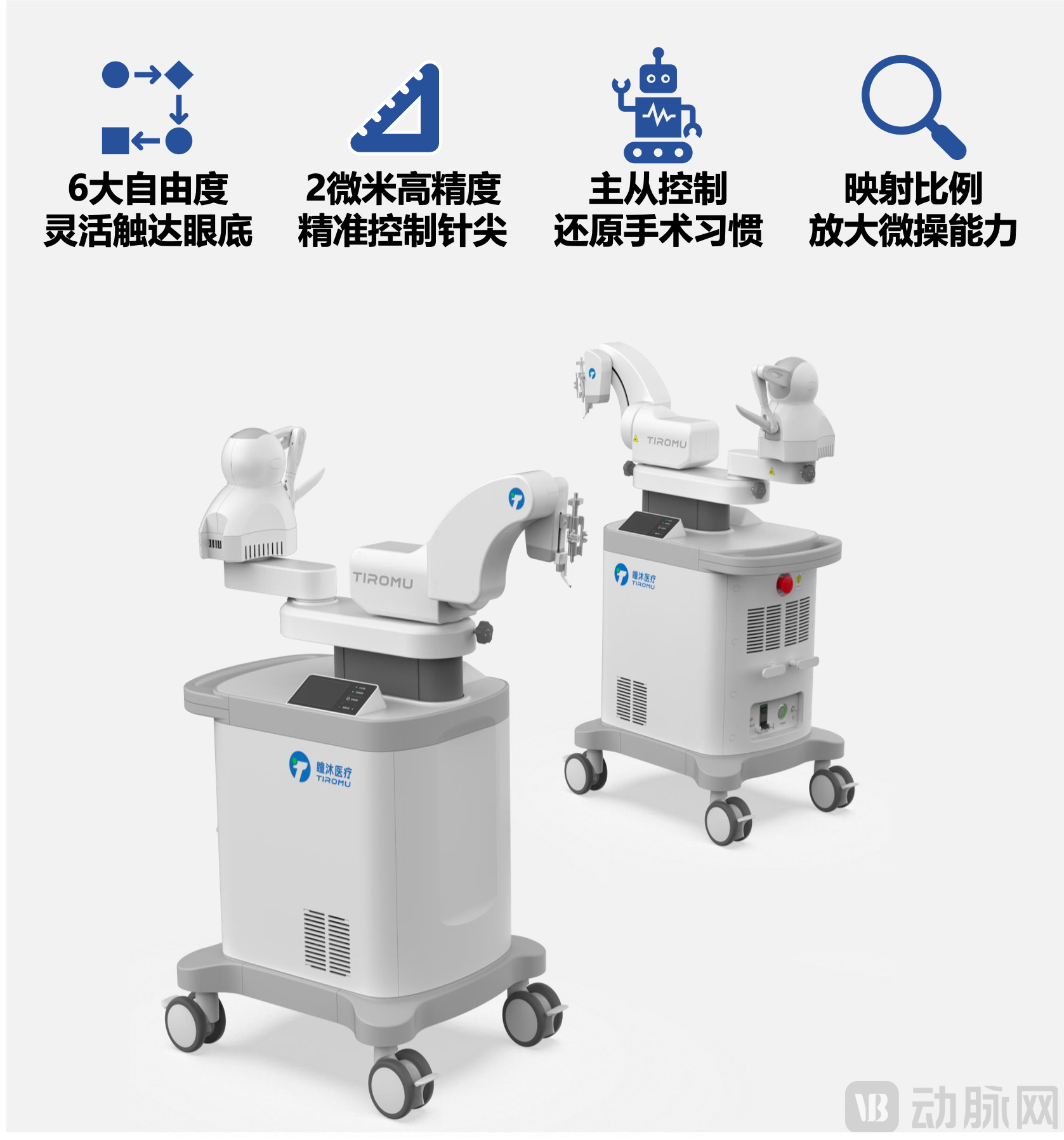
TIROMU's Self-Developed Retinal Surgery Robot
Looking ahead to technology evolution trends, TiROMU has determined that as OCT devices reach a turning point in their development, the deep integration of injection robots with intraoperative OCT imaging will become an inevitable trend.
Based on this strategic foresight, TiROMU has entered into a strategic collaboration with a leading OCT company in China, taking the lead in advancing the development of the next-generation fundus injection surgical robot 2.0. By integrating intraoperative OCT imaging, this product enables real-time automatic surgical path planning and navigation, positioning it to become the first ophthalmic surgical robot with "autonomous driving" capabilities in the industry.
TiROMU has accumulated deep expertise in key areas such as robotic end-effector sensing, precision drive control, and artificial intelligence algorithms. The company has filed multiple patents covering core technologies including master-slave control, force feedback, and adjustable mapping ratios, establishing a comprehensive intellectual property system encompassing robot design, control algorithms, and surgical navigation.
It is worth noting that TiROMU's strategic focus is not confined to the ophthalmology field. Leveraging its core technology platform for high-precision microsurgical robots, TiROMU is simultaneously advancing product development for additional specialties such as otolaryngology and neurosurgery, gradually building an ecosystem of intelligent solutions for microsurgery across multiple domains.