

NVIDIA's AI in Healthcare and Life Sciences Report 2025: Insights from Over 600 Industry Experts
Even in 2025, AI healthcare remains “hotter than ever.”
From the pursuit of clinical value validation for next-generation AI technologies, such as generative AI and large language models, in healthcare and life sciences to the proliferation of diverse AI-driven applications in these fields, innovation in AI-enabled healthcare and life sciences is flourishing. Alongside this vibrant progress, the market size continues to expand. According to forecasts by VCBeat, the market size of China’s AI healthcare sector is projected to reach RMB 115.7 billion in 2025 and further climb to RMB 159.8 billion by 2028.
Amid the industry’s rapid growth, a question looms for all stakeholders: As AI continues to achieve remarkable success in its integration with healthcare and life sciences, what directions will the industry evolve toward in the future?
To this end,NVIDIA surveyed more than 600 professionals and released the research report “The State of AI in Healthcare and Life Sciences and Trends for 2025.”
It is worth noting that,To ensure the objectivity and completeness of the survey results, these more than 600 respondents came from diverse fields and held various positions.In terms of sectors, NVIDIA interviewed professionals from four key sub-sectors: medical technology, tools and diagnostics; digital health; pharmaceuticals and biotechnology; and solution buyers and providers, thereby comprehensively covering the industry chain of healthcare and life sciences. Furthermore, these more than 600 interviewees included corporate executives, clinicians, technical equipment and solutions specialists, and academics, ensuring that the survey results were not only objective and comprehensive but also rich and diverse.

However, due to differences in industry sectors and perspectives, certain viewpoints vary. Therefore, this article primarily focuses on interpreting the overall development status and industry trends derived from the report.
Imaging Diagnosis Tops the List of AI Use Cases
Medical imaging and diagnostics, clinical decision support, and disease diagnosis and risk prediction are the three major AI use cases (application scenarios) in healthcare and life sciences at the current stage.
Among these, medical imaging and diagnostics ranked first with a 47% share, followed by clinical decision support at 43%, and disease diagnosis and risk prediction at 40%.
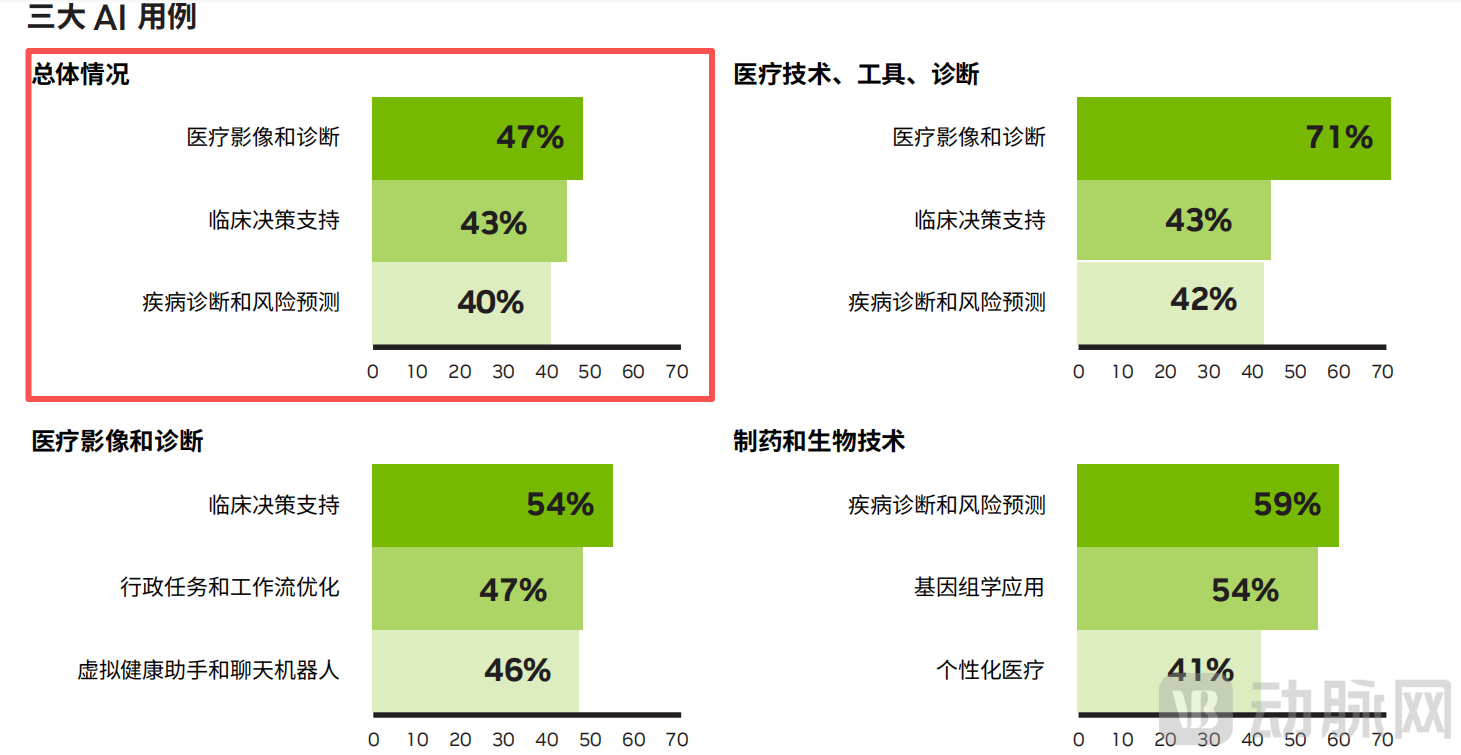
As of NVIDIA's report
Their ability to alleviate the shortage of medical resources and address the uneven distribution of high-quality medical care is one of the primary reasons they rank among the top three in the AI applications list for healthcare and life sciences.
Taking medical imaging diagnosis as an example, data previously disclosed by the National Health Commission of China indicates that the misdiagnosis rate in remote areas is two to three times higher than in urban areas. This suggests that the diagnostic capabilities of primary healthcare institutions in China still lag behind those of large urban hospitals. However, even large urban hospitals face challenges such as a shortage of physicians. According to the "China Health Statistics Yearbook 2022" and estimates by the National Bureau of Statistics, the staffing ratio of radiologists in China was only 0.17 per 1,000 population in 2021, indicating a severe shortage of radiology professionals. Compounding this issue are pain points such as the high difficulty and time consumption involved in interpreting imaging data, heavy workloads, the subjectivity inherent in diagnostic criteria, and the challenges in identifying early-stage lesions. Consequently, medical imaging diagnosis in China continues to suffer from misdiagnoses and missed diagnoses. Notably, the problems of misdiagnosis and missed diagnoses caused by shortages of medical resources are not confined to the radiology department. Artificial intelligence (AI) can effectively alleviate these issues and promote equity in healthcare access.
Specifically, in terms of diagnosis, AI not only efficiently processes and analyzes large volumes of images and data to enhance diagnostic efficiency, but also improves diagnostic accuracy and precision through high-precision analysis, thereby reducing the risks of missed and misdiagnoses. In terms of treatment, clinician-driven clinical decision support systems can provide physicians with real-time, precise diagnostic and therapeutic recommendations, helping them manage complex and variable clinical cases and assisting in making more scientific and rational treatment decisions. This enhances physicians’ clinical capabilities while improving patient outcomes. Furthermore, in healthcare settings, AI technology can develop disease prediction models by mining patients’ electronic health records, various laboratory and test results, and even lifestyle information. This assists physicians in achieving early screening and diagnosis, disease prediction, and follow-up management for patients, representing a rational and efficient allocation of medical resources.
If the sheer scale and urgency of demand serve as the “driver” for the integration and development of AI technology within these three major application scenarios, then the accumulation of massive datasets acts as the “fuel.” Whether it is in-hospital data, including imaging and laboratory test results, or health information from daily life (such as blood glucose monitoring and sleep health data), the volume is undeniably vast. This abundance of data has laid a solid foundation for the practical implementation and iterative advancement of AI technologies.
As a result, among these three major application scenarios, AI has been implemented most rapidly and has achieved phased results. Taking AI-assisted medical imaging diagnosis as an example, by May 2024, China had approved 85 AI-based medical imaging products under Class III medical device certification, covering the diagnosis of diseases in multiple areas including the eyes, lungs, orthopedics, cardiovascular system, breasts, and cervix.
The Three Major Fields Impacted by AI in the Next Five Years,
Virtual healthcare assistants are prominently included in the list.
When asked about the areas where AI will have the greatest impact over the next five years, 51% of respondents cited advanced medical imaging and diagnostics, 34% pointed to virtual healthcare assistants, and 29% identified precision medicine (treatments tailored to individual patient characteristics).

As of NVIDIA's Report
Among these, AI-enabled medical imaging diagnosis needs no further elaboration. As one of the most mature subfields of AI applications in healthcare and life sciences, medical imaging has already achieved certain practical outcomes, such as the assisted diagnosis of cardiovascular, cerebrovascular, and pulmonary diseases mentioned earlier. However, clinical expectations for the integrated development of these two domains remain high—on one hand, there is a continuous pursuit to expand the range of applicable diseases; on the other, there is a drive to advance diagnostic capabilities. For instance, in the assisted diagnosis of certain conditions, AI currently can only perform qualitative analysis (i.e., determining whether a disease is present) but cannot conduct quantitative analysis (e.g., assessing disease progression). In the future, with the application of large models and generative artificial intelligence, the scope of AI-enabled medical imaging diagnosis will continue to expand.
As for virtual health assistants, they have become one of the most high-profile applications in the AI-driven healthcare sector in recent years. From internet giants such as Ant Group to digital healthcare platforms like JD Health and Tencent Health, and from health IT vendors like iFlytek Healthcare to patient management platforms specializing in disease-specific care such as MiJian, a wide variety of AI-powered virtual assistants and virtual health management solutions have emerged.
The underlying reasons are as follows. First, with rising economic standards and heightened awareness of health management, consumer demand for health management services continues to emerge. Second, AI virtual health assistants can reshape the medical and healthcare industry chain through “scenario-based intervention.” These assistants not only serve as an entry point for internet healthcare companies and medical service providers to rapidly acquire consumer users in the short term, but also enhance user stickiness through long-term interaction and services, thereby increasing repurchase rates to a certain extent. Moreover, based on sustained long-term interactions, AI virtual health assistants can be regarded as a “portal” for accumulating users’ daily health and medication data. After anonymization, this vast amount of data can empower medical service providers to deliver more personalized and precise health management solutions, while also supporting real-world studies in pharmaceuticals and medical devices, thereby feeding back into the research and development of innovative drugs and devices. Finally, with the application of technologies such as generative AI and large language models, breakthroughs in AI reasoning capabilities and advancements in long-term memory functions have made proactive, full-lifecycle health management a reality rather than just an aspiration.
Consequently, AI-powered virtual health assistants in China are experiencing rapid growth. This surge has also led to a trend of homogenization among current domestic AI virtual health assistants. Nevertheless, some enterprises are leveraging their unique strengths to create differentiated AI virtual health assistants. For instance, the core competitiveness of Ant Health Assistant AQ, released by Ant Group this June, lies in its efficient integration of medical insurance services, basic health management, and high-quality healthcare resources. iFlytek Healthcare’s iFlytek Xiaoyi, built upon the iFlytek Spark large language model, excels at simulating clinical reasoning for the differential diagnosis of complex symptoms. JD Health’s JD Dawei Doctor has established a service loop encompassing “minor illness consultation and rapid medication purchase.” This system not only facilitates quick consultations for common ailments such as headaches and fevers but also seamlessly connects users to fast-track medication purchasing.
In the future, the interoperability of multimodal data—such as the integration of in-hospital and out-of-hospital data, as well as the connectivity between health monitoring data from various wearable devices and clinical laboratory test results—will continue to attract significant attention within the industry. Furthermore, how to uncover users’ genuine needs and foster efficient, organic collaboration among healthcare providers, pharmaceutical companies, medical device manufacturers, and insurance payers represents another noteworthy trend in industry development.
As for precision medicine, it has become another key focus of attention in the medical community in recent years. In fact, whether it involves more precise and efficient diagnosis, or more scientific and personalized treatment and health management plans, the ultimate goal is to maintain or improve the health status of users/patients. With the assistance of AI, diagnostic and therapeutic capabilities will continue to be enhanced across various dimensions in the future, which will inevitably lead to the realization of precision medicine.
Data Remains the Biggest Obstacle to the Development of AI+ Healthcare and Life Sciences
The realization of the “bright vision” for AI in healthcare and life sciences faces numerous obstacles.
Among them,Approximately 33% of respondents indicated that the greatest challenge in implementing AI within the healthcare and life sciences sector is data-related issues, such as privacy and autonomy concerns. This was followed by insufficient budgets and inadequate volumes of data for model training, each cited by 30% of respondents.These challenges are not only vast but also highly complex; to overcome them, enterprises and healthcare institutions need to find a powerful partner. NVIDIA is precisely that partner.
To empower healthcare, life sciences enterprises, and institutions in AI development, NVIDIA has built a comprehensive solution spanning from underlying hardware to top-level applications.
In terms of hardware, NVIDIA provides large-scale AI and high-performance computing support for healthcare and life sciences AI developers based on the most advanced AI computing platforms. Building upon this hardware foundation, NVIDIA has launched the NVIDIA Clara platform, which offers a suite of AI toolkits and software packages for healthcare and life sciences enterprises, such as BioNeMo for drug discovery, Holoscan for medical devices, Parabricks for genomics, and MONAI for medical imaging. Furthermore, NVIDIA has introduced NVIDIA Omniverse and NVIDIA Cosmos. The former is a highly realistic simulation computing platform used to build “digital twins” of laboratories and biomanufacturing facilities, while the latter is a platform for building custom world models at scale for physical AI systems, providing open-world foundation models and tools for data curation, training, and customization.
Leveraging NVIDIA Omniverse and NVIDIA Cosmos, NVIDIA launched NVIDIA Isaac for Healthcare earlier this year. This developer framework for AI-driven healthcare robotics provides comprehensive support for various medical robots, including digital prototyping, hardware-in-the-loop (HIL) product development and testing, synthetic data generation for AI training, policy training, and real-time deployment.
Taking NVIDIA Isaac for Healthcare as an example, we explain how NVIDIA empowers enterprises to address two major challenges: insufficient data for model training and budget constraints.
First, let us address the insufficiency of data for model training. On one hand, NVIDIA Cosmos can generate low-resolution synthetic adaptation data that precisely matches the real world. Because its synthetic data closely resembles the physical reality, it is highly suitable for the training needs of medical robots. On the other hand, while creating high-fidelity digital twin models, NVIDIA Omniverse also generates a large volume of physics-based, realistic synthetic data, which can be used for fine-tuning and reinforcement learning of medical robot models to improve their precision.
As for budget constraints, NVIDIA’s solution is closely aligned with its recent push for “digital twins.” It is reported that by integrating digital twins with physical AI, Isaac for Healthcare not only provides data support to healthcare and life sciences enterprises but also offers end-to-end support for the development and deployment of medical robots and devices, including digital prototyping, AI model validation in digital twin environments, and simulation-to-real deployment.

At Isaac for Healthcare, enterprises and institutions can not only reduce R&D and deployment costs and shorten development cycles by leveraging “high-fidelity environments,” but also strengthen and refine robot training strategies and algorithms through real-world data, synthetic data, and digital twin environments, thereby enhancing the performance of robots and medical devices.
To date, Isaac for Healthcare has established partnerships with numerous enterprises and institutions worldwide, including many industry leaders. For instance, at the NVIDIA GTC conference held in Washington, D.C., Johnson & Johnson announced that it would leverage NVIDIA Isaac for Healthcare to design, simulate, and test various stages of its MONARCH platform—from equipment installation and commissioning to patient interaction. The MONARCH platform is the first innovative technology of its kind to reach the market in the field of robot-assisted bronchoscopy. Previously, this process took approximately months or even years; however, with the assistance of NVIDIA Isaac for Healthcare, the timeframe has been reduced to just a few hours.
Johnson & Johnson stated, “This will enable the Johnson & Johnson MedTech team to evaluate multiple design concepts and conduct virtual testing of novel devices. The approach is also poised to revolutionize training for the MONARCH Platform in urology, which is scheduled for launch in the United States in 2026, allowing clinicians to rehearse complex scenarios in a high-fidelity, physically accurate anatomical simulation environment before engaging with patients.”
Prior to this, GE HealthCare also announced a partnership with NVIDIA to leverage NVIDIA Isaac for Healthcare in advancing autonomous imaging technology innovations, with a focus on developing autonomous X-ray technologies and ultrasound applications. With the support of NVIDIA Isaac for Healthcare, GE HealthCare can train, test, and validate the capabilities of its autonomous imaging systems in virtual environments prior to deployment.
Furthermore, it is worth noting that to alleviate budgetary pressures on enterprises and institutions, in addition to the aforementioned empowerment initiatives, NVIDIA has launched the NVIDIA Inception program. This program provides healthcare and life sciences companies, including startups, with support such as product discounts, technical assistance, marketing promotion, and financing matchmaking. To date, more than 4,000 healthcare and life sciences companies worldwide have joined the program.
Moreover, NVIDIA’s empowerment of the healthcare and life sciences industry extends far beyond improving efficiency and reducing costs. In response to other significant challenges facing the sector, NVIDIA is continuously seeking optimal solutions. For instance, to address concerns regarding the reasoning capabilities and interpretability of AI models, the NVIDIA Clara platform offers Reason, a vision-language model designed to advance interpretable AI in radiology and medical imaging. Developed in collaboration with clinicians from the U.S. National Institutes of Health (NIH), this model successfully captures the reasoning processes of human experts, thereby enhancing the transparency and interpretability of medical AI to a certain extent.
As previously stated, NVIDIA’s empowerment of AI in healthcare and life sciences is not confined to a single level; rather, it delivers comprehensive solutions through an entire ecosystem. As the future of AI in healthcare and life sciences arrives, we eagerly await to see how NVIDIA and its partners will translate these “future visions” into reality and further shape the industry’s trajectory.