

Nature: Paradigm Shift in Diagnosis — Million-Person Genomic Study Maps Genetic Architecture of Psychiatric Disorders
Approximately half of the global population will meet the diagnostic criteria for at least one mental disorder during their lifetime, with many individuals meeting the criteria for multiple comorbid conditions. For a long time, psychiatry has relied on symptomatic presentations to differentiate between distinct disorders; however, does this classification system truly reflect the biological essence of these diseases?
December 10, 2025,Psychiatric Genomics Consortium (PGC)A study published in the journal Nature provides the answer.By analyzing genetic data from more than 1.05 million patients with mental disorders and millions of healthy controls, the research team has mapped the most comprehensive genetic landscape of mental disorders to date.
(Source: Nature)
Led by Dr. Andrew D. Grotzinger of the University of Colorado Boulder, the research team revealedGenetic variants of 14 major psychiatric disorders cluster into five broad categories, each corresponding to a set of shared genetic risk factors,These five major categories collectively explain approximately 66% of the genetic variants associated with individual diseases. The study identified238 pleiotropic genetic loci associated with at least one factor,and functional genomics analysis revealed the unique neurobiological features of different disease clusters.
Jordan W. Smoller, the study’s senior author from the University of North Carolina at Chapel Hill, pointed out that this work provides important insights for future psychiatric research, treatment, and taxonomy:Future classifications of mental disorders may no longer be primarily based on "what patients say and do," but rather on "which brain cells are affected and which genetic pathways are dysregulated."
Traditional psychiatric diagnostic manuals classify most mental disorders as distinct, independent disease categories. For instance, depression and anxiety are listed as separate disorders in the Diagnostic and Statistical Manual of Mental Disorders (DSM). However, a notable phenomenon in clinical practice challenges this classification:High comorbidity.
Decades of twin and family studies have demonstrated that psychiatric disorders are highly heritable, and clinical observations have revealed significant comorbidity among different conditions. For instance, previous studies have shown that most patients diagnosed with major depressive disorder are also diagnosed with generalized anxiety disorder, and vice versa. This high level of comorbidity suggests that traditional diagnostic boundaries may not reflect the biological essence of these disorders.
To reveal the genetic basis underlying this phenomenon,This study integrated genome-wide association study (GWAS) data for 14 childhood and adult-onset psychiatric disorders. Compared with the Psychiatric Genomics Consortium’s previous cross-disorder analysis (CDG2), the average number of cases increased by approximately 165%, laying the foundation for more precise analyses.
These 14 disorders cover the major categories of mental illness: attention-deficit/hyperactivity disorder (ADHD), anorexia nervosa (AN), autism spectrum disorder (ASD), bipolar disorder (BIP), major depression (MD), obsessive-compulsive disorder (OCD), schizophrenia (SCZ), and Tourette syndrome (TS), as well as the newly added alcohol use disorder (AUD), anxiety disorders (ANX), post-traumatic stress disorder (PTSD), nicotine dependence (NIC), opioid use disorder (OUD), and cannabis use disorder (CUD).
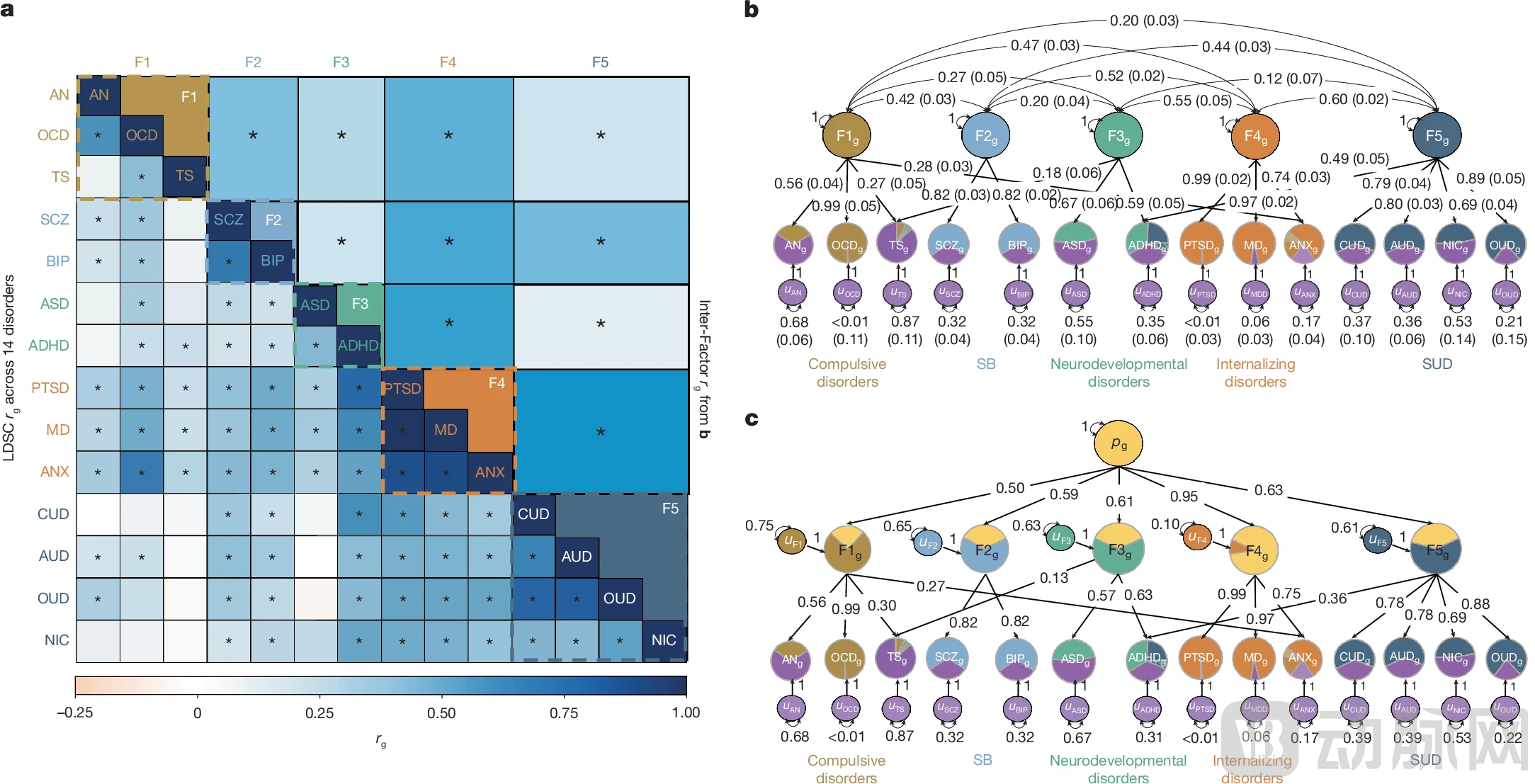
Figure: Genome-wide association study data for 14 psychiatric disorders (Source: Nature)
The research team used linkage disequilibrium score regression (LDSC) to estimate genome-wide genetic correlations, and the results showed:These diseases exhibit extensive genetic overlap, with particularly pronounced high genetic correlations observed among specific disease clusters.
To further quantify this degree of overlap, the study applied the bivariate causal mixture model (MiXeR) and found that the polygenic overlap among psychiatric disorders actually exceeded the levels estimated by LDSC. This suggests thatGenetic signals shared across diseases primarily reflect variants with consistent effect directions on each disease., whereas differences in genetic risk between diseases are driven by a smaller number of variants with opposing or unique effects.
Given the extensive genetic overlap among different mental disorders, what patterns does this overlap exhibit? Is there an underlying structure that can better explain the relationships among these disorders?
The core innovation of the study lies in applying Genomic Structural Equation Modeling (Genomic SEM) to model the genetic overlap among 14 diseases.Identify Five Potential Genomic Factors, with each factor representing a dimension of shared genetic risk.The five-factor model demonstrated a good fit to the data (Comparative Fit Index [CFI] = 0.971). The five latent genomic factors were as follows:
·F1 Obsessive-Compulsive Disorder Factor,Defined by anorexia nervosa and obsessive-compulsive disorder, with weaker associations observed for Tourette syndrome and anxiety disorders;
·F2 Schizophrenia-Bipolar Disorder Factor,Defined by schizophrenia and bipolar disorder;
·F3 Neurodevelopmental Factor,Defined by autism spectrum disorder and attention-deficit/hyperactivity disorder, Tourette syndrome also has a weaker association;
·F4 Internalizing Disorders Factor,Defined by post-traumatic stress disorder, major depressive disorder, and anxiety disorders;
· F5 Substance Use Disorder Factor,Defined by dependence on opioids, cannabis, alcohol, and nicotine, with some association also noted with attention-deficit/hyperactivity disorder.
Among these five major factors,The genetic link between the internalizing disorders factor and the substance use disorders factor is the strongest.The genetic correlation reached 0.60. This indicates that individuals carrying a genetic predisposition to internalizing disorders, such as depression and anxiety, are also more susceptible to substance abuse issues.
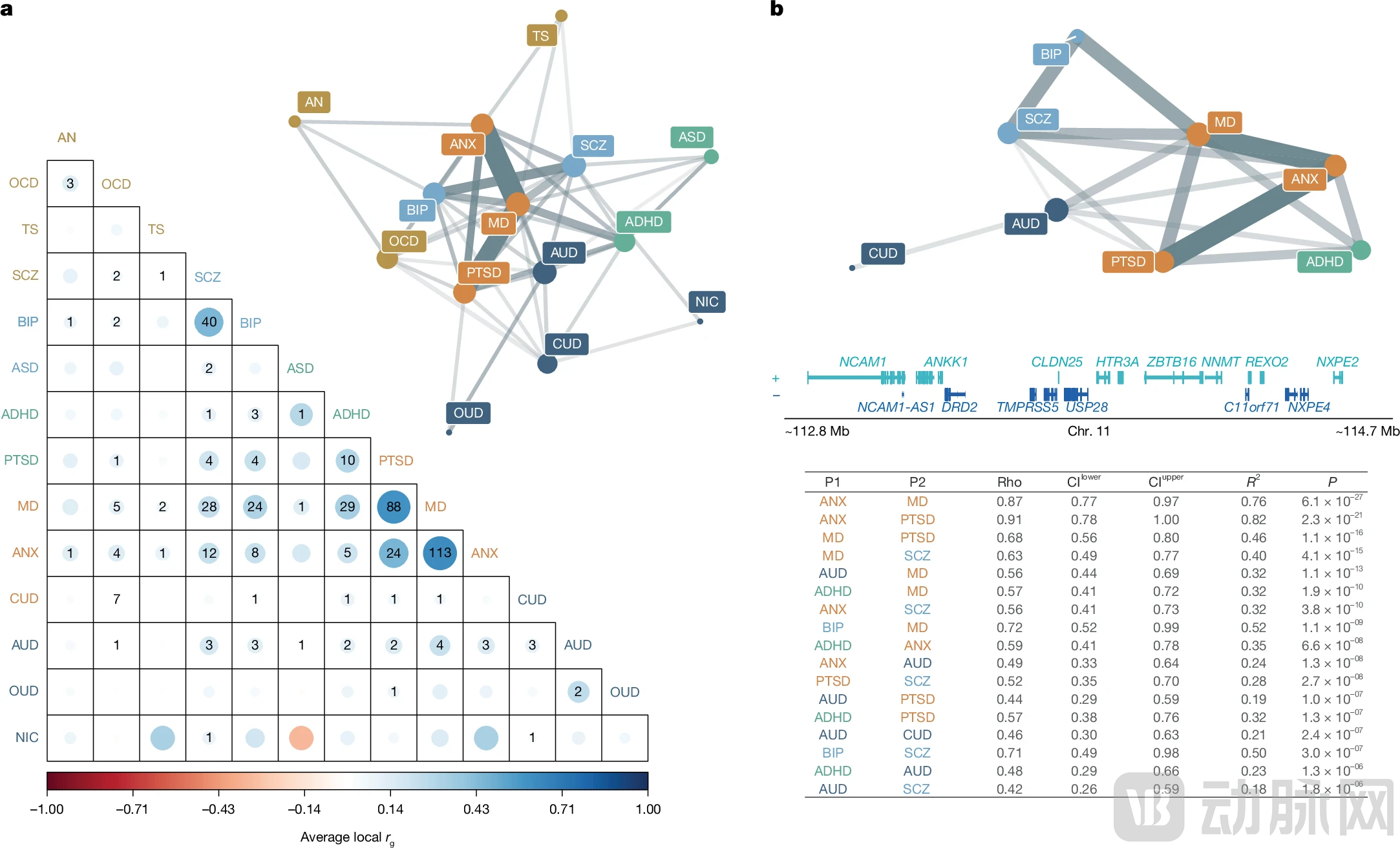
Figure: Local genetic correlations of psychiatric disorders across the genome (Source: Nature)
Analysis shows that, on average, approximately 66% of the genetic risk for diseases can be explained by these five major factors; in other words,Most genetic risks are shared across different diseases.However, there are exceptions. Tourette syndrome is the most “unique,” with 87% of its genetic variants unexplained by these five major factors, suggesting that the disorder may involve distinct genetic mechanisms.
More notably, the research team discovered a higher-levelGeneral Psychopathology Factor(p-factor), which can be understood as "the common genetic basis of all mental disorders." This factor is most closely associated with internalizing disorders (with an association strength of 0.95) and shows moderate associations with the other four factors (0.50–0.63).
These genetic factors not only influence mental disorders but are also associated with a variety of traits in daily life. The research team conducted a comparative analysis of the five major factors against 31 complex traits, revealing several intriguing patterns of association:
Both the internalizing disorders factor and the substance use disorders factor were associated with lower family income (correlations of -0.40 and -0.41, respectively) and with reduced cognitive ability in children (correlations of -0.27 and -0.40, respectively). This suggests that genetic susceptibility may influence socioeconomic status by affecting cognitive abilities.
The schizophrenia-bipolar disorder factor and the substance use disorder factor exhibit another characteristic: they are positively correlated with risk-taking propensity (with correlation coefficients of 0.31 and 0.38, respectively), which may partially explain why patients with these disorders sometimes display impulsive behaviors.
Most notably, the general psychopathology factor is highly correlated with multiple psychological vulnerability traits, including stress sensitivity (0.50), neuroticism (0.64), self-harm (0.74), and suicide attempts (0.87). This suggests the existence of a universal psychological vulnerability that may serve as a common "soil" for various mental disorders.
As co-author Andrew Grotzinger pointed out: “Many seemingly distinct diseases ultimately have more overlap than unique features, which should offer hope to patients. You can see the despair on people’s faces when you assign them five different labels instead of one.”
Identifying the five major genetic factors is only the first step. The more critical question is:How do these genetic factors function at the biological level? Which genes do they affect? In which cells of the brain are these genes expressed?
To address these questions, the research team conducted a meticulous scan of 1,093 independent regions in the human genome. The results revealed that certain genomic regions serve as “common hotspots” for multiple diseases. For example,A key region on chromosome 11 simultaneously influences eight distinct psychiatric disorders,This region contains a cluster of genes associated with dopamine signaling in the brain, where dopamine is the key chemical messenger regulating mood, motivation, and reward perception.
Through whole-genome scanning, the study identified238 genetic loci associated with the risk of mental disorders,Of these, 27 are "general-purpose" loci, influencing two or more types of disorders. These findings add 48 previously unknown risk loci, including 10 that are entirely novel, opening new windows into understanding the biological nature of psychiatric disorders.
A more in-depth analysis reveals the cellular and biological differences underlying different categories of mental disorders.By analyzing the expression patterns of these risk genes across different cell types in the brain, the research team found:
Schizophrenia and bipolar disorder are primarily associated with "signaling cells."The relevant genes are predominantly highly expressed in excitatory neurons of the brain, particularly in regions responsible for processing reality perception. This is akin to a malfunction in the "telegraph operators" responsible for transmitting information, leading to distortions in the perception and judgment of reality.
Internalizing disorders such as depression and anxiety are more closely associated with "supportive glial cells."The relevant genes are highly expressed in glial cells, such as oligodendrocytes, which are responsible for providing nutritional support and insulating protection to neurons. This is akin to a problem with the brain’s “infrastructure,” rather than with signal transmission itself.
Substance use disorders, in contrast, exhibit a high degree of specificity.Alcohol dependence is associated with genes encoding alcohol-metabolizing enzymes, while nicotine dependence is linked to nicotinic receptor genes, reflecting a distinct "substance-specific" biological mechanism.
Furthermore, studies have found that nearly all risk genes are located inMost Actively Expressed During Fetal Brain Development. This finding suggests that the biological "seeds" of mental illness may be sown even before birth, underscoring the importance of prenatal care and early intervention.
These findings are driving a fundamental shift in psychiatry. Traditionally, psychiatrists have diagnosed patients based on their symptomatic presentations—whether they feel sad (depression), experience excessive worry (anxiety disorders), or exhibit hallucinations (schizophrenia). However, this classification approach overlooks a key fact:Different symptoms may share the same biological roots, while identical symptoms may arise from different biological mechanisms.
Based on the aforementioned findings, the diagnosis and treatment of mental disorders are undergoing profound transformation.
This study has profound implications for the classification of mental disorders, driving a shift in the field toward a taxonomy based on cell biology rather than symptomatic observation. Terrie Moffitt, a clinical psychologist at Duke University, notes that this challenges the historical diagnostic boundaries outlined in the diagnostic manuals used by psychiatrists worldwide and indicates that the high comorbidity among various disorders is not coincidental but rather reflects shared underlying biological foundations.
This new framework offers practical clinical application value.Clinicians can help individuals with one disease develop skills to prevent the development of another disease,For example, by emphasizing stress management. These findings may also help researchers identifyTherapeutic Approaches for Multiple Diseases—Certain pharmacological interventions have been proven effective for a range of diseases (e.g., selective serotonin reuptake inhibitors), and future work can build on these findings to identify novel or repurposed therapies targeting shared factors.
The study also revealed an overlap between genetic variants associated with mental disorders and traits within the normal range, and not all such associations are adverse.For example, the schizophrenia–bipolar disorder factor is positively correlated with the non-cognitive components of educational attainment, suggesting that genetic variants associated with an increased risk of psychosis may also foster creativity, persistence, and other traits conducive to academic success.
This perspective redefines mental illness as the unfortunate convergence of natural variation and environmental stress, rather than flawed biology. Mental illness often manifests at the extremes of the genetic variation continuum, when certain gene combinations interact with life experiences in adverse ways.
This perspective onEmbryo ScreeningThese applications also have direct implications. If these genetic factors reflect normal variations that may confer either advantages or vulnerabilities, the selection of embryos based on high-risk scores could inadvertently reduce valuable neurodiversity while lowering disease risk.
The study also highlights current limitations and future directions.The analysis was primarily limited to European samples due to the limited availability of genome-wide association study data for non-European genetic ancestries.Cross-ancestry genetic correlation analyses indicate that findings for certain disorders, such as schizophrenia, may generalize well across diverse ancestral groups, whereas other conditions, including post-traumatic stress disorder and major depressive disorder, exhibit lower cross-ancestry correlations, underscoring the need for more ancestrally representative data in future studies.
Although the current sample size is already substantial, statistical power analysis indicates that to identify all common genetic variants associated with mental disorders, the sample size would need to be expanded by tens to hundreds of times—ranging from approximately 12 million participants for schizophrenia to over 80 million for major depressive disorder.
As psychiatric genomics continues to advance, the shift from symptom-based diagnosis to a neurobiology-driven classification system promises to pave the way for more precise risk prediction, more effective therapeutic interventions, and a better understanding of the nature of mental illness. This study provides a robust genetic foundation for recognizing that susceptibility to mental illness is part of a natural continuum rather than a biological defect.