

Peking Union Medical College Hospital Licenses Breast Ultrasound Imaging Technology to Mindray for RMB 200,000

Mindray
Medical Device R&D Manufacturer
Recently, Peking Union Medical College Hospital released a public notice on the conversion of scientific and technological achievements, proposing to"Breast Ultrasound Imaging Methods and Equipment"The relevant patented technologies were transferred to Shenzhen Mindray Bio-Medical Electronics Co., Ltd. via patent assignment, with the transfer amount being200,000 yuan。
This achievement was developed by a team led by Professors Wang Hongyan and Jiang Yuxin from the Department of Medical Ultrasound, Peking Union Medical College Hospital.
Wang Hongyan:Ph.D. from Peking Union Medical College, with visiting scholar experience at the University of Nottingham, UK. With over 20 years of clinical experience, currently serves as Deputy Director and Secretary-General of the National Center for Quality Control in Ultrasound Medicine, and as Expert Committee Member and Office Director of the Beijing Center for Quality Control in Ultrasound Medicine. Expert Committee Member for Superficial Organs and Peripheral Vascular Ultrasound under the Chinese Society of Ultrasound in Medicine and Engineering; Expert Committee Member for Superficial Organs and Peripheral Vascular Ultrasound under the Ultrasound Branch of the Beijing Medical Association. Executive Editor-in-Chief of the Quality Control Special Issue of the Chinese Journal of Ultrasound Medicine (Electronic Edition); Corresponding Editorial Board Member of the Chinese Journal of Ultrasonography; Youth Editorial Board Member of BMJ Quality & Safety (Chinese Edition); Reviewer for journals such as Academic Radiology. Primary research interests include the clinical application of novel ultrasound technologies in diseases of the breast, thyroid, vasculature, and gynecology, as well as related translational medical research; formulation and promotion of norms, standards, and guidelines for quality control in ultrasound medicine. Has presided over or participated in more than 20 national and provincial/ministerial-level projects, including those funded by the National Natural Science Foundation of China, the National Key Technology R&D Program, the International Exchange and Cooperation Center of the National Health Commission, the Beijing Natural Science Foundation, and the Teaching Reform Project of Peking Union Medical College Hospital, and has been responsible for completing multiple nationwide multicenter projects, such as“Promotion and Application of Standardized Image Storage and Structured Reporting in Breast Ultrasound,” “Multicenter Study on the Construction of a Quality Control System for Gynecologic Oncology Ultrasound,” etc.
Jiang Yuxin:Chief Physician, Professor, and Doctoral Supervisor, Department of Ultrasound Medicine, Peking Union Medical College Hospital. Member of the 12th and 13th National Committees of the Chinese People's Political Consultative Conference (CPPCC), and Member of the CPPCC National Committee on Education, Science, Health, and Sports. Concurrently serves as Vice President of the Chinese Medical Doctor Association, Vice President of the Beijing Medical Association, Chair of the Ultrasound Branch of the Chinese Medical Association, Editor-in-Chief of the Chinese Journal of Medical Ultrasound (Electronic Edition), Chair of the China Branch of the International Society of Ultrasound in Obstetrics and Gynecology, and Vice President of the Asian Federation of Societies for Ultrasound in Medicine and Biology. Research achievements have been awarded4 awards from the Chinese Medical Association for Scientific and Technological Progress, 3 awards from the Ministry of Education for Scientific and Technological Progress, and 2 Huaxia Medical Science and Technology Awards.Honored as a National Expert with Outstanding Contributions among Young and Middle-Aged Professionals by the Ministry of Health, an Outstanding Teacher in Beijing, a Model of Professional Ethics in Beijing, a National Role Model of Medical Ethics, and a recipient of the Chinese Physician Award; enjoys the Special Government Allowance from the State Council. Has long been working on the frontline of medical practice, primarily responsible for ultrasound consultations for complex cases over the years, resolving numerous diagnostic challenges for difficult cases both within and outside the hospital. Main areas of clinical and research focus include contrast-enhanced ultrasound, early diagnosis of breast cancer, ultrasound diagnosis of thyroid nodules, and vascular and obstetric/gynecologic ultrasound.
The Assignee of This Patent TechnologyShenzhen Mindray Bio-Medical Electronics Co., Ltd., is a leading and globally renowned supplier of medical devices and solutions in China. Mindray holds an industry-leading position in ultrasound imaging, patient monitoring & life support, and in vitro diagnostics. Its ultrasound product line is renowned for technological innovation and image quality, and has been widely adopted by healthcare institutions worldwide.
The patented technology proposed for conversion in this instance enables real-time quantification and visualization of compression force during breast ultrasound scanning. By intelligently analyzing the deformation of stratified breast tissues (such as the skin and adipose layers) in ultrasound images, it converts the operator’s manual pressure into intuitive, quantitative pressure values displayed synchronously on the imaging interface. This technology effectively guides clinicians to apply appropriate pressure during scanning, thereby enhancing image consistency and diagnostic comparability, while potentially reducing diagnostic errors or patient discomfort caused by improper compression.
Breast cancer is a malignant tumor that occurs in the epithelial tissue of the breast.
According to cancer statistics, breast cancer ranks first in incidence among malignant tumors in women, making early screening particularly important.Breast UltrasoundIt can clearly display the soft tissues of various layers of the breast, as well as the location, morphology, internal structure of lesions, and changes in adjacent tissues. This examination method offers numerous advantages, including cost-effectiveness, convenience, non-invasiveness, painlessness, absence of radiation, and high repeatability, making it one of the important approaches for early screening of breast cancer.
Currently, breast ultrasound examinations mostly adoptDirect MethodUndergo examination.
During the procedure, the physician applies coupling agent—a gel medium used to eliminate air between the transducer and the skin to ensure effective transmission of sound waves—onto the fully exposed breast skin. The physician then holds the ultrasound transducer firmly against the skin to perform scanning and image acquisition. To maintain optimal contact between the transducer and the skin and obtain clear images, the physician applies a certain amount of pressure with the transducer during the scan.
Studies have shown that for soft tissues such as the breast, the magnitude of applied pressure directly affects the quality of ultrasound images and the sonographic features of lesions.
Ultrasound FindingsIt refers to the characteristics of a lesion as manifested on ultrasound images, such as its morphology, echogenicity, and boundaries. For instance, in cases of lesions with softer consistency, excessive probe pressure may cause deformation of the lesion or local blurring of the image. This is particularly relevant for postoperative patients or those presenting with tenderness; excessive pressure during the examination can significantly exacerbate their pain.
However, in current clinical practice, the magnitude of pressure applied during breast ultrasound imaging relies entirely on the physician’s individual experience and operational habits, resulting in high operator dependence. This subjectivity can easily lead to degraded image quality due to improper compression force, or cause unnecessary pain and discomfort to patients.
Therefore, to address the issues of image quality variability and disparities in patient experience caused by the reliance on operator experience for compression force and the lack of objective standards, seeking an auxiliary method capable of quantifying and visualizing compression force has become a key direction for enhancing the standardization and precision of breast ultrasound examinations.
The core of this invention lies in providingAn Innovative Breast Ultrasound Imaging Method and Supporting Equipment, to assist in the objective quantification and real-time feedback of the pressure exerted by physicians on the probe during scanning, thereby guiding them to apply appropriate pressure for standardized operation.
This method first requiresAcquire ultrasound images of the subject's breast region. Subsequently, the system automatically stratifies breast tissue based on the images to identify the "target layer."
Target layers primarily refer to tissues that are prone to deformation under pressure, such as the skin layer and/or the subcutaneous fat layer; in certain embodiments, the glandular layer may also be included. The realization of layering relies on advanced image recognition algorithms, such as object detection algorithms (for locating tissue boundaries) or semantic segmentation algorithms (for precisely delineating tissue regions).
Next, the system quantifies the applied pressure based on the degree of deformation of the target layer to generate a "pressure quantification value." The measurement of deformation is primarily based on changes in the area or thickness (e.g., average thickness, maximum thickness) of the target layer.
Specifically, there are two main approaches to quantification:1. Directly measure the area or thickness of the target layer, since greater pressure results in more pronounced tissue compression, the quantitative pressure value is negatively correlated with the area or thickness value;Second, compare the target level with a “benchmark level.”, calculate the difference between the two in terms of area or thickness, the greater this difference value, the larger the deformation and the higher the pressure; therefore, the quantified pressure value is positively correlated with the difference value. The baseline level may be derived from a pre-constructed standard image database or obtained by scanning images of the patient’s breast in a lightly compressed state during the initial phase.
Upon obtaining the quantified pressure value, the system displays it in real time alongside the ultrasound image on the user interface. The visualization of pressure values takes various forms, such as intuitive energy bar filling, radial color diffusion, or gauge needle rotation, enabling physicians to grasp the current pressure level at a glance during scanning.
Furthermore, this method can alsoIntegrated Intelligent Image Quality Assessment Function. The system can automatically score the acquired ultrasound images (either the entire image or the lesion area) and display the scoring results.
When the score exceeds a preset threshold, the system can issue an alert (such as visual highlighting or an auditory signal) to inform the physician that the image quality obtained under the current pressure meets diagnostic requirements. Another auxiliary method for assessment is to monitor the displacement of the lesion area; if it remains stable, this also indicates that the current pressure is appropriate.
In addition to the aforementioned tissue stratification-based methods, the invention also provides anotherTechnical Approach for Pressure Quantification Based Directly on “Breast Lesion” Deformation. The workflow is similar: first, detect and segment the lesion area in the ultrasound image, then directly analyze changes in the area or thickness of the lesion itself to derive and display the applied pressure value.
To implement the aforementioned method, the ultrasound imaging equipment associated with the present invention integrates dedicated processors and algorithm modules at the hardware level. During operation, the transducer emits and receives ultrasonic waves to generate image data.
The processor performs a series of computations in real time, including image layering, deformation analysis, pressure calculation, and quality scoring. It ultimately integrates the ultrasound images, dynamic pressure quantification values, and potential quality control prompts for comprehensive display on the monitor, providing physicians with a complete real-time pressure guidance and image quality feedback system.
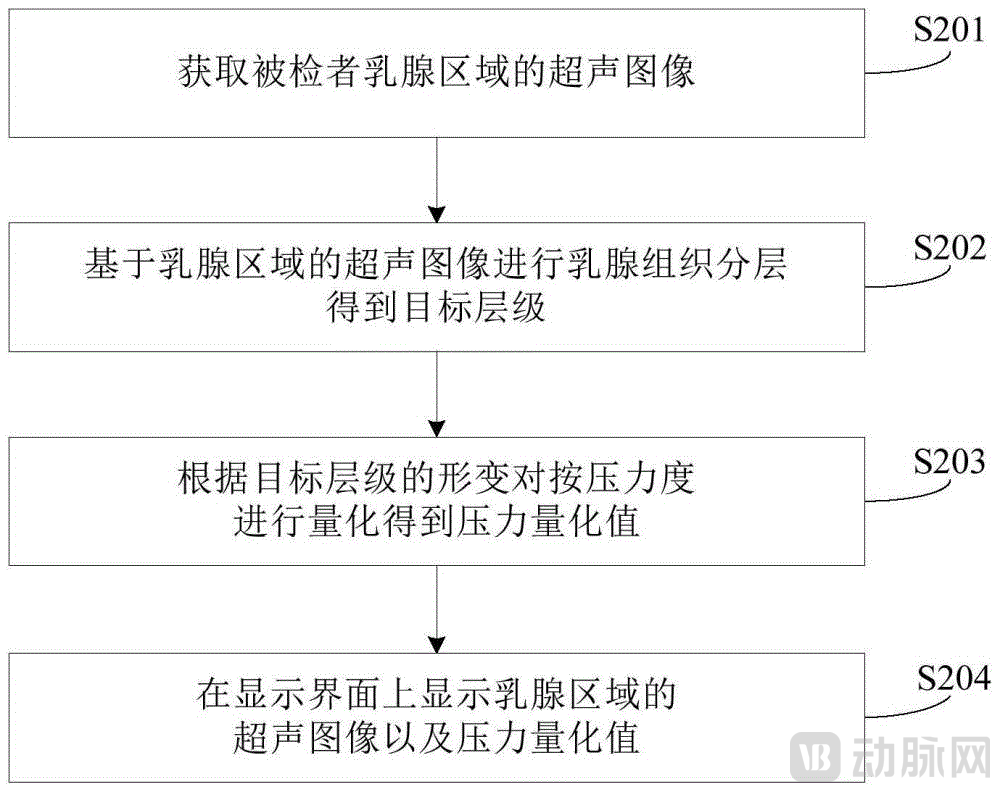
Schematic Diagram of the Technical Process
In summary, the present invention effectively addresses the issues of inconsistent image quality and patient discomfort in breast ultrasound examinations caused by reliance on individual experience for applied pressure, by converting elusive tactile pressure into objective, visual numerical and graphical indicators and integrating them with image quality assessment.
This technology empowers physicians, particularly junior doctors, to more rapidly and accurately master the optimal scanning pressure, thereby enhancing the standardization of examinations and patient comfort while ensuring the diagnostic value of images.
In response to the heightened demands for sensitivity and specificity in early screening, as well as the growing trend toward multimodal, intelligent diagnosis and treatment, leading medical device companies and research teams both in China and abroad are continuously expanding technological boundaries. They are conducting in-depth explorations in areas such as the integration of ultrasound imaging with other technologies, AI-assisted analysis, and quantitative elastography.
Professors Ding Mingyue and Yuchi Ming’s Team, School of Life Science and Technology, Huazhong University of Science and TechnologyAchieved breakthrough results in the field of breast ultrasound imaging methods and equipment, developing"Breast Ultrasound Computed Tomography Imaging System", this is the first domestically developed ultrasound tomography product with fully independent R&D. It has officially obtained a medical device registration certificate and is currently in the stage of commercialization and successful market launch.
Technical breakthroughs for this achievement began in 2010. The team successively overcame key technical challenges, including the localization of core components and 3D reconstruction algorithms, establishing a comprehensive technical system covering “mechanism research–prototype development–clinical validation.” Through deep industry-academia collaboration, laboratory findings were successfully translated into clinical-grade equipment ready for practical diagnosis and treatment, achieving end-to-end independent control of the technology chain.
In terms of breast ultrasound imaging methodology, this system achieves a paradigm shift compared to the single-dimensional data acquisition mode of conventional ultrasound. By employing a ring-array transducer to perform 360-degree omnidirectional scanning and integrating a full-scattering signal-based 3D reconstruction algorithm, it accurately delineates the millimeter-level spatial architecture of breast tissue. This approach effectively overcomes the limitations of traditional planar ultrasound imaging, increasing lesion detection rates by more than 40%, with a sensitivity of up to 92% for detecting microcalcifications in dense breast tissue.
Meanwhile, the system has been specifically optimized for the dense breast characteristics prevalent among East Asian women. By employing dual-parameter imaging based on speed of sound and attenuation, it maintains the advantages of being radiation-free and cost-effective while increasing the accuracy of early breast cancer diagnosis to 91.7%, significantly outperforming the 78.3% accuracy rate of conventional ultrasound. This provides a revolutionary tool for early breast cancer screening and will effectively help alleviate the current imbalance in breast cancer screening resources across China.
iSono HealthIn the field of breast ultrasound imaging methods and equipment, the world's first wearable automated breast ultrasound imaging system has been developed—ATUSA Whole-Breast Ultrasound Imaging System。
This system integrates wearable hardware, automated scanning, and AI-assisted analysis. The accompanying software enables automatic image acquisition and analysis for breast cancer diagnosis, effectively addressing key pain points in traditional mammography and ultrasound screening, such as the lack of unified standards, limitations in examining special populations (e.g., lactating women and individuals with breast implants), and insufficient ratios of specialized personnel. The system offers several advantages, including 3D visualization and localization, radiation-free operation (suitable for pregnant and lactating women, as well as individuals with dense breast tissue), convenience and efficiency (completing fully automated, hands-free scanning within 2 minutes, which is 10–15 times faster than manual detection, and supporting use in primary care settings or at home), and remote data management and tele-diagnosis (with cloud-based storage of scanning data to overcome geographical barriers).
In terms of development stage, the system obtained FDA 510(k) clearance in 2022, marking a key milestone in regulatory compliance. The product currently demonstrates clear clinical application value and adaptability to specific use cases. However, its AI capabilities remain in the research and development phase and will require subsequent clinical validation to confirm safety and efficacy. If the system can achieve AI-based automatic classification of lesion risk levels, it will further enhance the accuracy of screening at the primary care level.
Furthermore,The company was founded by two female engineers,Core members mostly haveRoche, Medtronic, IntelWith a professional background at renowned medical and technology companies, he/she possesses extensive experience in commercial development and imaging technology, providing strong support for the subsequent development and promotion of products.
Currently, various technical approaches coexist in the market to address the challenge of operational standardization, including deformation analysis via image algorithms, integration of hardware pressure sensors, and implementation of fully automated scanning.
In the future, these pathways may draw on each other or converge, such as by integrating real-time pressure feedback with automated scanning workflows and AI-based lesion detection, to develop more comprehensive standardized scanning protocols.