

AI-Powered Discovery of Herpesvirus Entry Target Slashes Drug Development Timeline by Orders of Magnitude
Imagine trying to identify the single critical target capable of blocking viral entry from among thousands of molecular interactions—it is akin to finding a needle in a haystack. Traditional experimental methods require testing each candidate individually, with each target potentially taking months to evaluate, meaning the entire process could span years.
However, the research team at Washington State University throughIntegration of Artificial Intelligence with Experimental Validation, successfully solved this problem. In December 2025, a research team from the School of Mechanical and Materials Engineering and the College of Veterinary Medicine at the university published their study in the journal Nanoscale, with Professor Jin Liu as the corresponding author.

(Source: Nanoscale)
They utilizeMolecular Dynamics Simulations and Machine Learning Algorithms, precisely identified a previously underappreciated polar interaction between Q181 and R747 from among thousands of amino acid interactions in the herpesvirus glycoprotein B (gB). This seemingly minor interaction serves as a critical "latch" for maintaining the stability of the viral fusion protein.
More encouragingly, when the research team experimentally mutated Q181 to proline (Q181P),The virus has completely lost its ability to enter cells.—Membrane fusion activity was completely blocked. This discovery not only elucidates the molecular mechanisms underlying herpesvirus entry into cells, but more importantly, demonstrates how artificial intelligence can compress research timelines that would traditionally span years into manageable periods, thereby opening new avenues for antiviral drug development. With advances in computational power and machine learning technologies, this approach is poised to play an increasingly significant role in a broader range of biological studies, offering new hope for human health.
Enveloped viruses, including herpesviruses, influenza viruses, and HIV, are surrounded by a lipid envelope. When these viruses seek to infect host cells, they must complete a critical step: fusing their envelope with the host cell membrane, thereby “injecting” the viral genome into the cell interior.
This fusion process is akin to a precise "key" unlocking a "lock." The fusion proteins on the viral surface serve as this "key," which must undergo complex conformational changes to accomplish membrane fusion. Taking herpesviruses as an example, their surface glycoprotein B (gB) is a Class III fusion protein that plays a central role during viral entry.
The mechanism of action of fusion proteins can be likened to a sophisticated mechanical device. On the viral surface, the fusion protein resides in a "pre-fusion conformation," a relatively stable state akin to a folded key. As the virus approaches the host cell, specific triggers (such as pH changes or receptor binding) initiate the unfolding of this "key": the fusion loops first insert into the host cell membrane, followed by a comprehensive rearrangement of the entire protein structure, ultimately resulting in a "post-fusion conformation" that completes membrane fusion. This entire process involves the precise coordination of hundreds of amino acid residues; any malfunction in critical steps may prevent viral entry.
The key to the issue lies in:How to Identify the One Interaction That Truly Determines Fusion Protein Stability from Thousands of Possible Interactions?
Herpesviruses are a widespread class of DNA viruses capable of causing various diseases, including herpes simplex, varicella-zoster, and infectious mononucleosis. More challenging is their ability to establish latent infections, remaining dormant in the human body for years before potentially reactivating. This characteristic is one of the key reasons why vaccine development against these viruses has consistently faced significant challenges.
If the key interactions that maintain the prefusion conformation of fusion proteins can be identified, it would theoretically be possible to design drugs that disrupt these interactions, thereby preventing viral entry into cells. However, fusion proteins typically consist of hundreds of amino acid residues, among which thousands of potential interactions may exist. Traditional biological research requires functional testing of each interaction individually; assessing a single interaction can take months, and employing a trial-and-error approach to identify critical interactions from among thousands could require years or even longer.
This is precisely where computational biology and artificial intelligence technologies shine. Molecular Dynamics (MD) simulations can model the trajectories of proteins at the atomic level, akin to capturing the motion of every atom with an ultra-high-speed camera, thereby recording the dynamic changes in all interactions. Meanwhile, machine learning algorithms can learn patterns from these massive datasets, automatically identifying which interactions are most critical for protein stability. This "computational screening plus experimental validation" approach can significantly shorten research processes that would otherwise take years, while simultaneously enhancing the accuracy of discoveries.
Faced with such complex challenges, the research team adopted a dual strategy of “computational screening plus experimental validation.” They selected herpesvirus glycoprotein B (gB) as the subject of study—a major fusion protein involved in herpesvirus entry into cells, classified as a Class III fusion protein. The study focused on the interaction between the fusion loop and the membrane-proximal region, as both regions play critical roles during viral fusion.
The first step of the study was to “reconstruct” the dynamic behavior of the gB protein in silico. The research team employed molecular dynamics simulations to track the protein’s motion trajectories at the atomic level, akin to recording the movement of each atom with an ultra-high-speed camera. These simulations generated massive amounts of data, documenting the interaction patterns among thousands of amino acid residues. Subsequently, the research team developedSpecialized Machine Learning Algorithms, enabling AI to “learn” from these massive datasets which interactions are truly significant. Machine learning models act like seasoned detectives, capable of identifying key evidence amidst a complex web of clues.
Following AI-powered intelligent screening, a previously overlooked interaction has come to light:Q181–R747 Polar InteractionsQ181 is a glutamine residue in the fusion loop region, and R747 is an arginine residue in the membrane-proximal region. The polar interaction formed between these two amino acid residues acts as a critical "latch," firmly locking the gB protein in its prefusion conformation. Polar interactions are common non-covalent interactions in proteins, formed through electrostatic attraction and hydrogen bonding between charged groups, and are essential for maintaining the three-dimensional structure of proteins.
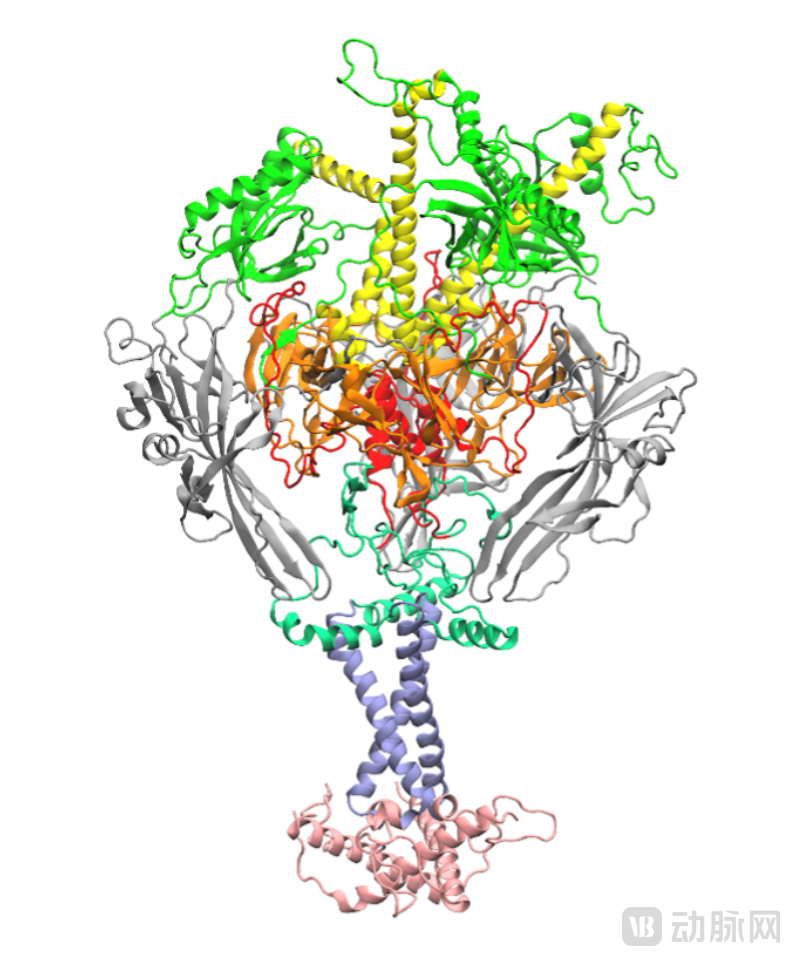
Figure: Researchers use artificial intelligence to precisely locate key proteins involved in viral entry (Source: WSU)
But is the AI prediction accurate? The research team conducted more in-depth molecular dynamics simulations to model the effects of mutating Q181 to proline (the Q181P mutation). The results were surprising: this seemingly minor change disrupted the secondary structure of the fusion loop, leading to a significant decrease in the stability of the gB pre-fusion conformation. The cyclic structure of proline restricts the flexibility of the protein backbone, much like inserting a mismatched component into a precision mechanical device, thereby disrupting the coordination of the entire system.
The most critical validation came from actual biological experiments. The experimental team led by Professor Anthony Nicola designed specialized experiments to test the impact of the Q181P mutation on viral fusion function. The results were encouraging:Q181P mutation completely abolishes the membrane fusion activity of gB, the herpesvirus thus lost its ability to enter host cells. More importantly, the experimental results were fully consistent with the predictions of the machine learning model, demonstrating the accuracy of AI predictions.
“This is just one of thousands of interactions. If we had relied on traditional trial-and-error methods instead of simulations, it might have taken years to identify it,” remarked Professor Jin Liu, the corresponding author. “The integration of computation and experimentation is highly efficient, significantly accelerating the discovery of these important biological interactions.”
However, the research team candidly acknowledged that while they have confirmed the significance of this interaction, current understanding remains incomplete regarding how such a subtle change influences large-scale structural alterations of the entire protein. Professor Liu stated, “There is still a gap between the phenomena observed in experiments and those seen in our simulations. The next step is to understand how this minor interaction affects structural changes on a larger scale. This is indeed a formidable challenge.”
The value of this study is reflected at multiple levels, ranging from theoretical breakthroughs to methodological innovations., to application prospects, are all worth in-depth discussion.
From a theoretical perspective, this study provides us withUnderstanding the Invasion Mechanism of Herpesvirusesoffers a new perspective. The discovery of the Q181–R747 interaction reveals the intricate molecular mechanism underlying the interplay between the fusion loop and the membrane-proximal region, providing deeper insights into the conformational stability of class III fusion proteins. More importantly, this finding may have broader applicability—other class III fusion proteins may employ similar stabilization mechanisms, offering crucial clues for understanding the functional mechanisms of the entire viral fusion protein family.
From a methodological perspective, this study demonstratesDeep Integration of Computational Biology and Experimental Biologyits immense potential. Traditional biological research is akin to groping in the dark, relying heavily on trial and error and luck. In contrast, leveraging machine learning to intelligently screen for key targets from massive computational datasets, followed by precise experimental validation, can enhance research efficiency by several-fold or even tens of fold. This methodological framework of “AI screening + experimental validation” is not only applicable to the study of viral fusion proteins but can also be extended to numerous other biological processes, such as protein folding, enzyme catalysis, and signal transduction, thereby providing a universal tool for the rapid identification of key molecular interactions.
From the perspective of application value, identification of the Q181–R747 interactionProvides potential targets for the development of novel antiviral drugs.Theoretically, small-molecule compounds or antibodies can be designed to interfere with this interaction, thereby blocking viral infection at its “entry” point. The advantage of this strategy lies in its targeting of a critical step in viral entry into cells, potentially preventing viral invasion during the early stages of infection and enabling earlier intervention than traditional drugs.
However, there is still a long way to go from target identification to the development of clinically viable drugs. First, a deeper understanding is needed of how the Q181P mutation affects the structural dynamics of the entire gB protein. As the research team acknowledged, current knowledge regarding “how minor changes can trigger major effects” remains incomplete. Second, it is necessary to evaluate whether drugs designed to target this interaction are sufficiently specific and safe, ensuring that they do not adversely affect the normal functions of host cells. Furthermore, the potential for viruses to develop drug resistance through mutation represents a persistent challenge that must be addressed throughout the development of all antiviral therapies.
The research team plans to further leverage simulation and machine learning techniques to construct a more comprehensive map of the gB fusion mechanism. This will not only help elucidate how the Q181–R747 interaction influences conformational changes across the entire protein, but may also uncover other critical interactions, therebyProviding More Target Options for Antiviral Drug Design。
What is even more anticipated is that this methodological framework canExtension to Research on Other Important VirusesFor example, key interactions in Class I and II fusion proteins, such as the hemagglutinin (HA) protein of influenza virus and the gp41 protein of HIV, can be investigated. By systematically identifying critical targets across different viral fusion proteins, it may be possible to discover broad-spectrum antiviral strategies or develop targeted interventions for specific viruses.
In the long term,This "mechanism-driven" R&D model could change the game in antiviral drug development.Traditional drug development often begins with known active compounds, optimizing their properties through chemical modifications—a approach that resembles "improvement" rather than "innovation." In contrast, new methodologies start by elucidating the molecular mechanisms of viral infection, first identifying key targets and then designing targeted interventions. This mechanism-to-drug development pathway has the potential to significantly enhance the success rate and efficiency of drug discovery, providing more powerful tools to address future threats from emerging viruses.